Over the weekend, Seth Myers’ made a joke about the iPhone’s inability to actually place a call thanks to AT&T’s shoddy service during “Weekend Update” on Saturday Night Live. The joke was terrible, but as terrible as it was, the entire audience immediately burst into hysterical laughter: they all knew what he was talking about.
I’ve never been such a big fan of using voice search on my phone. Take Google’s own voice search app for the iPhone. As far as translating my own search terms, it does pretty well, but it has an issue with ambient noise. For example, I may need Google’s help to spell the longest town name in Scotland, but I’m pretty sure the correct spelling isn’t “Llanfairpwllgwyngyllgogery BEEP HONK SCREECH CRASH chwyrndrobwllllantysiliogogogoch.”
Still, voice search enthusiasts who own iPhones now have another program to loudly and emphatically yell at. Following up on last week’s Dragon Diction app, Nuance has released Dragon Search
It works very similarly to the Google Mobile app: you simply tap a button, clearly say your search term, and then beam your search query up to Nuance’s servers, which promptly spits back the applicable results. Where Dragon Search differs from Google’s efforts is it can easily extend its search beyond just Google results: it will also search iTunes, Twitter, Wikipedia, Youtube, Yahoo and Bing.
If you’re interested, the app is free for now, although you should move soon on that free download: the free introductory offer ends soon.
We’ve lamented the iPhone’s unsuitability to be used as a weapon before. An iPhone wielded in the sock makes a satisfying nunchuku, don’t get us wrong, but in the viscera-choked inferno of the modern battlefield, you’re just never going to be able to close the projectile-perforated distance between you and your enemy enough to give him a really meaty thwack upside the head with one.
But while the iPhone’s physical design has inferior potential to cause mutilative harm to your fellow man, the App Store presents marvelous opportunities for the art of warfare. At least, that’s what U.S. military contractor Raytheon thinks, having just announced a range of military-oriented apps for the iPhone that will help soldiers in Iraq or Afghanistan use their handsets for war.
Six iPhones daisy-chained together to simulacrum the full ivory-and-ebony array of a piano’s 88 keys, progressing upwards through five octaves from a low C. Upon them, Mario Raimondi of the El Desafio foundation turns in a note-perfect rendition of Yann Tiersen’s “Comptine D’un Autre Été: L’après Midi,” which you might recognize from the Amelie soundtrack. A beautiful song, and we can only marvel at the dexterity required to tickle such small keys without relying on any haptic feedback whatsoever.
The only question is: what app is Raimondi using? It looks a bit like Mini Piano. Anyone know for sure?
Homer battles a horde of Mr. Smiths, reprising his role as the redoubtable Neo from "The Matrix Reloaded"
There’s probably nothing so dissimilar to an iPhone as a fresh, greasy donut covered in powdered sugar; and Homer would probably be the last person on Earth to ever have one (an iPhone, not a donut, dufus). So pairing Homer Simpson with an iPhone might just be crazy enough to be brilliant (this is Homer logic, it doesn’t necessarily have to make sense).
The Simpson’s Arcade features a hungry Homer in a quest for — you guessed it — donuts, with mini-games that include using “touch and accelerometer controls to ‘Slap Homer’ back to life,” says game publisher Electronic Arts.
EA says the the game — which it says is due out sometime this December — is voiced “by the real, live actors” from The Simpsons; with any luck this means the incontestably brilliant Hank Azaria and Harry Shearer will be channeling Chief Wiggum and Mr. Smithers from iPhones everywhere, soon.
Lou Reed’s a strange one, but then again, you’d pretty much expect him to be: as a teenager, the Velvet Underground founder was institutionalized by his parents and underwent a course of electro-convulsive treatment in order to cure his “homosexual feelings”… a traumatic event that I’ve always felt directly inspired Reed’s 1975 double album of recorded audio feedback, Metal Machine Music, which certainly sounded like brain synapses wildly misfiring. Reed’s latest accomplishment? A surprising foray into iPhone App development called Lou Zoom, which may be just as much of a waste of money as Metal Machine Music ever was.
As you can see, Lou Zoom basically just strips down your contact list to its barest essentials and explodes the text with a large point Helvetica Neue font, although it does include some improved search functionality as well. Frankly, it’s not much of an app: it looks pretty terrible, and only seems like it might be even marginally useful to the visually impaired. Still, Lou Reed “designed” it, so you can expect to pay $2.50 for it.
Lou, you know I love you.You are one of the greatest guitar players of the 20th century. You have single-handedly changed the course of rock and/or roll. But you can’t be all things to all men. It’s okay if you’re just a rock god: you don’t need to be an iPhone app developer too.
Although their App Store approval procedure has recently been modified to automatically reject apps that use them, Apple’s stance prohibiting developers from using private API calls has been looking a bit wobbly lately. First, Steve Jobs personally approved an app that used a private API to enable video streaming, and now comes word that Apple will officially allow developers to use the UIGetScreenImage() private API call in their applications.
According to the Apple forum moderator who outlined the change over in the official developer forums: “After carefully considering the issue, Apple is now allowing applications to use the function UIGetScreenImage() to programmatically capture the current screen contents.”
Developers should expect, however, to update their applications if a “future release of iPhone OS… provide[s] a public API equivalent of this functionality,” at which point, “all applications using UIGetScreenImage() will be required to adopt the public API.”
That’s an interesting development for a couple of reasons. For one, it actually allows streaming video from the iPhone camera on even older model iPhones, just by pasting enough UIGetScreenImage()s together. More interestingly, it implies that Apple is working to create public API equivalents of a lot of their most in-demand private API calls, which should expand app development possibilities dramatically by the time iPhone OS 4.0 rolls around.
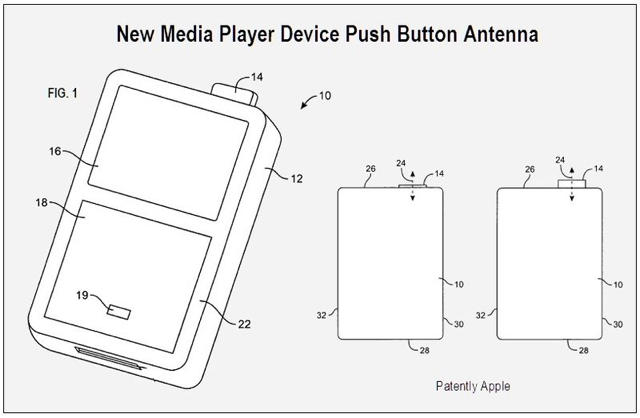
Although they’re certainly not head turners like the 3D head tracking patent Ed wrote about earlier today, Apple’s latest two patents describing improvements to the iPod interface are at least more likely to hit a device you own sometime soon.
The first patent suggests on how an iPod or iPhone might track an individual user’s preferences in order to improve the overall user experience. For example, if you skip the first 22 seconds of a particular song consistently, your iPod would automatically skip it for you next time you tried to play it. The same approach could be used for volume, equalizer settings, etc, as well as dimming songs in the track listings that are continuously skipped in favor of bolding ones that a user prefers.
Apple’s other patent application is pretty simple, but it’s a great, common sense idea: when a user tries to play a video on their iPod or iPhone, the operating system does a quick check against the battery life to determine if there’s enough juice left to play the whole thing, and, if not, warns the user.
Both patents seem like pretty useful additions to the iPod’s already robust user interface, and fairly easy to implement to boot. Don’t be surprised to see these features creep into an update sometime soon.
Apple’s latest iPhone ad revisits that old holiday chestnut “The 12 Days of Christmas” with a lucky smartphone owner breezing through the rigors of the season with a few effortless finger scrolls.
The coolest one, the last, turns on your Christmas tree. Though Apple has added a page on iTunes of apps featured in ads, this one’s not on it. We have it on good authority that it’s Schlage LiNK, a free app (requires extra hardware, though) designed as a remote control for home door locks.
Here’s the complete holiday app line up from the ad:
“Threats of this nature are serious and we caution the public to use common sense and good judgment when accessing the Internet from their commercial mobile devices… To purposely try to disrupt or negatively impact a network with ill-intent is irresponsible and presents a significant public safety concern.”
As reported earlier, Fake Steve’s Operation Chokehold — which started as a joke — is growing fast. The number of Facebook fans has jumped from about 300 on Tuesday to more than 2,000 by Wednesday afternoon.
Indeed, the protest is growing so fast it has alarmed Fake Steve, aka Newsweek columnist Dan Lyons, who is backing down.
“I’m trying to find a way to spin it down and get everyone to back off,” he said in an email.
On his blog, Lyons is now asking protesters not to overwhelm AT&T’s network. Instead, Lyons is suggesting a flashmob-style protest outside AT&T’s stores. The suggestion isn’t going down so well with some readers.
“Don’t turn pussy, Lyons,” wote mark2000 in the comments.
“Don’t apologize, backpedal, or otherwise wimp out,” added reader jycitizen. “I don’t think this will have a Y2K effect on the overall service if people participate in this so called flash mob. I do hope it will be enough of a PR gaffe that companies like AT&T will stop taking their customers for granted, and will shine the light back on issues of consumer protection and net neutrality.”
Fake Steve called on disgruntled AT&T customers to bring AT&T’s data network “to its knees” at 12 noon PST this Friday, December 18. (Here’s Fake Steve’s original Operation Chokehold post).
The action was prompted by comments made by AT&T’s CEO Ralph de la Vega that some iPhone users are using too much data.
Fake Steve is calling on disgruntled AT&T customers to bring AT&T’s data network “to its knees” at 12 noon PST this Friday, December 18. (Here’s Fake Steve’s original Operation Chokehold post).
The action is in protest of comments made by AT&T’s CEO Ralph de la Vega that some iPhone users are using too much data. The protest started as a joke, but is taking on a life of its own.
If you use the MobileMe to view or share files on your iDisk — and if you use your iPhone to do it — you might want to hit the App Store and click on Updates: Apple has just bumped the app up to version 1.1.
What’s changed? The new features include:
• Tthe ability to auto-complete email addresses when choosing recipients for a shared file.
• Automatic saving of file sharing emails to your Mail account’s Sent folder
• Images can now be tapped-and-held to save it to your photo roll or copy to another app.
• The maximum cache size has now double to 500MB.
• Faster technologies, various bug fixes and numerous localizations.
The MobileMe iDisk app is free, but you’ll need an iPhone running 0S 3.0 or later and a MobileMe membership to use it. Go get it.
Gizmodo’s Jesus Diaz wouldn’t recognize an understated argument if it politely coughed, tapped him on the shoulder, and then promptly blew his face off with a bazooka, so it’s no surprise that his latest post about the so-called “Apple Gestapo” Godwin’s itself from the start. It’s a hysterical and stupid overreaction to the practices Cupertino employs to maintain secrecy about upcoming products.
But even so, it’s worth a gander, because while Diaz’s interpretations of Apple’s procedures are utterly facile, it’s still a rare and unique look at exactly how Apple manages to keep some of the most widely anticipated products in the consumer electronic market quiet, year after year.
Wishful thinking? Maybe not: the first 247 reviews, 191 are five star — 77% — though some of the comments “I love this app, it’s a great Christmas present from Microsoft” set the BS-ometer spinning.
Any Bing aficionados out there planning to download the app?
I gave the web version a quick whirl when it first came out, but it didn’t blow my hair back. Haven’t bothered since.
Penny and John Alexander claim AT&T is firing them as iPhone users because they are costing the company too much money in roaming charges. The Alexander's home in Alabama isn't directly serviced by an AT&T cell tower.
AT&T is threatening to terminate the accounts of a pair of iPhone users because they’re costing the company too much money.
“AT&T is firing us as iPhone users,” says Penny Alexander, who lives in Dadeville, Alabama, with her husband John.
In late November the Alexanders received a letter from AT&T saying that because they didn’t live in an area directly serviced by AT&T’s network, more than half their calls were being routed through another company’s network. Thanks to roaming charges, the pair are costing AT&T too much money.
“This situation is rare,” the letter said, “but when it happens, our operating costs increase significantly which makes it difficult for us to keep our rates affordable for all other customers.”
So Apple has allowed into the Store a third-party video recording application for plain old 2G and 3G iPhones; but honestly, don’t get your hopes up too high.
iVideoCamera by Laan Labs suffers some serious limitations: it only records three frames a second, it can only record for a minute at most, and resolution is just 160×213. It’s little more than a series of stills stitched together into something vaguely resembling moving pictures.
Fake Steve is calling on disgruntled AT&T customers to bring AT&T’s data network “to its knees” at 12 noon PST this Friday, December 18.
The action is in protest of comments made by a company executive that some iPhone users are using too much data. The protest started as a joke, but seems to have taking on a life of its own. Judging by comments on forums, Facebook and Twitter, people are planning to take part.
Contacted by CultofMac.com, an AT&T spokesman said:
We understand that fakesteve.net is primarily a satirical forum, but there is nothing amusing about advocating that customers attempt to deliberately degrade service on a network that provides critical communications services for more than 80 million customers. We know that the vast majority of customers will see this action for what it is: an irresponsible and pointless scheme to draw attention to a blog.
The AT&T spokesman doubted the action — if it goes ahead — will have much effect. There’s only about 300 participants committed to take part, according to a Facebook fan page set up for the event. The spokesman also claims that many have criticized the event: several have pointed out that the action may affect emergency calls.
Protesters plan to disrupt AT&T’s data network in several ways:
Turning off WiFi
Streaming YouTube videos
Streaming live video with the new UStream Live Broadcaster app (iTunes link)
Remember way back in 2007 when Steve Ballmer famously yanked on his oligarch’s suspenders, chomped down on his cigar and told USA Today: “There’s no chance that the iPhone is going to get any significant market share. No chance?” Ballmer then went on to muse that Apple would only ever succeed in getting two or three percent market share, while Windows Mobile would own sixty to seventy percent of the market.
No. Wait. Stop chortling and high fiving each other for a second, I’m trying to make a point here: those are the words of a man who firmly believes his predictions. History has shown otherwise: Microsoft obviously got caught sleeping at the wheel when the iPhone came on the scene and utterly destroyed Windows Mobile’s place in the smartphone arena. Two years later, and Microsoft still hasn’t released a version of Windows Mobile that is even competitive with iPhone OS 1.0, let alone 3.0. But at least Microsoft is no longer feeling complacent about it: speaking to attendees of the Connect! tech summit in London, Microsoft UK’s Phil Moore made a frank appraisal of Windows Mobile when compared to the iPhone.
Every time Toshiba unveils a new NAND module, you should take note: that’s going to be a meaningful storage capacity when it’s time for Apple to refresh it’s line of iPhone OS devices.
Apple’s current line of flash-based devices, the iPhone 3Gs and iPod Touch, use Toshiba’s NAND flash memory modules to achieve their svelteness. The iPhone 3Gs uses a single 16GB or 32GB Toshiba NAND module, while the iPod Touch uses dual Toshiba NAND modules to double the storage.
Flash storage capacity roughly doubles every year, so it’s no surprise that Toshiba has just announced that they have now doubled the maximum capacity of its NAND modules from 32GB to 64GB. That means that next year’s refresh of the iPhone and iPod Touch should see the former packing 64GB of internal flash storage, while the latter will likely max out at 128GB.
128GB of storage is a magic number for the iPod Touch: 128GB means I can finally get rid of my 160GB iPod Classic and cram my iTunes library onto a Touch without worrying about juggling albums around like some sort of Walkman-wielding, early eighties troglodyte. For me, the whole point of living in music’s digital age is that there shouldn’t be a problem walking around with sixty two days worth of music crammed into my front pocket.
My guess is that once the iPod Touch gets to 128GB, you can say goodbye to the iPod Classic once and for all. It just no longer serves a point. Who thought your end-of-line would be written by Toshiba, though?
With all the discussion of the New York Times’s bizarre decision to run a column that states as received wisdom that the iPhone’s poor network performance in the United States is Apple’s fault and not AT&T’s, surprisingly little attention has been paid to the track record of reporter Randall Stross with regard to Steve Jobs.
So I visited his website, and I remembered where I’d seen his name — on the cover of a book I read in high school that made a tech prognosis so spectacularly wrong that it’s occasionally used as a case study against proclaiming whether a particular technology is a winner or loser. That book? Steve Jobs and the NeXT Big Thing. And its central premise was that Steve would never produce another tech industry hit. Seriously.
Cell tower photo by forklift - http://flic.kr/p/772WXR
Operation Chokehold — a flashmob-style protest against AT&T that began as a joke on Fake Steve’s blog — looks like it may actually take place.
The meme is gathering a lot of steam on Twitter and Facebook, with people saying they plan to join the protest.
“We have got to do this!,” says Mashable reader pjserven, who set up a couple of Facbook pages to help mobilize protestors: an event page and a fanpage that makes it easy to invite friends.
Subject: Operation Chokehold
On Friday, December 18, at noon Pacific time, we will attempt to overwhelm the AT&T data network and bring it to its knees. The goal is to have every iPhone user (or as many as we can) turn on a data intensive app and run that app for one solid hour. Send the message to AT&T that we are sick of their substandard network and sick of their abusive comments. The idea is we’ll create a digital flash mob. We’re calling it in Operation Chokehold. Join us and speak truth to power!
“I made up the note,” said Dan Lyons, aka Fake Steve. “A reader sent in the opposite idea — a boycott of AT&T for one day, everyone stops using their iPhone for a day, and we show them what’s what. I liked the sentiment but who’s going to stop using their iPhone? And for a whole day? I figured no one would go for it. But a one-hour flash mob of overuse? Now that i could see people doing.”
The fake memo follows Fake Steve’s inspired and widely-linked anti-AT&T rant last week. Fake Steve’s diatribe was prompted by comments by A&T CEO Ralph de la Vega’s saying the carrier may “incentivize” iPhone users to cut back on their usage.
Note: Operation Chokehold may adversely affect AT&T’s voice network and block emergency calls.
Although e-readers like the Amazon Kindle and the new (and maligned) Barnes & Noble Nook are certainly tempting additions to a gadget fetishist’s armoire of doodads, I’ve never had much interest in owning one.
My ambivalence isn’t simply due to the fact that I think books conveyed as mere digital information is less sensual and vibrant than books as a medium: there is that, but I have still enjoyed reading e-books (thanks to Gutenberg.org) for most of the last decade. It’s mostly because I only enjoy reading e-books in certain circumstances: for example, when waiting for a subway, or in bed with the lights off. The e-ink panels of the Kindle and the Nook don’t work in the dark, which means my fleeting interest in e-books can only be satisfied with backlit devices. A few years ago, that was through my Pocket PC and the fantastic e-book program, uBook ; these days, it’s through my iPhone and the Stanza e-reader app.
Stanza is fantastic, of course, but with the release of the Kindle for iPhone app earlier this year, I’d been interested in supplementing my iPhone e-reading with Kindle books for awhile, only to be stymied by the fact that Amazon’s app was for US audiences only. But today, that’s changed: Apple has finally introduced its Kindle for iPhone App to international users.
It’s the same app as before, allowing you to purchase, download and read hundreds of thousands of books through the Kindle Store while syncing your notes and bookmarks across devices… the only difference is it now works on iPhones and iPod Touches in over sixty different countries.
I tend to doubt Kindle for iPhone will replace Stanza as my default e-reader on the iPhone — it’s hard to beat Stanza’s vast library of free classics — but I’m at least looking forward to finally being able to supplement it.