When you switch on Voice Search in Google’s Mobile App for iPhone, you see a little bit of warning text underneath which reads:
“Voice Search only works in English, and works best for North American English accents.”
Tish and piffle, I thought to myself when I read that. I’m sure it’ll understand my humdrum Estuary English accent perfectly well.
But you know what? The warning was put there for a reason. Because so far, every search I’ve done has failed when I use my normal voice, and worked when I put on my appalling attempt at an American accent.
So thank you Google for giving us voice search, which is officially the New Best Thing Ever (better than the last Best Thing Ever, at any rate). But curse you, Google, for making me sound like a complete idiot every time I want to do a voice search for something in public.
Google’s voice search application for the iPhone is nothing short of spectacular. After tantalizing would-be users with either a PR goof or a brilliant marketing ploy that resulted in a delayed release on the AppStore, the updated version of Google Mobile finally hit on Monday and I got it on to my phone last night.
It’s like the home screen says, “For voice search, just bring the phone to your ear and speak. Really, no buttons required!” The program offers to let you watch a video to learn more, but it’s about as easy as it gets to call up a search results page that gives you just what you’re looking for simply by speaking into the phone.
When I searched for “70 Harper” the program returned results for “cindy harper,” but when I amended the search to “70 harper street, san francisco” I got a Google map pinned exactly to the address I spoke into the phone. Speaking about the incredible performance of this free app with my colleague Leander Kahney this morning, he agreed Google has served up something pretty amazing, saying, “it even understands my weird English accent.”
Say what you will about Google having worn out its welcome, or being on the downside of its rise to Internet glory, this advance in mobile search technology is a huge leap forward in this reviewer’s opinion. The iPhone may not yet be a fully functioning Star Trek communicator, but Google’s voice search brings it closer than many thought we might get.
China and Apple still in iPhone talks (photo: The Tenth Dragon)
China Mobile’s CEO Tuesday gave the latest hint Apple may still get its iPhone into the world’s largest marketplace by the end of 2008.
“China Mobile is still interested in [bringing the ] iPhone into China Mobile markets,” Marketwatch quoted Wang Jianzhou when addressing the GSMA Mobile Asia Conference. The carrier’s head didn’t provide details, citing a non-disclosure agreement with Apple.
China, with over 600 million mobile users, remains a highly-prized target for Apple. CEO Steve Jobs has said he expects to sell the iPhone in the Asian country by the end of the year.
Tech makes cheating more, not less complicated. Case in point: a desperate wife, going by the name of Susan042764, asked on the Apple forum whether raunchy photos of her husband could have automatically attached themselves to an email (send to a woman’s address) due to an iPhone “glitch.”
Honey, for your sake, we hope that’s the only “virus” he catches.
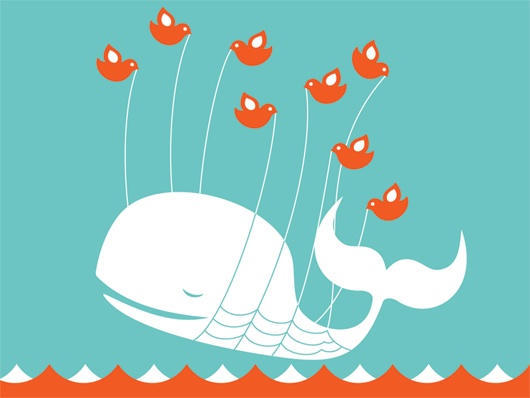
The Fail Whale enjoying a well-earned break, yesterday.
Today’s big question: what is the best Twitter client for iPhone? I asked everyone in my house, but neither of them had an opinion. So I asked Twitter instead.
At the time of writing, there’s a lot of praise for Tweetsville and Tweetie (not actually publicly available yet, it seems) and Twittelator.
My favorite right now is Twitterfon. I only discovered it a few days ago, while discussing iPhone software over a pint in the pub, but it as soon as I’d got it installed, it replaced Twitterific as my daily quick-must-check-my-Tweets-else-I’ll-probably-die app. (Did someone say something about time and attention? No? Good.)
Why do I like Twitterfon? Mainly because it’s fast, also because it looks like an iPhone app. Twitterific was too pokey, too cramped, too dark, for my liking.
For the second time this month, Barclays Capital’s Ben Reitzes reduced his target price for Apple shares. Citing lower handset expectation and increased pressure on higher priced products, Reitzes Photo: Cishore/Flickrcut his target price for Apple to $113, down from $121.
On Nov. 7, Reitzes trimmed his target price for Cupertino shares to $121 from $125.
The Barclays analyst told investors he expects a two percent drop in first quarter 2009 earnings to $9.4 billion, down from $9.6 billion. Apple may earn $34.4 billion for 2009, a drop from $35.7 billion previously expected. In fiscal 2010, Apple earnings could rise 18 percent to $40.55 billion, a drop from $42.8 billion early estimated.
The battle to bring the iPhone to Taiwan became a bit more crowded as that Asian nation’s top carrier announced it will start selling iPhone service “before the end of the year.”
December is the tentative launch date for exclusive sales deal, Digitimes reported Monday.
In a brief statement released over the weekend, Chunghwa Telecom said it “has signed a contract with Apple, and it will provide third-generation iPhone services in Taiwan before the end of the year,” according to the Dow Jones News service.
The Google Mobile team is expected to enhance its iPhone search product with a voice recognition add-on as soon as today, according to a report in the New York Times.
Having already reorganized the way it delivers the results of an iPhone search request earlier this week, the Mountain View, CA search engine company is taking another step toward perfecting the way it handles the challenges of entering and retrieving information with hand-held wireless devices.
“Solving those two problems in a world-class way is our goal,” says Vic Gundotra, a former Microsoft executive who now heads Google’s mobile businesses.
With teams of voice recognition engineers working in New York, London and Mountain View utilizing trillions of search queries Google users have made over the years, one aspect of the service relies on a statistical model of the way words are frequently strung together, according to Mike Cohen, a speech research who was co-founder of Nuance Communications before coming to Google.
The service also takes advantage of the iPhone’s accelerometer to put itself into “listen” mode when the phone is raised to a user’s ear, a design development contributed by a Google researcher in London.
Both Yahoo and Microsoft already offer voice services for cellphones. The Microsoft Tellme service returns information in specific categories like directions, maps and movies. Yahoo’s oneSearch with Voice is more flexible but does not appear to be as accurate as Google’s offering, according to the Times report.
The Google system is far from perfect, and it can return queries that appear as gibberish. Google executives declined to estimate how often the service gets it right, but they said they believed it was accurate enough to be useful to people who wanted to avoid tapping out their queries on the iPhone’s touch-screen keyboard.
As of this writing the add on was not yet available on the AppStore, but as Raj Reddy, an artificial intelligence researcher at Carnegie Mellon University says, “whatever they introduce now, it will greatly increase in accuracy in three or six months.”
Photographer Russ Croop has been creating art on his iPhone using an app called NetSketch that allows you to draw using your fingers, like the above “Point Lobos.”
Croop’s colorful creations look more like art (check out his online gallery, where you can also watch them being made in video form) and less like displacement practice than most, but local galleries have not yet signed him on to show them, according to iArt Mobile.
Maybe art on such a small screen underwhelms them, assuming the idea is to show works on the iPhone, but it’s probably just a matter of time. iPod art has already found its way into galleries.
Fans of comics’ “Golden Age” now have a great way to feed that jones on the iPhone and iPod Touch with Comic Zeal from Bitolithic.
The $1.99 app lets you download an unlimited number of classic comics from the 1930s and 1940s, a period that saw the arrival of the comic book as a mainstream art form, when the medium’s artistic vocabulary and creative conventions were defined by its first generation of writers, artists, and editors.
The app downloads full comics to store locally on your device for easy access offline, and takes full advantage of the iPhone platform’s pinch-zoom and fingertip scrolling so you can move around pages quickly and zoom in to detail as you wish. A recent update makes turning pages with the swipe gesture a breeze and counts as an excellent improvement to the original released version.
“I had been itching to do some development for the Mac but when we learned the iPhone and iPod contained most of OS X I knew I had to do SOMETHING on the device,” Melbourne-based developer Emiliano Molina told Cult of Mac. “During that time, a colleague let me borrow some of his most precious comic books. The most leisure time I had was on the train but I couldn’t risk damaging them,” he says, “eventually I realized that what I needed was a digital version of those comics on the iPod.”
The Comic Zeal library contains an eclectic mix of titles that have fallen out of copyright, such as Romantic Adventures, Strange Worlds, Racket Squad and a personal favorite of this reviewer, Eerie.
Molina is also developing what he calls the Comic Zeal Creator, which allows you to convert the CBR/CBZ files of comics you find on the internet into Comic Zeal’s CBI format, so you can upload your own favorites to the iPhone for storage and later access. The Creator remains in Beta and can be downloaded from the Bitolithic website.
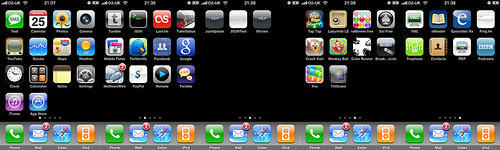
What with all the talk about how hard it is to manage large numbers of apps with the iPhones swipey-sidey interface, I wondered what people are doing when it comes to visualizing the things. A computer’s screenshot is one large image (maybe two or three with multiple monitors). You could argue that an iPhone’s screenshot isn’t complete without all its screens – up to 10 of them – lined up side-by-side.
And that’s what some people are doing, in the process creating gorgeous little personalized maps of portable computing. This one by thepatrick on Flickr (used under Creative Commons license – thanks thepatrick), is labeled with descriptive notes that explain each geopolitical region.
If yoo fink Cheezburger haz a flavr, yoo gonna wuv dis iFone app which make da lolcatz go woop-wwop-ffloop in yor pocketz. It down-woads da lolcatz wivvout da web stuffs which crashy yr Safarie. Srsly.
(Alternatively, if you are an intelligent human being who hates lolcats and thinks this post would have been better suited to the Cult of Lolcats blog (coming soon), the Cult apologizes for wasting your time and suggests you move on to the next post. Thank you.)
Third party iPhone app developers may be able to update and execute arbitrary code from their applications at will, circumventing Apple’s App Store approval process, according to a report at TechCrunch.
The exploit stems from a trick documented by developer/blogger Partick Collison, who figured out a workaround to allow for the display of dynamic default.png images that load when an app is opened on the phone.
Jason Kincaid, who writes for TechCrunch, believes this security flaw makes it possible that “using the same technique with arbitrary code would likely allow a developer to update and execute whatever code they’d like at will.”
Kincaid notes that this is only an issue insofar as Apple purports to retain control of everything that appears on the AppStore. Developers enjoy the capability of running malicious code in just about every Windows or Mac desktop application you can buy without a screening process similar to the one Apple maintains before allowing iPhone and iPod touch applications to be distributed through the AppStore.
It’s also worth noting that no developer or application has been found to have used this particular exploit to run malicious code to date, and that Apple could act to close the loophole before anyone’s phone is put at risk.
UPDATE: This post has been edited for statistical clarity.
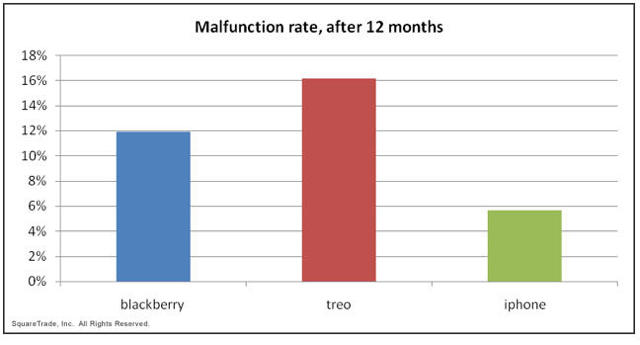
iPhones fail at roughly half the rate of Blackberry smartphones after one year of operation, according to a study by Square Trade research. Square Trade, a company that sells add-on warranties covering electronic devices beyond their manufacturer warranty periods, looked at the failure rates of 15,000 phones covered under its plans. According to their data, the malfunction rate for iPhones after one year is 5.6 percent, compared to 11.2 percent for the Blackberry and 16.2 percent for the Treo.
The study projects the failure rate for the iPhone after two years will be between 9.2 and 11.3 percent, compared to actual two-year failure rates of 14.3 percent for BlackBerries and 21.0 percent for Treos.
Of course, the sample size producing these numbers is a tiny fraction of the millions of smartphones on the market and may or may not be a truly accurate picture of the actual failure rates of the three kinds of phone.
Interestingly, the study found neither battery life nor call quality problems to be major issues for the iPhones that did fail. As was true with all three models in the study, the predominance of failure-related issues had to do with the touchscreen interface.
One area where iPhone does appear to lag its two main competitors is in failure due to accident: 12 percent of iPhone failures happen because the owner drops it, spills liquid on it, or otherwise stops treating it like the sensitive mobile computing device it is.
The drumbeat continues as Barclays Capital Friday became the latest analyst firm to trim its projection of iPhones sales for the first quarter of fiscal 2009. Citing the weak economy, analyst Ben Reitzes believes 5 million handsets will be sold during the quarter, down from the previously expected 6.2 million.
In a note to investors, Reitzes cited a “continued weakness in the economy” and an inventory already flush with 2 million iPhones.
Barclays also cut its target price for Apple shares to $121 from $125, however retained the Cupertino, Calif. company stock as overweight.
Apple will report $9.6 billion in revenue for the December quarter and $35.7 billion for fiscal 2009, down from $36.1 billion, the note predicted Friday. Apple reported $7.8 billion for the quarter ended Sept. 31.
Cupertino, Calif.-based Apple is finding a warmer reception in Europe than at home, two new surveys indicate. The iPhone, which sold 6.9 million units during the third quarter, now owns 17.5 percent of the smart phone market, beating RIM for second place among European mobile phone users.
Analysts at Canalys reported Thursday Apple experienced 523 percent growth during the quarter, outpacing RIM, which registered an 83 percent increase to 15.2 percent market share compared to 2007.
Apple’s rise trimmed Nokia’s market leadership, the Finish handset giant slipping to 38 percent of European cell phone sales, down from 51 percent a year ago.
Today, Stanford professor Dr. Ge Wang and his company, Smule, introduced Ocarina, the first and only app that transforms the iPhone into an expressive musical wind instrument.
The app synthesizes sound in real-time, just like a regular instrument, based on actual gestures including wind input, tilt, and finger placement over the four holes overlaid on the multi-touch pad. Unlike other iPhone audio apps, the sound is not pre-compiled but is generated by the notes, gestures and nuance of the individual performer. As a result, it allows an iPhone user to explore and master the musical sounds of an entirely iPhone-native version of an ancient flute-like instrument.
Smule’s audio engine (CHiP) and the Smule Sonic Network make it possible to hear live performances around the world. With the globe view, you can hear performances, and see the origin of that performance.
Dr. Wang, in addition to being CTO of Smule, is director of the Stanford Laptop Orchestra, and the author of the Chuck audio programming language.
Formation of the first iPhone Philharmonic cannot be far behind. Perhaps one day, iPhone music will be its own category at the Grammys.
I don’t know about you, but I get funny looks from folk when I show off my iPhone, then have to sheepishly confess that it doesn’t do MMS messages.
“Phhhfft,” people say, pulling out their 2-year-old Nokias that they got for free. “Even this crappy old thing can do MMS.”
Apple’s workaround is to send iPhone owners a plain text message with a link to a webapp, where they can view their MMS. In the UK, the O2 webapp is horrible. No-one at O2 has bothered to make it iPhone-friendly. The whole setup is clunky, to put it mildly.
Ross McKillop thinks so too, and that’s why he decided to build a better webapp, one that is designed for iPhone. The result is the newly renamed iPhoneMMS, which lets you view incoming and send outgoing MMS messages, via a complex arrangement of protocols and emails.
It’s still clunky compared to proper MMS support, but it’s a good deal better than the shoddy mess supplied by O2. Until they and Apple get their collective act together to make a decent built-in MMS application, it’s the best option.
The business market, long desired by Apple, picked the iPhone to top a J.D. Power and Associates survey for smartphone customer satisfaction. Ease of operation and the Mac OSX operating system were named the two biggest reasons, according to the survey released Thursday.
The iPhone garnered 778 points out of a 1,000 total possible score. RIM’s BlackBerry scored 703 and Samsung received 701 points. Palm’s Treo took its place in the cellar, getting 644 votes.
Software problems accounted for a quarter of the complaints by corporate users regarding smartphones. Of that group, 44 percent said they were forced to reboot their phone at least once a week during the year.
Is the meteoric rise in demand for Apple’s iPhone cooling off? BMO Capital is the latest to issue a projection of slower production of the handset for the first fiscal quarter of 2009.
BMO’s Keith Bachman Thursday reduced his estimate for first quarter iPhone sales to 5.6 million from 6.6 million. At the heart of the prediction is 2 million of the 6.9 million units sold in September went into inventory.The analyst said due to that “channel fill” it will be difficult for the December quarter to compare to the 6.9 million handsets sold in the quarter ended September 30.
The analyst said the December quarter will bring 5.6 million iPhones sold, down from 6.6 million previously projected. Still the number is expected to be a 15 percent increase in end-user sales over the 4.9 million sold in September.
So this has popped up in the feeds this afternoon, and after my initial excited clicking all I can say is “Oh.”
Because it really isn’t a proper keyboard, it’s a tiny clip on thing that does little more than recreate the built-in software keyboard in plastic. The typing’s slow, and all thumbs anyhow.
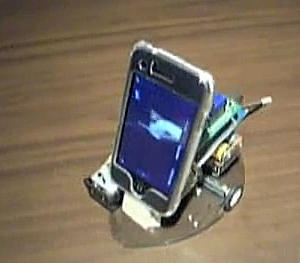
This iPhone robot (moves forwards, backwards, turns) from Japan was made using an Arduino CPU board with a TA7291P motor. It runs on four AA batteries.
The Demonstration video is worth a watch just for the techno background music…
Apple may have cut by 40 percent fourth quarter production of its flagship iPhone handset, a Friedman, Billings, Ramsey analyst said Monday.
The drop in production would be far deeper than the 10 percent cut previously anticipated.
“Our new checks indicate that iPhone production could fall more than 40 percent sequentially in the 4Q,” FBR’s Craig Berger wrote in a note to clients.
The drop in production shouldn’t be interpreted as a dip in iPhone demand. In October, Apple reported shipping 6.9 million iPhones during the third quarter.
However, the lowered production may signal “no market segment will be spared in this global downturn,” wrote Berger.
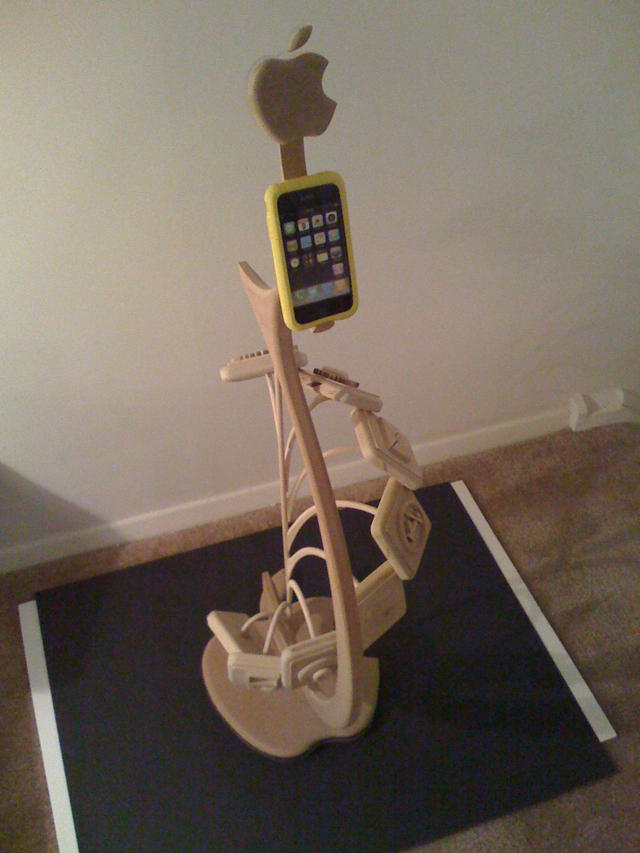
Virginia Commonwealth University design student Kyle Buckner had an assignment “to create a pedestal to hold [a] ‘precious object’.”
We hope he received an A+ for the hand-carved wooden stand he created for his iPhone. Complete with Home Screen icon “leafs” that connect to a rod that spins inside the stand’s main arm, Buckner’s piece is made completely of wood, save for bits of plexiglass which connect each icon leaf to its “branch” on the stand.
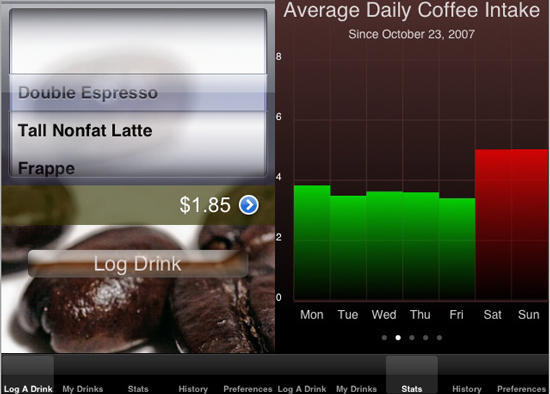
If you want to know how much money you’re spending on espressos, latte and the like (and gauge how much you’re buzzing), this is the iPhone, iPod Touch app for you.
CoffeeNut costs a buck. Which is still less than a cup of coffee, these days.