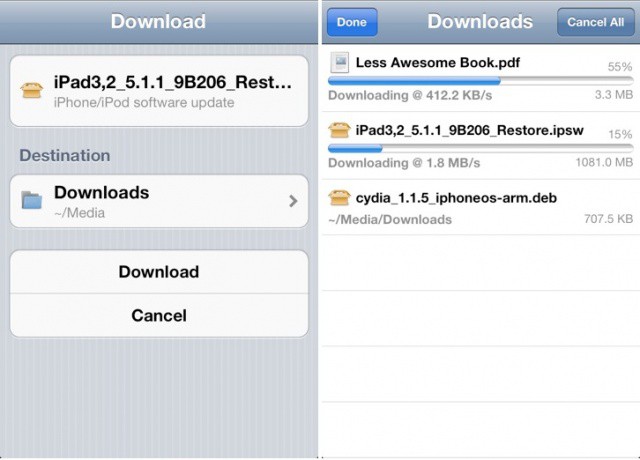
It took a while, but Safari Download Manager finally supports iOS 5.
One of the first tweaks I used to install after jailbreaking previous iPhones was Safari Download Manager, a terrific little package that does exactly as its name suggests: allows you to download files right within mobile Safari. The downside to this tweak, however, has long been its lack of support for iOS 5. That is, until it got updated today.
We got all excited about The Amazing Spider-Man earlier this month when developers Gameloft released the title’s first teaser trailer. And today the official game of the 2012 blockbuster has hit the App Store. As you’d expect from Gameloft, the 3D visuals look terrific, and they promise to “make Spider-Man more realistic than ever before!”
However dramatic the stories about her extra-curricular activities and personality are, Martha Stewart remains the undisputed queen of crafts.
But the last time I did anything crafty was back in high school when I ditched three periods and headed for the beach — so I wasn’t horribly enthusiastic when Martha Stewart CraftStudio popped up on our radar. Color me shocked though, because it’s pretty darn awesome — especially for kids, and people who actually know what they’re doing.
You can't tell in a still photo, but the reflections on the volume slider button in iOS 6 dynamically update as you move the device.
Since the early days of Apple, an emphasis has been put on realistic user interfaces, starting with the Apple Lisa’s GUI in 1983. This drive for skeuomorphism in design is more present in iOS than ever before. Having a touch screen allows applications to feel more natural, simulating actual real-world buttons and objects. If speculation is to be believed, future versions of iOS may take this trend even farther by placing user interface shadows based on the actual position of the light source in the room.
Many businesses still feel that the App Store doesn't truly address their needs
As more and more companies move forward with BYOD programs and/or mobile strategies centered around streamlining workflows for mobile professionals, the idea of the enterprise app store has gone from being a nice add-on feature to being seen as necessity for businesses, schools, and government agencies.
Developing a strategy around mobile apps is seen as a core need by a solid majority of companies – 66% of organization are considering or implementing internal app stores according to a Sourcebits survey of over 6,000 enterprises. That doesn’t mean that actually pursuing an enterprise app store strategy is an easy prospect.
Despite some advances in volume purchasing by Apple, many companies feel that mobile app options are still sub-par for their needs, particularly when it comes to the purchasing process and volume licensing.
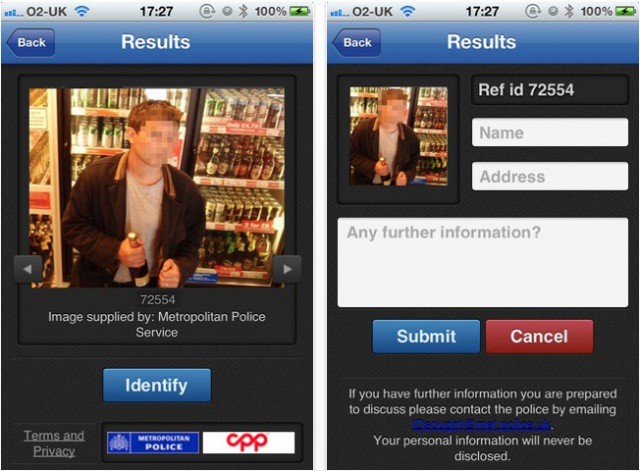
With Facewatch id, you can help the Metropolitan Police identify suspected criminals.
The Metropolitan Police have released a new smartphone app for Android, iOS and BlackBerry devices that allows Londoners to identify suspected criminals. Called Facewatch id, the free app allows you to enter a post code and then presents a collection of CCTV images of people wanted for questioning by the police, including over 3,000 people involved in last year’s London riots.
Mobile companies without strong customer appeal could lose big time as more and more businesses adopt BYOD.
Most discussions around BYOD and costs focus on one of two areas. The first is the cost reduction that a company might see if employees provide their own iPhones (or other devices) and pay for their own mobile plans. The second is the cost for mobile management solutions to secure and manage those personally-owned devices along with the apps and data stored on them.
Those are major concerns, but research company ARCchart recently identified a completely different cost of the BYOD trend – the revenues that device manufacturers and carriers are likely to lose as BYOD becomes a standard practice across the business world. According to ARCchart, the worldwide mobile industry could take a hit as big as $40 billion over the next four years as a result of BYOD.
Universal shows how to do a mobile ad campaign the right way.
Over the past few months we’ve learned a lot about the mobile ad market from a variety of studies. We know that iOS users are more likely to respond to ads than Android users, and that there’s often a big return on ads designed specifically for the iPad and other tablets. We’ve also learned that many ad agencies haven’t yet realized the value in either of those data points.
One company that sees the value of mobile ads is Universal Pictures. Universal has created an interactive mobile campaign for its upcoming “Savages” – an Oliver Stone thriller that opens a week from Friday (July 6) – that ticks all the right boxes for mobile ad success.
Why hasn't Apple introduced Quick Reply to iOS yet?
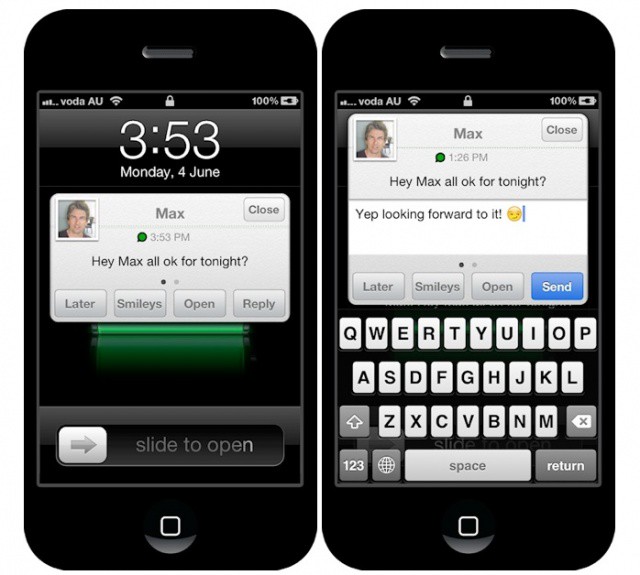
If you’ve ever jailbroken an iPhone, you should be familiar with BiteSMS, the built-in Messages replacement that delivers almost every feature you could ever want in a messages app. One of its highlights is a feature called Quick Reply, which allows you to respond to incoming messages from the home screen, the lock screen, or from within other apps using a handy popup window.
The developer behind this awesome app has now brought Quick Reply to the hugely popular WhatsApp messenger, using a new tweak that’s available now from Cydia.
Is the focus on iOS and other mobile devices becoming too big of a priority for IT?
BYOD and ever-increasing mobility are business trends that are forcing many organizations to take a fresh look at security. The idea of employees connecting from home, coffee shops, and even planes has led to an overall increasing awareness of the need to secure remote connections. At the same time, business data residing on the iPhones, iPads, and other mobile devices of those employees is causing the IT industry to take a fresh look at mobile device security.
That is, of course, a good thing. With the focus on mobile security, however, many IT organizations are letting the security and overall design of their core networks to become outdated – and exposing their companies to incredible risks in the process.
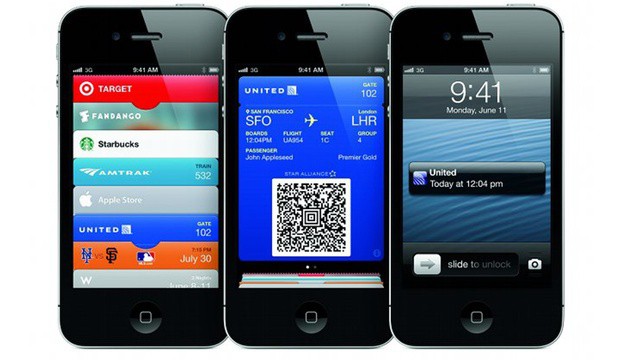
Itching to try out Passbook already? Here's how to activate it.
Apple released its second iOS 6 beta to registered developers yesterday, and it included a number of new changes. The Cupertino company’s new Passbook app remains inactive, however… unless you know about the workaround.
Although nothing you can do within the Passbook app itself will get it working, there is a little trick you can perform in mobile Safari. Here’s what you need to do.
In a long-awaited update, Google is finally brining some improvements to its Gmail app for iOS. The newest update brings support for Notification Center, “Send-As”, and persistent login, all useful features which should be well received by users of the app.
iMessage and related services are gaining critical mass compared to text messaging.
Apple has put a lot of work into developing its own secure messaging platform. With Mountain Lion and the Messages app that Apple rolled out in iOS 5, Apple is setting up its iMessage platform with a lot potential advantages for consumers and business users alike. For business, the always available and secure messaging is huge. Messages and conversations can be found on an employee’s iPhone, iPad, home iMac, work MacBook Air – that’s taking the concept of RIM’s BlackBerry Messenger service to a higher level.
For consumers, the great features are the integration of non-phone devices like the iPad and iPod touch and reduced reliance on carriers for texting, which can translate to cost savings (depending on mobile carrier/plan).
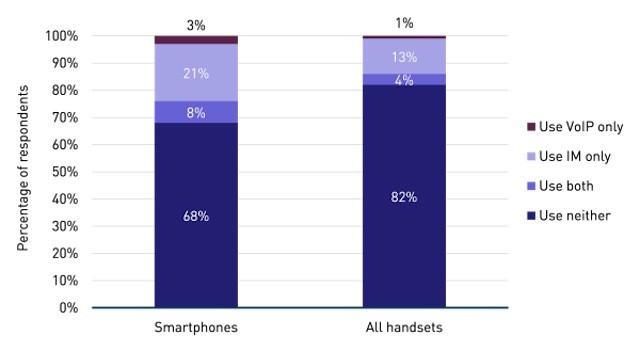
While most of us still use SMS to send text messages, there’s a distinct trend in shifting to using solutions like Apple’s Message platform.
Yelp check-ins are coming to Apple's new Maps app.
Although iOS 6 looks a lot like iOS 5 on the surface, a number of Apple’s built-in apps and services have received some big changes. The biggest overhaul comes to the Maps app, which has done away with Google Maps in favor of Apple’s own 3D mapping service. Another feature you can look forward to in Maps, according to an Apple document sent out to developers, is Yelp check-ins.
A US judge today set a trial date for the US government’s lawsuit that accuses Apple and book publishers of conspiracy to fix the price of e-books. The case will begin June 3, 2013 and is based in part on antitrust charges, with the US Justice Department claiming that Apple colluded with five book publishers to artificially inflate electronic book prices in early 2010, when Apple was releasing the iPad.
Going from BlackBerry to iOS management is a culture shift, but that can be a good thing.
Despite its continuing downward spiral, many IT professionals continue to acknowledge that RIM’s BlackBerry platform — or more accurately its BlackBerry Enterprise Server (BES) — remains the most secure mobile platform on the market. That’s a fact RIM hypes every chance it gets. Usually RIM points out that BES supports over 500 security and management policies. That’s roughly ten times the number of discrete management options that Apple has built into iOS.
While that number sounds impressive, the real difference between BlackBerry management and iOS management isn’t really about the number of policies. In many ways, it isn’t even about what IT can or can’t manage. The real difference is a cultural divide in the way mobile devices and mobile management is perceived.
Companies developing internal iOS apps need to ensure those apps don't compromise security. Photo: 1Password
Many IT departments are under intense pressure to develop and implement a range of mobility initiatives. Those initiatives often span a range of IT disciplines. There’s the effort to develop internal apps, provide access to new and legacy systems from mobile devices like the iPhone and iPad, the need to manage and support users devices as part of BYOD programs, and the need to develop customer-facing solutions like mobile-oriented sites and native apps.
With so many pressures hitting IT organizations at the same, compromises are being made because of tight deadlines and budgets. According to security expert Jeff Williams, that push to get solutions out as quickly as possible may result in solutions that have major security flaws in them.
User input is key to planning and managing a successful enterprise app store
Enterprise app stores are becoming a common feature in many business that have embraced BYOD and mobile devices like the iPhone and iPad. An enterprise app store offers two core advantages: it allows users to easily install apps developed internally and it allows IT managers and others to offer a set of recommended apps from public sources like Apple’s iOS App Store.
Given the thousands of business and productivity apps available for iOS devices (not to mention profession-specific apps in other categories), providing guidance to users can help get them started with the best tools quickly and easily. The tricky part, however, is deciding which public apps to include in an enterprise app store.
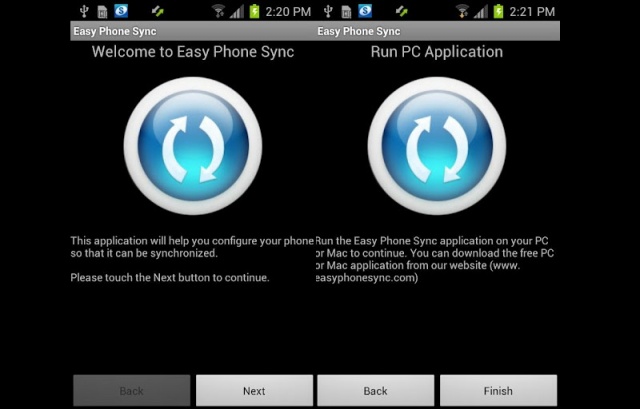
It’s no secret, Samsung has been crawling under Apple’s skin for quite some time. Now, with the release of the Samsung Galaxy S III, Samsung wants iPhone users to know they can make the switch effortlessly thanks to a free app they’re making available to UK Galaxy devices. The app is called Easy Phone Sync, from developer Media Mushroom, and promises to makes transferring your iOS content over to your new Galaxy device a breeze.
Arguing the iPad can't access legacy IT systems often means IT is ignoring much bigger problems
Plenty of people have offered their thoughts and opinions about Microsoft’s Surface devices after the company unveiled the two tablets earlier this week. One particular thread of conversation has been what Surface means for the iPad in businesses and enterprises. One piece that stood out to me was Justin Watt’s blog post Goliath Wants David’s Market.
Watt offers an interesting and well written argument that Surface may find success in many companies because they are still using legacy applications and processes – some of which may have originated long before Windows XP and OS X and have been patched countless times to over the years or decades to continue functioning. His core argument is that many iPad users access these tools using virtual desktop solutions like Citrix Receiver. As a result, at least for some tasks, the iPad functions as a Windows tablet. That could give Surface and other Windows tablets an edge over the iPad if they can directly deal with the legacy code involved or deliver the same virtual desktop experience.
The truth, however, is that many companies are chugging along on legacy solutions that were never designed to work with devices like the iPad. In fact, some widely used legacy systems have roots that weren’t even designed to work with Windows! In many companies, IT has been able to keep the age and state of those systems under wraps. But the iPad, and now the iPad versus Surface discussion, is now pushing that dirty little secret into the light of day.
One user interface designer has swapped Cupertino for Menlo Park.
We often hear stories about Apple luring talented individuals away from rival companies over to its Cupertino campus. But sometimes it works the other way around. Facebook has installed a new Product Design Manager, Chris Weeldreyer, who previously worked as an Apple user interface design engineer.
BYOD offers useful lessons for any business, even ones that don't offer BYOD programs.
BYOD may be one of the big technology trends out there for businesses, but not every business wants or needs a BYOD program. BYOD is, of course, not a magic bullet for addressing every company’s mobile needs. It also isn’t guaranteed to deliver cost savings compared to providing employees with corporate owned and managed devices.
Companies not pursuing BYOD can still gain value from investing in some of the technology concepts and solutions that becoming a standard part of BYOD programs. After all, BYOD is one of the biggest trends of consumerized IT, but it is only one trend out of many.
Here are five key BYOD lessons that any business or organization can apply even without implementing a BYOD program.
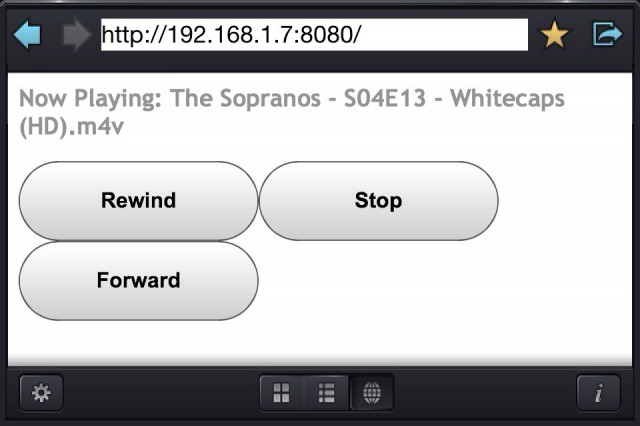
The new browser-based remote is ugly but effective.
CineXPlayer, the excellent, rock-solid, play-anything video player for iOS, had gotten yet another big update. Every time the app is bumped to a new version, I wonder what the developers will be able to add next time. And today’s answer is… Quite a lot.
The App Store extends its reach across Africa, Asia, and Europe.
With the incredible success of the App Store, sometimes it’s easy to forgot that there are still many, many countries the world over that don’t have access to it yet. That number has been reduced today, however, as Apple brings its mobile marketplace to another 32 countries, bringing the total number of countries with access to the App Store to 155.
In two days, Sonic the Hedgehog will be celebrating his 21st birthday. While Sonic goes out and parties like it’s 1999, SEGA will be discounting all digitally available Sonic games for you and I to enjoy. For a limited time, you can head over to any of the following gaming/app stores and enjoy the great deals being offered by SEGA.