We have an exclusive interview with one of the top people in the Apple story. I’d say they were number 3: the third most influential person in Apple’s history.
This is the first time they spoken publicly about Apple in many, many years. They have some good stories, a lot of fascinating insights, and a couple of surprises.
Is this Steve Jobs driving a tank in a classic Apple TV spot from the late 1990s? That was the rumor at the time: Jobs was making cameos in Apple commercials.
Ken Segall, the TBWA ad man responsible for naming the iMac and Think Different, reveals the truth after the jump. He also shares some rare behind-the-scenes photos he took during the filming of this commercial and another from the same era.
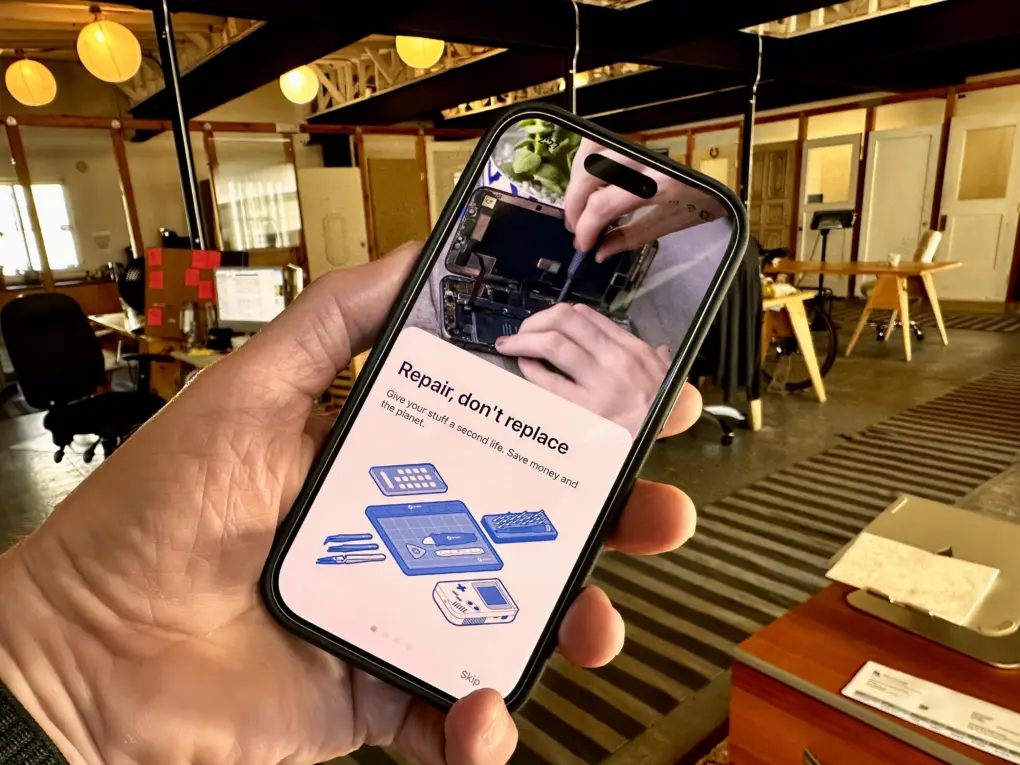
Kyle Wiens, the CEO of iFixit, is launching an online community focused on fixing high-tech products rather than throwing them away.
Best known for its awesome teardowns, the Mac-oriented repair company iFixit is launching a online community devoted to fixing high-tech products, rather than tossing them away.
“The world has a problem with rapidly consuming devices and tossing them aside, ignoring long-term environmental impact,” said iFixit CEO Kyle Wiens on the company’s blog. “With your help, we are going to change that. I’m confident that we can change our culture of ephemeral ownership.”
Currently in private beta, iFixit Answers looks like a cross between a forum and a wiki. In a blog post announcing the launch, Wiens outlines four points that should be of interest to all publishers focused on building productive online communities:
It’s important that posts get more useful over time. It’s not uncommon for a traditional repair forum response to become the canonical source for an answer to a problem, only to get outdated and stagnant as technology changes.
It’s important that we recognize expertise. It matters if the author of an answer is a professional technician, or has helped 200 people fix their problems.
It’s important to make helping people fun. There’s a rush that comes from helping someone solve a tricky problem, being recognized by people for the research you put into a question before asking it, or testing your hardware diagnosis mettle against others.
And most important, we need to close the feedback loop between the people answering questions and those asking them. Repairing things is uniquely tangible — when you use a solution proposed by someone, you know for a fact whether or not it worked. Finding out that the answer you gave someone actually fixed their problem is one of the greatest feelings in the world.
It’ll be very interesting how iFixit makes good on these points. The future on online publishing is nurturing community, and Wiens has nailed some of the key points. We’ll be keeping a close on the project.
“… in the latest development build Atom appears to have resurrected itself zombie style in 10C535. The Atom lives another day, but nothing is concrete until the final version of 10.6.2 is out.”
New on the app store is Car Finder, a clever app that leads back to your parked car using augmented reality.
The app uses the iPhone’s camera to overlay the direction of your car and how far away it is. The app relies on the camera and a digital compass, and is compatible only with the iPhone 3GS running 3.1 or later.
Meet Ken Segall — the man who dreamed up the name “iMac” and wrote the famous Think Different campaign.
Segall is a veteran creative director who worked at Apple’s agency, TBWA\Chiat\Day, back in the day.
“I’ve put in 14 years working with Steve Jobs on both Apple and NeXT,” says Segall. “I’m the author of the Think Different campaign and the guy who came up with the whole “i” thing, starting with iMac.”
Segall collaborated closely with advertising legend Lee Clow, chief creative officer of TBWA\Chiat\Day, whose retirement was widely — but prematurely — reported last week.
In this exclusive interview, Segall talks about working with Steve Jobs, how Jobs initially hated the word “iMac,” and the importance of the Think Different campaign to Apple.
Here’s a couple of videos of the new 27-inch iMac in action as an external display. The new iMac is the first that can act as a monitor for another machine, but will only work with devices that output DisplayPort video, like newer MacBooks.
Powered by good old valves, the Wall of Sound iPod Speaker claims to the most powerful iPod speaker available.
It’s for “people who believe that music should be listened to loudly,” the company’s website says. “It looks frightening, and it IS frightening.”
Handmade by a company called by Brothers of Stockholm, the first edition of this monster speaker is sold out, so the company is taking pre-orders for a second gen speaker. Only $4,495.00 — sign up here.
The sexiest all-in-one computer has long been the iMac, and last year’s 24-inch model was a beauty. But oh my Lord, the new 27-inch machine induces crazy lust. Look at the size of that screen!
I just returned from the Apple store with one. I went to buy the new Magic Mouse. They were out of stock, so I bought the new iMac instead — it comes with a Magic Mouse.
Crazy, I know. I just couldn’t help myself. We’ve already got a 24-inch model, but the 27-inch is so much… bigger.
Yeah, like 3-inches of extra screen makes a difference. But it does. The screen is simply HUGE. There’s no other word for it. If you’re sitting right in front of it, hunched over the keyboard, you have to physically MOVE YOUR HEAD to look from one corner to the other. You get motion sickness if there’s video playing, like being in the front seats of a movie theater.
Thanks to this big beautiful screen, the sexiest desktop in the world got a lot sexier. The question is though: is the screen too big?
Full review after the jump, including real-world benchmarks and tons of pics.
I’m a multitouch junkie. Everything I touch has to be multitouch, or it just ain’t right. I can no longer use a regular laptop trackpad — there’s no two-finger scrolling. It irritates me no end if I can’t point, scroll and double-click with my fingers.
How long will it take then, to get used to the Apple’s new Magic Mouse? So far, it’s been frustrating. It seems like the Magic Mouse would be perfectly natural to use, but it isn’t.
As anticipated, Apple has updated the Apple TV software to 3.0, which brings a new interface and home screen with quick access to favorite content. Instead of drilling down to get to a recently-rented movie, it’s now accessible right off the home screen, as are favorite TV Shows, podcasts and YouTube movies.
The update also adds support for iTunes LPs and iTunes Extras, as well as Genius Mixes and internet radio.
The update likely breaks Boxee, the unsanctioned internet media player that actually makes the Apple TV useful, but internet radio is a welcome addition.
To support the new Apple TV software, Apple has also updated iTunes to 9.0.2. As well as being compatible with the Apple TV 3.0 software, the update adds a new “dark” viewing option in Grid View. The iTunes update also once again breaks Palm Pre syncing.
Print and cut-out your own scary Steve Jobs Halloween mask, courtesy of Dan Draper. http://www.flickr.com/photos/macobyte/2302719050/
Forget Balloon Boy and Billy Mays this Halloween. Dress up as your favorite demonic CEO instead.
You’ll scare the pants off work colleagues when you walk in the elevator, and the neighboorhood kids will be in a bag of hurt when you give them apple slices instead of sickly sweet candy.
Hit the jump for a full-size mask that you can print and cut out.
The world’s most influential computer expert is once again recommending consumers buy Macs over Windows PCs.
Mossberg has just published his annual fall computer buying guide, and says that while Windows 7 is almost as good as Snow Leopard, and PCs can be “priced hundreds of dollars lower than Macs,” Apple wins because of the built-in iLife software:
“The arrival of Windows 7 makes PCs from Hewlett-Packard, Dell and others much better choices than their Vista-equipped predecessors were. Microsoft has closed most of the gap with Apple’s Mac OS X operating system. Also, Windows PCs are often priced hundreds of dollars lower than Macs, and offer many more choices.
But in my view, Apple’s built-in software still has the edge. Snow Leopard is fast and reliable. And it comes with a full suite of excellent built-in programs, including email, photo and video software. Microsoft has stripped Windows 7 of such programs.”
Here’s Mossberg on video discussing some of the options.