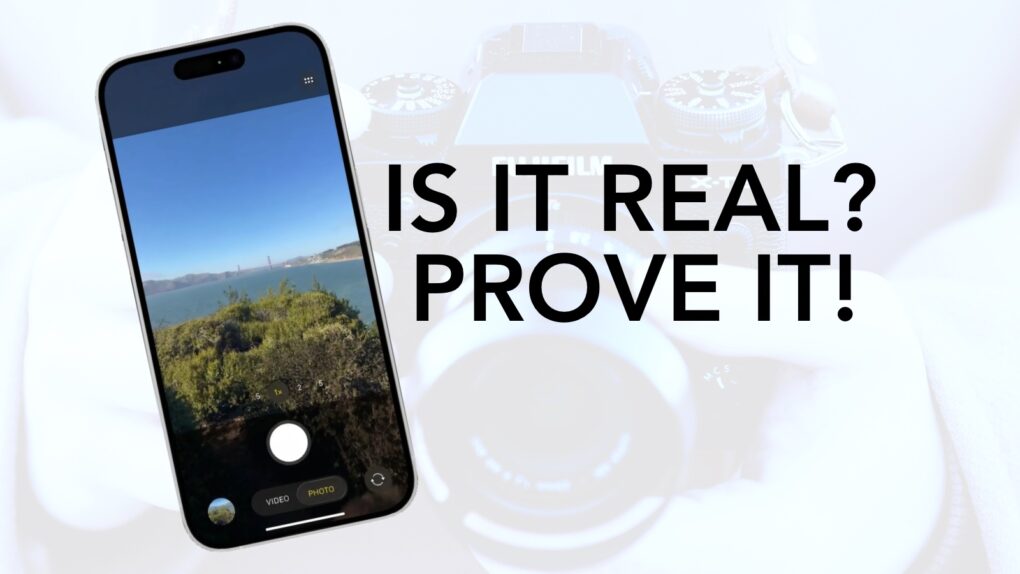
Apple is building a new way to prove your iPhone photos are real. Called Apple Reference Image, it could become a highlight of iOS 27. The tool is designed to verify whether a photo was actually captured by the iPhone’s camera, not an AI generator.
It showed up in a privacy disclosure buried in iOS 27 beta 5.
How Apple Reference Image will work
AI-generated “slop” is rapidly flooding social media, with endless streams of fake photos, bizarre videos and manufactured stories designed to grab attention and rack up clicks.
The problem is that much of it looks convincing enough to fool people scrolling through their feeds, making it increasingly difficult to tell what actually happened from what was dreamed up by a generative AI tool. Apple Reference Image will apparently help combat the problem.
It isn’t a filter or a toggle you’ll notice right away. The feature works through a new “Reference” mode hidden in the Camera app. Enabling Reference mode embeds special provenance data into a picture’s metadata the moment you tap the shutter.
That data acts like a digital fingerprint tied to your iPhone’s actual camera sensor. The clever part? The system does not authenticate a photo automatically.
Instead, you tap a “Reference” badge on the image whenever you want to prove it’s legitimate. Doing so sends the raw photo, sensor signatures, capture timing and unique hardware identifiers to Apple’s Private Cloud Compute servers.
Private Cloud Compute then checks whether the photo really came from that sensor and assigns the image a unique ID, sending back an authenticated version.
Apple can also refuse to authenticate an image if it suspects a sensor has been compromised. Moreover, it can retroactively pull authentication from a sensor’s older photos if something looks off later on.
Why Apple Reference Image matters right now
Authenticated photos will reportedly work across the Apple ecosystem. You’ll be able to view them on iPhone, iPad or Mac, and the Reference badge will be clickable on desktop as well.
The feature isn’t limited to photos, either. Apple’s disclosure text mentions “photos or videos” and “uncropped footage,” hinting at the video component down the line.
To be clear, because Reference mode must be enabled before a shot is taken, this doesn’t look like a tool for everyday snapshots. Instead, it looks more like something built for professionals to prove a shot wasn’t faked.
For instance, a photojournalist might need to prove that an image really came from the scene of an event. A photographer could want to demonstrate that a picture hasn’t been fabricated. Even a courtroom could potentially benefit from a way to establish where a piece of visual evidence came from.
That focus makes sense given the moment we’re in. AI-generated images are now good enough to fool almost anyone at a glance. Watermarks and other detection methods meant to flag them are still far from foolproof, while AI-detection tools are laughably easy to fool.
Apple already tags AI-generated content from its Image Playground tool with metadata labeling. But Apple Reference Image flips that approach. Instead of marking what’s fake, it offers hardware-backed proof of what’s real.
Part of an anti-slop trend
Apple Reference Image puts Apple in the same league as camera makers like Leica, Sony and Nikon, which use the C2PA Content Credentials standard for similar authentication. Google adopted the same standard for its Pixel 10 lineup earlier this year.
But Apple Reference Image apparently isn’t based on C2PA. Instead, Apple appears to be building its own authentication system around the iPhone’s hardware and Private Cloud Compute.
In some future iOS 27 version
Currently, Apple Reference Image waits behind the scenes, switched off by default in iOS 27 beta 5. Nothing in the beta disclosure confirms when, or if, the feature will go live for everyday users.
Apple often pulls features found in early betas before a public release, so treat this one as promising but unconfirmed for now. iOS 27 should arrive this fall alongside new iPhones.
Still, the timing lines up with a broader industry push toward photo provenance. Generative AI keeps blurring the line between real and fake images. A hardware-verified stamp of authenticity from Apple could prove genuinely useful, especially for anyone whose job depends on proving a photo is real.
As AI-generated images continue taking over social media, simply saying “I took this photo” may no longer be enough. A future iPhone could let you prove it.

Anurag Chawake is a tech-focused writer specializing in smartphones, apps and consumer technology. His interest in computers began during the Windows 98 era, eventually leading him to explore everything from operating systems to mobile devices and PC hardware. Anurag previously contributed to The Indian Express, covering Apple, Android, gaming and the broader technology landscape.

