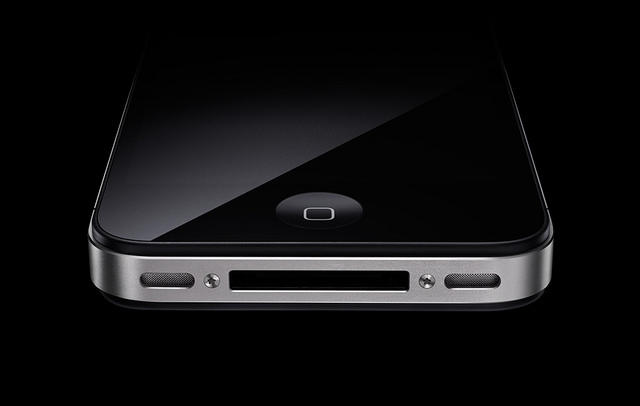
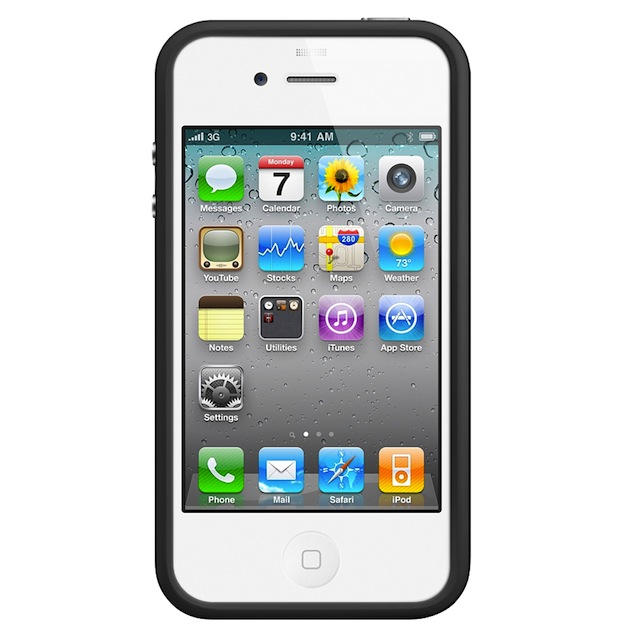
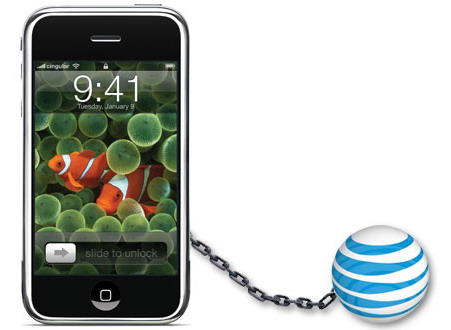
This is something of a pro tip, but if you have an original 2007 iPhone dock, time to dust it off: DVICE has found that it actually works better than Apple’s new, custom-fit iPhone 4 dock.
The explanation is all about looseness: although the iPhone 4 dock perfectly fits the handset, it’s actually just a bit too tight, making the handset difficult to remove from the cradle with just one hand. The original iPhone dock has none of these problems.
Don’t have an original iPhone dock? Check the eBay listings to pick one up for a song?
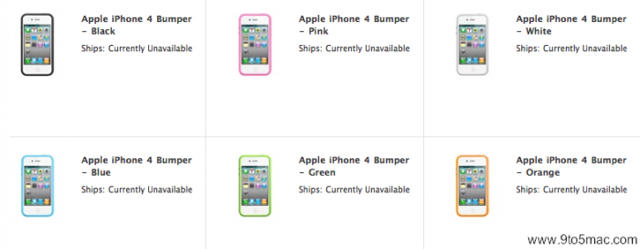
It looks pretty official at this point that whatever measures Apple is going to take in fixing the iPhone 4’s reception problems, free bumper cases isn’t going to be one of them. Just in time, then, comes this quick and easy guide on how to use silicone modeling clay to make your own cheap bumper, which will not only protect it from a shattering fall, but also prevent the glass surface from getting scratched on tables and the like. Extend the sugru a little farther over the iPhone 4’s antenna danger spot at the lower left corner and that should help minimize dropped bars when you’re gripping your iPhone 4 as well.
If you’re hoping to get some sort of solution for your iPhone 4 antenna woes by calling up tech support, think again: Apple’s internal procedures when it comes to the iPhone 4’s reception have been leaked, and officially, there’s no problem with the iPhone 4 antenna unless there’s signal problems when you aren’t holding it.
What’s been rumor, speculation and a good way to fill blog space is now…well, still all of the above; but the rumors are beginning to sound more and more like hard fact — that Verizon has bagged the iPhone.
Just days after the iPhone arrived at Apple stores, and one day afteron the same day it hit AT&T’s outlets, Bloomberg News says “two people familiar with the plans” claim that Verizon will begin selling iPhones next year in January. The two sources spoke anonymously; not surprisingly, neither Bloomberg News nor anyone else running the story has been able to get an official comment from either Apple or Verizon.
If you are squeamish or faint of heart and love all things Apple you just might want to skip reading this post, but on the other hand if Freddy Krueger is your friend and all the gut wrenching destruction of his movies are for you then keep reading. We’ll take a look at three videos that show Apple’s latest gadget the iPhone 4 getting blended, microwaved, and shot.
We’ve received some comments from iPhone 3GS users that their battery life after the iOS 4 update has declined. This can in most cases be attributed to poorly written apps or apps that don’t support the multitasking feature introduced in iOS 4. Are you experiencing this problem? Have you identified an app or some other reason for the decline in battery life on your iPhone 3GS? Tells us all about it in the comments.
Apple’s accidentally hinted at the existence of iWorks for iPhone a few times in the past now, but these blurry images over at 9to5Mac are the first plausible look at the software, demonstrating a beta of Pages for iPhone running on an iPod Touch.
Sure, this kind of image is something that could be easily spoofed by a programmer with a jailbroken iPhone, but I suspect that it’s legit: with iMovie for iPhone, Apple has already demonstrated itself to be ready to start porting over their desktop apps to iOS.
As a film, Michael Korbel’s Apple of My Eye is schmaltzy enough that it might make you want to puke out a kidney. The plot can best be best described thusly: old man walks down street with granddaughter, looks into a window, hallucinates for thirty seconds about being a lilliputian riding a toy train.
“Grampa? GRAMPA?” the alarmed girl asks as her dead-eyed grandfather wobbles back and forth, clearly in the throes of a ministroke. “Let me tell you a story!” he cries. The film ends just before the little girl’s inevitable response: “Oh, great. I’m sure it’ll be a humdinger.” *eyeroll* “Let’s just get you back to the assisted care facility, okay?”
Pretty putrid. In fact, if it weren’t filmed with an iPhone 4 and edited with iMovie for iPhone, I’d tell you to watch something more interesting. But it was, which makes Apple of My Eye impressive, tacky though it may well be. If anything, it just goes to show how good the iPhone 4’s video capabilities are… at least when wielded by professional cinematographers under ideal lighting conditions.
Don’t have an iPhone 4 but still want to use iMovie for iPhone? There’s no real reason it can’t work on the likes of the 3GS, and so it does, with a little jailbreaking.
The hack’s easy enough. If you’ve got a jailbroken iPhone, you just edit the info.plist file of the app and change the “Minimum System Version” to 3.0.0 and “Front-Facing Camera” to False. Launch the app again and you’ve got the ability to edit videos on your last-generation iPhone, seemingly without much performance degradation.
If you haven’t already played Giana Sisters, you’re missing out! It’s one of the best platform games on the iPhone & iPod Touch and I highly recommend you try it. If you share my love of Giana Sisters, you too will be pleased to hear that a HD version is making its way to the iPad soon, according to Touch Arcade.
Originally released in 1987, The Great Giana Sisters was first developed for the Amiga, Atari, Commodore 64 and other consoles of the era. It was quickly pulled, however, after running in to legal trouble with Nintendo due to its similarity with Super Mario Bros. The game was reborn in 2005 when it was renamed simply Giana Sisters, and made its way on to mobile phones, and a few years later, the Nintendo DS.
Today, 5 years on, Giana Sisters is one of the best platform games in the App Store for the iPhone and iPod Touch, and Touch Arcade have reported today that its developers, Bad Monkey, have sent them a bunch of screenshots for their upcoming HD version of the game. You can check them out and find out more info here, or read Touch Arcade’s review of the current game here.
If you can’t wait until the iPad release on 9th July, you can find the iPhone & iPod Touch version in the App Store here.
As they are wont to do, the guys over at iSuppli have ripped apart their pretty new iPhone 4s, done some math and figured out how much it cost to make.
What’s the damage to Apple? The 16GB iPhone 4 costs $187.51 to put together in hardware costs alone, with the fancy new Retina Display costing $28.50 per unit, the A4 CPU costing $10.75 and the new gyroscope only coming in at around $2.60./
Needless to say, there’s a lot more money spent on every iPhone 4, including marketing, design and manufacturing, so this isn’t a complete view of how much profit Apple is looking at per device, but I still always find this stuff fascinating, like taking my dental records down to a pawn shop and seeing how much I could get for my fillings.
Steve Jobs just can’t seem to make up his mind. Just a few days after he tersely told a customer that people experiencing rampant reception issues with their iPhone 4 that people were “holding it wrong,” Steve Jobs has written to another Apple customer, saying “There is no reception issue [with the iPhone 4]. Stay tuned.”
Isn’t that a bit of a contradiction? Even if a forthcoming iOS 4.0.1 update does fix the reception issues, that still implies there wasan issue. Plus, why do we need to hold it in a specific way if there’s no issue whatsoever?
More interestingly, what are we “staying tuned” for if there’s no issue with the iPhone 4’s reception at all? A placebo? If you want one of those to work, Steve, you’re not supposed to tell the patient.
The mouse has once again darted around the cat. Just a few days after the official release of the iPhone 4, userland has once again managed to find its way around Apple’s updated security measures to jailbreak the handset and get root access to the device.
Don’t expect to do this yourself for now: because the exploit uses remnants of Apple’s own code, it can’t be released to the public just yet, and it’s possible the forthcoming iOS 4.0.1 update might put a kibosh on this particular jailbreaking strategy.
But if you’ve got dreams of high-res Cydia apps dancing in your head, be patient and keep waiting for Dev Team Christmas.
I was gutted to find this morning that my brand new iPhone 4 didn’t work with my beloved TomTom Car Kit — the best automotive cradle/charger for the iPhone, bar none.
The iPhone 4 fits in the cradle OK, but it doesn’t charge. Discovering this filled me with disappointment. I love the TomTom Car Kit (which costs $100 but is well worth it). It holds the iPhone just where I want it for navigation and music. It charges the iPhone, and boosts the GPS signal when using TomTom’s excellent navigation app. And it doesn’t move, even if I clumsily bash on the iPhone’s screen with my big sausage fingers.
So I’m delighted there’s a simple and inexpensive fix for the charging issue — a small strip of velcro.
As Engadget tipster Ben Peacock Martin Alaniz discovered, you cut a small strip of velcro (the soft side) and stick it to the back of the Car Kit cradle, just behind the dock connector.
There is no need to attach anything to the iPhone itself. The velcro acts as a cushion holds the moving part of the cradle flat, pushing the Car Kit’s electrical contacts against the iPhone’s. Simple and cheap.
What it is:Auto Verbal Pro (iTunes link) is handy, if not quite full-featured augmentative and alternative communication (AAC) software that gives non-verbal people an inexpensive tool to communicate using an iPhone, iPod Touch or iPad.
Why it’s cool: Other high-end AAC solutions such as Proloquo2go (iTunes link) cost well upwards of $100 while Auto Verbal Pro hit the iTunes store a couple of weeks ago at 99¢. The introductory price won’t last long but even when NoTie Software kicks its offering up to $30 it will still be a bargain for the help it can bring to people with autism or other conditions that make it difficult for them to communicate verbally.
With over 100 pre-programmed icons in its intuitive interface, Auto Verbal Pro makes it easy for a non-verbal person to say basic phrases such as “I am tired,” or “I am OK,” and things such as numbers, days of the week, shapes, colors, food items, animals and so on. There are 10 icons which can be custom programmed to utter more complex phrases, such as “This software is the bomb, isn’t it?” and a text entry field in which any phrase can be typed and played through the device speakers. Users can choose between large and small buttons, which can be very useful to the visually impaired or fat-fingered, and between male or female sounding computerized voices in low-fi or hi-fi quality.
While great strides have been made in recent years developing software to speak for us, Auto Verbal Pro showcases some of the limitations that persist. The built-in low-fi voicings are certainly intelligible but lack any kind of nuance or expressiveness. Hi-fi voicings are even more intelligible and slightly more expressive, but they require WiFi Internet access in order to work, since the files live on NoTie’s servers. When a custom or typed phrase is called on to use a hi-fi voice, the software connects to NoTie and plays back the sounds using QuickTime, which results in clunky, irritating delays. Where no Internet access is available, the program defaults to the low-fi voicing.
All and all, this is useful and potentially even quite amusing software; with good reason it quickly jumped into the Top 5 Paid Medical apps on the iTunes App Store.
Where to get it:Auto Verbal Pro (currently English-only, but with French, Spanish, and German versions planned) is available on the App Store for a limited time at 99¢, after which its price will jump to $30. It’s well worth investing a dollar now to see if it’s something that could be useful to you or someone you care about.
Touch Arcade have reported today that game developers, Mobile 1UP, have “bitten the bullet” and announced in the Touch Arcade forums that they are porting Lemmings to the iPhone & iPod Touch. All 120 levels of the original game will feature, and what’s more, it will be a free download.
If you’re unfamiliar with Lemmings, it’s a 20-year-old puzzle game that was originally developed by DMA Design, now Rockstar North, and published by Psygnosis. The aim of the game is to guide a group of Lemmings through different landscapes by assigning them individual skills, in order to get a certain number of them through to the exit.
Lemmings first appeared on the Commodore Amiga and was one of the most popular games of its time. Since then it’s been ported to a wide variety of game systems, most recently to the PSP and PlayStation 3 consoles.
If you’d like to keep track of Mobile 1UP’s progress on the iPhone & iPod Touch port, you can follow their live blog throughout the whole process.
Mobile 1UP have stated that Lemmings will be submitted to the App Store as soon as it’s ready – stay tuned for a review when it’s released!
This new gadget is called a “Bringrr,” but we think that’s only because “Hey, Don’t Leave The Prototype in a Bar Next Time, Dumbass Device” wouldn’t fit on the box:
Pair the little Bluetooth-equipped plug with a phone, pop it into a car’s cigarette-lighter port, and it’ll have a conniption (alarm, flashing lights) if the car is started without the phone in close proximity.
Being the star of the best comedy series of all time has its perks: recognized waiting in line like some sort of pleb by an Apple Store employee, actor Jason Bateman was pulled from the line and ushered into the Apple Store to get his iPhone 4 ahead of the less famous people waiting in line in front of him.
Usually, we’d be incensed at the privileged treatment celebrities get, but in Michael Bluth’s case, I think we can make an exception.
Edit: This post was originally accompanied by a photo of Jason Bateman being spoken to by an Apple store employee while waiting in line for his iPhone 4, which we picked up from the celebrity gossip blog WWTDD. If you want to see Jason Bateman looking bored and sitting on the ground in a long line while an Apple Store Genius with his underpants exposed talks to him, you should go over and see the pictures there.
Having problems with your iPhone 4 reception when you touch the bottom of your device? According to antenna expert Spencer Webb, don’t blame Apple… blame the FCC.
Just about every cell phone in current production has the antenna located at the bottom. This insures that the radiating portion of the antenna is furthest from the head. Apple was not the first to locate the antenna on the bottom, and certainly won’t be the last. The problem is that humans have their hands below their ears, so the most natural position for the hand is covering the antenna. This can’t be a good design decision, can it? How can we be stuck with this conundrum? It’s the FCC’s fault.
You see, when the FCC tests are run, the head is required to be in the vicinity of the phone. But the hand is not!
Basically, because phones have gravitated away from clamshell or extendable antenna designs, and because the FCC has rigid guidelines on how much radiation a cellphone is allowed to pump directly into your skull, Apple had to put the antenna at the bottom of the phone… right where most people will grab onto it.
When Apple rejected WiFi Sync from the App Store, speculation was that their reasons had a lot to do with future Cupertino’s own plans to allow iDevices to sync with Macs wirelessly.
The latest Jobs’ email lends some credence to that theory. Rick Proctor wrote Jobs and asked, “Do you think you will ever allow syncing iPhone to Mac over wifi?”
Jobs’ terse but cheery response: “Yep, someday.”
Excellent news. I’m sick of syncing my iPhone through wires like some sort of caveman. If we get wireless syncing, though, is it too much to ask for inductive charging as well?
You’re probably sick of reading about the iPhone 4, so here it is in a nutshell: It’s slick as sh*t and I recommend without hesitation that you buy it.
No yellow spots
Holding it the “wrong way” drops bars, but it doesn’t matter much to performance.
It doesn’t scratch that easily, no matter what you’ve read.
We’ve been able to replicate the iPhone 4 radio reception ‘Death Grip’ with older iPhones, and speed tests show that network performance is perhaps more complex than the number of bars in the upper left corner.