We reported two weeks ago that Capcom was planning on bringing Street Fighter 4, to the App Store despite the iPhone and iPod Touch’s lack of waggling physical controls… but now we can see exactly how the iconic fighting game will play on Apple’s line-up of touchscreen handsets thanks to a recently released trailer.
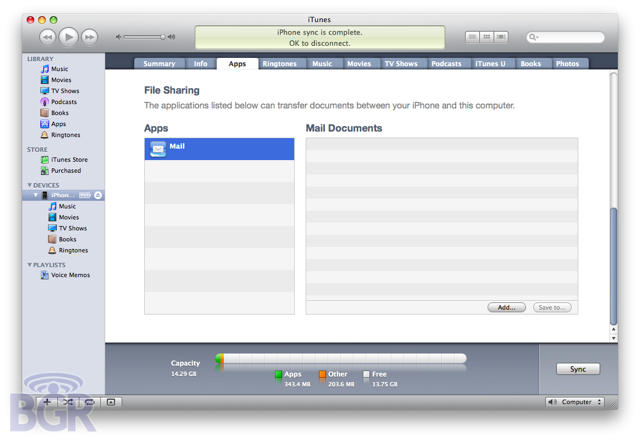
The dread iPhone backup progress bar (via iPhone Lover)
Just a shade over nine years ago, Apple launched iTunes, a fairly late, fairly average MP3 player with CD burning built in. And though it lacked many of the features of Audion, then the best music player for Mac, it not only became the market leader, but it set the stage for the iPod, widespread legal music downloads, legal TV, the iPhone, and soon the iPad. It would be no exaggeration to say that iTunes saved Apple. It would be no exaggeration to say that iTunes is now Apple’s most successful piece of software ever in terms of users.
But it would also be no exaggeration to call it the worst piece of software Apple makes and the one thing that could disrupt Apple’s current march to mobile device dominance. It has bloated into a crashy kludge that the rest of the Apple universe depends upon. Despite a lot of good intentions from amazing software developers, iTunes has become Apple’s Internet Explorer 6 — an unmitigated disaster.
The WiFi-Where App in action (before Apple removed it from the App Store).
Having purged the App Store of porn, it looks as though Apple is now clearing the App Store of Wi-Fi finders.
On Wednesday, it appears that Apple removed several popular Wi-Fi stumbers from the App Store, including WiFi-Where, WiFiFoFum and yFy Network Finder.
Apple sent a note to the developer of WiFi-Where on Wednesday saying their app has been removed because it uses “a private framework to access wifi information.”
According to Doctor Who lore, inside the dimpled chassis of the genocidal Dalek is a cycloptic squidling, but Steve over at BotBuilder knows the real truth: in actuality, the warbling, murderous cyborgs are remote controlled via iPhone using the accelerometer.
According to Steve, “The iPhone sends out OSC signals over WiFI to processing which then talks over serial to my Servo Board. The Dalek moves around when you tilt the ipod/iphone. I am getting the accelerometer data out for this. I also have a turret that can be rotated and some leds that are switch-able.”
All very well and good, Steve, but you just haven’t taken this project far enough until I can pick up my iPhone, shriek “Exterminate!” into the mic and have it automatically converted into an oscillating, high-pitched electronic shriek emanating from the remote-controlled Dalek’s head plunger.
Yesterday, Cupertino surprised everyone by throwing a bonafide legal temper tantrum about rival handset maker HTC’s alleged infringement on up to 20 Apple patents.
Although Apple is targeting HTC, the takeaway here is clear: Apple’s going after Android, HTC’s bread-and-butter. Google recognizes this, and is standing in solidarity with HTC.
As Apple fans, it’s easy to lose sight of the big picture here. Competition is good for the consumer, and Android becoming a credible threat to the iPhone’s dominance will only make the iPhone cheaper and better for consumers in the long run.
There’s other aspects that make this sort of patent battle bad news for consumers though. The New York Times Bits blog asked some IP experts on the possible ramifications of the Apple-HTC patent dispute, and according to Harvard Law School professor Jonathan Zittrain, if Apple wins, we could see the courts order HTC to hit the kill switch on their Android phones, just like what happened in the TiVo/EchoStar lawsuit of 2004.
Folks, let me tell you a secret: I sing. I sing all the damn time. It’s a good job I work at home all by myself, because if I worked in an office I’d drive my colleagues crazy by singing at them all the time.
And since the birth of the App Store, I’ve been looking for a looper. A looper, for those who don’t know, is a musical effects pedal that grabs a short snippet of audio and, well, loops it. Over and over again. And lets you record another loop on top. Repeat, ad lib to fade.
It’s a quick and easy way to do clever things live on stage, and fun things when you’re trying to write new songs.
There’s been a load of apps that promised some kind of looping capability, and I’ve tried a bunch of them and never found anything that really nailed it. Looping needs to be ultra-simple, instantaneous and spontaneous. None of the apps I tried made that possible. None of them until Everyday Looper.
You need not risk $20 million in alimony to find deleting compromising text messages from your cell phone useful.
That’s the premise behind Tiger app, a nod to philandering putter Tiger Woods, an iPhone application that erases indiscreet SMS messages, forever, right after you’ve read them. You can set a text “life span,” then those texts are deleted from both user’s phones, living up to its slogan “to cover your tracks.”
A boon for star-crossed lovers, double dealers, anyone needing a bit of privacy in a world of oversharing, this is certainly a more elegant solution than the double SIM card, a favorite in amore-happy Italy from where I write — where the number of SIMS outnumber inhabitants.
It also provides a much-needed buffer in the dating world, since it offers a tigertext ID you can give to out and then figure out if beer goggles are 20/20 or not.
As one of the app reviewers, JJH13 says: “I was out at a party last night and met someone and wasn’t sure I wanted him to have my number. I noticed he had an iPhone and just gave him my tigertext user name. Later I can decide whether to give him my number. I love the fact what I say via text is pretty much going to stay that way. I work as an attorney in family law and can see some great uses for this professionally.”
However, even the yawningly monogamous may find a use for this: who doesn’t have a few friends or co-workers whose SMS messages are just about always worth automatically deleting?
Boston is one of the first US cities — along with Pittsburgh and San Jose — to let angry citizens file complaints about potholes, graffitti and missed trash pick-ups via iPhone.
Boston’s Citizens Connect, which city officials say has been downloaded 5,000 times since it’s October 2009 debut, won’t be the only way people can let city government know what’s awry in their fair city.
The Cradle of Liberty aims to be the city of smartphone apps thanks to a new one called Boston Urban Mechanic Profiler, or BUMP.
It’s still under development, but the general idea is that instead of using bumping to exchange your phone number with that cute denizen of the coffee table adjacent, by bumping fists with their phones drivers or bicyclists can quickly and easily report road conditions to city officials.
To bridge the iPhone divide — wealthy areas get bumped a lot, poorer areas not at all — officials are considering equipping city workers who live in less affluent neighborhoods with iPhones so they can boost the bumps.
There’s reason enough to arch a wry eyebrow at yet another classic platformer with a virtual control overlay ported to the App Store, and Gameloft’s newest iPhone gaming release, Rayman 2: The Great Escape is no exception, even at $6.99.
Apple’s latest iPhone ad “Family Travel” follows the app-heavy formula of the most recent iteration of the campaign but adds a Mom’s gushing narration mix to make its point: the App Store is pretty neat.
The premise of the app is that the iPhone works as a veritable Swiss Army Knife for traveling Moms. “It’s unbelievable how much better family trips have gotten!” Narrator Mom enthuses, as she demonstrates using the SouthWest Airlines app to check on her reservations, find a place to eat at the airport with Gate Guru, checks if she turned the lights off with the Schlage Link app and then finally hands her iPhone off to the kids so they can watch Pixar’s FInding Nemo to the flight.
It’s a pretty standard iPhone ad, interesting mostly because of how synonymous the iPhone is with the App Store at this point. Most of the iPhone “features” that Apple advertises these days are third-party software: the iPhone, as far as its advertising campaign is concerned, is pretty much defined as a product by the App Store. Apple is essentially advertising a platform instead of a product, and it’s simply amazing to me that two years ago that platform just didn’t exist.
The guys over at Vimov has given Touch Arcade a great first-look at their port of Hexen II a great fantasy-themed FPS built upon the venerable Quake engine in 1997.
It’s an impressive port: it runs fluidly, it has a surprisingly innovative control scheme and only the music is missing. The big problem here, though, is that there’ll just never be any way to play it on a non-jailbroken iPhone unless Vimov can ink a deal with Activision, the owners of the Hexen franchise.
The problem is that while Hexen II’s executable is open source, the game data isn’t. The Hexen II GPL license allows for non-commercial redistribution, so Vimov could potentially knock this port up to the App Store as a free product… but since Apple doesn’t officially support a method for users to transfer their own files (like Hexen II’s game data files) to the iPhone for third-party programs to use as they see fit, the app would never be improved.
Still, it’s impressive work, and there is still some hope that Vimov and Activision can work something out: Hexen II was one of my favorite games back as a LAN-going nineteen year old, and I’d happily drop a fin or two for the pleasure of playing it on my iPhone.
The iPhone 3GS is like a Formula One car: fast, sleek and a thrill to drive. And then, every hour or so, it has to hit the pits to refuel (only, unlike refueling an F1 car, it takes hours, not seconds). Now, imagine if every F1 car had button on the steering wheel that the driver could punch, and a fuel cell would drop from some kind of team drone-copter and refuel the car while it was rocketing around the track. Pretty cool, right? Well, that’s what using the TruePower iV Pro is like.
According to new data from Gartner, Apple’s iPhone operating system is the third most dominant smartphone platform in the world, with a 14.4% market share.
The iPhone still trails Nokia’s Symbian operating system and RIM’s BlackBerry OS. The discrepancy between RIM and Apple is only by five percent… but RIM has only grown their market share by about 13% in the last year, where as Apple has nearly doubled theirs.
On the other hand, there’s still a wide, wide discrepancy between Symbian and iPhone OS. Nokia’s smartphones account for 46.9% of the global 2009 smartphone market, but that’s down from 54.2% the year before… and more and more users continue to abandon the platform in favor of other OSes, like the iPhone’s.
In fact, looking at Gartner’s numbers, it’s easy to spot a trend: the only smartphone OSes that are growing in market share are the iPhone OS, Android and the BlackBerry OS… and the iPhone is outgrowing all of them.
Give it another couple of years: by 2011, the iPhone OS will be the most widely used smartphone OS in the world.
After January 27th’s unveiling of the iPad, it became abundantly clear that Apple has meaningful plans for iPhone OS outside of the smartphone arena. In fact, given the App Store’s runaway success, it’s just good business sense for Apple to try to get iPhone apps on as many devices as possible: not just phones, portable media players and tablets, but more traditional laptop and desktop machines as well.
The question is, then, when will OS X and iPhone OS begin to converge? When will OS X become compatible with iPhone OS?
In a recent New York Times blog post, Nick Bilton examines this very question, and talks to a former senior Apple Engineer to get to the bottom of whether or not iPhone apps could run natively on OS X one day.
The iTunes store is pulling off and putting on sexy apps faster than you can stuff a dollar bill in a g-string.
Case in point: the Hooter’s girls are back in bikinis to “clean” your iPhone screen. Hooters Calendar Screen Wash was quietly reinstated Feb. 24 and is now back on sale. The $0.99 app is for a +17 audience, though it doesn’t seem to be any more prurient or wholesome than some of the babes-in-bikini apps that were yanked over sexual content. Another five Hooters-related apps, from several different app makers, also appear to have been reinstated.
No one seems more surprised than the creators, On the Go Girls, who remarked on the company blog:
“Wow! Surprising! We are shocked! Our Hooters Calendar Sexy Screen Wash was restored to the App Store last night 2am PST.”
No-name bikini apps still seem to be AWOL from the iTunes store, which makes me wonder whether it’s more a question of brand-name franchises like Playboy and Sports Illustrated flaunting their stuff than one of women complaining about them.
At least with this iPhone you don’t have to worry about managing or forgetting its cookies. A Japanese bakery called Green Gables whips up these handmade smart cookies — the “camera” on the back is an especially nice touch — but fortunately they spared us the glossy black frosting and made them out of what looks like gingerbread instead.
If you’re looking for a more slavish copy to sink your teeth into, there are other options.
AT&T’s 3G service may be widely reviled, new data from PC World in collaboration with wireless analysis firm Novarum indicates that not only has Ma Bell done a lot over the course of the last year to shore up thew weaknesses in its network, but that in most cities it’s one of the fastest and most reliable networks around.
Thanks to the App Store, the iPhone and iPod Touch have a wide library of frankly excellent remote apps available to most users. If your device can accept commands through WiFi or Bluetooth, the iPhone family is the best universal remote out there… but with most homes filled to the gills with dumb gadgets that can only be controlled by blinking infrared beams, that’s a big “if.”
Power A’s latest product, the iPhone Universal Remote Case, adds the IR functionality to the iPhone and iPod Touch, allowing it to communicate with any of your household’s stupidest devices. The IR transmitter’s built right into the sleek case, which adds a minimal footprint to your existing device.
Once your handheld’s ensconced, controlling every gadget in your house is as simple as loading Power A’s app, which will even update itself with new device profiles overtime. Not bad indeed… although that $60 price seems a bit much.
The first generation iPhone’s metallic underbelly was undeniably magnetic to objects like the sharpest ridges of house keys, and in that sense, the current iPhone’s backing is an improvement: the plastic just doesn’t pick up scratches like the metal iPhone backplate used to.
Still, there’s something ghetto about a plastic iPhone, isn’t there? It just doesn’t feel like an Apple product anymore unless it has been hewed out of a piece of aluminum. Martin Schrotz seems to have felt the same way, because he decided to ditch the plastic backplate of his cherished iPhone 3Gs and replace it with a custom titanium body he forged himself.
The process wasn’t without its pitfalls. “I had the original cover measured digitally, and I then started to draw the new cover in CAD. It’s made out of a special titanium alloy that is RF transparent. I had tried aluminum but that was a complete disaster.”
The Apple logo is a bit big for my taste, but otherwise, I’m jealous: my first-generation iPhone has always felt firmer and more substantial in my hand than my girlfriend’s second-gen iPod Touch, but barring Apple restoring the metal-backed option to their iPhone line, this is about the only way in town to marry the performance improvements of Apple’s later handsets with the heft of their first design.
They might have cancelled the follow-up to their cute little rolling blob series, Rolando, because it couldn’t be turned into a “freemium” title, but iPhone game startup Ngmoco clearly isn’t doing bad itself: they’ve raised $25 million in capital fund and purchased Freeverse.
Who is Freeverse? They’re another popular iPhone gaming company, responsible for titles such as Moto Chaser and Skee-Ball.
The move should allow Ngmoco to take their successful “freemium model” — in which games are free for users to download or play, while the developers themselves make their money through in-game advertisements and in-app purchases — and roll-it out to their recently acquired Freeverse titles.
As a business model, it makes a lot of sense: with the average price of apps ever plummeting, Ngmoco’s freemium approach allows them to give most users what they want — a free, simple game to play — and squeeze revenue out of them anyway. I don’t necessarily think that leads to very sophisticated games in the long run… but most people don’t want sophistication, they want entertainment.
Let’s face it: crushing disobedient flesh into a Dolce & Gabbana corset dress is easier than getting into one of their runway shows.
So the dynamic fashion duo has decided use the iPhone to broadcast 2011 women’s winter looks at two shows during fashion week in Milan. You can follow them with your iPhone here or, if you don’t have an iPhone try your buffering luck with Facebook, too.
iPhone fashionista followers won’t get that neck nasty cramp caused by gazing upward from first-row seats like D&G darlings J-Lo or Victoria Beckham, but you may have to get up early or sneak a peek at work.
A potentially revolutionary way to stream next-gen video games to hardware technically too underpowered to run those titles natively, thin client OnLive might be the best thing to happen to gaming since, well, the Internet.
Essentially, the technology works by making a game into an interactive, streaming video, rendering all the gameplay on a beefy server, compressing the video and shooting it off to you as you play. Imagine, for example, playing a shooter like Crysis — which can cripple even a top-of-the-line PC — on your iPhone. Actually, scratch that, because you don’t really have to: at this year’s DICE Summit in Las Vegas, OnLive CEO Steve Perlman gave a brief demonstration of Crysis running on Apple’s handheld.
If the idea of playing full-featured, next-gen games on your iPhone doesn’t get you excited, it gets better: Perlman has also confirmed that OnLive will support tablets, clearly giving a wink and a nod to the iPad.
The only question is: will OnLive be able to solve the latency issues inherent in the thin client gaming approach? Perlman swears it’s feasible, as long as each OnLive user is within 100 miles of a server, but a high ping’s a deadly thing in an FPS. OnLive could very well be a revolution… but at the end of the day, I think we’ll be more likely to be playing slower-paced games like Civilization V through our iPad OnLive client than Crysis.
If this is what Apple considers 'overtly sexual' content, we fear for civilisation itself - and the entire company needs to get out more.
Complaints from women are behind Apple’s recent purge of sex-themed apps, Phil Schiller told the New York Times.
Philip W. Schiller, head of worldwide product marketing at Apple, said in an interview that over the last few weeks a small number of developers had been submitting “an increasing number of apps containing very objectionable content.”
“It came to the point where we were getting customer complaints from women who found the content getting too degrading and objectionable, as well as parents who were upset with what their kids were able to see,” Mr. Schiller said.
What it is: Zinio, in partnership with major publishers of traditional books and magazines, offers subscription-based digital content over the Internet and via its iPhone/iPod Touch native app available free in the iTunes AppStore.
Why it’s cool: Zinio has spent the past 10 years helping people get digital access to the traditional magazine content they already love. Now, at the dawn of Apple’s iPad era, Zinio is poised to offer some of the most compelling content iPad users will see on the device — and just may help save the ailing traditional publishing industry in the bargain.
Many have wondered about Apple’s model for distributing e-reader content — how it will look, what it will cost, and what Apple’s percentage of the revenue take will be — when the iPad makes its market debut in March.
Jeanniey Mullen, Zinio Global Executive Vice President and Chief Marketing Officer, told us in a wide-ranging conversation at Macworld earlier this month such concerns make no difference to her, since Zinio’s own model will remain platform agnostic. “Our most important relationships are with publishers and readers,” she said. “Zinio revolutionizes the reading experience and we’re excited about iPad’s potential for making that a great mobile experience” but the company doesn’t sell its current content through the App Store and that won’t change when the iPad comes along.
What you are looking at is a screenshot of the contents of the iPhone OS 3.2 SDK, and those circled files? Look at their names. That’s just About as clear an indication as there can be that a forthcoming iPhone, the iPad or both will be able to make video calls.
That’s not all. 9to5Mac has also dug up some references in some of iPad’s telephony applications of imbedded video chat strings.