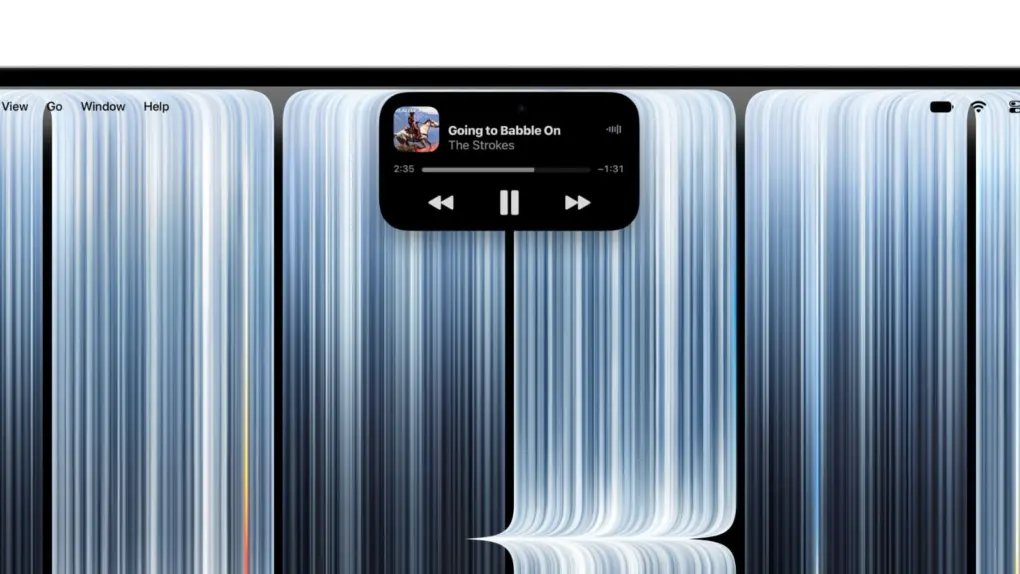
The new MacBook Pro with PROLED XDR Display is the first with a Dynamic Island. The interactive, pill-shaped module is borrowed from the iPhone, but where’s the iPhone’s Face ID? Apple left it out — and some Mac fans are mad.
On the iPhone, the Dynamic Island wraps around the TrueDepth camera that powers Face ID. But not on this pricey MacBook Pro — Touch ID still handles login authentication. Instead of the laptop unlocking magically when users look at it, they will need to give it the finger instead.
MacBook Pro gets Dynamic Island but not Face ID
On the new MacBook Pro, which Apple unveiled Wednesday, the Dynamic Island replaces the familiar screen notch with an interactive hub for notifications, music and Siri. And the laptop’s touchscreen — the first ever on a Mac — makes tapping those controls feel more natural than ever.
Yet even on a laptop costing thousands of dollars, unlocking the machine still requires Touch ID rather than the effortless glance that Face ID offers on the iPhone. The curious omission exposes a weird gap in Apple’s ecosystem: While the company spent years making its devices feel more seamlessly connected, some of its best everyday conveniences remain stubbornly confined to individual products.
At MacBook Pro prices, fans aren’t just asking for a flashy new display. They want the whole experience to feel top of the line. Face ID would offer a more seamless way to unlock a Mac than Touch ID because it authenticates you with a simple glance, without requiring you to touch a button or position a finger correctly.
The redesigned MacBook Pro comes in 14-inch and 16-inch models. On both models, the Dynamic Island replaces the notch from previous MBP models.
Apple says the Dynamic Island is the new home for Spotlight, Live Activities and Siri AI. You can also answer a call or control music. And thanks to the touchscreen, a single tap can accept an AirDrop request or pause a song. (According to Apple’s fine print, Spotlight only works in the Dynamic Island if Siri AI is available and enabled.)
The price makes the omission sting
The MacBook Pro with PROLED XDR Display isn’t a cheap laptop. The 14-inch model with an M5 Pro processor starts at $2,899. The 16-inch version starts at $3,399.
Step up to the M5 Max, and prices start at $4,499 and $4,799 for the 14-inch and 16-inch models. At those prices, it’s easy to see why the lack of Face ID — a premium feature Apple introduced nearly a decade ago with the iPhone X, and has since added to iPad Pro — stings.
The iPhone’s screen notch originally happened because Apple needed a place to put the Face ID hardware. That evolved into the Dynamic Island with the iPhone 14 Pro, turning the useless screen cutout into a handy way to interact with the device.
So, why did Apple omit Face ID from the new MacBook Pro? Likely because the sensor array required for the biometric authentication system is just too large. Face ID depends on a TrueDepth camera system with three modules: a laser that projects a grid of tiny infrared dots onto a user’s face, a flood illuminator that shines infrared light at the face, and an infrared camera that snaps an image of the user, reads the resulting pattern, and generates a 3D facial map, according to Wikipedia.
“The technology that enables Face ID is some of the most advanced hardware and software that we’ve ever created,” Apple says. “The TrueDepth camera captures accurate face data by projecting and analyzing thousands of invisible dots to create a depth map of your face and also captures an infrared image of your face. A portion of your device’s neural engine — protected within the Secure Enclave — transforms the depth map and infrared image into a mathematical representation and compares that representation to the enrolled facial data.”
The laptop’s screen is incredibly thin and likely doesn’t have room for the required hardware.
Some Mac fans want Face ID with that Dynamic Island
Some potential customers balk at paying a premium for a touchscreen and a Dynamic Island without Apple’s facial recognition system.
Complaints started piling up on X immediately after Wednesday’s announcement. (Apple faced a similar backlash when the $1,999 iPhone Duo arrived last month with Touch ID instead of Face ID.)
Many hoped the new MacBook Pro would finally add facial recognition to its arsenal of high-end features. Imagine unlocking your MacBook just by looking at it.
“So let me get this right… @Apple is finally putting a touchscreen on the MacBook Pro,” wrote @MicahBerkley on X. “A feature that no one wanted…. Yet the features that we do want, FaceID, 5G Sim card slot they completely ignore. Apple we’re starting to get tired of you.”
Many called out the MacBook Pro’s lack of Face ID as a missed opportunity.
“I never expected that the first MacBook with official Dynamic Island support would be released alongside the touchscreen version, but it’s a pity that it still doesn’t support Face ID yet,” wrote @safaricheung on X.
Others expressed similar sentiments:
Apple really added the Dynamic Island to the touchscreen MacBook Pro but STILL didn't give it Face ID
This was literally the PERFECT opportunity pic.twitter.com/JDyRqmUf50
— sid (@immasiddx) October 28, 2026
The fact that the new MacBook has still Touch ID instead of Face ID pic.twitter.com/BHnSBnCe8y
— Gianluca Minoprio (@gminoprio) October 28, 2026
Not everyone is bothered by the lack of Face ID on the new MacBook Pro, though. Some forum users still advocate for Touch ID, arguing a deliberate press confirms your intent with a single tap.
And nobody following the rumors should be shocked. Bloomberg’s Mark Gurman previously said Face ID on the Mac remains years away.
If Face ID is a deal-breaker at these prices, the wait continues. The new MacBook Pro is currently up for preorder, and it starts arriving Friday, November 6.

Anurag Chawake is a tech-focused writer specializing in smartphones, apps and consumer technology. His interest in computers began during the Windows 98 era, eventually leading him to explore everything from operating systems to mobile devices and PC hardware. Anurag previously contributed to The Indian Express, covering Apple, Android, gaming and the broader technology landscape.