
After years of rumors, Apple finally appears ready to launch the first folding iPhone. It’ll be the most significant shakeup to the basic design of an iOS device since… well, ever.
There’s no official confirmation of a foldable iPhone, of course. But the rumors are unusually detailed, covering everything from the screen size and hinge design to the processor, cameras and even the phone’s possible name.
Here’s what to expect, when and at what cost.
Apple is ready to make foldables practical
Foldable phones have been around commercially since 2018, when Royole introduced the FlexPai, followed by Samsung, Huawei and others. But Apple stayed out of the market while the technology matured.
Foldable displays brought persistent problems including visible screen creases, fragile hinges, bulky designs and other problems. Apple wanted a device without these, plus its foldable iPhone needs to offer real advantages over conventional models.
The most compelling feature will be display area. Given the leaked specs, the foldable will offer roughly 29 square inches of screen. For comparison, the iPhone 17 Pro Max’s display is 17.9 square inches. So, 40% more screen area in a handset that’s equally portable.
Leaks coming out of Cupertino indicate that Apple particularly focused on eliminating the unsightly screen crease and making the hinge durable. But it also needed to design a handset thin enough to feel like an iPhone while still packing in a large battery and sophisticated cameras.
Read on to see what the folding iPhone rumors indicate about how close Apple got to its design goals.
Table of contents: folding iPhone rumors
- A book-style iPhone that opens into a mini tablet
- Folding iPhone won’t have a big ugly screen crease
- Thinner than you might expect
- Big battery needed
- Powerful A20 chip and plenty of RAM
- Two rear-facing cameras, not three
- Goodbye Face ID?
- Just two casing colors
- MagSafe and wireless charging: Yes
- So… iPhone Ultra? iPhone Fold?
- Folding iPhone price: Prepare yourself
- Folding iPhone is right around the corner
A book-style iPhone that opens into a mini tablet
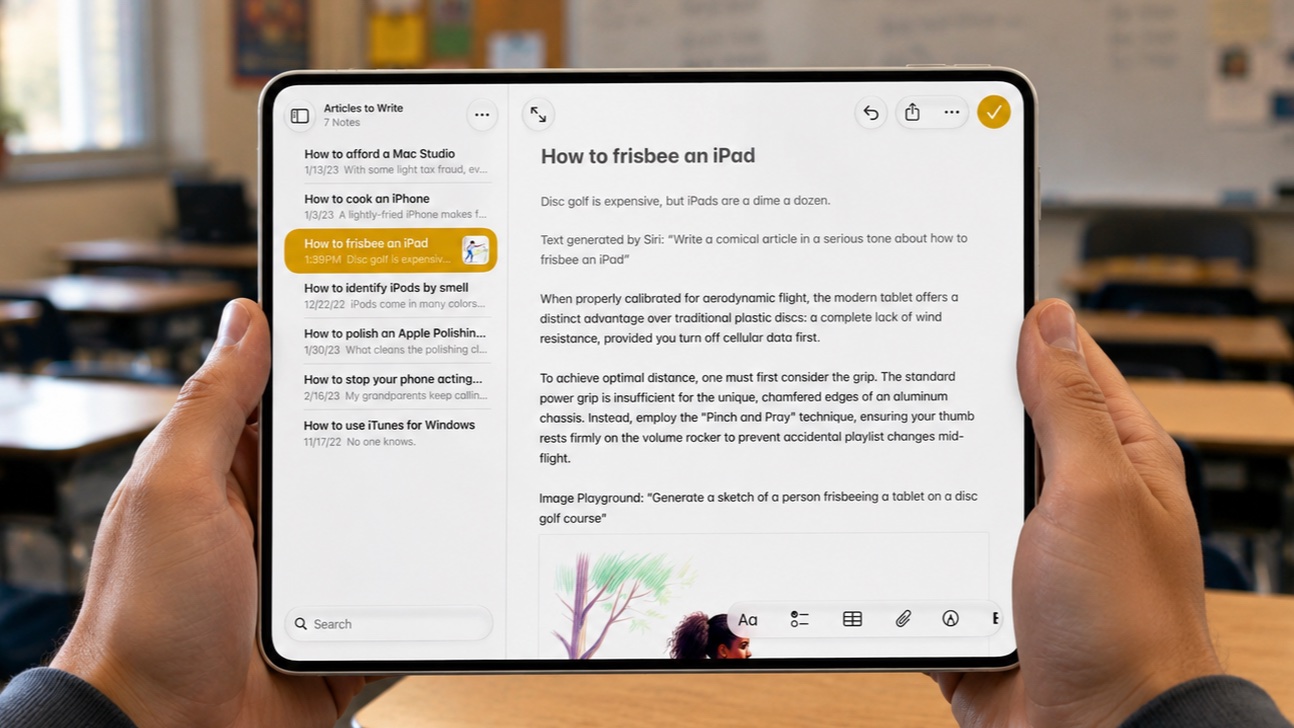
Don’t call the folding iPhone a “flip phone” — leaks show it won’t use the same design as the old Motorola RAZR. Instead, Apple is reportedly going with a book-style in which the smartphone opens into what’s essentially a small iPad. That inner OLED screen could measure around 7.8 inches, giving the iPhone its largest display ever.
With the folding iPhone open, the larger screen’s 4:3 aspect ratio will be much better suited to side-by-side multitasking than the tall, narrow screens found on conventional iPhones. That’s what Apple is also reportedly working on special iOS features to enable displaying two apps side by side as well as iPad-like sidebars in some applications.
To be clear, opening the folding iPhone won’t be necessary to use it. The device is expected to have a roughly 5.5-inch touchscreen on the outside for quick interactions, like checking messages and other notifications.
Folding iPhone won’t have a big ugly screen crease
Folding iPhone concept: D. Griffin Jones/ChatGPT/Cult of Mac
Everyone has surely seen social media posts critical of the very idea of a folding iPhone because they don’t want a handset with an unsightly screen crease down the middle. Apple seems fully aware of that, and isn’t making one.
It held off introducing a foldable until it could get a display panel in which the crease is virtually invisible. The foldable OLED display is expected to use ultra-thin glass and a custom Samsung display process designed to reduce thickness while improving rigidity. It’s likely the same tech used in Samsung’s new model that’s getting very positive reviews.
Apple is also reportedly developing a sophisticated hinge using liquid metal or other advanced materials. The goal is to make the hinge durable while allowing the screen to fold without leaving an obvious permanent crease.
Thinner than you might expect
There’s also pre-launch resistance from people who expect the folding iPhone to be about twice as thick as a traditional model. That’s not what’s going to happen.
“Dummy” units of the device leaked out months ago, and one widely circulated estimate puts it at roughly 4.5mm thick when unfolded and around 9mm to 9.5mm when closed.
For comparison, the current iPhone 17 Pro Max is 8.75mm thick, and the upcoming iPhone 18 Pro Max is rumored to be 9mm thick to make room for a larger battery. So the foldable will be far, far from being twice as thick.
Big battery needed
An unusually large screen pulls more power than a typical handset display. Apple could compensate for the power demands of that display with an unusually large battery. There’ll be two — one on each side of the foldable, and early rumors put the total capacity somewhere around 5,400mAh to 5,800mAh. These will be high-density battery cells to keep the size down.
However, a counter rumor says instead the total will instead be 4,883mAh. While a bit of a comedown, it’s nearly the same as the battery in the Galaxy Z Fold8, which uses a similar design to the folding iPhone.
And remember, keeping the device slim is one of Apple’s priorities.
Powerful A20 chip and plenty of RAM
The folding iPhone will need to be powerful, and will therefore use Apple’s next-generation A20 Pro chip… the same as is going into the iPhone 18 Pro and Pro Max. It will reportedly be manufactured using TSMC’s cutting-edge 2-nanometer process, which will supposedly bring an 18% performance increase and 30% better power efficiency.
Rumors also point to 12GB of RAM, the same as in the current iPhone Pro models. It useful for AI as well as the multitasking features Apple is reportedly developing for the larger internal display.
Two rear-facing cameras, not three
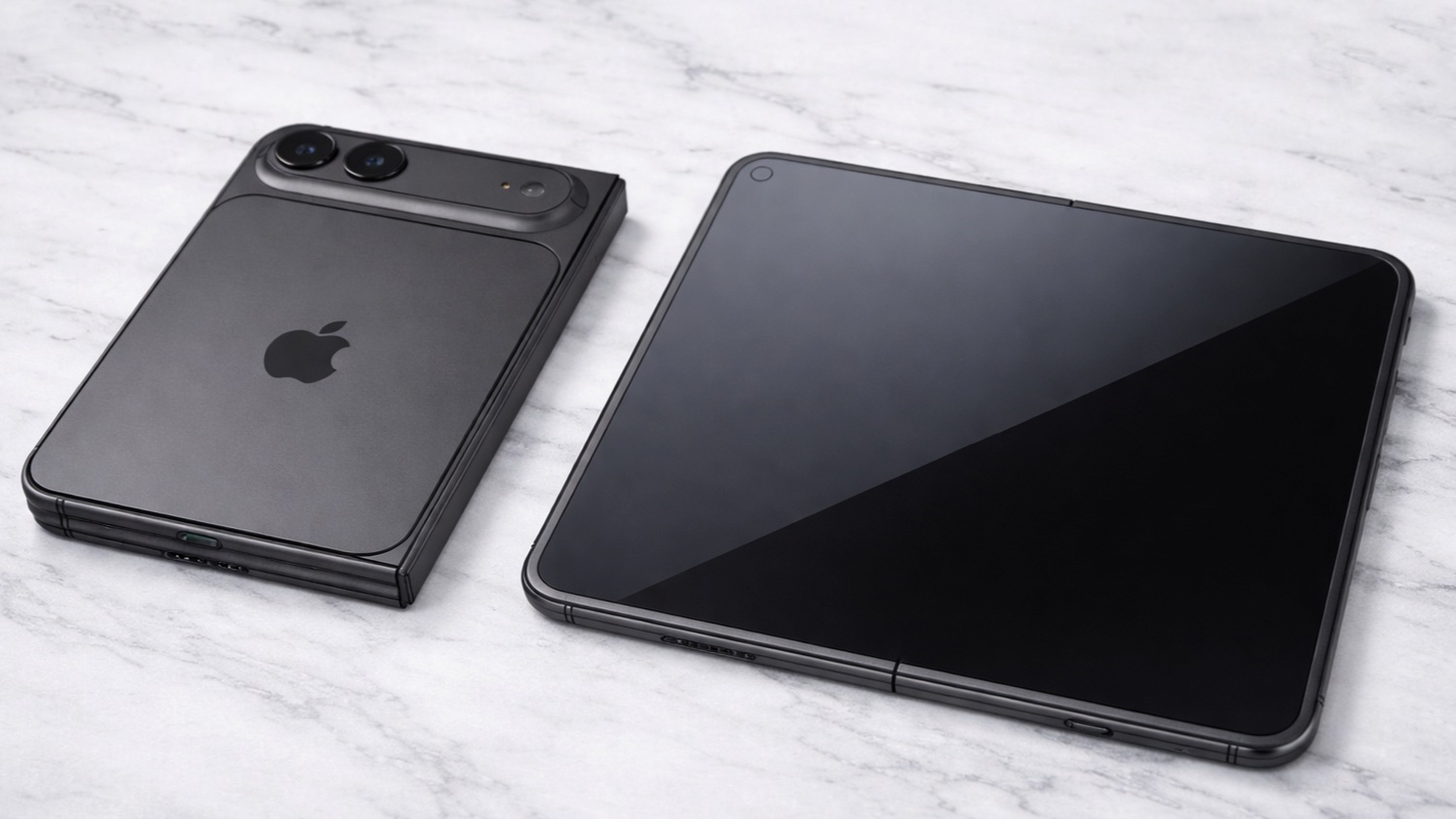
Photo: ChatGPT/Sonny Dickson/Cult of Mac
Industry leaks and supply-chain reports point to a camera array in the iPhone Fold built around space-saving compromises. Most obviously, it is not expected to match the triple-camera setup found in the “Pro” models.
Expect a two-camera rear system with a 48-megapixel main camera next to a 48-megapixel ultrawide. A dedicated telephoto camera reportedly won’t fit into the ultra-thin design.
And speaking of two cameras… rumors suggest there will be separate selfie cameras for the outer screen and the inner folding display. These will apparently be 24MP, like the iPhone 17 series.
Goodbye Face ID?
Speaking of space-saving compromises, the folding iPhone may not have Face ID because the TrueDepth camera system would take up too much valuable space inside an extremely thin device.
If you weren’t aware, Face ID does far more than look at a picture of you. The TrueDepth camera system combines an infrared camera with a dot projector and flood illuminator to create and read a detailed 3D map of the user’s face. There’s apparently no room for all that.
Apple is reportedly considering Touch ID built into the foldable’s side button instead.
Just two casing colors
The latest rumors point to just two launch colors for Apple’s folding iPhone, with white/silver and dark blue looking like the strongest candidates. Earlier reports mentioned a dark gray or black option, but something like indigo now seems more likely.
Expect few color choices because this will be a low-volume, premium product. Producing a foldable is more complicated and expensive than making a conventional iPhone, so limiting the number of colors would simplify manufacturing and inventory management for Apple.
MagSafe and wireless charging: Yes
There were persistent rumors and speculation that the folding iPhone would back MagSafe and wireless charging. It was allegedly another victim of the need to keep the handset very, very slim.
Not so. A recently leak indicates that MagSafe made the cut, which means the foldable will support magnetic stands, wallets, chargers and more.
So… iPhone Ultra? iPhone Fold?
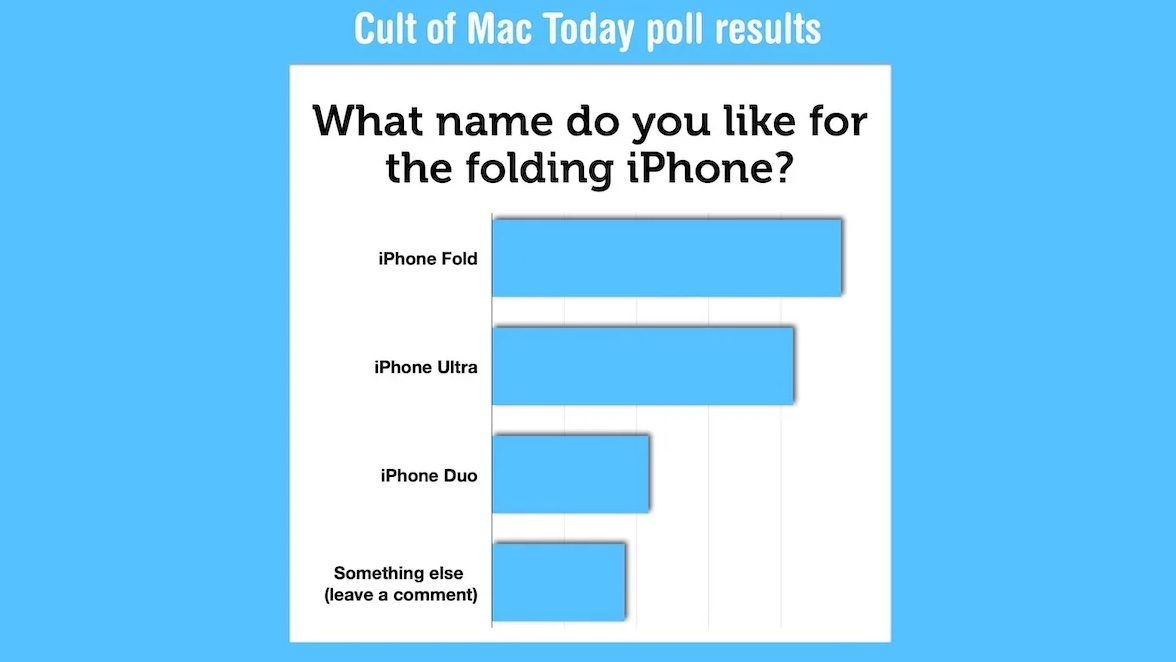
Chart: Cult of Mac
Perhaps the biggest mystery about the folding iPhone is what Apple will call it. There are two strong contenders, and no source deep inside Apple has been able to reveal which is correct.
One of these is iPhone Fold because, well, it’s an iPhone that folds. In a recent poll of Cult of Mac readers, this was the winning option. Problem is, Samsung already uses Galaxy Fold, and Apple may not want its most expensive new iPhone to sound like a copycat of its biggest competitor.
That means the strongest alternative may be the iPhone Ultra. Apple already uses Ultra branding for the Apple Watch and other premium products, and the first folding iPhone certainly qualifies as an Ultra-level device.
Folding iPhone price: Prepare yourself
This device will be packed with premium features, especially that 7.8-inch display, and all that will drive up the price. Analysts’ estimates put the first folding iPhone somewhere between $2,000 and $2,500.
But don’t overreact — this is simply what foldables cost. Samsung’s new Galaxy Z Fold8 starts at $1,900, while the more premium version costs $2,100, for example.
Folding iPhone is right around the corner
Making a folding iPhone was a monumental technical challenge, and there were questions about whether Apple could get the job finished on time for the expected fall 2026 launch. Turns out all that worrying was for nothing, and the device has reportedly been in testing for months.
It’s now widely expected to launch at Apple’s September event on Wednesday, September 9. Pre-orders are likely to begin later next week, and the product should reach customers on Friday, September 18.
After months of rumors, we know the folding iPhone will be announced alongside the iPhone 18 Pro and Pro Max, plus the Apple Watch Series 12. Learn more about these:
- iPhone 18 Pro and Pro Max rumors: What we know about Apple’s next flagship iPhones
- Apple Watch Series 12: Everything we know so far
- Apple Watch Ultra 4 rumors: Everything we know so far

Ed Hardy has been writing full-time about tech for 26 years, and using it for much longer than that. His intro to Apple was a Macintosh SE/30 (which he still has), but now he uses a 13-inch iPad Pro as his primary computer.
That’s because he’s a “tablet first” type of guy. Rather than use a Macbook, he connects a keyboard case to the iPad. And instead of a desktop Mac, he connects his tablet to a 27-inch display and full-size keyboard. (So don’t try to tell him that everyone has to use a Mac to be productive.)
Before coming to Cult of Mac, Ed wrote for NotebookReview, TabletPCReview and Brighthand, as well as other sites.


One response to “Folding iPhone release date and specs — everything we know [Updated]”
You had an earlier article saying MagSafe might make it, but no mention in this article ?