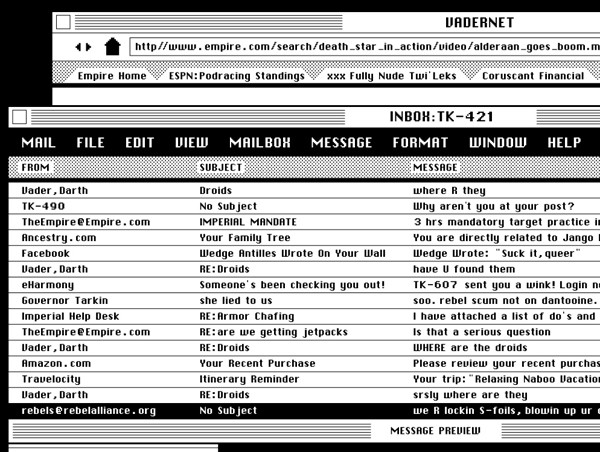
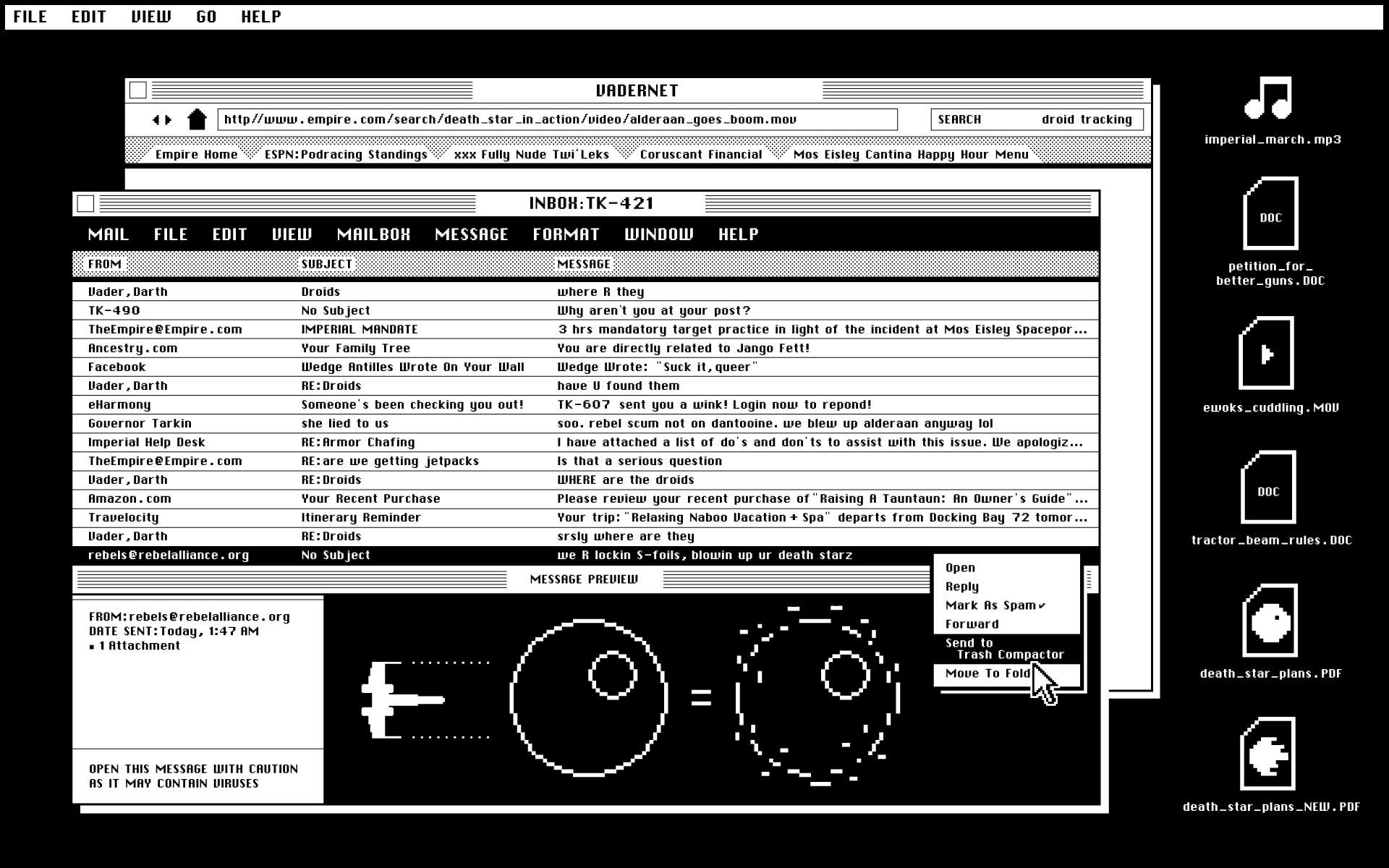
It’s been a good week for Apple-Star Wars Geekdom. News today of a Death Star desktop screenshot, circa Mac System 6 era. TK-421 is not at his post (again), Darth is urgently looking for two lost droids, and spam exists on Vadernet even Far, Far Away.
Kudos to designer Matt Chase for this awesome vintage mockup of a black & white Safari, Mail and the right-click menu option to Move to Trash Compactor. Complete image (1920×1200) available here.
I suspect Darth has a Steve Jobs in Carbonite case on his iPhone, too. Or would that be Han Solo?
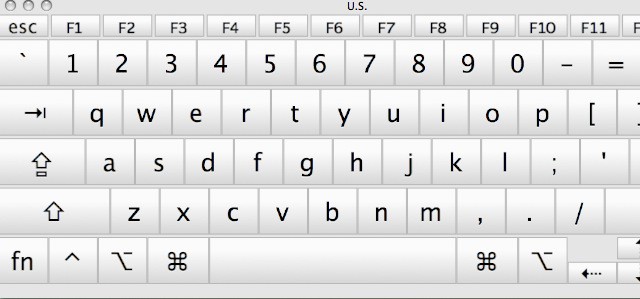
Have you ever needed to insert a special character while typing a document in Mac OS X, but didn’t know how? Apple doesn’t provide an easily accessible way to view which keys generate which characters. Buried in System Preferences though, is a keyboard viewer which will let you figure out which keys give which symbols. This video will show you how to enable this function and use it to discover helpful key combinations.
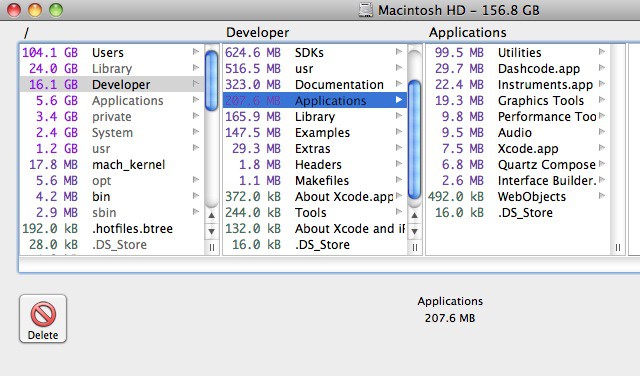
It happens to everyone. Over time, large files will build up on your hard drive and take up space needed for important files, such as photos, music, and the like. It can be frustrating trying to find these files to see if they are of any importance. Enter OmniDiskSweeper, a free utility that solves all those problems. As you’ll see in this video, it’s a handy tool that can help you free up a lot of space.
Is Apple Chief Operating Officer Headed for HP CEO Chair?
Apple Chief Operating Officer, Tim Cook.
From today’s Q2 analyst conference call:
On Steve Jobs: “He is still on medical leave, but we do see him on a regular basis. And as we previously said, he continues to be involved in major strategic decisions. I know he wants to be back full-time as soon as he can.”
On iPad 2: “Demand on iPad 2 has been staggering.”
On Android: “We continue to believe—and even more and more every day—that iPhone’s integrated approach is materially better than Android’s fragmented approach, where you have multiple OSes on multiple devices with different screen resolutions and multiple app stores with different rules, payment methods, and update strategies.”
On Samsung: “We are Samsung’s largest customer. And Samsung is a very valued component supplier to us, and I expect that strong relationship will continue. Separately from this, we felt the mobile communication division of Samsung had crossed the line.”
On Japan: “… there’s aftershocks, there’s still uncertainty about the nuclear plant, there’s power interruptions. If that stays at the level that it is today, I’m not as worried. I would worry if something happened and took a turn for the worst.”
On iPad in education: “… last quarter, we were about a 1:1 ratio of iPads to Macs, which is, I think, amazing given the short life of the iPad. And really demonstrates what kind of opportunity there probably is there.”
And one from Apple’s chief financial officer, Peter Oppenheimer, on iPhone: “We saw stunning iPhone sales.”
Apple released iTunes 10.2.2 today and the new version of iTunes contains a number of important bug fixes. According to Apple these fixes include:
• Addresses an issue where iTunes may become unresponsive when syncing an iPad.
• Resolves an issue which may cause syncing photos with iPhone, iPad, or iPod touch to take longer than necessary.
• Fixes a problem where video previews on the iTunes Store may skip while playing.
• Addresses other issues that improve stability and performance.
iTunes 10.2 came with several new features and improvements, including:
• Sync with your iPhone, iPad, or iPod touch with iOS 4.3.
• Improved Home Sharing. Browse and play from your iTunes libraries with Home Sharing on any iPhone, iPad, or iPod touch with iOS 4.3.
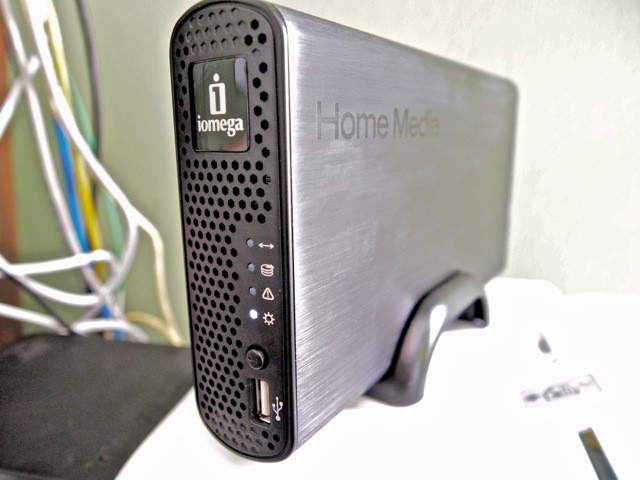
It’s a little admitted secret, but one of the biggest reasons people like Network Attached Storage drives is for Torrent downloads. They’re the easiest ways to download obscure British TV shows, for example, that can’t be easily had here in the U.S. After downloading a couple of shows, users watch them via WiFi streaming on their MacBooks or iPads.
Trouble is, Torrent downloads slow everything on the home network to a crawl. Everyone complains when the network is clogged with Torrents of Shameless or The Killing. Well, not any more. You can set up one of Iomega’s new Home Media Network Hard Drive, Cloud Edition at work and use the office’s net connection to download Torrents at night. Then you stream them over the net to your home.
I’ve been testing one of the Home Media Drives for several weeks. There’s a been a few glitches, but on the whole, it works well. Now I’ve got my own little Amazon S3 system, with none of the monthly fees.
Apple released an update to the Mac OS X Lion Developer Preview 2 last Friday. The update is available to developers that are beta testing Lion via Software Update on the Apple menu. According to the update:
The Lion Developer Preview Update is recommended for all users running Mac OS X Lion Developer Preview 2
The update did not include information on specific fixes or updates. If you’ve discovered something about the update please share your discovery by leaving a comment.
Apple has released the third version of its developer preview for Xcode 4.1. The new update according to Apple:
This is a pre-release version of Xcode 4.1 for both Mac and iOS development. This release requires Mac OS X Lion Developer Preview 2 Update and includes iOS SDK 4.3. Continue to use Xcode 3.2.5 or Xcode 4 on a Snow Leopard partition if you plan to submit Mac or iOS apps to the App Store.
Xcode 4.1 Preview 3 includes these new features:
• Updated to support Mac OS X 10.7 Lion preview 3 and include iOS SDK 4.3
• Improved Assistant editor logic when switching among different file types
• Fixed a bug that prevented indexing of some projects
• Fixed a bug related to nil settings in the Core Data model editor
• Fixed a bug in LLVM GCC 4.2 and LLVM compiler 2.0 for iOS projects
• Additional bug fixes and stability improvements
You can download Xcode 4.1 Developer Preview 3 from Mac Dev Center.
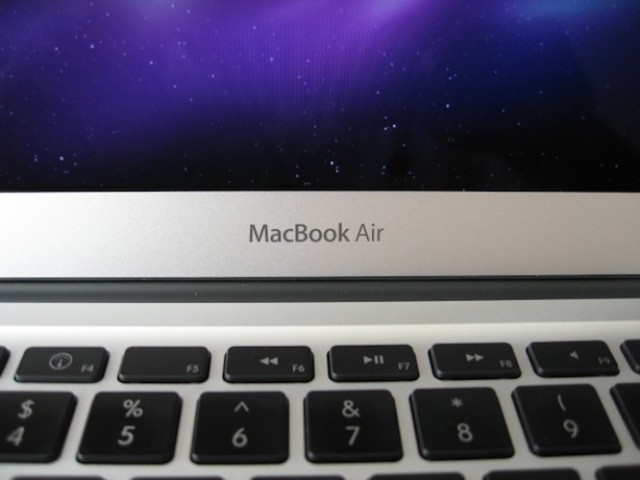
AnandTech is reporting that Apple has appeared to have made some changes to the MacBook Air released in October 2010. The Macbook Air refresh last fall included some welcome surprises for Apple fans — a new 11.6″ form factor, an external case redesign, faster graphics, and larger SSD drives. All of this came at a lower price. The most interesting part of the refresh was the new SSD drives. Apple didn’t use regular 2.5″ or 1.8″ SSDs and instead introduced a whole new type of SSD form factor called mSATA SSDs a.k.a. blade SSDs.
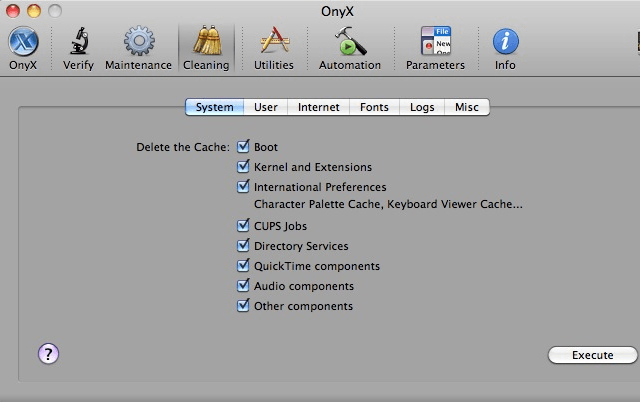
It happens to everyone. After time, your Mac will start to slow down. This can get awfully frustrating, but it’s not the end of the world. The free application OnyX can help your Mac run just like it did the day you bought. With some simple maintenance, your Mac will be just like new! In this video, you can find out how to get Onyx and use it to tune up your system.
MacTech Boot Camp is coming to Dallas next week and is filling up fast, but CultofMac.com readers can get last-minute tickets — plus a $200 discount.
MacTech Boot Camp is an intensive one-day training program for Mac consultants and IT technicians. It boasts more than a dozen sessions covering everything from effective marketing to proper support call technique. There are also sessions on networking, printers, Windows on Mac, security, scripting and command line — plus a bunch more. If you want to get up to speed as an independent Mac consultant, this is the program for you.
The Dallas event is April 27 at the Hyatt Regency DFW.
You can even take an exam to become an Apple certified tech at the show. There’s a study group before a proctored Apple Certification Exam. There’s also a discount for MacTech attendees: take the test for $199 (It’s normally $299).
If you’re not in Texas, no worries. MacTech Boot Camp is a traveling roadshow. There’s a show coming up fast in Boston (May 18 at Royal Sonesta Hotel), followed by Los Angeles (July 27) and Chicago (Aug 31). Attendees can save $200 by registering early.
CultofMac.com is a media partner of MacTech Boot Camp.
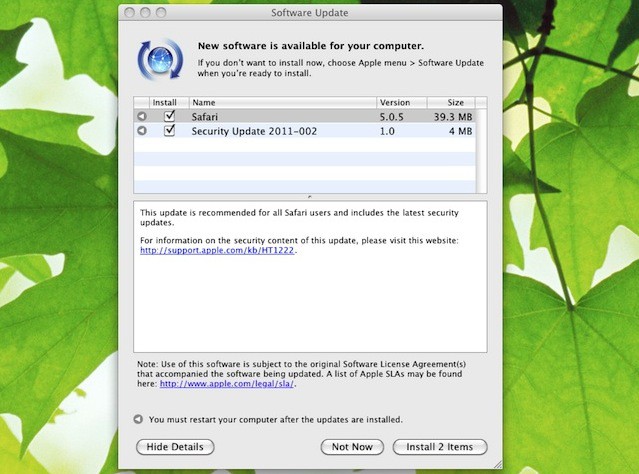
Apple has just released Safari 5.0.5 – an update for Safari on Mac OS X which offers unspecified bug fixes and security updates for Apple’s web browser application.
The release notes read:
This update is recommended for all Safari users and includes the latest security updates.
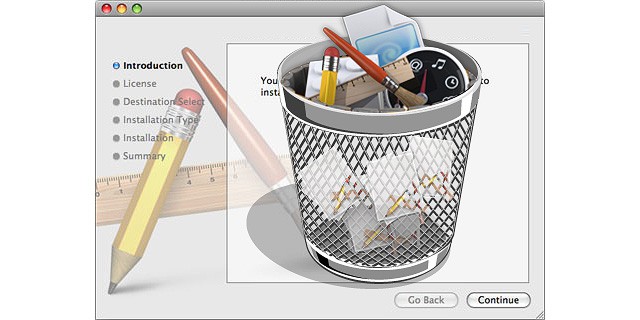
Uninstalling software under Mac OS X is generally a straightforward procedure — just delete the program from the Applications folder. Few vendors offer uninstallers on the Mac, and generally they’re not necessary. Most programs don’t run background components or alter system settings files (like the Registry on Windows), and leaving old preferences and support files on the hard drive generally doesn’t do much harm.
But if you are trying to remove an old or corrupt component, reinstall software to change a serial number, or just free up disk space, removing all components of the old application can be important. These components include the application itself, preferences and support items, and sometimes hidden files or kernel extensions. Anyone who’s had problems installing an Adobe CS application or removing Symantec AntiVirus will appreciate how hard it can be to fully remove old software.
The latest beta version of Safari now features a do-not-track privacy setting to prevent online advertisers from tracking users as they surf the Web.
The tool has been added to the latest version of Safari in Lion, the upcoming update to OS X expected to go public this summer.
Safari is the third major browser to add a do-not-track setting. It joins Microsoft’s Internet Explorer and Mozilla’s Firefox include it, but Google’s Chrome does not — yet.
Google, of course, is one of the web’s biggest online advertisers. It’s also worth noting that Apple offers an in-app advertising program called iAds that competes with other forms of advertising, online and off.
It has got to be the first standup skit ever about OS X’s Software Update. In fact, it’s the first skit I’ve seen from a popular comic about Macs in general, except Sinbad of course. A sign of Apple’s ever-expanding popularity?
I just spent the last hour or so reading the 1996 profile, which Isaacson published when Gates was at the height of his power. Isaacson managed to get full access by persuading Gates it was a shot at winning Time’s Person of the Year. Gates didn’t win, but the profile is a great piece of work. It’s full of personal anecdotes and is psychologically penetrating. Isaacson talked to Gates’ friends, family and colleagues, and paints a rich, detailed portrait. It’s highly readable but also critical of Gates. We can only hope Isaacson does the same thing for Jobs, who has famously resisted biographers so far. As previously reported, Jobs has granted Isaacson full access for iSteve: The Book of Jobs, which is to be published early next year. (I don’t think it’s fair, but columnist Michael Wolff says Isaacson is a social-climbing sycophant).
Here’s a taste of the Gates piece:
When Gates decided to propose to Melinda in 1993, he secretly diverted the chartered plane they were taking home from Palm Springs one Sunday night to land in Omaha. There Buffett met them, arranged to open a jewelry store that he owned and helped them pick a ring. That year Gates made a movie for Buffett’s birthday. It featured Gates pretending to wander the country in search of tales about Buffett and calling Melinda with them from pay phones. After each call, Gates is shown checking the coin slot for loose change. When she mentions that Buffett is only the country’s second richest man, he informs her that on the new Forbes list Buffett had (at least that one year) regained the top spot. The phone suddenly goes dead. “Melinda, Melinda,” Gates sputters, “you still there? Hello?”
Okay, this is sorta creepy — and if you aren’t aware of this little fact by now, you should be: Unless you’ve adjusted the settings to turn this feature off, every time you snap a photo with your iPhone it embeds data with your exact location in the image file. This data, called a geotag, can be easily read using easily available software by anyone who has access to your images online (btw, contrary to what the folks at NBC say, it’s not new technology; the ability to geotag photos has been around since at least the first iPhone to include GPS, the 3G).
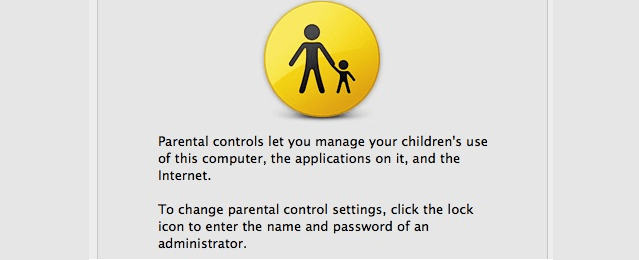
As a parent, it is always important to keep tabs on what your children are doing on the computer. Whether it’s the sites they are visiting, the amount of time they spend online, or even what applications they are using, Mac OS X can cover it. OS X includes a set of parental controls that can be tweaked to anyone’s liking. In this video, you will see how to set up parental controls and use the features that work best for you.
This is a guest post by Paul Lamere, an executive at The Echo Nest, a music intelligence company located in Somerville, Mass. It was originally published here.
For the last year we’ve heard rumors of how both Apple and Google were getting close to releasing music locker services that allow music listeners to upload their music collection to the cloud giving them the ability to listen to their music everywhere.
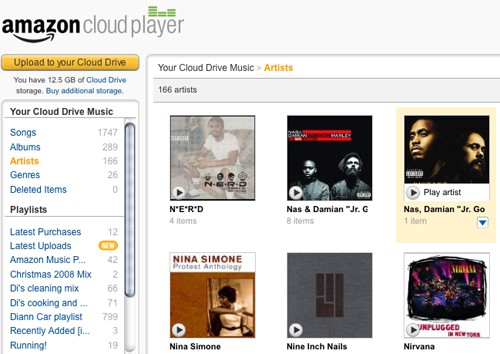
So it was a big surprise when the first major Internet player to launch a music locker service wasn’t Google or Apple, but instead was Amazon. Last week, with little fanfare, Amazon released its Amazon Cloud Drive, a cloud-based music locker that includes the Amazon Cloud Player allowing people to listen to their music anywhere.
Amazon’s entry into the music locker is a big deal and should be particularly worrisome for Google and Apple. Amazon brings some special sauce to the music locker world that will make them a formidable competitor:
If you are a recent Mac switcher, there is a good chance that there are some Windows applications that you still may want to use. If so, Virtual Box is a great application to let you do this. In this video, you will se how to get virtual box, install an operating system, and run Windows apps side by side with your OS X apps.
Have you ever needed to move Microsoft Word documents between your Mac at home and your PC at work, but you just didn’t know how, or if it was even possible? Once you know what to do, it is a relatively simple and straightforward process that requires nearly no effort. Find out what to do in this video.
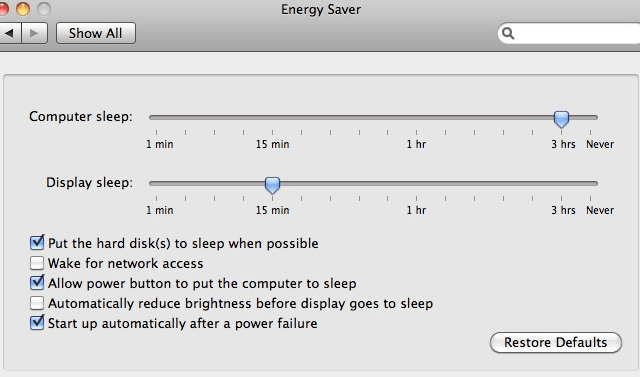
Have you ever found yourself thinking that your Mac takes too much power or that your MacBook battery is draining too quickly? If you have, you’ll want to check out this video. In it, I’ll show you some of the best, yet most overlooked options for saving energy on your Mac.
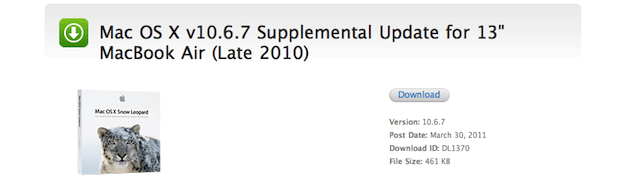
The release of Mac OS X 10.6.7 isn’t even two weeks old and Apple has issued a supplemental update that patches the latest OS release. The patch fixes problems encountered by late 2010 13-inch MacBook Air users who upon launching iTunes experienced crashes that left their computers completely frozen and unresponsive.
I even experienced it myself before the problem mysteriously disappeared after forcing the machine to restart by powering it off and then on again. Since then I haven’t had a problem, but for some the problem persists. Luckily Apple has a fix.
According to Apple:
This update addresses an issue that makes the system unresponsive when using iTunes. It is recommended for all 13″ MacBook Air (Late 2010) users running Mac OS X v10.6.7.
You can grab this update via Software Update on your Mac or download it directly via this support page.
Ten years ago Apple bestowed a new operating system unto the world, Mac OS X. A merger of NeXTStep and the Classic Mac OS, OS X finally delivered Apple’s first major evolution in OS design after a half decade of failed attempts: Taligent, Copland, Rhapsody…
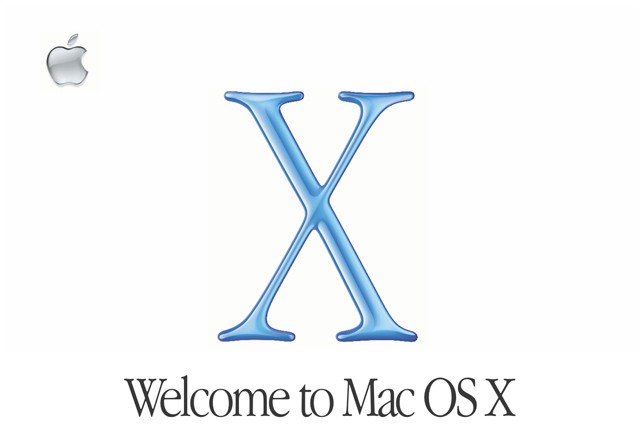
To teach new users how to use its new creation, for a few years Apple included an explanatory brochure titled Welcome to Mac OS X with every copy. These booklets provided a helpful introduction to the new OS. In honor of the tenth anniversary of OS X, here’s a look back at how Apple described things in 2001.
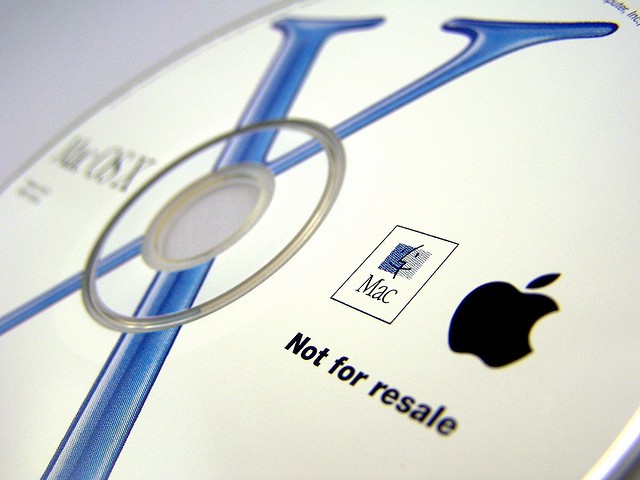
The instal disk for Max OS X. Photo by malagent: http://www.flickr.com/photos/49368060@N00/2310215514/
Mac OS X celebrates its tenth birthday today. The groundbreaking operating system was introduced to the public on March 24, 2001. Mac OS X helped reverse Apple’s fortunes in the desktop PC market, and has underpinned a lot of Apple’s subsequent success. Most importantly, it spawned iOS, which runs today’s iPads and iPhones.
Below is the story of how OS X’s game-changing interface came about. The story gives some insight into corporate creativity at Apple. OS X’s interface started as a side project. But as soon as Steve Jobs got wind of it, it was fast-tracked. Jobs became intimately involved in its development — a scary prospect for the programmers working on it.
But the struggle wasn’t just in its development. Apple had to nail the switch from the old Mac OS to the new, or it could have sunk the company. Guess which ally was crucial to the transition — Apple’s old enemy, Microsoft.
With the launch of OS X, Jobs finally took the title of Apple’s permanent CEO. Prior to that he’d been the interim CEO, or iCEO, and OS X was the last major part of the company he needed to fix.