Leander has been reporting about Apple and technology for nearly 30 years.
Before founding Cult of Mac as an independent publication, Leander was news editor at Wired.com, where he was responsible for the day-to-day running of the Wired.com website. He headed up a team of six section editors, a dozen reporters and a large pool of freelancers. Together the team produced a daily digest of stories about the impact of science and technology, and won several awards, including several Webby Awards, 2X Knight-Batten Awards for Innovation in Journalism and the 2010 MIN (Magazine Industry Newsletter) award for best blog, among others.
Before being promoted to news editor, Leander was Wired.com's senior reporter, primarily covering Apple. During that time, Leander published a ton of scoops, including the first in-depth report about the development of the iPod. Leander attended almost every keynote speech and special product launch presented by Steve Jobs, including the historic launches of the iPhone and iPad. He also reported from almost every Macworld Expo in the late '90s and early '2000s, including, sadly, the last shows in Boston, San Francisco and Tokyo. His reporting for Wired.com formed the basis of the first Cult of Mac book, and subsequently this website.
Before joining Wired, Leander was a senior reporter at the legendary MacWeek, the storied and long-running weekly that documented Apple and its community in the 1980s and '90s.
Leander has written for Wired magazine (including the Issue 16.04 cover story about Steve Jobs' leadership at Apple, entitled Evil/Genius), Scientific American, The Guardian, The Observer, The San Francisco Chronicle and many other publications.
He has a diploma in journalism from the UK's National Council for the Training of Journalists.
Leander lives in San Francisco, California, and is married with four children. He's an avid biker and has ridden in many long-distance bike events, including California's legendary Death Ride.
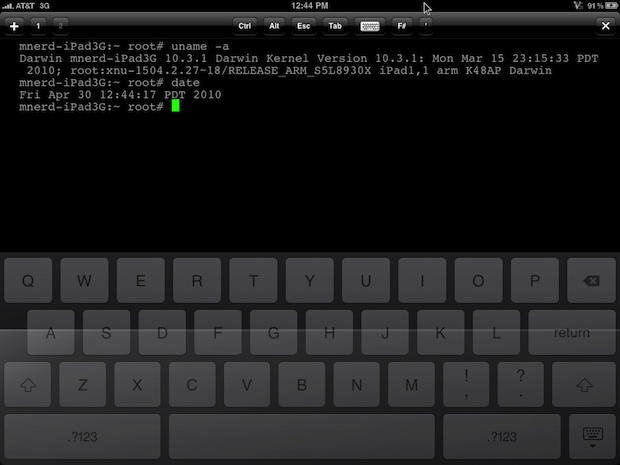
MuscleNerd used the “Spirit” jailbreak, an software tool that promises untethered unlocking of Apple’s recent devices (iPhone 3GS, iPod Touch 3G, and iPads). The Dev Team has promised to release Spirit to the public soon. In preparation, be sure to backup your SHSH Blobs. You can find a step-by-step guide from Redmond Pie here.
Here is MuscleNerd’s video showing Cydia running on an iPad 3G.
The first thing you’ll want to do on your brand new iPad 3G is sign up for a data plan. It’s pretty easy, and you can do it right on the iPad. It’s basically half-a-dozen finger taps (except for typing in your credit card number of course).
I’m waiting here like a kid at Christmas, pulling the curtains, hoping to see the UPS Fed-Ex truck outside. Some of you guys on the east coast may have got yours by now. Let us know in the comments. And send us pictures; we’ll post them.
It was a Brian J. Hogan, a 21-year-old resident of Redwood City, California, who found Apple’s iPhone in a bar, according to Wired.com.
He now regrets not trying harder to contact Apple, and sold the phone to Gizmodo because they told him “there was nothing wrong in sharing the phone with the tech press,” according to a statetment provided by his attorney to Wired.com.
Hogan has been interviewed by law enforcement investigators but has not been charged with a crime. His attorney says he is willing to cooperate with authorities…
… The person who found the phone “is very definitely one of the people who is being looked at as a suspect in theft,” San Mateo County Chief Deputy District Attorney Stephen Wagstaffe told Wired.com Wednesday. “Assuming there’s ultimately a crime here. That’s what we’re still gauging, is this a crime, is it a theft?”
… A friend of Hogan’s then offered to call Apple Care on Hogan’s behalf, according to Hogan’s lawyer. That apparently was the extent of Hogan’s efforts to return the phone.
John Stewart on The Daily Show rips Apple a new one for going Big Brother on Gizmodo:
“Apple – you guys were the rebels, man, the underdogs. People believed in you. But now, are you becoming the man? Remember back in 1984, you had those awesome ads about overthrowing Big Brother? Look in the mirror, man! …It wasn’t supposed to be this way – Microsoft was supposed to be the evil one! But you guys are busting down doors in Palo Alto while Commandant Gates is ridding the world of mosquitoes! What the fuck is going on?!
…I know that it is slightly agitating that a blog dedicated to technology published all that stuff about your new phone. And you didn’t order the police to bust down the doors, right? I’d be pissed too, but you didn’t have to go all Minority Report on his ass! I mean, if you wanna break down someone’s door, why don’t you start with AT&T, for God sakes? They make your amazing phone unusable as a phone! I mean, seriously! How do you drop four calls in a one-mile stretch of the West Side Highway! There’re no buildings around! What, does the open space confuse AT&T’s signal?!
…Come on, Steve. Chill out with the paranoid corporate genius stuff. Don’t go all Howard Hughes on us.”
Hewlett-Packard is buying Palm for $1.2 billion, the company has announced. Of all the potential suitors, I don’t think HP was mentioned as a candidate. Looks like HP will be making smartphones running Palm’s WebOS, which it may or may not rebrand. The company currently makes Windows Mobile smartphones and PDAs. Looks like it wants to manage its own hardware and software, à la Apple.
Palm CEO Jon Rubinstein is expected to carry on, the HP statement says. Minor note: Rubinstein started his career at HP before working for Steve Jobs at NeXT and then Apple.
Police have identified and interviewed the person who found Apple’s iPhone 4G at a bar, the San Jose Business Journal reports.
Also, it looks like Gray Powell, the engineer who lost the iPhone at the bar, and an Apple lawyer reported it as a theft. However, the District Attorney still hasn’t determined whether the case is a crime.
Investigators said they have identified and interviewed the person who took the phone from the Gourmet Haus Staudt on March 18 after it was left there by Apple engineer Gray Powell following a birthday celebration. Officials were unable to tell the Business Journal whether that person, whose name has not been released, was the same person who eventually sold the phone to tech Web site Gizmodo.com. […]
Wagstaffe said that an outside counsel for Apple, along with Apple engineer Powell, called the District Attorney’s office on Wednesday or Thursday of last week to report a theft had occurred and they wanted it investigated.
Another piece of the iPhonegate puzzle has fallen into place. It’s been officially revealed for the first time that Apple reported it’s iPhone 4G protoype as “stolen,” not lost, according to the Wall Street Journal:
Stephen Wagstaffe, the chief deputy district attorney for San Mateo County, said Apple contacted authorities and “advised us there had been a theft,” which led to the search warrant and an investigation.
Until now, it’s been rumored that Apple considered the iPhone stolen — but hasn’t been officially confirmed. The distinction, of course, is crucial. If authorities conclude the iPhone was stolen, Gizmodo may be on the hook for buying stolen property. If the iPhone was lost, Gizmodo may be in the clear. However, under California law, a lost item that isn’t properly returned to its owner may also sometimes be considered stolen.
The authorities themselves don’t seem to have reached a conclusion yet. It is still unclear if they are investigating Gizmodo or the person who sold Gizmodo the phone. CNet spoke to the San Mateo District Attorney , reporting that it “has not been able to confirm whether the felony investigation is targeting Gizmodo staff, the iPhone seller, or someone else.”
If the authorities conclude that Gizmodo bought stolen property, staff may face up to a year in prison. But if police and the District Attorney are pursuing the seller, the raid on Gizmodo editor Jason Chen’s home may not have been warranted. Gizmodo may be protected under California shield laws, which prohibit judges from issuing search warrants against editorial publications, including online news sites. Techcrunch reports that the investigation has been “paused” while authorities decide whether Gizmodo is shielded or not.
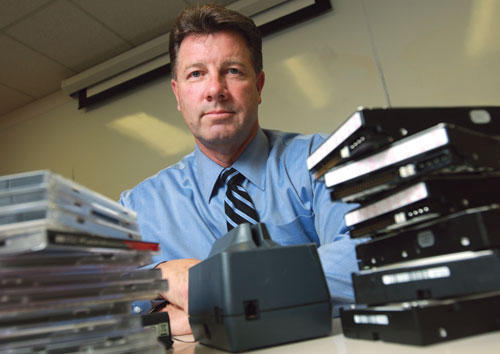
David Hendrickson heads the Rapid Enforcement Allied Computer Team, the police task force that ordered a raid on Gizmodo editor Jason Chen. Picture: San Jose Business Journal:
Apple sits on the steering committee of the special police task force investigating iPhonegate, Yahoo News reports, raising the possibility that the company may have had a hand in the raid of Gizmodo editor Jason Chen’s house.
Friday’s police raid on Chen’s apartment was ordered by Rapid Enforcement Allied Computer Team (REACT) task force, which is commissioned to investigate high-tech crimes. Apple is a member of the task force’s steering committee.
Apple is one of the 25 companies that sit on REACT’s “steering committee.” Which raises the question as to whether Apple, which was outraged enough about Gizmodo’s $5,000 purchase of the lost iPhone for CEO Steve Jobs to reportedly call Gawker Media owner Nick Denton to demand its return, sicked its high-tech cops on Chen.
The San Mateo District Attorney’s office said the task force is investigating a “possible theft,” but wouldn’t say whether the target is Gizmodo or the person who found the iPhone in a bar and sold it to the site.
Yahoo News notes that the task force has investigated other cases in response to requests by committee members, including Symantec, Microsoft and Adobe.
“In either case, it’s hard to imagine — even if you grant that a theft may have occurred under California law, which requires people who come across lost items to make a good-faith effort to return them to their owner — how the loss of a single phone in a bar merits the involvement of an elite task force of local, state, and federal authorities devoted to “reducing the incidence of high technology crime through the apprehension of the professional organizers of large-scale criminal activities,” as the REACT website motto characterizes its mission.
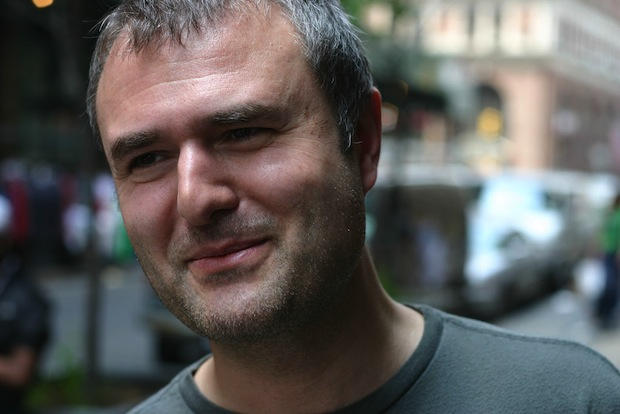
Gizmodo’s publisher Nick Denton is not likely to back down to Apple or the police, says a publishing industry executive who has followed Gawker closely for years.
Denton, who owns Gizmodo’s parent company, Gawker Media, relishes a fight in the courts, says the executive, who asked not be named.
The seizure of Gizmodo editor Jason Chen’s computers is illegal, says Gawker Media, the parent company of the blog.
As a journalist, Chen is legally protected from divulging his sources of a story: in this case, details of Apple’s 4G iPhone, which Gizmodo purchased after an Apple engineer left a prototype in a bar. Gawker says the authorities are not allowed to search his computers in pursuit of a suspect, presumably the person who sold Gizmodo the iPhone.
Gawker cites section 1524(g) of the California Penal Code protecting journalists’ sources. It further cites O’Grady v. Superior Court, which extends the protections to online journalists. The O’Grady case is another Apple case, but one that the company lost. Apple tried to force Jason O’Grady to divulge his sources after his PowerPage website published details of another product Apple was working on.
Wow. Silicon Valley police have seized several computers belonging to Jason Chen, the Gizmodo editor who detailed Apple’s iPhone 4G prototype for the site.
California’s Rapid Enforcement Allied Computer Team entered editor Jason Chen’s home without him present, seizing four computers and two servers. They did so using a warrant by Judge of Superior Court of San Mateo. According to Gaby Darbyshire, COO of Gawker Media LLC, the search warrant to remove these computers was invalid under section 1524(g) of the California Penal Code.
Gawker says the seizure of Chen’s computers is illegal. As a journalist, he is legally protected from divulging his sources, and authorities are not allowed to search his computers in pursuit of a suspect (presumably they’re after the identity of the person who sold Gizmodo the iPhone).
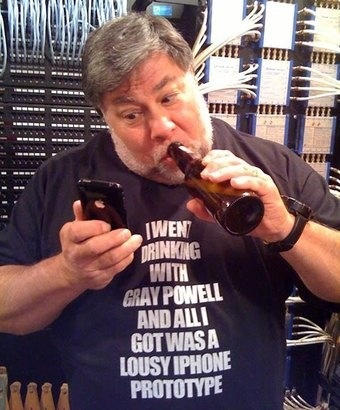
Here’s a interesting story about secrecy and making mistakes at Apple. The story is told by Woz, Apple employee number one (check out his hilarious shirt).
While Woz was waiting in line to buy the iPad last month, an Apple test engineer showed him a prototype iPad. It was just a few hours before the device went on sale. Woz, who is still an Apple employee, fired up the Numbers app. Little did he know, the unit was 3G test prototype, and was not to be shown or used outside of secure areas at the company HQ. Unfortunately, Woz’s playing with it must have somehow sent up a warning flag at Apple.
“… I can tell you that the test engineer who showed me an iPad after midnight, for 2 minutes, during the iPad launch was indeed fired. I opted to spend 2 minutes with Numbers on this iPad, trying some stunts I’d seen on Apple’s website demo video. I was not told that it was a 3G model and I had no way to know that. I was told that this engineer had to wait until midnight to show it outside of Apple’s secure area. And I’m an Apple employee who he was showing it to. My guess is that he was allowed to take the iPad outside of the secure area but still not supposed to show it.”
The test engineer was fired for betraying Apple’s ironclad rules on secrecy. The device was not to be shown to anybody — not even Woz. (And worse, Woz told Steve Jobs about seeing the iPad that night. Jobs himself said it was “no big deal.”)
On the other hand, Gray Powell, the Apple engineer who lost an iPhone 4G prototype at a bar, is still employed at Apple.
“Product secrecy is good for Apple and should be strictly enforced, but maybe 10% of niceness and 90% of strictness is OK too,” writes Woz.
It seems mistakes are forgiven, but betrayals are not.
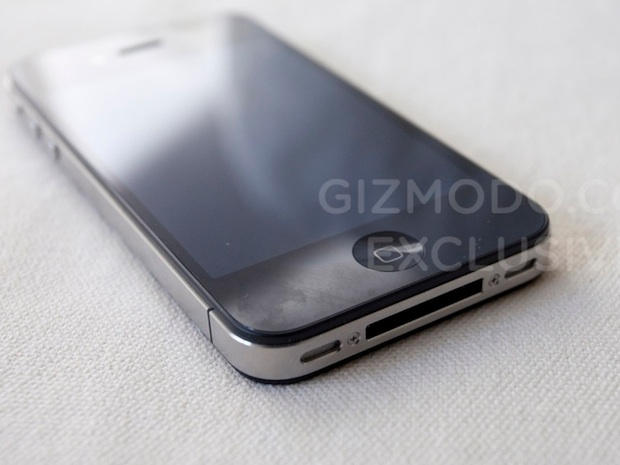
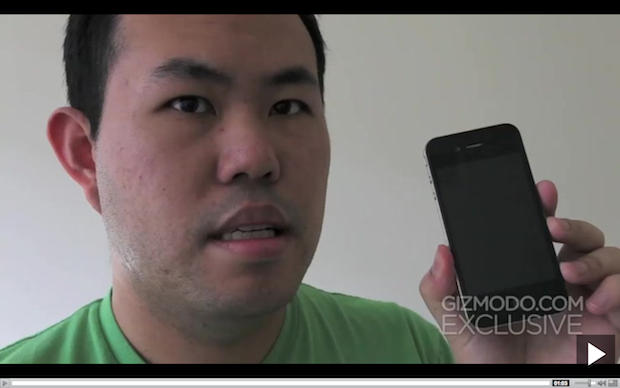
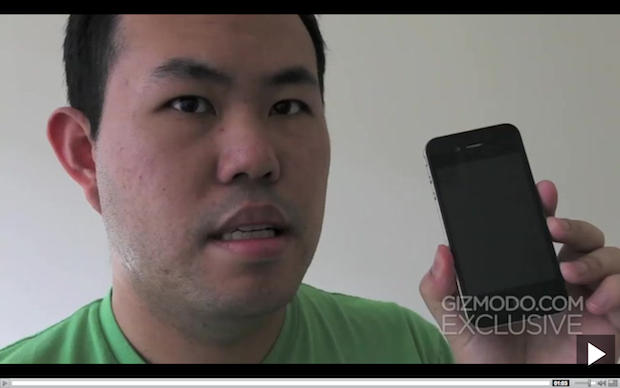
Gizmodo's Jason Chen with a prototype of Apple's iPhone 4G, which the site bought for $5,000 after it was left in a bar. The cops are now investigating.
There’s another juicy wrinkle in iPhonegate. The Silicon Valley cops are investigating, reports CNet:
Silicon Valley police are investigating what appears to be a lost Apple iPhone prototype purchased by a gadget blog, a transaction that may have violated criminal laws, a law enforcement official told CNET on Friday.
Apple has spoken to local police about the incident and the investigation is believed to be headed by a computer crime task force led by the Santa Clara County district attorney’s office, the source said. Apple’s Cupertino headquarters is in Santa Clara County, about 40 miles south of San Francisco.
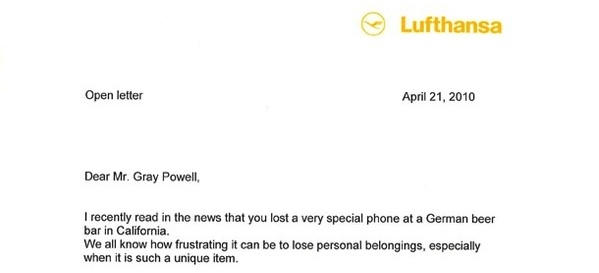
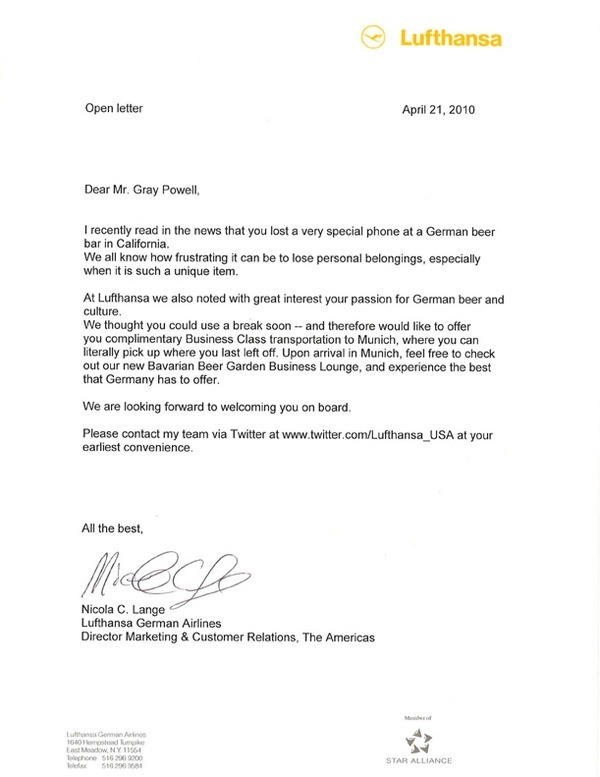
The German airline Lufthansa is offering a free flight to Germany to Gray Powell, the unfortunate Apple employee who lost a prototype iPhone 4G.
Powell lost the prototype iPhone in a German beer garden in Redwood City. It ended up being sold to Gizmodo and became the biggest tech story in recent memory, catapulting Powell into unwelcome notoriety. To make him feel better, the airline is offering to fly Powell to Munich on Business Class, and wants him to check out their new Bavarian Beer Garden Business Lounge.
“We though you could use a break soon,” said the airline’s open letter to Gray, posted to the company’s Twitter account. “And therefore would like to offer you complimentary Business Class transportation to Munich, where you can literally pick up where you last left off.”
As the focus of iPhonegate shifts to the legality of Gizmodo’s purchase (hint: it looks very dodgy), we have to ask: who would you rather be right now? The poor schlub who lost the iPhone in a bar? Or the guy who found it, made a half-hearted effort to return it, and sold it to a ferociously-competitive tech website, which may be on the wrong side of the law?
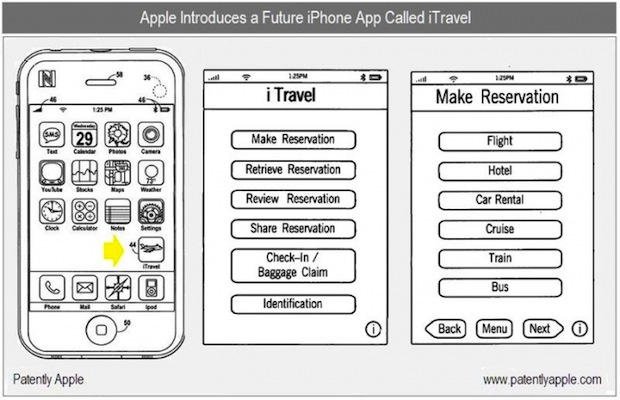
Apple has filed a very interesting patent for a travel app called iTravel that books flights, hotels and car reservations. But the most interesting part is how it uses a radio chip to check you in at the airport, whisk you through security and allows you to wireless board your flight.
The iTravel app uses Near Field Communications, a short-range wireless technology that is starting to become widely used in cell phones for mobile ticketing, payment and electronic keys, especially in countries like Japan.
Apple is rumored to be adding NFC chipset to the next iPhone. If so, it could turn the iPhone into an electronic wallet, allowing you to for everything, from a cup of coffee to a subway ride. Your iPhone could unlock your car, pick up e-coupons at the local mall, and pay for all your supermarket groceries just by laying it on top of the checkout.
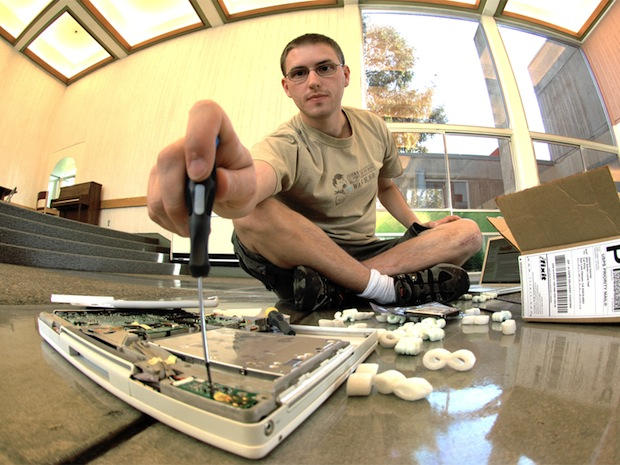
iFixit is famous for its authorative Apple product teardowns. I just emailed the CEO, Kyle Wiens, with some questions about Gizmodo’s teardown. Here’s Kyle’s take:
Gizmodo emailed me asking the same thing.
I asked them why they didn’t remove the (very removable) EMI shields.
It’s closer to production than I was expecting. I’d say this thing is very very close.
What sucks for Apple is if they have to cut features for some reason. Of course the prototypes would have all the features they’re considering (flash, camera, etc.). But realities force feature removal at the last minute, like they did with the iPod Touch. I’m sure the iPod Touch prototypes had cameras in them.
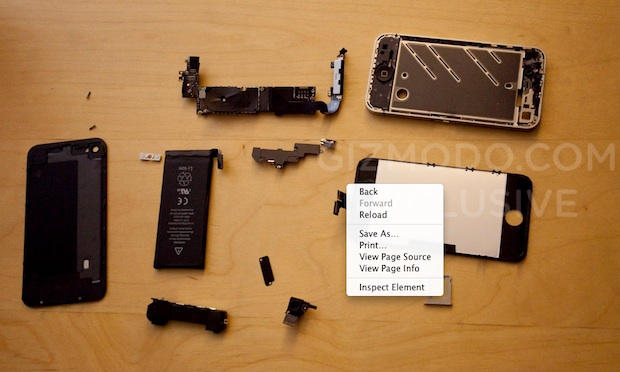
Before returning the iPhone it bought from a guy in a bar for $5,000, Gizmodo performed a teardown. It has just published the results. Unfortunately, it’s pretty uninformative. The teardown reveals the iPhone has a much bigger battery (19% larger), while the rest of the components are much smaller to make room.
The big question — whether the new iPhone runs Apple’s A4 chip — is unanswered because Apple bonded a non-removable metal plate over the motherboard.
The main logic board is one very weird piece of this puzzle… Unfortunately for us, Apple intends to keep this a secret. There are no markings on the board, but even so, the board was encased in metal all around so nothing could get through and would be very difficult to remove without breaking the device. Anyone trying to take this part off the phone would damage the device irreparably. On top of this metal, there was a thermal paste-like material. And on top of that, black tape. They really didn’t want people looking inside.
Obviously, Apple was afraid of this device falling into the wrong hands, which is exactly what happened. One clue whether it runs the A4 is the smaller circuitry. The A4 is a system-on-a-chip, which would require less supporting components.
Apple’s executives dropped several references to “extraordinary” new products during the Q2 conference call, but unfortunately gave little clue what they might be.
Indeed, one Wall Street analyst asked if they were entirely new products, or upgrades to current products.
Peter Oppenheimer, Apple’s CFO responded: “We’re just not going to help our competitors (by talking),” he said.
But he added: “We’re very confident in our product pipeline and very excited about coming months.”
The conference call references reiterate Steve Jobs’ Q2 press release: “… we have several more extraordinary products in the pipeline for this year,” Jobs said.
Apple is sweeping up PC switchers and new iPhone users by the millions.
Take the 8.75 million iPhones Apple sold in the March quarter. Add them to the 42.4 million sold at the end of the last quarter. That makes 51.15 million iPhones sold to date. That’s a lot of iPhone users.
Also consider that half of the Macs sold in the quarter from Apple stores were to people who have never owned a Mac.
The March quarter was Apple’s best ever for iPhone sales, racking up more than double the number of units sold in the same quarter last year. Mac unit sales are up 33 percent. Apple is projecting similar numbers for the next quarter.
And there’s no end in sight. On the analyst conference call right now, Apple COO Tim Cook is talking about increased retail distribution points (like Radio Shack) and the massive growth opportunities in China. And all this during a recession.
Apple has settled claims with state regulators who allege the company mishandled electronic waste. Photo: Thomas Dohmke
Apple has just reported record earnings for Q2 2010. Earnings and profits were the best ever for a non-holiday quarter, and sales of Macs and iPhones were up by a big margin. The only blip is iPod sales — down 1 percent year-on-year.
“We’re thrilled to report our best non-holiday quarter ever, with revenues up 49 percent and profits up 90 percent,” said Steve Jobs in a statement. “We’ve launched our revolutionary new iPad and users are loving it, and we have several more extraordinary products in the pipeline for this year.”
Highlights:
Q2 2010 revenue = $13.50 billion
Profit = $3.07 billion, or $3.33 per diluted share. (Last year, revenue = $9.08 billion and profit = $1.62 billion)
Gross margin = 41.7 percent, up from 39.9 percent last year
2.94 million Macs sold (up 33 percent year-on-year)
8.75 million iPhones sold (up 131 percent year-on-year)
10.89 million iPods sold (down one percent year-on-year)