Leander has been reporting about Apple and technology for nearly 30 years.
Before founding Cult of Mac as an independent publication, Leander was news editor at Wired.com, where he was responsible for the day-to-day running of the Wired.com website. He headed up a team of six section editors, a dozen reporters and a large pool of freelancers. Together the team produced a daily digest of stories about the impact of science and technology, and won several awards, including several Webby Awards, 2X Knight-Batten Awards for Innovation in Journalism and the 2010 MIN (Magazine Industry Newsletter) award for best blog, among others.
Before being promoted to news editor, Leander was Wired.com's senior reporter, primarily covering Apple. During that time, Leander published a ton of scoops, including the first in-depth report about the development of the iPod. Leander attended almost every keynote speech and special product launch presented by Steve Jobs, including the historic launches of the iPhone and iPad. He also reported from almost every Macworld Expo in the late '90s and early '2000s, including, sadly, the last shows in Boston, San Francisco and Tokyo. His reporting for Wired.com formed the basis of the first Cult of Mac book, and subsequently this website.
Before joining Wired, Leander was a senior reporter at the legendary MacWeek, the storied and long-running weekly that documented Apple and its community in the 1980s and '90s.
Leander has written for Wired magazine (including the Issue 16.04 cover story about Steve Jobs' leadership at Apple, entitled Evil/Genius), Scientific American, The Guardian, The Observer, The San Francisco Chronicle and many other publications.
He has a diploma in journalism from the UK's National Council for the Training of Journalists.
Leander lives in San Francisco, California, and is married with four children. He's an avid biker and has ridden in many long-distance bike events, including California's legendary Death Ride.
Thanks to Apple’s just-announced iPhone software developers kit, VOIP will likely be coming to the iPhone, according to Alex Schaefer lead programmer of Apollo, a web-based iPhone instant messaging application.
Schaefer is just one of many Mac developers itching to develop for the iPhone. There’s more reaction from developers in this other Wired News story: Developers on iPhone SDK: OMG! ABFT!
Here’s two more data points supporting the rumor that Apple will allow Dashboard Widgets to run on the iPhone. (See earlier post)
Apple Evangelist Matt Drance is due to speak at next week’s Widget Summit in San Francsico. Matt is “actively involved in helping 3rd parties develop for iPhone,” says his bio on the Summit website. (However, it’s doubtful Drance will announce anything about the iPhone on Tuesday. It looks like he’ll be talking about Widgets in Dashboard.)
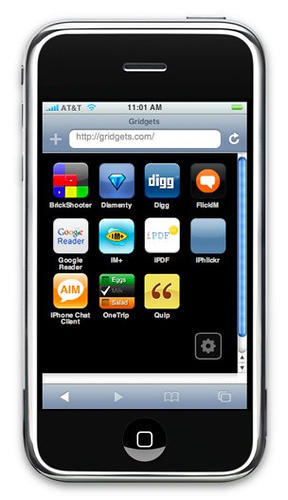
And reader Andrew Mayne notes that Apple’s new webapps page uses widget-sized icons to show all the apps for the iPhone.
“Last I checked, the normal OS X (non-widget apps) didn’t have as many button shaped icons,” writes Andrew in email. “The convenient button shaping could be a coincidence… but a rather convenient one.”
I heard a rumor today that Apple is shortly going to allow third-party applications on the iPhone. They won’t be full applications, however: they’ll be Desktop Widgets.
You will soon be able to drag any Dashboard Widget into iTunes, and they’ll sync with the iPhone, the source said.
To run on the iPhone and provide interactivity, they’ll require JavaScript, which means the iPhone will shortly get a Java update. When? The source didn’t say.
But the source did say that Apple hasn’t released iPhone widgets yet because Java has proven to be a major draw on battery power. Presumably, Apple has figured out how to tackle this problem. How? Again, the source didn’t say.
In OS X, Widgets are like mini web pages that run in Dashboard instead of a web browser. According to Apple’s Developer website, they’re a mix of HTML, JavaScript and CSS.
Unfortunately, this is all I know. I promised not to reveal the source of the rumor, but they’re well-placed. This is coming from just one source, via a third-person, so I’m only 70 percent confident it’s true. When I worked at MacWeek, we’d never publish rumors as news until it had been confirmed by at least three separate sources.
However, the redoubtable Glenn Fleischman reports for TidBits that Apple is getting near to making third-party applications available for the iPhone. Glenn has no details, but suggests the release is imminent.
UPDATE: As readers kindly point out, I’m confusing Java with JavaScriot: two separate technologies that share a name. The iPhone already has JavaScript, but not Java, so nothing would need to be added for Dashboard Widgets to work. Thanks for the feedback.
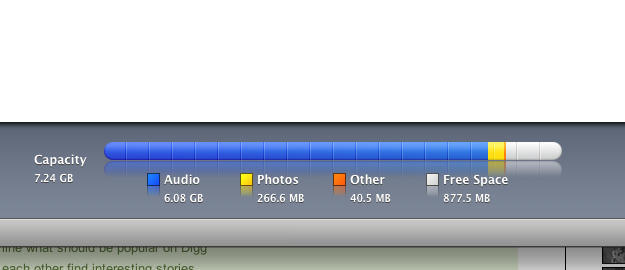
There seems to be a memory leak with some iPhones that quickly gobbles up the device’s storage space.
A <a href=”https://discussions.apple.com/thread.jspa?messageID=5025646�″>discussion thread</a> on Apple’s support forums details the iPhone’s “Other” memory category growing to several gigabyte in some cases. (The “Other” category is shown in the iTunes screenshot above)
The source of the memory blob is mysterious, but one sufferer suggests that Google Maps may be causing the problem. The Google widget may be caching every map that’s loaded.
The only way to clear the growing memory blog is to wipe the device and start from scratch. One reader reports that upgrading to 1.1.1 did not free a memory blog that had grown to 1.6GB, but wiping and restoring the phone dropped it to a reasonable 14MB.
“Partnerships take a lot of work – you want to go out on a few dates before you get married. Yes, we dated a few people but didn’t get married… and so there were a few unhappy girlfriends out there.”
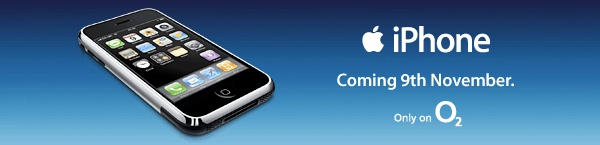
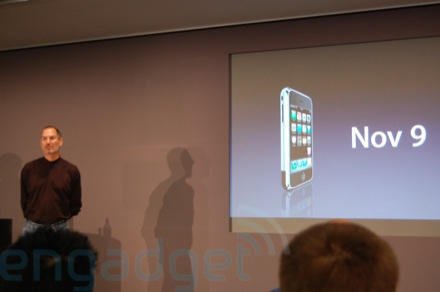
As expected, Steve Jobs at a press conference in London this morning announced the UK iPhone will launch November 9th, use the O2 network, cost £269 and £35 a month for an unlimited data plan. The phone will be available at the Carphone Warehouse, at about 1,300 outlets.
The iPhone will be more expensive, £269= $537, and there’s no 3G — which is common in Europe. Jobs said it’s to save battery power. 3G chips would reduce battery life to just a couple of hours:
“It’s pretty simple, says Jobs. “The chipsets work well apart from power. They’re real power hogs. Most phones now have battery lives of 2-3 hours and that’s due to these very power-hungry 3G chipsets. Our phone has 8 hours of talktime life. That’s really important when you start to use the internet and want to use the phone to listen to music. We’ve got to see the battery lives for 3G get back up into the 5+ hour range. Hopefully we’ll see that late next year. Rather than cut the battery life, we’ve included Wi-Fi and sandwiched 3G between Edge and a more efficient Wi-Fi.”
No announcement about other European countries, though it’s widely rumored it’ll be Orange in France and T-Mobile in Germany. Said Jobs: “We’ll be in a few countries in Europe in the next quarter.”
The European version of the iPhone looks like it’ll be available only in the UK and Germany at first, leaving iPhonophiles in other EU countries looking at unlocked iPhones as their best bet of getting their hands on a multitouch phone.
My friend Roger Aberg, who runs the MacFeber site, already has an unlocked iPhone he uses in Sweden. He has no problems with the device, he says, but he’s hoping the European iPhone will be upgraded to HSPDA — a super fast 3G standard that’s common in Europe.
Writes Roger in email: “People are a bit skeptic about the non-3G-part. I hope for a HSDPA-version (or turbo 3G) that is plenty faster and is pretty common here. Its 3.6 mbit (regular 3G is 0.3 mbit) and would be sweet on the iPhone! That would make me upgrade.”
However, some analysts don’t expect a 3G version of the iPhone until 2008 at the earliest, when Apple will introduce the iPhone to Asia.
If Apple delays the 3G iPhone, Europeans outside the UK or Germany looking for an unlocked iPhone might be best off shopping for one in the U.S. Thanks to the weakness of the dollar, and local European sales tax (or VAT, which can run to 25 percent in some European countries), Yankee iPhones will likely be cheaper — about $35 according to Roger.
The iPod will get three new features at Steve Jobs’ media extravaganza Sept. 5 according to the rumor mill: a touch-screen, Wi-Fi and digital radio. I think two of three are likely:
1. The touch-screen is a slam dunk. It’s the natural successor to the scroll wheel. Who’d buy a new, high-end iPod without it? Case closed.
2. Wi-Fi is unlikely. What’s it good for? Sharing tunes with other iPod users in public, ala the Zune? Maybe, but I think not. Copy protection and DRM is too problematic. How about using Wi-Fi to sync tunes with your computer? Maybe, but you’ll still need a cable to charge the device, so what’s the point? Maybe Wi-Fi could connect the iPod to a set of speakers via an Airport Express base station and AirTunes? Seems like a lot of trouble for a pretty minor feature. Wi-Fi is good for getting on the internet, so unless the iPod is also getting Safari and e-mail, I don’t see the point of adding it.
3. Digital radio is the real killer. It’s a feature that could spell real trouble for the satellite radio industry. With digital radio, the iPod could be a portable TiVo for music, automatically recording favorite shows, rewinding live broadcasts and purchasing songs over the air. Digital radio is so consumer-friendly, it’s completely transformed the UK radio market in a couple of years, and though U.S. broadcasters seem terrified of it, the success of satellite radio is spurring them into action. As Wired News reported in July:
“In the United Kingdom, more than 4.7 million digital radios have been sold since 1999. Listeners browse station listings in an electronic program guide, pause and rewind content as it’s broadcast, bookmark specific programs or songs, and record them using postage-stamp-size memory cards. And starting in May, they can buy songs as they hear them on the radio, downloading them to computers, digital receivers or cell phones.
… IBiquity says that the HD Digital Radio Alliance, a consortium of U.S. broadcasting chains, will commit nearly $250 million in air time to promote the format in 2007. And UBC Media’s Simon Cole says that satellite’s head start in the United States might actually be good news for HD Radio. “Satellite is softening up the market,” he says. “It’s waking U.S. consumers up to what digital can deliver.”
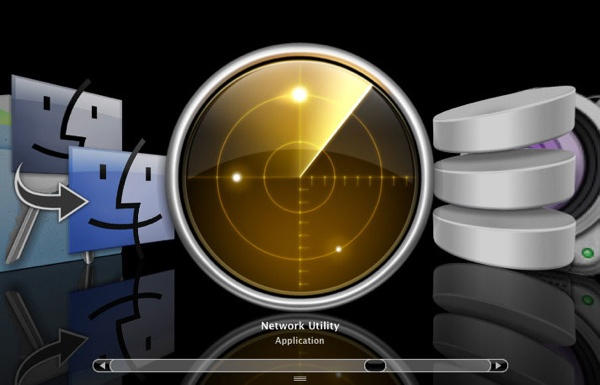
Unafraid of Apple’s lawyers, Think Secret has a gallery of gorgeous screenshots and icons from the latest build of Leopard (9A527), which was released to software developers last week.
Above is the large version of the new Network Utility icon. According to Think Secret, almost all the icons in Leopard are now bigger, better and brighter.
And just as the icons are getting bigger, so too are the applications. According to Think Secret, Address Book has grown from 25.2MB in Tiger to 47.7MB in Leopard; Safari has grown from 6.5MB to 51.9MB; and Mail has grown from 49MB to 279.7MB.
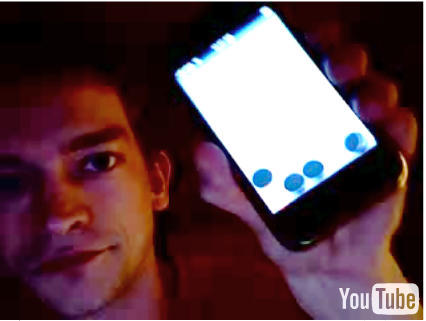
Hacker genius Erling Ellingsen has made his own $2 multitouch input pad from a plastic bag full of blue dye and an iSight camera. He’s also hacked the iPhone’s accelerometer that allows you to control the phone by tipping, rotating or shaking it.
Ellingson’s jury-rigged multitouch input pad lets him control his computer with his fingers, just like the iPhone or Jeff Han’s futuristic multitouch table. Using a bag of die and an iSight camera beneath it, Ellingson can navigate the Web, move chess pieces and play a virtual keyboard. How it works exactly is not clear, but check out the impressive video:
Ellingsen has also hacked the iPhone’s accelerometer, allowing him to control various homemade iPhone applications by tilting, rotating or shaking the iPhone. Ellingsen has created three demo apps controlled by tipping and shaking: a virtual Steve Jobs bobble-head that bobs its head when the phone is shaken; a maze that is navigated by tipping and turning the phone; and a virtual box of balls that roll and bounce as he rotates the phone. Again, see the impressive video:
So far, he’s thinking about an iPod+Nike-like pedometer, a Labyrinth game, SmackBook navigation for Safari and a virtual pet that’s shakeable, among other ideas.
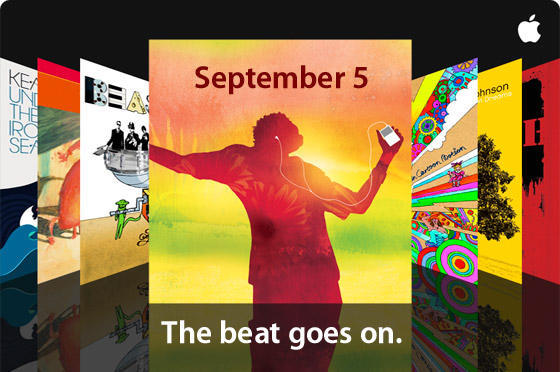
Apple just sent out invites to a special media event at San Francisco’s Moscone West convention center on September 5 at 10AM — and music is clearly the theme.
There’s been lots of speculation that new iPods are on tap, including stubby, ugly iPod nanos and a touchscreen iPod Touch.
Photographer Frasier Spiers spotted this chappie with an Apple ‘do at the weekend grand opening of Glasgow’s new Apple store.
The rest of Fraser’s pictures in this Flickr set capture the character of Glaswegians better than any other the other pictures I’ve seen from the grand opening.
One of the things I thought strange about the other picture sets was the absence of drunks. If you’re out all night in Glasgow, you’re certain to encounter a few. Well, Fraser captured one. Fraser says this young man was extremely drunk, and boasted about his sexual prowess to the waiting line for hours.
I thought this guy was a drunken thug, but he’s nerd from GlasMUG cheering people on.
And here’s a kid who queued for hours in a Che Guevara shirt. Fraser writes: “The irony of wearing a Che Guevera (SIC) hoodie whilst queueing for hours to attend a retail store opening is beyond parody. “I wanted an iPod Shuffle for Christmas, but my mommy says that Apple exploits the workers! I got a packet of seeds and a sickle instead”¦.”
(Thanks Oleg for noting Fraser’s pictures in the comments).
The latest build of Leopard (build 9A527) has a default desktop that looks like some kind of Star Trek supernova in outer space, according to a leaked screenshot.
Here’s what it looks like in use. The outer space theme is used at least twice in Leopard: the Time Machine backup app also has a spacey UI.
As Phil Ryu notes, with the cosmic backdrop, Leopards’ interface looks like the control deck of a futuristic spaceship looking out into void.
Could Apple be trying to imply that Leopard is so advanced it’s positively science fiction?
After learning that the teen who first unlocked the iPhone got a Nissan 350Z for his efforts, Wired News editor Kevin Poulsen is willing to trade his classic Nissan 300-ZX for an unlocked iPhone.
Kevin’s car is similar to the car Woz drove (see below), but it needs a bit of TLC, so you might want to offer him an unlocked Razr instead. Or maybe just a regular razor. You know, for shaving. Bids in the comments please.
Two Apple geniuses from Apple’s new store in Glasgow, which celebrated its grand opening this weekend. Photo by Setteb.it.
Gary Allen of IFOAppleStore, who travelled to Scotland from Berkeley to attend the grand opening, noted that the doorway smelled of urine. Scots are notorious drunken urinators in shop doorways. Link.
Many wireless companies will unlock cell phones after the initial one- or two-year contract has been fulfilled. But AT&T says the iPhone is “different” and won’t be unlocked at the end of the contract:
AT&T will unlock phones for customers once they have fulfilled their contracts, which typically run one to two years. One big exception: Apple’s iPhone, distributed exclusively in the USA by AT&T. “That’s different,” says AT&T spokesman Mark Siegel.
The “leaked” pics of a new iMac making the rounds are clearly a Photoshop fake made from images of Apple’s Cinema Displays taken from Apple’s website. See below.
The color also screams fake.
A new iMac is rumored to be introduced by Steve Jobs at a special event at Apple HQ on Tuesday — and everyone is hoping for a redesign. But Apple’s consumer machines do not come with metallic finishes. That’s reserved for the “pro” level machines. If the iMac has a new case, it will be made of plastic and will come in black, white or maybe other fruity colors.
Fake Steve has been outed by (of all publications) the New York Times, and turns out he’s Dan Lyons, a senior editor at Forbes. Here’s the story: A Mystery Solved: ‘Fake Steve’ Is an Editor
“Mr. Lyons said he invented the Fake Steve character last year, when a small group of chief executives turned bloggers attracted some media attention. He noticed that they rarely spoke candidly. “I thought, wouldn’t it be funny if a C.E.O. kept a blog that really told you what he thought? That was the gist of it.”
Ironically, Lyons was the author of a Forbes hit piece on blogs last year, called Attack of the Blogs. It begins: “Web logs are the prized platform of an online lynch mob spouting liberty but spewing lies, libel and invective.”
Of course, libel, lies and invective is what makes Fake Steve fun, but a lot of it was aimed at his fellow journalists. It was pretty clear Fake Steve was a journalist or editor — given all the pops he made at fellow Silicon Valley scribblers. He called Gawker publisher Nick Denton a “macrocephalic sodomite” (Denton is gay and has a large head).
Now that he’s been outed, it’s going to be pretty uncomfortable for him running into his targets.
UPDATE: Fake Steve has just posted his won entry about the Times story. He’s glad he was busted by the Times and not Valleywag, which has been on the hunt for months. Fake Steve writes:
“One bright side is that at least I was busted by the Times and not Valleywag. I really, really enjoyed seeing those guys keep guessing wrong. For six months Dr. Evil and Mr. Bigglesworth put their big brains together and couldn’t come up with the answer. Guy from the Times did it in a week. So much for the trope about smarty-pants bloggers disrupting old media. Brilliant. My only regret is that we didn’t get a chance to see Bigglesworth take a few more swings and misses.”
According to The Register, a Microsoft employee who made this hilarious Zune parody ad (featuring his boss, Monkey Boy Steve Ballmer) was fired for his trouble.
Columnist John Dvorak, who is perhaps the most hated pundit by Mac users because of his constant (and quote deliberate) Mac bashing, is now a Mac user himself — and he likes it.
In his latest PC Magazine Column, Dvorak confesses that he has been using an iMac at work for a couple of months, and it’s “not half bad.” After heaping on more weak praise, he says he has no plans to buy a Mac for personal use at home, but he increasingly finds himslef recommending the Mac to friends and neighbors who ask him what to buy! He writes:
“I can see why the Mac is gaining market share, because the rationale for using one is simple. Do you want to deal with the agony of antivirus, firewall, antispyware, and other touchy software subsystems, many of which do not work well? Or do you want to boot Microsoft Word and write a document and be done with it?
As someone who does recommend gear to people, I have to think to myself, “Should I recommend something that will come back to haunt me, or recommend a Mac with its higher price but lower hassle factor?” The answer is simple. I hate the idea of having to do customer service for people who cannot keep their systems clean, and that’s most people.”
Apple’s Q3 was the company’s best ever. It raked in $5.41 billion in sales, posting a $818 million in profit. Gross margins — the amount of revenue that is profit — is up to a whopping 36 percent. This surely is the highest in the industry. By contrast, Dell reported Q2 2007 margins of just 4.3 percent, earning $605 million profit on revenues of $14.1 billion.
Apple also reported 10 million iPods sold — up 21 percent on the year before; and 1.76 million Macs, up 33 percent year-on-year.
Apple’s stock is rebounding on the news: it’s up 6 percent after taking a hammering yesterday on AT&T’s iPhone numbers.
AT&T’s quarterly results said only 146,000 were activated in the first two days — so it looks like 124,000 people either waited a few days to activate their phones, or had trouble activating them, as was widely reported.
The “proof” is that FSJ’s computer has an IP address in Boston — and Ihnatko lives in Beantown. Ergo sum.
The Sitening blog obtained FSJ’s IP address by sending him a special URL in email. When FSJ visited the special URL, it revealed his IP address: 68.160.21.224, which comes from the Boston area.
But I’m skeptical. Andy’s a humorous writer, but the styles are different. And FSJ is obviously a reporter or editor with a Silicon Valley business publication — Forbes or Fortune, or such like — not a specialist Mac writer. The subject matter on FSJ’s blog ranges too far from Apple — he’s obsessed with Sun and Google as he is with Steve Jobs.
When Wired News first contacted FSJ earlier this year to set up a sponsorship deal, my colleague Kevin Poulsen, the ace hacker, used the headers of FSJ’s emails to track him to a hotel in New York, then a public park or cafe in New York (he was probably using free WiFi), and finally suburban Boston.
We assumed Fake Steve was traveling that day. Maybe he took a business trip to New York to his home in Boston. But who knows? Maybe he works in Boston, or that’s where his girlfriend lives?
The only one who knows FSJ’s identity for sure is my boss, Wired News EIC Evan Hansen, who’s keeping mum.