Leander has been reporting about Apple and technology for nearly 30 years.
Before founding Cult of Mac as an independent publication, Leander was news editor at Wired.com, where he was responsible for the day-to-day running of the Wired.com website. He headed up a team of six section editors, a dozen reporters and a large pool of freelancers. Together the team produced a daily digest of stories about the impact of science and technology, and won several awards, including several Webby Awards, 2X Knight-Batten Awards for Innovation in Journalism and the 2010 MIN (Magazine Industry Newsletter) award for best blog, among others.
Before being promoted to news editor, Leander was Wired.com's senior reporter, primarily covering Apple. During that time, Leander published a ton of scoops, including the first in-depth report about the development of the iPod. Leander attended almost every keynote speech and special product launch presented by Steve Jobs, including the historic launches of the iPhone and iPad. He also reported from almost every Macworld Expo in the late '90s and early '2000s, including, sadly, the last shows in Boston, San Francisco and Tokyo. His reporting for Wired.com formed the basis of the first Cult of Mac book, and subsequently this website.
Before joining Wired, Leander was a senior reporter at the legendary MacWeek, the storied and long-running weekly that documented Apple and its community in the 1980s and '90s.
Leander has written for Wired magazine (including the Issue 16.04 cover story about Steve Jobs' leadership at Apple, entitled Evil/Genius), Scientific American, The Guardian, The Observer, The San Francisco Chronicle and many other publications.
He has a diploma in journalism from the UK's National Council for the Training of Journalists.
Leander lives in San Francisco, California, and is married with four children. He's an avid biker and has ridden in many long-distance bike events, including California's legendary Death Ride.
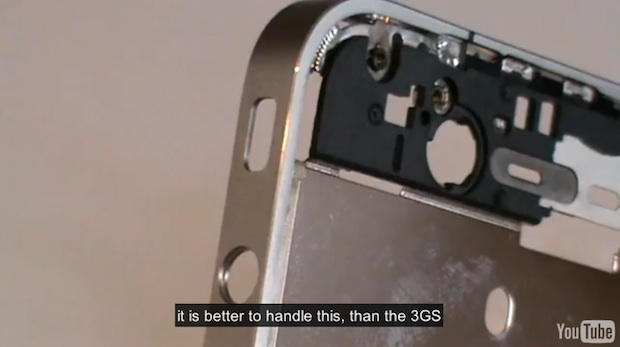
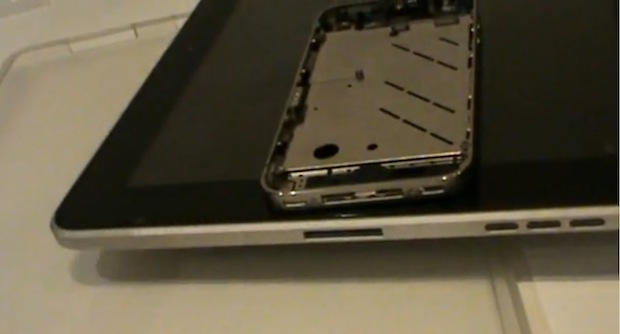
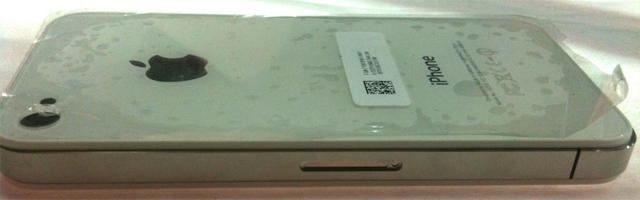
The iPhonePortugal website has posted two videos taking a closer look at the chassis of the new 4G iPhone. There are no surprises, but it is interesting to see how closely the industrial design of the iPhone 4G matches the iPad and new MacBook Pros.
These parts were purchased in China by one of our readers (weren’t stolen or found) then delivered to us. We will not reveal the price.
Are those parts genuine? We can not know but we can tell for sure those parts are perfect, have no defects, not faulty at all, there is not even one single difference between the 2 copies we have.
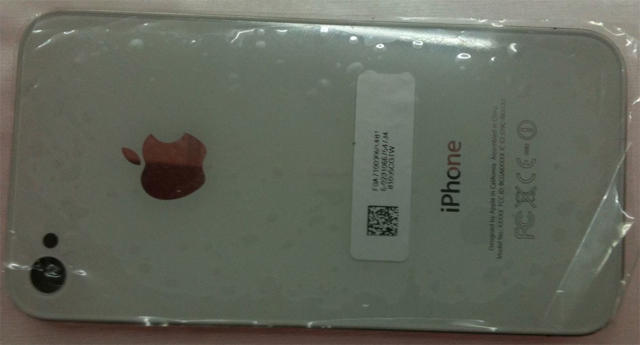
These are pictures of what appear to be spare parts –PowerbookMedic is a repair shop — but don’t appear to be the final versions. The text on the back is placeholder text. As well as the back case, PowerbookMedic also has images of a white front panel and some chassis parts.
The 4G iPhone is likely to be introduced at next week’s WWDC.
The grieving family of a Foxconn worker who jumped to his death in January protest outside the factory.
The rash of suicides at Foxconn are not due to harsh working conditions but the plight of China’s migrant workforce, says an open letter signed by a dozen Chinese sociologists.
The letter blames the string of Foxconn suicides on the social problems faced by China’s vast class of migrant workers.
Originating from poor rural areas, Chinese migrant workers are often rootless and isolated, cut off from friends and family. Instead of finding good jobs in urban factories, they are often too poorly paid to settle in their new cities, and have limited access to education and healthcare. With no prospects at home, they are stuck. The sociologists call it the “path of no return.”
We have made them live a migrancy life that is rootless and helpless, where families are separated, parents have no one to support them, and children are not taken care of. In short, this is a life without dignity.
The sociologists note that at the end of 2008, the population of Shenzhen exceeded 12 million, but only 2.28 million were registered as permanent residents. The giant Foxconn plant, which employs upwards of 600,000 workers, is located in Shenzhen.
The sociologists call on Foxconn and the Chinese central government to boost wages, and improve access to housing, eduction and healthcare. They also say demand workers be given a “voice,” which presumably means unions.
We call on every enterprise, to make a conscientious effort to increase migrant workers‘ pay and rights, and allow migrant workers to become true “citizens of the enterprise”.
Working together with our colleagues in the PRC’s propaganda ministry we have developed a great new counter-narrative that we’ve been pushing pretty hard in background conversations with friendly hacks. Basically it’s the notion that Foxconn’s suicide rate is actually below the national average of China, meaning that if you’re working at Foxconn you’re actually less likely to commit suicide. That’s right. The truth is, we are actually saving lives in China.
Fake Steve continues:
But, see, arguments about national averages are a smokescreen. Sure, people kill themselves all the time. But the Foxconn people all work for the same company, in the same place, and they’re all doing it in the same way, and that way happens to be a gruesome, public way that makes a spectacle of their death. They’re not pill-takers or wrist-slitters or hangers. They’re not Sylvia Plath wannabes, sealing off the kitchen and quietly sticking their head in the oven. They’re jumpers. And jumpers, my friends, are a different breed. Ask any cop or shrink who deals with this stuff. Jumpers want to make a statement. Jumpers are trying to tell you something.
Steve Ballmer at CES 2010 with a prototype tablet from Hewlett-Packard.
“It is a long game,” Microsoft CEO Steve Ballmer told reporters on Thursday in response to Apple overtaking his company on the stock market. “We have good competitors but we too are very good competitors.”
He added: “I will make more profit and certainly there is no technology company on the planet that is as profitable as we are.”
“Let’s see what happens as I am still pleased that 94 times out of a 100 somebody picks a Windows PC,” he said.
Microsoft shares closed at $25.01 on Wednesday, giving it a market cap of $219.18 billion. Apple closed at $244.05, a market value of $222.07 billion.
Workers install suicide netting at a Foxconn plant. Image: NYT.
The Asian electronics giant Foxconn is in full damage control mode after yet another suicide at one its giant Chinese factories, which cheaply pump out electronics for Apple and others. But one of the company’s representatives made an unfortunate statement when talking about the conditions at its factories:
“There is a fine line between productivity and regimentation and inhumane treatment,” said Louis Woo, an aide to Mr. Gou at Hon Hai. “I hope we treat our workers with dignity and respect.”
But of course, that’s not true at all. There’s a huge difference between productivity and inhumane treatment, not a “fine line.” And it’s that gap that makes all the difference.
Foxconn has a reputation for a stressful and oppressive work atmosphere. Employees are paid relatively well, but are pushed hard to produce and are not allowed to talk to each other during work, according to reports. The work is repetitive, mind-numbing and robotic. Stress, isolation and hopelessness: it’s a recipe for trouble.
Apple and the other tech companies that are Foxconn’s customers must bear some responsibility here. It’s time Apple stepped up its annual audit of contractors and lived up to its promise of “ensuring the highest standards of social responsibility.”
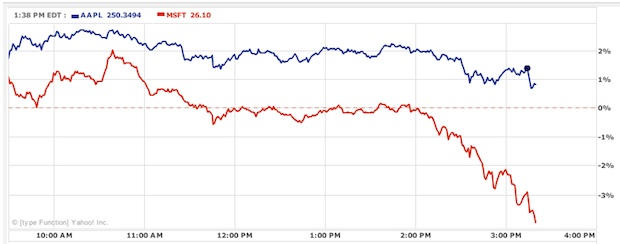
In one of the biggest and unlikeliest turnarounds in business history, Apple is the most valuable company in technology, passing Microsoft in market capitalization.
Apple’s market cap has passed $227.1 billion — ahead of Microsoft’s $226.3 billion. Apple is up about 1.8% today, and Microsoft down about 1%.
Of course, this may change tomorrow, but for the moment, Apple is the new king of technology.
What a difference a decade makes, when Apple was on the ropes and Microsoft look unassailable. Now, Apple is clearly at the forefront of the next huge wave in tech: mobile. Microsoft isn’t even in the game.
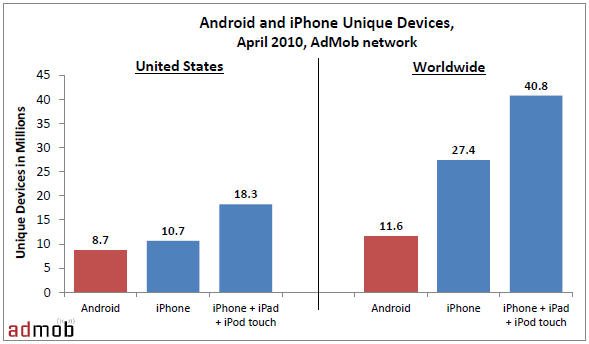
There are twice as many iPhone OS devices in use as Andorid devices, the mobile advertising company AdMob estimates.
AdMob’s April Mobile Metrics report analyzed the number of unique Android and iPhone devices in its network. The company found that in the US, there were 10.7 million iPhone devices and 8.7 million Android devices. Include the iPod touch, and there are 2 to 1 iPhone OS devices compared to Android. Overseas, the gap is even wider: 3.5 to 1 iPhone devices compared to Android.
The numbers are illustrative because both platforms are growing fast, but there little idea how many are in day-to-day use. For example, Apple has sold 85 million iPhones and iPod touches in the last three years, but doesn’t say how many are in use. At its recent developer conference, Google boasted that it is activating 100,000 Android devices a day. Gartner estimates that Apple’s OS now powers 15.4 percent of global smartphones, while Google’s Android has 9.6 percent of the market.
AdMob says its numbers are good beceause they are based on actual data, not estimates, and it has a large sample size.
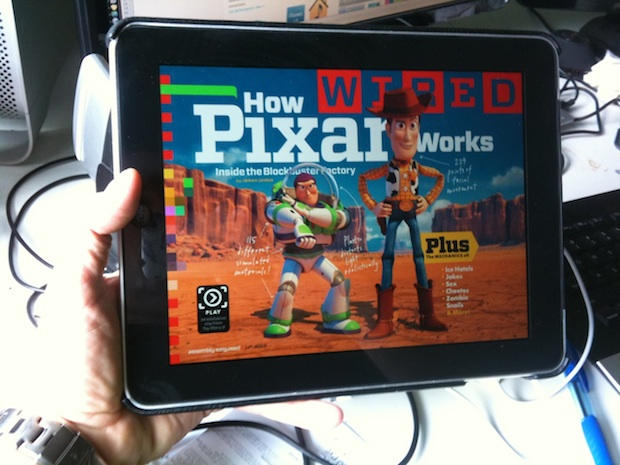
Against the odds and earlier than expected, Wired magazine has debuted its interactive magazine app for the iPad. And it’s killer.
The Wired app blends the magazine’s superb editorial editorial and high production values with elements that only digital can bring – interactivity and multimedia. The stories are well-written and beautifully designed with big, gorgeous photos. Navigation is easy and intuitive and there are lots of interactive graphics and supplementary video.
“Wired magazine will be digital from now on, designed from the start as a compelling interactive experience, in parallel with our print edition,” says Chris Anderson, Wired’s editor in chief. “Wired is finally, well, wired.”
Thanks to Apple’s ban on Flash, the app had some birthing troubles, and was expected later this summer. Wired has solved the Flash issue by making the app native to the iPad — it’s not an Adobe Air or Flash port. According to Anderson, it’s made with the same Adobe productions tools used to create the print magazine, so it’s (relatively) easy and quick to produce in parallel. This, of course, is crucial.
It’s not cheap — $4.99 a pop — which has already upset some reviewers on iTunes. Because the digital edition is produced in parallel and distribution costs are near zero, it should cost a lot less than print, critics reason. (The print edition costs less than a dollar with a subscription).
But the price is perhaps one of the most important things about the digital edition. Wired is trying out a new business model, one that many print publishers are praying will work. Me too. If Wired can make it profitable enough to support its editorial costs, that’s good news for everyone — publishers and readers.
Check out CultofMac.com’s quick video tour of the Wired iPad app (This video will play on the iPad, btw):
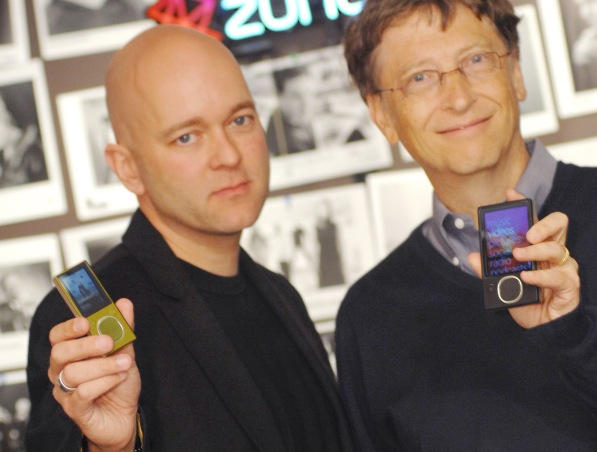
Microsoft's James J Allard (seen here with Bill Gates) is leaving the company, largely because of failed attempts to match Apple's iPod, iPhone and iPad.
Two of Microsoft’s highest-profile executives are leaving, and Apple’s running rings around the company is partly seen as the reason.
Robbie Bach and James J Allard, leaders of Microsoft’s Entertainment & Devices Division, are both leaving and will not be replaced. It is Microsoft’s biggest management shakeup in years. The restructuring will put CEO Steve Ballmer in direct charge of Microsoft’s consumer-focused mobile businesses, which are getting a kicking from Google, Nintendo and especially Apple. This transition is reminiscent ofwhen Bill Gates left Microsoft, which signified a turning point for the company’s leadership and direction.
In fact, Venture Beat’s Dean Takahashi, who wrote a pair of books about the Entertainment & Devices Division (Opening the Xbox and The Xbox 360 Uncloaked), says the inability to compete with Apple is behind the shakeup:
Allard’s last project at Microsoft was Courier, which Ballmer canceled earlier this year. It was viewed as an attempt to take on the Apple iPad. While Bach’s division is profitable now, it may be remembered for its inability to take on Apple in the increasingly critical mobile business. And that may explain why, any day now, Apple’s market capitalization is going to become bigger than Microsoft’s.
UPDATE: Horace Dediu has a good guess why Bach was fired: he lost Hewlett Packard when the company bought Palm. “Bach lost a key account; in fact, he could be responsible for having lost the biggest account that Microsoft ever had. Ballmer is a sales guy and he knows the importance of these relationships. A customer like HP must be managed carefully and their strategy must be steered to fit with yours. If HP felt they needed to go somewhere else for their mobile OS, it’s a slap in the face, but if they buy the asset and IP and internalize a competing platform, then that is a dagger to the heart for Ballmer.”
Google has graduated its spiffy Chrome browser for Mac from beta to stable release. It’s a major milestone for the browser, and an indication Google is taking the Mac platform seriously. For a while, it looked that Chrome for Mac was an afterthought.
Today, I’m happy to announce that Google Chrome for Mac is being promoted out of beta to our stable channel. We believe that it provides not only the stability, performance and polish that every Mac user expects, but also a seamless native Mac application experience that Mac users will feel instantly at home with.
I’m a big fan of Chrome, even though it’s a memory hog with multiple tabs open. It’s fast and there’s a big and growing gallery of more than 4,500 extensions.
I don’t often play around with advertising, but Olympus’ virtual ad for it’s new PEN E-PL1 camera is pretty fun.
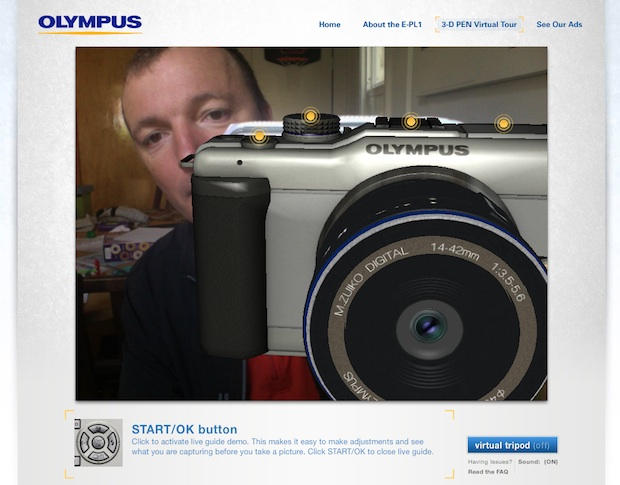
Go to www.getolympus.com/PEN3d and download a paper cutout of the camera (you can get it here). Install a plugin, and when you hold the paper camera up to your iSight webcam it turns into a 3D model of the camera.
It’s quite magical and I laughed with delight when the virtual camera appeared on screen. You can remove the lens, check out different shooting modes and play with the flash. Turn the camera around and you can take pictures or shoot video of yourself, which you can share on Facebook.
The virtual camera works well on a MacBook and iMac. Even though you have to install a plugin, I think it’s worth it. This is digital marketing done well.
The PEN E-PL1 is one of a new generation of new Micro Four Thirds (M4/3) cameras that promise DSLR quality with point-and-shoot ease. It has an interchangeable lens, built-in image stabilization and can record HD video.
(The June print issues of Wired and Popular Photography contain pre-cut cameras. There’s also a competition to win the camera and some cash: Shoot a video explaining what you’d do with the PEN camera and $5,000. Details at www.youtube.com/getolympus).
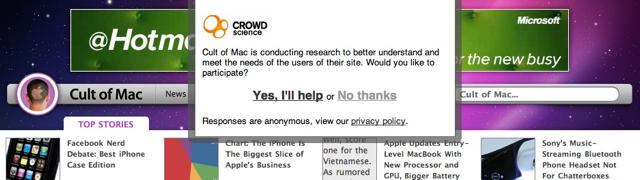
We’re running a survey to get a better idea of who you are and what you like to do online. Yes, we know, surveys can be a pain, but the data is essential for our sales team to represent us properly.
If you like what we do, it’d be a huge help if you could fill it out. The survey is a pop-down ‘toaster’ style. It’s conducted by Crowd Science, a well-respected name (here’s some info about Crowd Science from TechCrunch). The survey hovers over the leaderboard for a few seconds and disappears if you ignore it.
The survey isn’t too bad. We’ve kept it as painless as possible. It’s about a dozen questions, standard stuff, mostly about your usage of online social-media and some basic demographic information. It’s totally anonymous and takes a few minutes to complete.
The survey is persistent. It’ll run until we turn it off. This allows us to gather a stream of up-to-date information, rather than a snapshot that’s soon out of date. But don’t worry — only a small percentage of readers see the popdown. If you see it and ignore it, you won’t see it again for at least 3 months. And if you take the survey, it won’t pop up again.
The information is essential, otherwise we wouldn’t run it. The site needs to make revenue or we won’t be able to operate. And to make revenue, the sales team needs to give potential advertisers good readership info.
We appreciate your help — many thanks.
UPDATE: I’ve removed the static link from this post, which didn’t work. My apologies. Crowd Science doesn’t support static links.
Reader “Romeo From Brazil” wrote in to share an awesome tip: how to quickly and easily get a U.S. iTunes account anywhere in the world.
Romeo’s method works like a charm. You don’t need a credit card and it is far easier than other methods we’ve seen. Best, it works in ANY country, so if you’re in the U.S., you can use it to buy music available only in the U.K. And if you’re outside the U.S., you can use the account to buy apps and music not available in your country, like Apple’s iWorks suite.
Even though the iPad will go on sale in Canada at the end of the month (May 28), our friends north of the border are buying them by the boatload on the grey market.
It’s not hard to smuggle an iPad across the border, but Canadians have to jump through a couple of hoops to download apps from the U.S. App Store.
Apple has settled claims with state regulators who allege the company mishandled electronic waste. Photo: Thomas Dohmke
Federal antritrust regulators are taking a keen interest in changes Apple made to its iPhone developers agreement, the Wall Street Journal and Reuters are reporting.
Steve Jobs is at it again — emailing Apple customers with answers to their questions.
This one was sent to CultofMac.com by reader Paul Greenberg, who asked Jobs about a missing MobileMe feature that’s been bugging him for three years: the inability to sync notes via MobileMe.
An update to ABC’s iPad app that adds 3G video streaming has already been submitted to the App Store.
The popular app will likely win Apple’s approval and will shortly be available as a free download. Since its launch a month ago, ABC’s app has been one of the most popular on the iPad, all owing users to enjoy high-quality streams of ABC’s hit shows, like Lost.
However, as we noted last week, the app works over Wi-Fi only. It will not stream video over AT&T’s 3G cell network. This came as a shock and surprise to new iPad 3G owners, who were also beginning to discover that other video services, like Netflix and Youtube, severely downgrade video quality when streaming over the cell network.
Web surfing on the iPad 3G using its cell connection is really pretty good, especially if you get away from congested urban areas.
Using the iPad over the weekend, I’ve been pretty impressed by the speed of the iPad 3G for routine Web surfing. Video, however, is another matter — it’s a disappointment.
The “Spirit” iPad/iPhone jailbreak is available for download from the Dev Team. You can download Spirit here.
The free, untethered jailbreak is available for Mac and Windows, and works with any iPad, iPhone, or iPod touch on firmware 3.1.2, 3.1.3, or 3.2. It’s a quick, easy, one-click process, according to QuickPwn, although the Cydia app is buggy. Just download the jailbreak software, plug in your device, and your iPad or iPhone is instantly recognized. Hit the “Jailbreak” button and you’re done.
Note: Before performing a jailbreaking make absolutely sure you’ve got a backup of your SHSH blobs so that if anything goes wrong you can restore to 3.1.2. You can find a step-by-step guide from Redmond Pie here.
Spirit is not a carrier unlock (which allows you to use unauthorized wireless carriers like T-Mobile).
The Dev Team highly recommend syncing with iTunes before trying this jailbreak. If anything goes wrong, you will have to restore the device. It’s especially iffy on the iPad.
Note: On iPad, all this is still sort of beta. Some packages in Cydia, not designed for iPad, might screw up your system and require you to restore. Be careful. (And no, Cydia’s appearance is not final.)
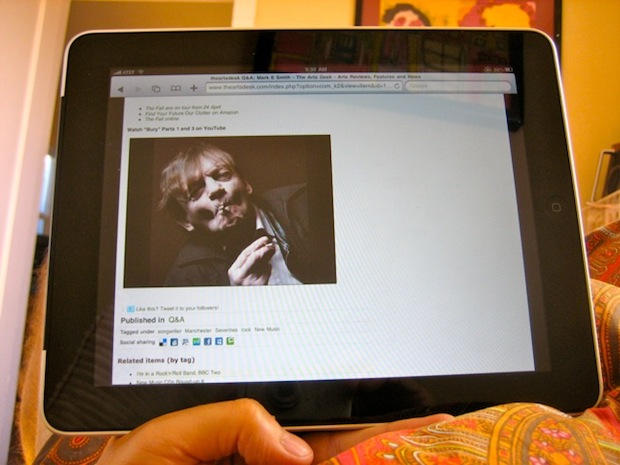
I just noticed something about surfing the web on an iPad. Here’s a hint: look at the red circle in the New York Times screenshot above.
It was hard to spot because it’s actually noticing something that’s not there: the blue Legos where the Flash plugin should be.
In January, when Steve Jobs introduced the iPad, he wasn’t able to load the NYT‘s front-page videos (remember the Lego bricks visible during his debut event?) The absence of Flash seemed like a major problem. Video, games, rich-media — none of these would work, pundits said, and the iPad would be a crippled device.
But that hasn’t proven to be the case. Not at all. During the past month I’ve been using the iPad, I’ve rarely encountered problems with the lack of Flash. All the sites I visit regularly – the BBC, NYT and Wall Street Journal — all of them have quickly made video and rich-media available in iPad-friendly formats.
YouTube is especially iPad-friendly. I’ve yet to encounter a YouTube video the iPad wouldn’t play. And because so many sites use YouTube to embed video, it seems like a lot of the web is iPad-friendly.
The only problems is streaming music from MixRiot (which I use a lot but isn’t exactly mainstream) and playing Farmville and thousands of other Flash games. But given how much time I waste fertilizing my kids’ crops and sending them gifts, that’s actually a blessing.
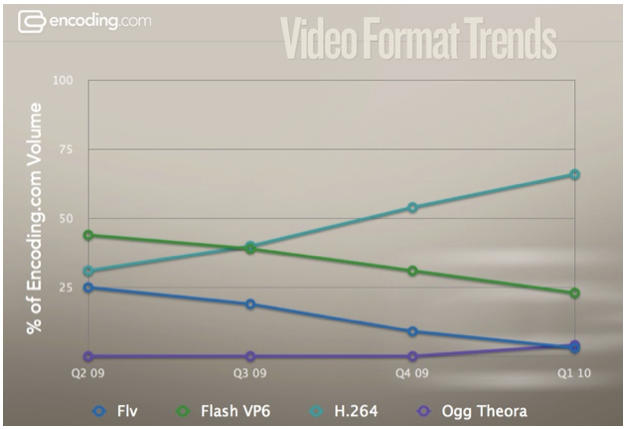
And it’s only going to get worse for Flash. Look at the chart below from Encoding.com, which does a lot of video encoding for sites like MTV and MySpace. In the last four quarters, Flash video (represented by FLV and Flash VP6) dropped from 69 percent to only 26 percent of all videos. Meanwhile, the H.264 format went from 31 percent to 66 percent, and is now the most popular format by a long shot.
Here’s a couple of screenshots from the iPad’s YouTube app showing the dramatic difference in quality between Wi-Fi and 3G.
The screenshot above is from video streaming over WiFi. And below is the same YouTube video playing over 3G.
I paused the video before taking the screenshots and tried to take them at about the same point.
The difference is clear. Over Wi-Fi, video quality is near high-def. Over 3G, it looks like a bad QuickTime movie from the mid-1990s.
Of course, this isn’t new — it’s just much more noticeable on the iPad’s big beautiful screen. This has been the case on the iPhone for some time, but on the smaller screen, the difference in quality isn’t as dramatic.
UPDATE: As our friend Chris Foresman of Ars Technica fame points out in the comments, 3G tops out at a paltry 64Kbps. ” It looks like crap on the iPhone,” says Chris, “so it shouldn’t be a surprise that it looks like crap 4x as big?”
Foresman says the 64Kbps number isn’t generally known, but is reported in Apple’s developer docs. AT&T had said there would be a limit, but didn’t say what it was.
64Kbps is pathetic for 3G. According to the International Telecommunication Union standards body, 3G specifies a minimum data rate of 144Kbps in high-mobility (vehicular) applications, 384Kbps for pedestrian applications, and 2Mbps (that megabits per second) for indoor (stationary) applications.
The honeymoon is over. I’ve discovered my first major disappointment with the iPad 3G, and I’ve only just started playing with it. Video over 3G on the iPad totally and utterly sucks.
The picture is noticeably downgraded on a 3G connection. The built-in YouTube app delivers video that’s very low-res compared to the video it delivers on a Wi-Fi connection. It’s barely watcheable.
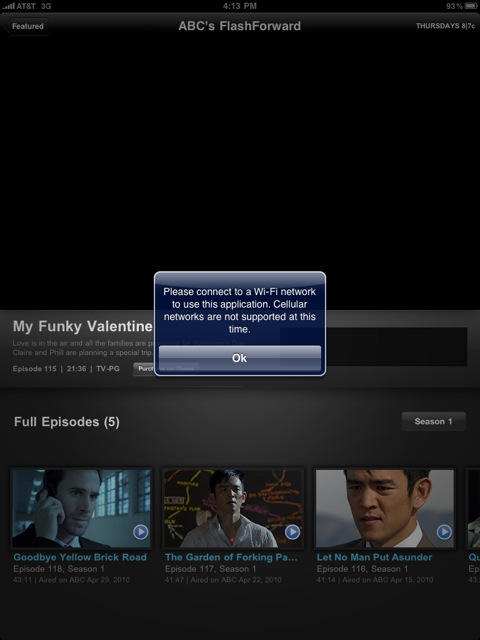
And apps like the ABC app and Netflix won’t work on 3G at all. They both The ABC app launches a pop up that says: “Please connect to a Wi-Fi network to use this application. Cellular networks are not supported at this time.”
It may be better to get a Wi-Fi only iPad and invest in a MiFi, which appears to work flawlessly for delivering high-def video, according to reader reports on iLounge.
UPDATE: My mistake. Netflix does work over 3G. The video quality is clearly lower resolution however.
Here’s a couple of screenshots showing the difference:
The iPad 3G is the iPad everyone’s been waiting for. Let’s face it: the 3G data connection and GPS makes this the iPad you don’t want to to leave at home.
There’s almost no physical difference between the iPad 3G and the Wi-Fi only iPad, except for the strip of black plastic on the back covering the 3G antenna, and the microSIM slot on the left-hand side.
The contents of the box are the same (iPad, charging brick and sync cable). The only difference is a pin tool to pop the microSIM slot.
Like the WiFi iPad, you must connect it to iTunes before it powers up. It will not switch on out of the box. There is no software update at present. The iPad doesn’t register itself with AT&T you call up the Settings menu and hit Cellular Data option.
Signing up for a data plan wasn’t too bad. You type in username, password, and credit card details. You have to create a new account, which seems to be linked to an AT&T account if you have one (it pulled up my address that it had on file). The sucky AT&T connection in this part of San Francisco made it slower than it should submiiting the data and waiting for a response. However, the activation of the data plan took only a couple of minutes.
Be warned: monthly data fees are ongoing unless you cancel. This is going to be easy to forget at the end of the month. If you cancel and want to re-enroll, you have to go thorough the entire enrollment process again. Kinda painful.
Web surfing is pretty slow — but that’s because AT&T is overloaded and the signal weak here at my office. It’s not really a fair test. I’ll conduct more tests later at home.