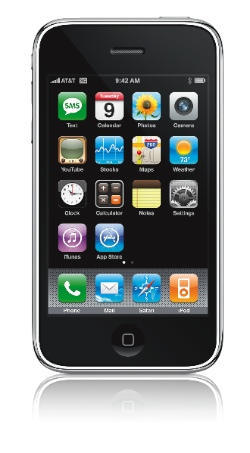
Handset maker Motorola has reportedly decided to focus on the open-source Android platform, dropping most of its other cell phone designs – as well as more employees.
“They were like a drunk asking for another drink in the software area,” Gartner analyst Ken Dulaney explained to Cult of Mac.
After laying-off 10,000 employees and unsuccessfully attempting to regain its past glory, the Schaumburg, Ill.-based company will cut at least four handset platforms, choosing to concentrate on Android and two other handsets, the Wall Street Journal reported, citing unnamed sources Wednesday.
Giant discount retailer Walmart has slashed its price for MP3 music to 74 cents, challenging both leader Apple and Amazon. The Bentonville, Ark. chain also announced Tuesday it’s MP3 store will offer a free download with each music CD purchased.
The new pricing is limited to what Walmart calls its “Top 25,” songs from such artists as Coldplay, Nickelback and Carrie Underwood.
For some time, you could hardly read about Apple without “iPod-maker” following closely behind in press and analyst comments. However, that symbiotic description is dated, according to one of the rising stars among unpaid Apple watchers, Andy Zaky.
Zaky, who watches Apple sales figures from his post at Bullish Cross, wrote Monday iPod sales contributed just 14.2 percent to the fourth quarter revenue of the Cupertino, Calif. company.
By this time in 2009, the iPhone will replace the iPod as the second-greatest revenue generator for Apple, next to Mac sales, the blogger wrote. Last week, Apple reported selling 6 million iPhones for the quarter.
The blogger is among a new breed of Apple analysts not employed by financial houses to provide estimates and insight. Fortune recently gave bloggers the nod over pros in predictions on Apple’s recent Q4 report.
Few things rankle a Mac user more than seeing new and interesting products and services rolled out that only work on PC. In my household, Netflix’s “Watch Instantly” is at the top of this maddening list. Basically, anyone with a Netflix account and sufficiently fast PC can watch any of 12,000 movies direct from Netflix servers at no extra charge. It hasn’t come to Macs because the service relies on PC-only DRM. And this drives my wife nuts. As she sees it, she’s already paying Netflix for service, and since that subscription now includes streaming she can’t use, she’s getting charged for a phantom service.
I can’t say I disagree.
At any rate, Netflix today proclaimed that this sad state of affairs won’t continue for long. Starting tomorrow, a limited number of Mac subscribers will be able to use Watch Instantly via a new version of the software rooted in Microsoft’s Silverlight technology (it’s a lot like Flash). Since Silverlight bakes in the PC DRM, it runs fine on a Mac and takes no additional tweaking to function.
Unfortunately, the new platform will be rolled out slowly, with Netflix only promising support for all Intel Mac users by the end of the year. So it might be awhile before Netflix stops getting the stinkeye from my apartment.
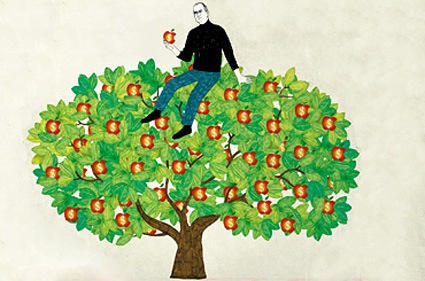
Apple’s giant stash of cash is a constant source of speculation in the tech world. Now standing north of $25 Billion, Apple has the money to acquire all but a few hundred companies in the world, and it makes people nervous that the Cupertino Kings won’t snatch up someone big.
Our friend Brian over at Epicenter has an interesting piece of speculation, rating the most likely and least likely acquisition targets Apple could go after during the current downturn. It’s a thought-provoking read, and it’s accompanied by a really fun poll in which readers suggest who Apple should take on. The Dell entry is priceless.
For my part, I always think that the big questions about Apple’s cash and who the company will acquire tend to be misguided. Over its entire history, Apple has shown again and again that it will buy small organizations that possess a specific technology or capability that Apple lacks. That’s the story with NeXT, it’s the story with Logic, and it’s the store with PA Semi. Other than that, Apple invests in its own ideas and its own new efforts, because Steve Jobs believes the solutions Apple needs to triumph don’t exist yet. Apple spends way more time doing its own thing than it does snapping up outsiders.
And a portion of that $25 billion is going straight back into Apple’s future – the company still needs to build that brand new campus in Cupertino, right? Not to mention, new aluminum milling processes aren’t cheap to implement, either…
The T-Mobile G1 has only been out for a couple of days, but new problems with the first generation of Google’s entry into the phone business continue to materialize just about every hour on the hour. Still the most shocking is the lack of corporate e-mail and calendaring support, with Google assuming that a third-party developer will just magically figure out how to do Exchange ActiveSync and Lotus integration.
Today, the big news is that Google plans to send out a software update at some point with a touchscreen keyboard so that it becomes possible to enter text while using the phone in vertical portrait orientation. Yes, in case you missed it earlier, it’s impossible to even type in a URL while browsing the web in the preferred one-handed iPhone style orientation. Granted, the G1 has a physical QWERTY and a pretty decent one at that, but it’s incredible that any company could ship a phone this intricate without realizing this could be a deal-breaker in actual human use. It’s like they didn’t even test their ideas out before sending them to final production.
I bring all of this up, because it’s another piece of evidence that even though an open-source model works incredibly well when working on technical feasibility and optimization, it’s pretty poor at making a consumer-facing complex system work well together. It’s the same reason that Linux has incredibly low-level networking and multithreading code, and it’s still impossible to expect a decent graphical user interface.
Apple’s focus on freakishly detailed design and engineering can have its own failings, of course (most specifically in leaving out any features that Steve Jobs can’t understand the value of), but it also tends to lead to solutions that were considered as full experiences instead of a collection of features. It all works together well, instead of working well in spite of contradictory features. The holistic approach Apple takes to product design is the reason we love it. Android’s haphazard approach of fixing things as they become crises. Google will mostly catch up eventually, but I have to pity T-Mobile for being forced to fight back with such an unfinished product. The G1 is so far behind that it’s hard to imagine anyone who isn’t a hobbyist being pleased with the first kludgy Android phone.
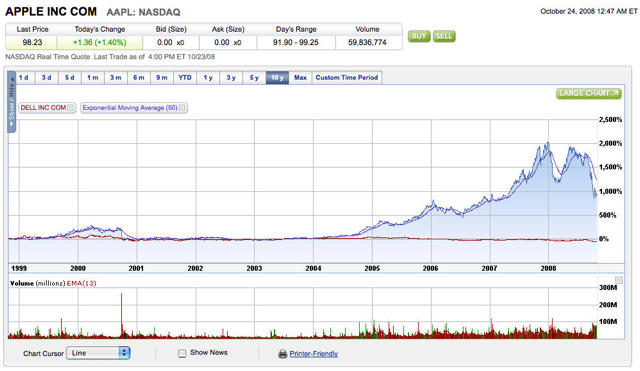
Eleven years ago, Michael Dell, CEO of Austin, TX-based Dell Computers was asked what he would do if he were CEO of Apple Computers. His answer: “I’d shut it down and give the money back to the shareholders.”
It’s hard to know what Steve Jobs would say if he were asked the same question today, because he rarely speaks to the press. But if he wanted to, he could do the very same thing for Dell, Inc. shareholders tomorrow and still have about $10 billion left in the bank.
Apple reported nearly $25 billion cash-on-hand at the end of FY2008 Tuesday and Dell had a market cap of about $24 billion with $9 billion cash of its own at the close of trading on Thursday, graphic indications of the changed fortunes of the two companies over the past decade or so.
Mr. Dell retains a considerable advantage over Mr. Jobs in personal wealth, however, with a Texas-sized net worth of $17.3 billion compared to Jobs’ mere $5.7 billion.
Looking at the chart above comparing the price movements in the stock of the two companies in the past ten years, you have to wonder what they’ve been up to down there in Austin, don’t you?
Partially hidden by the fantastic iPhone sales numbers Tuesday was the fact that Apple outsold RIM’s BlackBerry during the third quarter. Analysts say the information may serve as a roadmap for Apple.
Tuesday, Apple CEO Steve Jobs said 6.9 million iPhones during the quarter. RIM sold 6.1 million BlackBerries during the same period, according to reports.
Global Markets
“Apple sells to a much wider audience than RIM,” Gartner analyst Ken Dulaney told Cult of Mac. Apple’s iPhone 3G is sold in 51 nations.
Cool your jets. That’s the advice from analysts on a flurry of conjecture about whether Apple is stealthily testing online some mix of iPhone and MacBook.
What sparked the talk was a brief mention in the New York Times that an unnamed search engine found in its logs an unannounced Apple device with a display size between an iPhone and a MacBook.
Lending further weight to the suggestion were comments by CEO Steve Jobs that the Cupertino, Calif. company “had some pretty interesting” ideas for the netbook or mini-notebook market.
An unannounced Apple product with a display somewhere between an iPhone and a MacBook is lurking out there somewhere, according to an anonymous source at an unnamed search engine company.
Buried in an update to his post about Steve Jobs’ participation on yesterday’s Apple 4Q earnings call, New York Times technology writer John Markoff says a source to whom he promised anonymity confirmed the search engine company has spotted visits from an Apple product with a display that is neither iPhone nor MacBook.
Should we be looking for iPhone 3.0 or NetMac 1.0?
Citi Wednesday cut its target price for Apple to $153 from $170, joining several other analyst firms reducing Apple share price while advising investors the Cupertino company remains a good buy.
“We believe this is an attractive opportunity to buy a leading technology innovator on sale,” analyst Richard Gardner told clients Wednesday.
Although the financial firm reduced estimates for fiscal 2009 through fiscal 2010, Citi maintained a “Buy” rating for Apple shares.
Apple blew past analyst expectations, reporting Tuesday it sold 6.9 million iPhones for the quarter ended Sept. 30. Despite outselling RIM, the stock target price was cut Wednesday by one financial expert.
In a long-awaited pronouncement of Apple’s financial health, the company announced a 35 percent jump in revenue, posting $7.9 billion for the quarter, up from $6.2 billion for the same quarter in 2007.
Last Friday we issued the call for our designer savvy readers to create Sheppard Fairey-style posters of your favorite Apple luminaries.
unravel stepped up. A graphic designer from the San Fernando Valley, unravel told us, “I admire [Ive’s] work. Besides, I figured people would be doing Jobs first, so why not create one for somebody who deserves recognition too.”
On the eve of the release of Apple’s fourth quarter results, one analyst firm suggests the number to watch is how many Macs were sold during the period ended Sept. 30.
Piper Jaffray offered clients predictions that were slightly more optimistic than the Wall Street consensus. Mac sales are “key” to Cupertino’s financial picture, according to the analysts.
In a note to investors, the financial firm predicted 2.8 million Macs were sold during the fourth quarter. The estimate expands on a 2.7 million Wall Street projection.
Will Motorola’s Android handset pose a greater threat to the iPhone, improving on the G1, the first Google phone from HTC and T-Mobile? That’s the question on many minds as details of Moto’s open-source phone appeared Monday.
Motorola’s Android unit, not expected until late 2009, reportedly sports many features missing from the G1, offering improved specs, according to Monday’s BusinessWeek.
Citing information distributed to carriers, the financial news source said the Motorola device appears to be “a higher-end version” of the G1, produced by Taiwan’s HTC.
Steve Jobs' health is a topic of concern for the Apple community -- and for Wall Street. Photo: Apple
In the Cold War era, a cottage industry was created around determining the geopolitical significance of Khrushchev or Brezhnev not appearing at the May Day reviewing stand. For silicon valley, it is Apple CEO Steve Jobs and Tuesday’s new product announcement.
Was Tuesday’s announcement of new MacBooks a cryptic message to investors worried about Jobs’ health? We all remember the dive Apple’s stock took when a rumor (which turned out to be false) spread that the Apple leader had been rushed to the hospital for heart trouble.
So, when Jobs shared the stage with Chief Operating Officer Tim Cook and Senior Vice-President of Industrial Design Jonathan Ive, speculation began that Apple was sending a message to Wall Street: don’t worry, we have a plan.
To mark the one-month anniversary of launching HD sales at its iTunes Store, Apple announced it will offer more than 70 episodes of Fall prime-time hits from ABC, CBS, NBC, Fox and cable.
Among the HD episodes are ABC’s “Desperate Housewives,” “Lost,” “Grey’s Anatomy” and “Eli Stone.” CBS shows include “CSI,” CSI: New York, “CSI” Miami” and “Numb3rs.” NBC show in HD on iTunes include “30 Rock,” Heroes,” “The Office” and “Law and Order: SUV.”
Apple said it has also sold 200 million television episodes and 1 million HD episodes. The HD episodes from ABC, CBS, NBC and Fox cost $2.99 a piece while each regular episode from the iTunes Store carry a $1.99 price tag.
In September, Apple kicked-off HD sales, offering 12 high-definition NBC episodes for free. The announcement coincided with the release of iTunes 8 and the return of NBC, which left the iTunes Store in August 2007, following a dispute over pricing of its television shows.
Now we’ve seen them, now we know. The new MacBooks and MacBook Pros are quite nice in some respects, and quite frustrating in others.
What amuses me about the whole thing, though, is how astoundingly far-out some of the pre-event speculation was. It’s always part of the fun, exploring the gamut of people’s expectations and imaginations as they dream up the kind of product they’d like Apple to create for them.
My favorite this year was the iMac-as-docking-station concept, which showed an iMac-like monitor with a huge hole in one side, into which a folded MacBook could be slotted. A nice fantasy indeed, but still a fantasy. And Apple’s not in the business of fulfilling every fanboy’s fantasy.
No, Apple’s in business to make profit, like every other computer manufacturer. As such, it’s product development decisions are, and will be, driven by the profit they can be reasonably expected to generate.
Reaction is still coming in from analysts on Apple’s decision to drop the price of its plastic entry-level MacBook. While ThinkPanure and others believe the sub-$1,000 notebook isn’t enough to attract worried consumers, some onlookers told Cult of Mac the move was a good beginning.
“They’ve never done cheap well – but the $999 MacBook is a good start,” Piper Jaffray analyst Andrew Murphy e-mailed Wednesday.
Murphy said Apple is positioning Mac sales for a long economic slowdown. Wednesday, JPMorgan said Apple had “meaningful buffers” that could allow the company to ride out any initial impact. Analyst Mark Moskowitz pointed to the value of Cupertino’s brand and iPhone revenue expected later in 2009.
Although the price cut affects a legacy plastic MacBook, more than half of the consumers considering the $999 plastic MacBook will opt for the newly-unveiled $1,299 aluminum unibody design, Murphy wrote.
The upshot of Tuesday’s new products: a slight or no impact on Apple margins. The company is expected to announce third quarter numbers later this month.
JPMorgan Wednesday upgraded Apple to Overweight from Neutral, arguing the company is protected from the cold winds of a consumer downturn.
“We think that Apple’s brand and market share momentum offer meaningful buffers” despite 70-75 percent of Cupertino’s sales relying on the consumer, analyst Mark Moskowitz told investors this morning.
Acknowledging even Apple won’t come away unscathed from the current slowdown in spending, Moskowitz wrote “Apple likely has a backstop beyond the first round.”
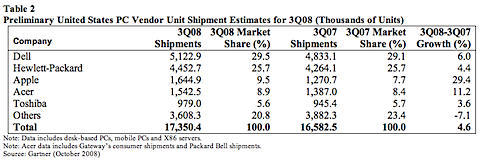
Apple’s share of the PC market reached nearly 10 percent during the third quarter. Although Cupertino retained the third position in U.S. shipments, Apple posted 29 percent growth, outstripped all other computer makers.
Gartner announced Apple controlled 9.5 percent of domestic PC sales, up from 7.7 percent a year ago. In stark contrast to Dell and HP which had 6 percent and 4 percent growth respectively, Apple had a more than 29 percent increase during the third quarter of 2008.
Apple sold 1.6 million Macs during the third quarter, up from 1.2 million shipped the previous year.
Tuesday, Apple unveiled a lower-priced entry MacBook onlookers saw as a response to concerns of slowing consumer spending. The company has set Oct. 21 to release third quarter sales figures.
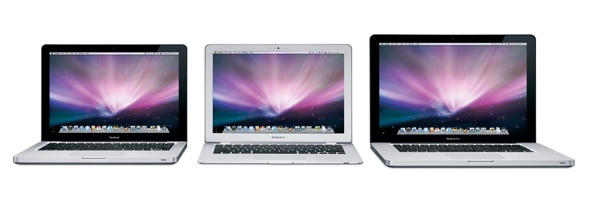
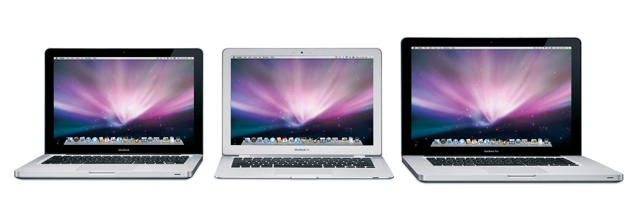
Apple promised that it would finally pull its attention off the cash cow iPhone and iPod product lines to spotlight notebooks at an event this morning, and they weren’t kidding. New MacBook, new Air, new Pro, and a new matching Cinema Display for good measure. The design team absolutely hit it out of the park on these machines, which are all glass, shiny black accents, and subtly tapered corners. Like the iMac whose design they refine and make significantly more appealing, these machines look like they were just made to sync with an iPhone or iPod touch (and, if anything, they make the continued use of white plastic docks for those devices look increasingly incongruous). This is Apple’s best design work, and it’s for a Mac — something we haven’t seen since the 12″ PowerBook G4 that I’m typing on was introduced. Read on for the Pros and the Cons…
The ‘will he or won’t he’ question was answered Tuesday when Apple CEO Steve Jobs announced he’ll offer a $999 MacBook in time for the holiday shopping season.
Although the price cut is on the entry-level 2.1GHz white plastic MacBook and not on one of the nifty unibody aluminum notebooks introduced, the news appeared to satisfy some analysts.
“I think it is important to note that MacBook pricing is coming down. Nobody is immune to the consumer,” Vijay R Rakesh, ThinkPanmure analyst, told Cult of Mac.
After talking up the benefits of a sub-$1,000 notebook, the rumor mill is now soft-peddling the idea as everyone waits for Cupertino’s notebook event slated for 10 a.m. Pacific (1 p.m. ET).
In a post claiming what will and won’t appear, Daring Fireball blogger John Gruber calls analyst speculation of $800 notebooks so much “jackassery” leading up to Tuesday’s unveiling.
Gruber and others are talking of Apple lowering to $999 the price of the 2.1 GHz MacBook which had cost $1,099. In addition, two new MacBook Pros and MacBooks will be introduced. Also rumored: a glass trackpad that also acts as a trackpad button and the replacement of Intel’s graphics chipset for NVIDIA.
“We would be surprised if they didn’t have a $999 MacBook option” for investors, Piper Jaffray Apple hardware analyst Andrew Murphy told Cult of Mac Tuesday.
“If not, (Apple) has some explaining to do,” Murphy said.
He bases his belief on Apple’s prior statements of a “product transition” prompting lower margins.
Monday, Bernstein Research analyst Toni Sacconaghi estimated Apple could gain up to 69 percent in potential revenue if a sub-$1,000 notebook is released.
Giant discount chain Wal-Mart in November may become the second retailer to sell Apple’s iPhone, a report said Monday.
Wal-Mart, which already sells a huge number of iPods, could announce a deal Nov. 15, just two weeks before the retail sector’s “Black Monday,” according to the Boy Genius Report website.
In September, electronics retailer Best Buy began selling iPhones, making it the first third-party retailer to offer the Apple handset.
Gartner analyst Ken Dulaney told Cult of Mac if the report is true, the addition of Wal-Mart with its 3,500 stores, would be a good move.
“Problem is that Wal-Mart shoppers are on budgets and the iPhone is expensive for them both in device cost and service,” Dulaney wrote in an e-mail.








 Now we’ve seen them, now we know. The new MacBooks and MacBook Pros are quite nice in some respects, and quite frustrating in others.