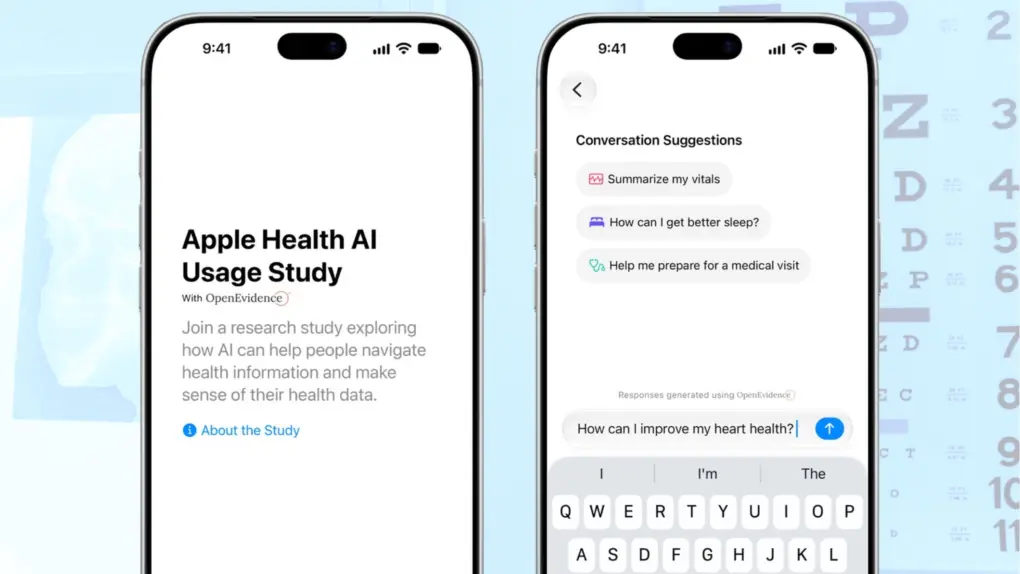
Apple just launched the Apple Health AI Usage Study, a research project that tests how people use AI for health questions.
The U.S.-only study takes a look at trust, clarity and everyday health decisions, with the aim of shaping how health gets designed at Apple.
Inside the Apple Health AI usage study
People are increasingly turning to AI chatbots like ChatGPT to get answers to health questions, understand medical test results and make sense of symptoms. Some also use AI to research potential treatments or prepare questions for their physicians. But the trend raises important questions about accuracy and trust, as AI can produce convincing answers that are incomplete or simply wrong. Apple is researching better options.
The Mac maker announced its study plans in a Sunday press release. Built in partnership with OpenEvidence, it runs through a dedicated iPhone app.
The company describes OpenEvidence as a clinical AI platform that’s widely used by healthcare professionals. Some of its answers draw from sources like The New England Journal of Medicine, the Journal of the American Medical Association and Nature.
Participants will be able to ask the app questions about everyday health, with answers coming from linked, peer-reviewed clinical citations. But the app presents complex medical information in easy-to-understand language.
Those participating can also choose to share HealthKit data like resting heart rate, activity, sleep or lab results. As it turns out, Apple wants to see how personal data affects relevance and understanding.
The study also aims to explore whether health AI can actually help people prepare for doctor visits.
Why Apple is running the research
Apple says it’s aware of large language models giving incomplete or unclear answers, which is why its research is critical.
“At Apple, we believe responsible innovation starts with scientific rigor and clinical grounding. Health is deeply personal, and conducting a dedicated research study is the most thoughtful way to understand how people engage with, comprehend, and evaluate health AI in everyday life,” said Sumbul Desai, M.D., Apple’s vice president of Health and Fitness. “Insights from this study will help advance the broader scientific conversation and ensure that as technology evolves, we continue building trusted tools that genuinely support people wherever they are on their health journey.”
Privacy and safety guardrails
Apple has clarified that none of the study data will be used to train AI models, but participants can choose if they share HealthKit metrics or survey responses.
The app also has guardrails to detect if someone is asking certain concerning questions. Following this, it also suggests meeting a provider or guides towards other resources.
Apple also stresses that the app is not meant to diagnose or treat any condition, nor does it replace professional medical advice.
How to join
The study is open for up to 200,000 eligible participants. They must be 21 or older and in the United States.
You’ll also need an Apple Intelligence enabled-iPhone running iOS 26 or newer. Those interested can download the study app from the App Store to enroll.

Anurag Chawake is a tech-focused writer specializing in smartphones, apps and consumer technology. His interest in computers began during the Windows 98 era, eventually leading him to explore everything from operating systems to mobile devices and PC hardware. Anurag previously contributed to The Indian Express, covering Apple, Android, gaming and the broader technology landscape.