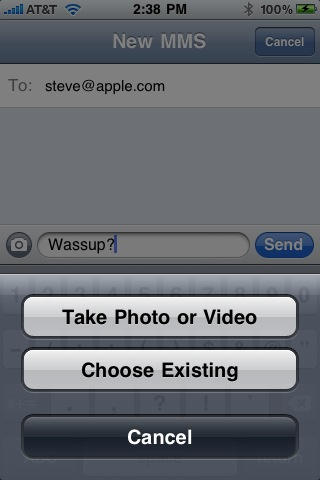
With Apple’s recent ridiculous app store refusals, now is the perfect time to free your phone. Jailbreaking your device might seem too difficult to take on, but by following the steps below you can easily add a video camera to your 3G, or tether your Macbook to your 3GS. This How-To will guide you through jailbreaking your specific device using either Pwnage Tool or Redsn0w. Also included are simple instructions to unlock your device, letting you use it with different carriers.
Note: 3GS, 2nd gen and 3rd-gen iPod Touch owners who have recently updated to firmware 3.1 cannot jailbreak their phones unless they revert back to 3.0.1.
Every now and again, a game comes along that makes you feel like a ham-fisted idiot, as though you’re clawing at your iPhone or iPod touchscreen with all the grace of a lobotomised monkey wearing boxing gloves. But the game is so compelling and addictive, you play on anyway, getting killed approximately every ten seconds, going ARRRGGGHH and then having another go anyway. Eventually, you realise that it’s you, not the game. The game isn’t unfair—you’re just rubbish, and you need to learn how to improve, just like in the old days with the likes of Defender.
Squareball by Finn Ericson ($1.99/£1.19, App Store link) is one such game. The concept is simple: drag the levels left or right to ensure your ever-bouncing ball doesn’t disappear into a hole or hit red tiles, and collect all the green tiles before the timer runs out. With graphics akin to Atari’s Adventure in pseudo-3D and a fab soundtrack, this game’s had me addicted and loving it and hating it in equal measure since its day of release. Today, I interviewed its creator to find out how this retro-themed mix of Pong, Breakout and simplified Super Mario-style platformer came to be.
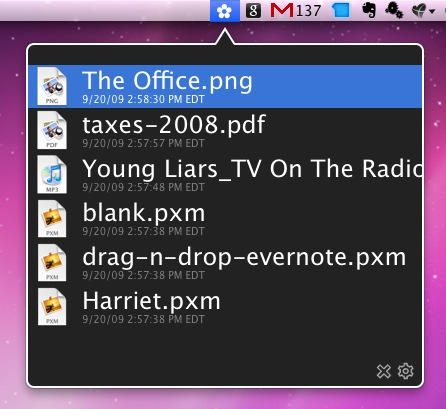
Now this looks interesting: Blasted is a Menu Bar app that quietly tracks what you’ve been working on – all the files you’ve created, opened, or modified recently – and makes them available when you need them via an unobtrusive icon.
It’s Friday and it’s time for a weekly digest of tiny iPhone reviews, courtesy of iPhoneTiny.com, with some extra commentary exclusive to Cult of Mac.
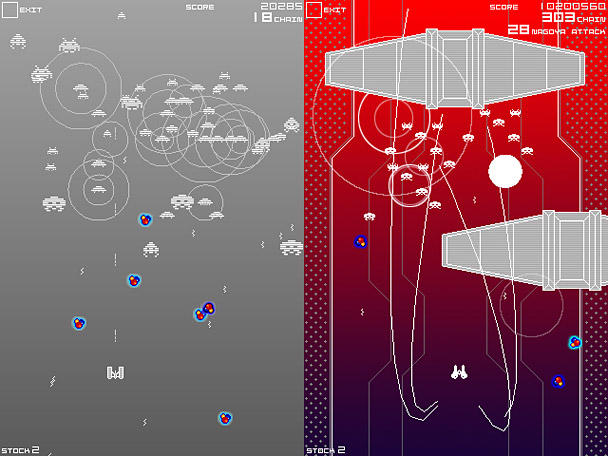
This week, I review Smart Maps – Brussels, Who’s Buying, Tasks – Tick If Off, Pac-Man Remix, FortuneBall, Mr.AahH!! Lite, Space Invaders Infinity Gene, A Quest of Knights Onrush, Power Toppler, and CrunchUrl.
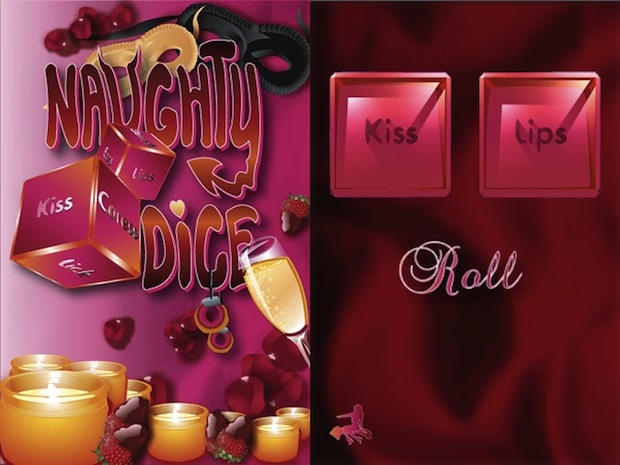
News of Apple’s refusal to allow 17+ app promo codes broke with this Cult of Mac interview with James Miller, Director of Marketing for Trichotomy Media. Naughty LOADED Dice, a foreplay game with a secret menu to dictate dice rolls, snuck past the Apple censors and made its way onto our iPhones and into our bedrooms.
In a recent email to Cult of Mac, Trichotomy Media attributed our coverage of the promo code refusal as instrumental in their reinstatement. To celebrate free love and free iPhone apps, we’re giving away a Naughty LOADED Dice promo code.
Just comment on this post with your favorite dictator, fascist, suppressor of freedom, book burner or other comment and you’ll be entered to win. Contest ends midnight, September 20th.
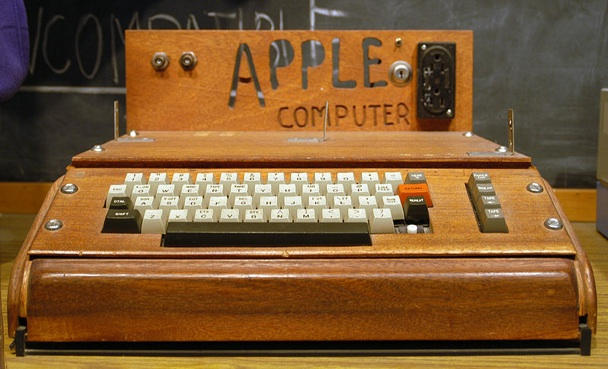
A man describing himself as an “82-year-old antique” is putting a relatively young 32-year-old Apple I for sale on eBay in the next few weeks.
One of 200 computers hand made by Steve Wozniak, somewhere between 30 and 50 are thought to be still around. (If you’re more interested in seeing one than buying one, the Smithsonian has an Apple I on display as it’s being presented to the Homebrew Computer Club in Palo Alto).
Back in July 1976, the Apple I sold for $666.66. The computers, sold in a kit, came with 4KB standard memory, that you could bump up to 8KB or 48KB with expansion cards. You had to add your own case, keyboard and display.
Guesstimates say the computer could fetch between $14,000 and $16,000.
The seller wrote in to San Francisco Chronicle tech columnist David Einstein about how he might get publicity for the sale.
Einstein replied, “I don’t think your computer is valuable enough to spark much general media interest before you sell it.”
Alas, he underestimated the Cult of Mac. Mr. Antique, we want to hear from you!
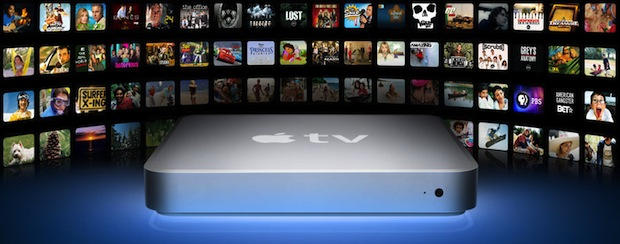
A major update of the Apple TV may be in the works.
Apple has slashed the price of the 160GB Apple TV to $229 (from $329) and discontinued the 40GB model. Meanwhile, it looks like Apple’s new iTunes LP — a new format for multimedia music bundles — is designed for high-resolution output on the AppleTV.
The iTunes LP content is output at 1,280-by-720, the native resolution of an Apple TV when hooked to a high-definition TV. Apple’s new iTunes Extras (bonus movie material usually included on bonus DVDs and now available for download on iTunes) is also designed to be output at the same high resolution. While this is natural for movie content, it’s a curious choice for music content, albeit multimedia music content, which might naturally be formatted for playing on computers and laptops.
Which all points to a major update for the Apple TV in the near future. The AppleTV hardware has remained essentially unchanged since its introduction, although it has received a couple of software upgrades.
The 160GB model is the only configuration of the Apple TV now on offer. The 40GB Apple TV was previously priced at $229.
Steve Jobs usually refers to the AppleTV as a “hobby,” and not a real business. The choice of movies for the device on the iTunes store remains relatively limited.
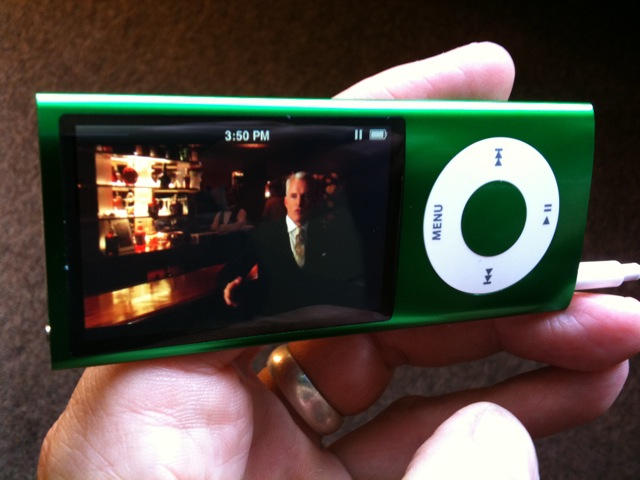
Apple’s new fifth-generation iPod nano, now with a video camera, is a perfect pearl of 21st-century technology. It’s a lovely piece of electronic jewelry that does almost everything except dispense pints of beer.
It can record video, play movies, store weeks’ worth of music, wake you in the morning, remind you of a dental appointment, record how many steps you walked to work, and how long it took you. It remembers all your contacts, records voice memos, stores your shopping lists and plays a bunch of games that are controlled by tipping and tilting the beautiful little device.
It’s easy to get complacent about Apple’s iPods, new ones come out so often. They’ve got to be 3D holographic auto-mastubators to get anyone’s attention. But take a step back, and it’s pretty astonishing how much advanced technology is stuffed into such a tiny device, and how beautifully it’s done.
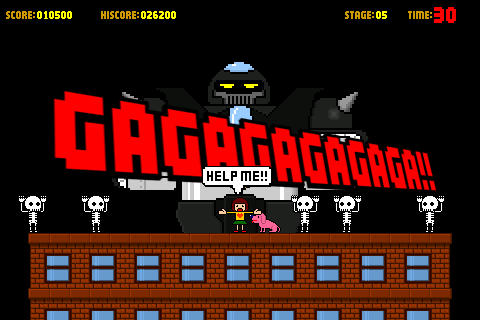
GAGAGAGAGAGA!! Giant Metal Robot unhappy with anti-iPod-gaming crowd!
I’ve been a gamer since the very early 1980s, and have owned more systems than you can shake a stick at. A year ago, I happily penned an article for this very site, suggesting iPod gaming was a crock of shit. And you know what? I was dead wrong… absolutely, painfully, utterly, astonishingly wrong. The fact is, iPod is the most exciting platform for gaming we’ve seen in years.
Alan Kay, the computing visionary who first envisioned the Dynabook computer concept, worked at Xerox PARC and helped make the original Mac amazing, is one of my favorite technology philosophers. Simply put, he had a way of turning a phrase when discussing the progress of technology that could bring clarity to a muddled topic.
Of all his quotes, my favorite is also one of his most casual. He said that the Macintosh was “the first personal computer good enough to criticize.” In his mind, everything else had been so crummy that to begin listing faults would pretty much convince you that PCs shouldn’t exist at all. Ever since, the mark of an emerging technology’s arrival is the point at which it becomes good enough to begin figuring out what’s wrong with it.
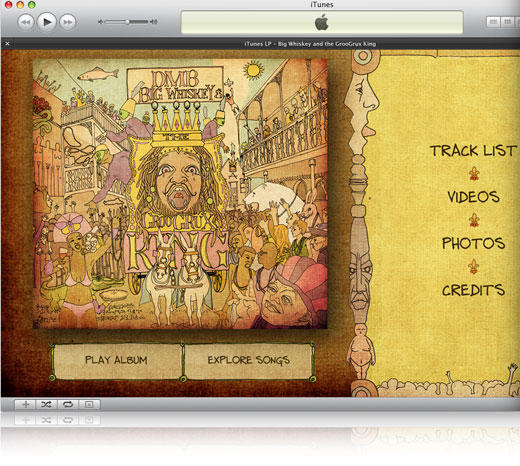
And of all of Apple’s announcements this morning, only the digital album format iTunes LP (also known as Cocktail) qualifies as a major improvement to a nascent technology. Simply put, though Apple long ago figured out how to sell music as digital downloads, it’s taken until now for them or anyone else to get in the ballpark of how to make those downloads feel anywhere near as special as a physical CD or LP.
Having played around with it for a bit (and watched several more demos of albums I haven’t picked up), it’s quite clear that Apple’s made a huge leap forward. And in so doing, it has made it abundantly clear how far they have to go.
Here are five steps Apple could take to make iTunes LP a competitor with your vinyl collection:
1. Get It Off My Computer and On My Devices The nice animation, visuals, video, and lyric displays offered for the first round of iTunes LP are nice and all, but I don’t actually spend a lot of time focusing on my music when playing it back off of a computer. iTunes is a background task most of the time, and even this immersive experience won’t change that — and it’s kind of weird to “page” through liner notes with mouse clicks. The entire look and feel is dramatically more suited to the iPhone or, dare I say it, a tablet computer. If Apple brings multitouch into the equation, maybe the format will restore some of the emotional connection to the tangible object of music in some way. For now, this is some nice animation I’ll never look at again.
2. Offer Lossless Audio Files At this point, the only people who are under the impression that limiting the supply of legitimate digital music actual limits the piracy of music work for record companies, yet it’s nearly impossible to buy truly CD-quality (or better) digital audio from major recording artists online. Apple should use the opportunity presented by iTunes LP to significantly up the quality of its audio to make the music itself sound more special.
3. Make it Simple for Artists to Use Do you know how many iTunes LP titles are available today, the first day of launch? Six. A 43-year-old Bob Dylan record you should already own, a greatest-hits collection from the Doors, American Beauty by the Grateful Dead, the new Norah Jones, the new Dave Matthews Band, and actor Tyrese Gibson’s way-autotuned comic book mash-up MAYHEM! Something for everyone, eh? If that somehow isn’t enough music for you, Apple is offering five (5!) additional albums for pre-order.
Yeah.
Clearly, the format is too complex for artists and labels to get behind yet. If you have the budget of Dave Matthews or Bob Dylan, you can have people make it for you, but if you’re pretty much every other artist, taking advantage of the format will take some (or a lot) or doing. If Apple wants this to become a de facto standard for digital albums, it needs to make this a blindingly easy process for artists to participate in — as easy as submitting your record to iTunes for sale. I don’t know exactly what that looks like, but it’s a clear key to success.
—-
Again, iTunes LP is a fascinating effort. But it’s only good enough to criticize. The next year will be Apple’s opportunity to get it right or watch this concept go the way of the enhanced CD.
When i was younger I worked as a house painter and had a great JVC boombox that blasted punk tunes to everyone’s annoyance.
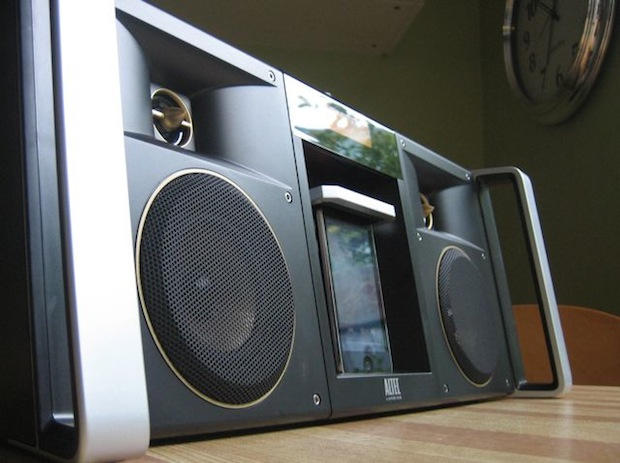
That’s why I like Altec Lansing’s new $300 Mix iMT800, a ghettoblaster for the iPhone age.
The Mix Boombox is loud and obnoxious, like a boombox should be. It mixes old school block-rockin’ beats with new school digital connectivity. It easily fills a room with sound and can piss off the neighbors, even in the daytime.
Noted cogitator Jason Kottke has an interesting thought on the experience of getting fully up to speed with brand-new Apple hardware and software. Basically, things have gotten so good that, barring minor speed improvements, you can’t tell any difference between new and old. He terms it “The Apple Upgrade Problem”:
“Which is where the potential difficulty for Apple comes in. From a superficial perspective, my old MBP and new MBP felt exactly the same…same OS, same desktop wallpaper, same Dock, all my same files in their same folders, etc. Same deal with the iPhone except moreso…the iPhone is almost entirely software and that was nearly identical. And re: Snow Leopard, I haven’t noticed any changes at all aside from the aforementioned absent plug-ins.”
Jason’s on to something interesting here. If you are a frequent Apple upgrader, you get far less of a thrill than if you wait a long time between devices. Consider the negligible differences between last year’s MacBook Pros and this year’s (unless you love battery life, FireWire, and SD cards, there’s not much to discuss). Or between the first video-capable iPod nanos and the current models (styling and form factor tell the whole story). And that’s without mentioning that it’s literally impossible to tell a 16-gig iPhone 3G apart from a 3GS.
So what does this mean?
For most people, very little. Unless you’re buying replacement hardware on an annual or at most biannual basis, you won’t have these kinds of difficulties. I, for one, had an iPod from 2004 that lasted me until I bought a green nano last year — huge leap forward. My PowerBook G4 stuck it out for five-and-a-half years before my beloved unibody MacBook arrived. And I won’t even go into just how much better the iPhone 3GS is than the BlackBerry Pearl it replaced.
For some people, Apple’s current predictability is a major boon. For corporate purchasers for example, the ability to requisition multiple models of a computer and not make it clear in the design who has the nicest or newest machine is a big deal for IT. That way I don’t get jealous when my 2008 unibody MacBook starts to age unfavorably against what I can only presume will be a 2010 unibody MacBook Pro. That’s true on iPhones, too, where executives who adopted a 3G last year don’t look hopelessly out of date around their 3GS-packing peers.
Honestly, the more I think about it, the very few people who are negatively affected by stuff like this are Apple’s most diehard fans — creative professionals who rely on new Mac hardware and software to help them do great work. The same people, it should be noted, who carried Apple through its darkest days. I’m less concerned on the hardware front (Apple always sticks with a design for a few years to avoid costs and focus on bigger leaps forward), but in software, it is a niggling question. And if the Mac isn’t providing creative pros with interesting novelty and inspiration, Apple isn’t executing on the fullness of its mission — where’s the creativity?
Now, it’s clear that Snow Leopard was a deliberate pause in the OS X development cycle to make sure that everything just worked a whole lot better. Other than a few front-stage changes, it was meant to invisibly make your existing Mac more stable and speedy. The question remains just how Apple will evolve OS X next. There are a lot fewer gaps than there used to be — and so much interesting work to be done in mobile and other touch interfaces.
What do you think — is there interesting work to be done on OS X as we know it? Or does Snow Leopard signal an end to innovation in conventional desktop operating systems?
Apple is already setting up shop for Wednesday’s “It’s only rock & roll” press event that will likely see new iPods with cameras and the return of Steve Jobs to the public eye.
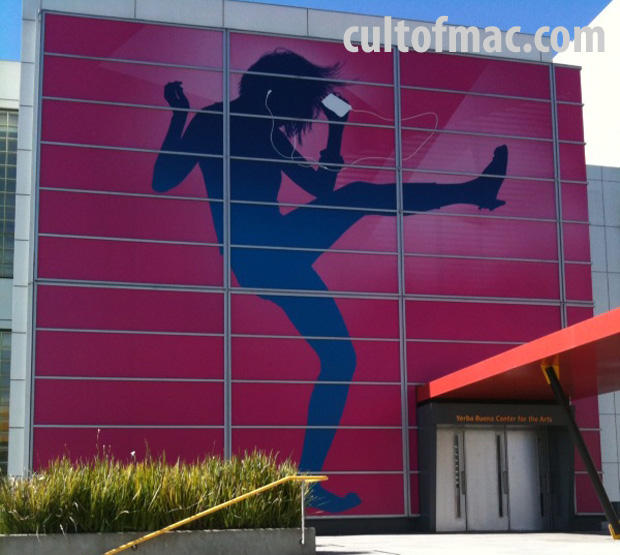
Apple has already hung a big banner on the front of the Yerba Buena Center for the Arts in San Francisco — the venue of a press event next Wednesday at 10AM. The company last week sent invites to reporters with the line: “It’s only rock and roll, but we like it.”
The banner out front shows a rockin’ iPod chick kicking her feet in the air as she freaks out. The company has also hung a big banner inside the front door with a white Apple logo on a silver background.
There are no other posters visible inside the venue. The center is crawling with security guards. There are half-a-dozen security guards with Apple-logo shirts at the front, back and sides. Apple will likely have a 24-hour security detail until the event starts on Wednesday.
There’s a TV van already parked to the side on Third Street. The van is likely there to transcode video from the event for distribution via iTunes and Apple’s website, which the company typically does just after the event ends.
The event will likely see the introduction of new versions of the iPod touch and iPod nano with built-in cameras, which has all but been confirmed by dozens of cases for the new devices. There will also likely be a new version of iTunes with built-in hooks to social software like Facebook.
The event will also probably mark the return of Steve Jobs to the public stage. It’s hard to imagine he’d let the event happen without him, even if it’s just a few words at the start. But let’s hope he’s well enough to MC the whole show. He’s been missed in the last year. No one does an Apple event like Jobs.
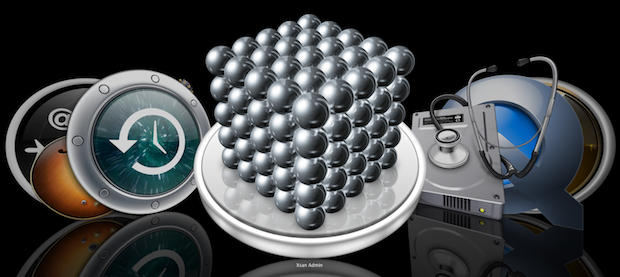
All the icons for folders and apps in Snow Leopard are now drawn in glorious 512 x 512 pixels. It’s a step toward making the operating system resolution independent, and perhaps also to make Snow Leopard a touchscreen friendly OS.
But it’s also obviously done just for the art of it. These icons are real beauties. They are full of great details and little surprises. One icon contains the words to a song, visible only if you blow it up to its full size.
If Apple wanted to stand the world on its ear next Wednesday at the It’s Only Rock and Roll But We Like It event in San Francisco, the company would announce it is opening iPhone software development to all comers and is dropping the facade of exclusive distribution through the iTunes App Store.
Heresy, you say? Perhaps in the eyes of some, but read on to learn why those two moves would be best for the company, the platform, for developers and – most of all – consumers.
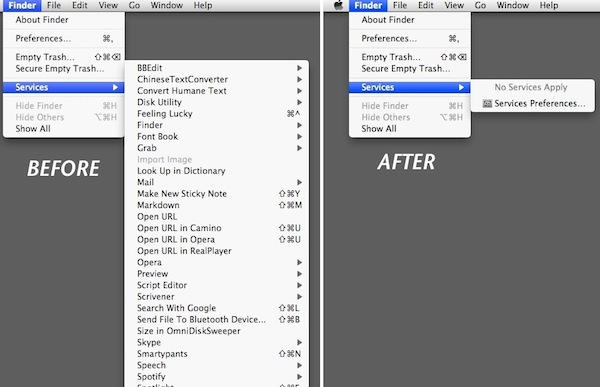
Snow Leopard’s revitalised Services menu is probably my favorite improvement among the many included in the upgrade.
At long last, the user has been given total control over Services. We can choose whether or not they are used, we can assign keyboard shortcuts that suit us, and we can create entirely new Services using Automator.
The crucial difference between Services in Leopard and Services in Snow Leopard is context.
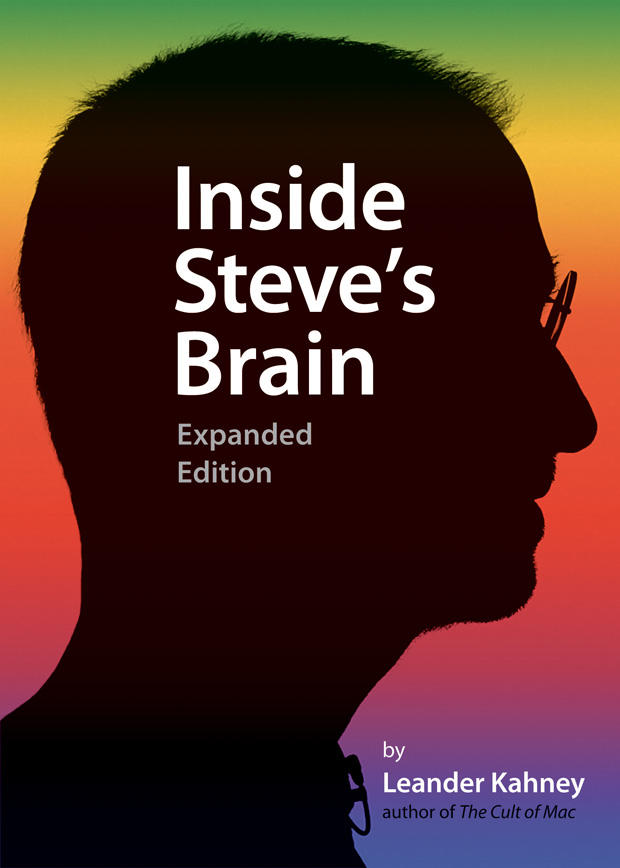
Coinciding with Steve Jobs return to the public eye next week, Penguin Portfolio is reissuing my book Inside Steve’s Brain with a new chapter about how Apple will cope without its dynamic CEO.
Published in April 2008, Inside Steve’s Brain was a New York Times best-seller and an international hit (translated into 15 languages and a best-seller in Brazil and Italy). But the book was written before Jobs’ recent liver transplant, so the publisher asked me to update it for a second edition.
Jobs will take the stage next week at Apple’s special press event to show off new holiday iPods to the press. He has to: If he doesn’t show up Sept. 9, there’ll be a media shitstorm and Apple’s stock will tank.
Jobs’ last public appearance happened exactly a year ago. Last Sept. 9, he presided over a similar iPod event at the same venue. Bloomberg had accidentally published Jobs’ obituary, and when he appeared onstage he flashed a slide with Mark Twain’s famous line: “The reports of my death are greatly exaggerated.”
Indeed. One liver transplant later, Jobs is still with us, thank God. But there will be a time when Apple will have to do without its supreme leader, and as I explain in the new chapter of Inside Steve’s Brain, the company will be both royally fucked and totally OK when the inevitable happens.
The more I play with Snow Leopard, the more it looks like it’s designed to run Apple’s upcoming tablet.
Look at Expose in the Dock — the new feature that reveals all an application’s open windows when you click and hold the application’s icon. It’s tailor-made for fingers. Even more convincing is Stacks in the Dock. Hit a folder icon in the dock, and up pops the folder and all its files. Each icon is a big target for your finger, and the window has a big, fat slider for scrolling up and down (no more fiddly little arrows at the top or bottom). Both of these UI tweaks scream ‘touchscreen.’
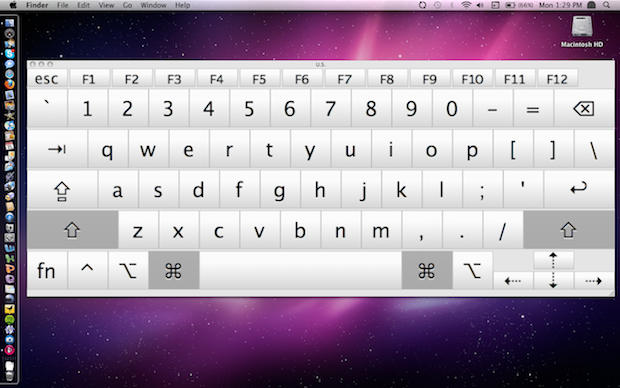
And then today I discovered an unheralded feature that the minute I saw it, I thought, “Game over! Here’s rock-solid proof that Snow Leopard is designed for touchscreens. This is a tablet operating system.”