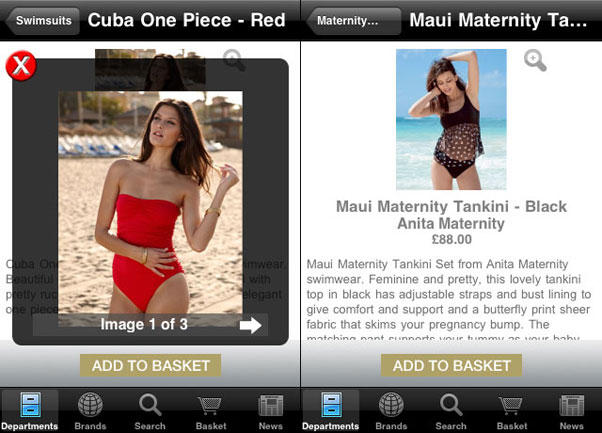
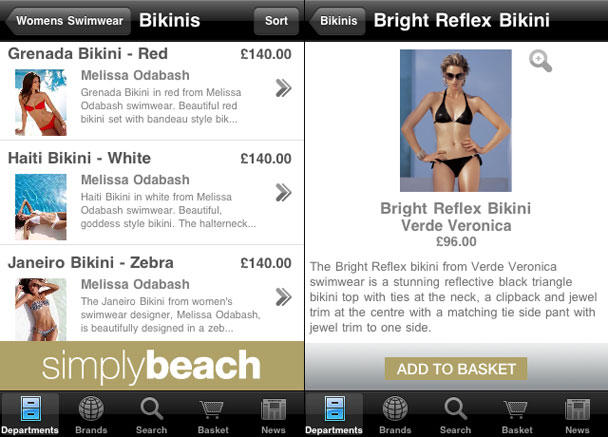
On Friday, Simply Beach received an email from Apple about the decision to remove any overtly sexual content from the store and that included the Simply Beach application.
“The email also made mention to numerous complaints they had received from customers regarding ‘this type of content’ and implied it was these complaints which had led to the changes,” says the app’s developer, Andrew Long. He added that Simply Beach thought this was a hoax.
The mobile porn company Pink Visual calls Apple’s purge of 5,000 or so saucy apps “delusional corporate revisionism.”
The company, whose slogan is “we innovate, you masturbate,” had its “Cutest Girls” app yanked in the App Store purge. Noting that apps from Playboy and Sports Illustrated were untouched, the company’s Director of New Business Development, Liam Colins, issued a statement that said:
“Apple has taken their brand control beyond normal standards, and this is one basis of their remarkable success. When they are attempting to control and dictate what is viewed, listened to and utilized by consumers on devices they purchased and pay for monthly, however, it becomes an act of censorship, pure and simple. Mobile porn exists, it is prolific and it is desired by many of Apple’s customers. To pretend that people will not watch porn or seek out sexual content on their iPhone or iPods is delusional corporate revisionism.”
The statement continued:
“The fact that they left Playboy and Sports Illustrated up indicates that this action is not only hypocritical, but that it is based more on corporate strategy than on any deeply felt scruples or actual consumer complaints. Do they seriously expect people to believe that a kid seeking out inappropriate content via the app store would try searching for ‘Sunny Leone’ before searching for ‘Playboy’?”
Apple’s COO Tim Cook was extremely bullish on Apple’s prospects in 2010, in spite of economic gloom and increased competition in phones and PCs.
Speaking to a handful of Wall Street analysts on a Goldman Sachs webcast, Cook predicted the iPad will be a hit and that the Mac will continue to grow, especially in enterprise. And thanks to the recession, Apple will open dozens of “jaw-dropping” new stores this year in prime locations.
Three hardware deals are on tap for today. We start with a $499 deal on 2GHz Mac mini desktops from the Apple Store. (These items seem to be flying off the shelf, so order now, if interested.) Also up: $119 for 16GB iPad nano MP3 players. We round out our top three daily deals with 8GB iPhone 3Gs for $99 from AT&T.
Along the way, we check out the latest batch of App Store price drops, including NBA League Pass Mobile, the ‘Conan Says’ Soundboard for iPhone and iPod touch users, and a $100-off deal on iPhones from Best Buy. As always, check out CoM’s “Daily Deals” page after the jump for details on all of these items.
They might have cancelled the follow-up to their cute little rolling blob series, Rolando, because it couldn’t be turned into a “freemium” title, but iPhone game startup Ngmoco clearly isn’t doing bad itself: they’ve raised $25 million in capital fund and purchased Freeverse.
Who is Freeverse? They’re another popular iPhone gaming company, responsible for titles such as Moto Chaser and Skee-Ball.
The move should allow Ngmoco to take their successful “freemium model” — in which games are free for users to download or play, while the developers themselves make their money through in-game advertisements and in-app purchases — and roll-it out to their recently acquired Freeverse titles.
As a business model, it makes a lot of sense: with the average price of apps ever plummeting, Ngmoco’s freemium approach allows them to give most users what they want — a free, simple game to play — and squeeze revenue out of them anyway. I don’t necessarily think that leads to very sophisticated games in the long run… but most people don’t want sophistication, they want entertainment.
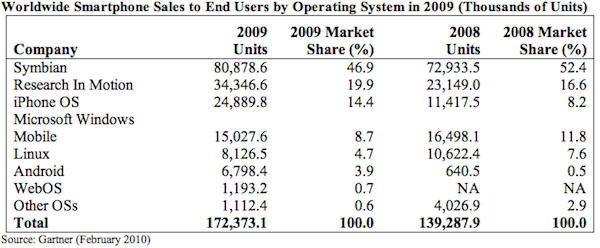
Apple’s iPhone had the third largest share of the worldwide smartphone market in 2009 with 14.4 percent of the market, shipping 24.9 million handsets, analysts said Tuesday. In 2008, Apple had only 8.2 percent of smartphone sales and sold only 11.4 million iPhones.
Apple’s share of the market grew 6.2 percent in 2009, making it the fastest-growing handset maker and knocking Windows Mobile out of the third spot. (In December, reports said the iPhone had overtaken Windows Mobile in the United States.)
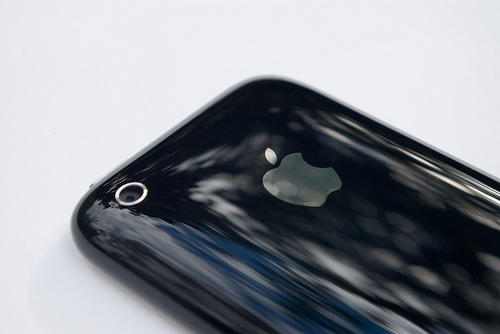
The iPhone 3GS. Creative Commons-licensed photo by Fr3d: http://www.flickr.com/photos/fr3d/2660915827/
Is Apple considering its iPhone OS for products other than the iPhone and iPad? A new job ad by the Cupertino, Calif. electronics maker seeking an Engineering Manager suggests such an expansion could be in the works. The manager would be tasked with leading “a team focused on bring-up of iPhone OS on new platforms.”
Such a team would be responsible for “low-level platform architecture, firmware, core drivers and bring-up of new hardware platforms,” according to the job listing posted last week and first spotted by Computerworld.
Let’s face it: crushing disobedient flesh into a Dolce & Gabbana corset dress is easier than getting into one of their runway shows.
So the dynamic fashion duo has decided use the iPhone to broadcast 2011 women’s winter looks at two shows during fashion week in Milan. You can follow them with your iPhone here or, if you don’t have an iPhone try your buffering luck with Facebook, too.
iPhone fashionista followers won’t get that neck nasty cramp caused by gazing upward from first-row seats like D&G darlings J-Lo or Victoria Beckham, but you may have to get up early or sneak a peek at work.
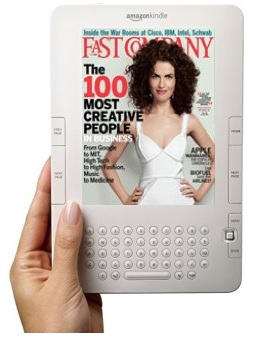
Is Amazon planning to morph its Kindle e-reader into an all-purpose tablet PC and take on Apple? That’s the thinking of one analyst who views a Monday announcement with Microsoft as potentially the first signs of a ‘KindlePad.’
“Amazon is going to build a ‘KindlePad,'” MKM Partners analyst Tim Boyd told Barron’s Monday. Amazon will pay an undisclosed amount for a cross-licensing deal with Microsoft. The arrangement gives the online retailer access to the software giant’s intellectual property while Microsoft can use Amazon’s Linux-based servers. Amazon’s Kindle is specifically mentioned.
Amazon may have sold 3 million Kindles since the e-book reader was introduced, a recent report suggested. Although the company has been reticent about specific sales figures, CEO Jeff Bezos told analysts “millions” of consumers own Kindles.
Danish newspaper Information‘s latest cover was a delightfully dead pulp fake of the iPad’s touchscreen display.
The cover story is the same “print is dead” piece we’ve seen countless times before, prophesying that the only future of publishing is digital, with the iPad as one of many Messiah-like devices that must be embraced by the public in order to save the traditional print industry.
Well, the iPad certainly isn’t going to hurt the chances of print, but if the recent reports that the New York Times is considering charging its subscribers $30 a month for the iPad version is anything to go by, the biggest hurdle is going to be getting old media to run their businesses more intelligently and efficiently in the digital age… and nothing Steve Jobs can do is going to help them with that.
A potentially revolutionary way to stream next-gen video games to hardware technically too underpowered to run those titles natively, thin client OnLive might be the best thing to happen to gaming since, well, the Internet.
Essentially, the technology works by making a game into an interactive, streaming video, rendering all the gameplay on a beefy server, compressing the video and shooting it off to you as you play. Imagine, for example, playing a shooter like Crysis — which can cripple even a top-of-the-line PC — on your iPhone. Actually, scratch that, because you don’t really have to: at this year’s DICE Summit in Las Vegas, OnLive CEO Steve Perlman gave a brief demonstration of Crysis running on Apple’s handheld.
If the idea of playing full-featured, next-gen games on your iPhone doesn’t get you excited, it gets better: Perlman has also confirmed that OnLive will support tablets, clearly giving a wink and a nod to the iPad.
The only question is: will OnLive be able to solve the latency issues inherent in the thin client gaming approach? Perlman swears it’s feasible, as long as each OnLive user is within 100 miles of a server, but a high ping’s a deadly thing in an FPS. OnLive could very well be a revolution… but at the end of the day, I think we’ll be more likely to be playing slower-paced games like Civilization V through our iPad OnLive client than Crysis.
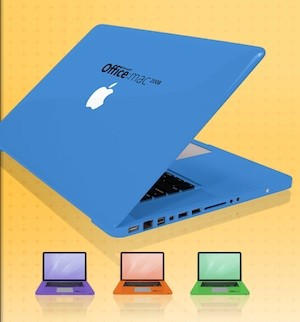
Office for Mac isn’t exactly a software suite most Apple fans pick up unless they absolutely have to, but if you don’t mind compromising your integrity a little bit, you can pimp Office on Twitter a little bit and automatically enter yourself into a drawing to win one of two 2.53GHz, 15-inch MacBook Pros.
All you need to do is either follow officeformac on Twitter, or retweet @officeformac while including the #officeformac hashtag. With a little bit of luck, you’ll win one of the garishly repainted, Office-branded MacBook Pros.
Unfortunately, it’s only open to residents of the US or Canada, which means Microsoft is missing a golden opportunity to bribe at least this Germany-based Apple blogger into saying some good things about their products. If you’re interested, you better get moving: the give-away ends on Thursday.
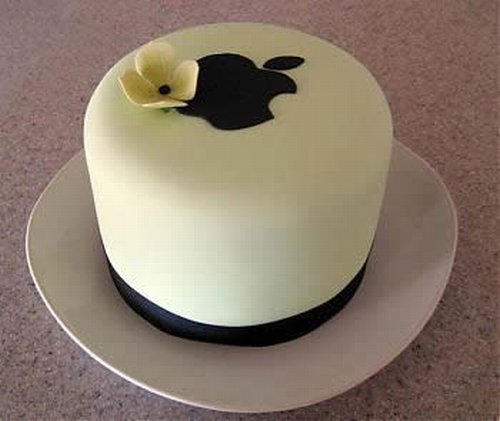
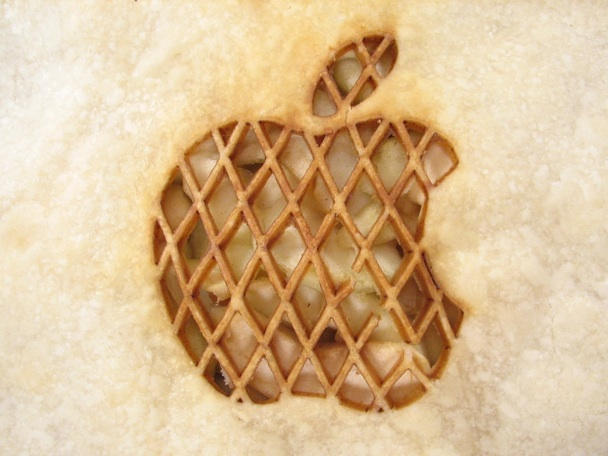
The kind of minimalist Apple-logo cake Steve Jobs might like
Tomorrow is Steve Jobs’ 55th birthday. Many happy returns Steve.
Steve Jobs was born February 24, 1955.
To celebrate his birthday, we’re replaying Jobs’ great 2005 commencement speech to Stanford University’s graduating class.
Delivered just a year after being treated for cancer, Jobs is uncharacteristically open about life and death. If you’re interested in learning more about when Steve Jobs was born, check out this detailed look at his life and legacy.
Jobs tells three simple stories from his life, and they all include some some great advice. He advises to trust your gut, follow your heart and do what you love.
It’s a great speech. The video is 15 minutes long. If you haven’t seen it, you should.
The video and full transcript of the speech after the jump.
If this is what Apple considers 'overtly sexual' content, we fear for civilisation itself - and the entire company needs to get out more.
Complaints from women are behind Apple’s recent purge of sex-themed apps, Phil Schiller told the New York Times.
Philip W. Schiller, head of worldwide product marketing at Apple, said in an interview that over the last few weeks a small number of developers had been submitting “an increasing number of apps containing very objectionable content.”
“It came to the point where we were getting customer complaints from women who found the content getting too degrading and objectionable, as well as parents who were upset with what their kids were able to see,” Mr. Schiller said.
Aerial footage of Apple’s massive data center in rural North Carolina clearly show how large the $1 billion complex is.
Shot recently by a local realtor, the footage shows a massive facility the size of a shopping mall.
Experts note that Apple’s data center will be among the largest in the world, rivaling centers run by internet giants like Microsoft and Google. The unusual size of the data center suggests that Apple is investing heavily in cloud computing. At 500-000 square feet, the facility is five-times the size of Apple’s West Coast center in Newark, Calif.
Apple has said little about the complex, except that it’ll be its east coast data hub.
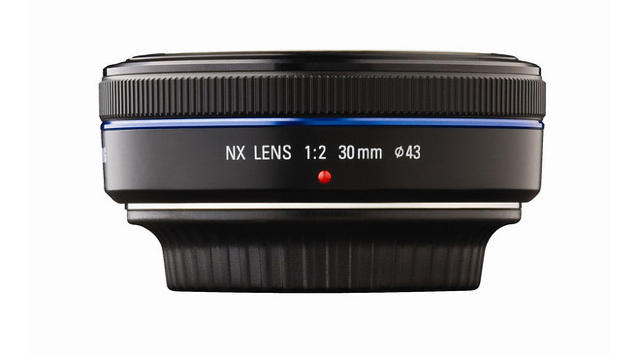
Samsung over the weekend unveiled five lenses for its recently introduced NX10 camera. The lenses are small enough to fit on the NX10, often described as one of a growing number of compact EVIL cameras with Electronic Viewfinders and Interchangeable Lenses.
Available in the first half of this year, the lenses include the following: 18-55mm f3.5-5.6, 20mm f2.8 “pancake”, 60mm f2.7 macro, 20-50mm f3.5-5.6, 18-200mm OIS f3.5-6.3. (The lenses join the 30mm, 18-55mm, and 50-200mm lenses introduced at the CES.)
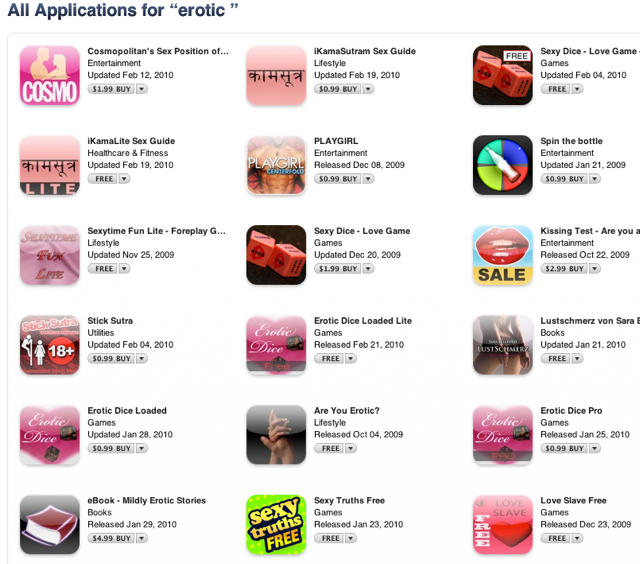
Erotic Titles Available on iTunes Feb. 22, 2010 10:30am PST
Apple’s App Store Porn Police or, perhaps the Puritanical Posse, if you prefer — has its work cut out if it’s to make Steve Job’s new decision stick and ban “overtly sexual apps” on the App Store.
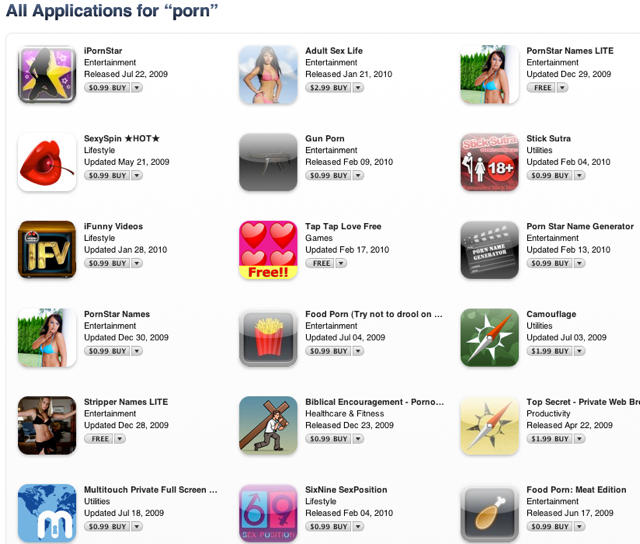
As a previous post pointed out, some culling of the filth and froth has already begun, invariably taking down relative innocents in its wake. But the images posted here, snagged within the past half hour from the iTunes menu of available titles, give an idea of how thin the ranks may have to become before Apple’s online emporium has as squeaky clean a catalog as some might want.
Tellingly, too, it will be interesting (as some comments to the ongoing SEXGATE coverage have pointed out) whether Playboy and Sports Illustrated will ever be deemed too “overtly sexual” to have a place at the App Store table.
Hypocrisy, is thy name Apple?
Porn Titles available on iTunes App Store Feb. 22, 2010, 10:30am PST
We kick-off the last week of February with two hardware deals and one software bargain. First up is a Mac Pro for $2,649. The desktop unit has 4 cores and pumping at 2.66GHz. Next is a fresh batch of App Store freebies, including geoLocals 3, a location-based search search application. The final top deal is the CiragnoTV Mini USB media device. You can take video stored on USB or a memory card and display it all either on a TV with HDMI or a simple AV connection.
As always, for details on these products plus many others, be sure to check out CoM’s “Daily Deals” page right after the jump.
UPDATE (23 February): The Simply Beach developer just emailed us to say that “Apple appear to have quietly reinstated the Simply Beach app this evening”. He notes that neither he nor his customer received any communication whatsoever from Apple.
Ourrecentarticles on Apple’s decision to ban “overtly sexual apps” have caused plenty of arguments in the comments. Some (including your correspondent) think Apple’s being ridiculous, overbearing and taking a dangerous path in initiating a blanket ban on even extremely mild content, such as images of women (or, er, men) in bikinis. Others claim Apple should be applauded, and they can’t wait to see the back of apps with sexual content, no matter how mild.
However, Apple’s stance hasn’t only affected the likes of iWobble, as Andrew Long of software development company Exploding Phone explains: “One of our customers has fallen foul of Apple’s new puritan crusade—the crazy thing is, the customer is an online beachwear retailer, Simply Beach, that happens to sell bikinis via an online store and the accompanying iPhone app that we developed for the company.”
Andrew notes that Apple removed the app without warning. On Friday, Simply Beach received an email from Apple about the decision to remove any overtly sexual content from the store and that included the Simply Beach application. “The email also made mention to numerous complaints they had received from customers regarding ‘this type of content’ and implied it was these complaints which had led to the changes,” says Andrew, adding that his customer initially thought this was a hoax.
If this is what Apple considers 'overtly sexual' content, we fear for civilisation itself - and the entire company needs to get out more.
At the time of writing, Apple has yet to respond, and Andrew resubmitted the app with a much increased age rating, although he states: “Neither we nor our customer believes that the content warrants a rating.” The app also has some heavy investment by the swimwear company, and was soon to have had a revision including multi-currency pricing and video streaming. “This upgrade is now under threat until we find out where Apple’s puritan values lie,” said Simply Group MD Gerrard Dennis in a press release. “This has put people’s jobs at risk as we rely on all income streams. We are not Apple, we don’t have billions sat in our bank account! It would have been better to have had some warning or discussion before removing the app. I assume all clothing retailers that sell anything other than overcoats will now have to be removed from iTunes?” (our emphasis)
“Personally speaking, I think the decision is ludicrous, but to be honest not much that Apple does surprises me any more,” says Andrew, stressing that his views don’t necessarily reflect those of his customer. “As an iPhone developer you have to be prepared for the goalposts to shift unendingly and be as dynamic as you can in changing to meet the new way of life.” However, in this case, Andrew thinks it’s clear the content is not ‘overtly sexual’: “Apple has clearly been overzealous and inconsistent in trying to rid the App Store of ‘bikini blight’. It makes a mockery of the rating system, too, which is surely there to ensure that questionable content doesn’t get into the wrong hands.”
To add insult to injury, Andrew notes that his customer sells some of its goods through an Amazon feed, which is still available through the Amazon iPhone app. “And I’m sure if you searched that app for more fruity items, you’d find many images available which are much worse by the average person’s moral compass.”
At the time of writing, Apple hasn’t responded to our request for a comment. We also note that there’s not a total bikini ban—you can still get the Sports Illustrated swimsuit issue, perhaps because Apple didn’t want to piss off Time magazine? (Hat tip: Nicole.)
Apple ranked third in a recent BusinessWeek customer service survey, jumping from last year’s 20th spot. Like 2009, however, the company had high marks for “quality of staff” and “efficiency of service.” The Cupertino, Calif. company trailed No. 2 USAA, an insurance company, and No. 1 L.L. Bean.
Dell, the only other computer maker to reach the list’s top 25, was ranked No. 23.
Just like my fascination with the bulbous iMac G3 series, I tend to be fascinated by the shapes of gadgets, and in my explorations at the local Berlin flea market, I have a habit of picking up delightfully non-conformist pieces of obscure and obsolete retro technology, never quite knowing what I’m going to do with them.
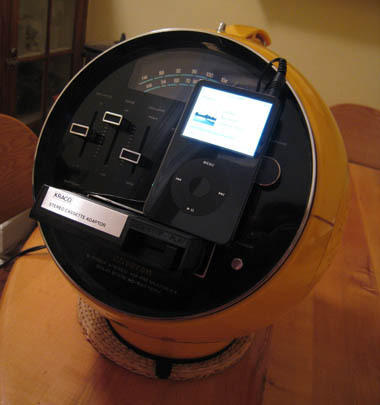
That’s why I love this guide over at Unplggd explaining how to convert a vintage 8-track player into an iPod speaker dock.
It’s not really very hard: all you do is take an 8-track cassette adapter, plug a regular cassette adapter into it, and plug in your iPod.
It’s intuitive, but not particularly ingenious or elegant. The real reason I’m delighted with this DIY, though, is because I just picked up almost that exact same 8-track player a couple of weeks ago, and now I can turn it into something more useful than an overly precious conversation piece. If you’re over 30 or 35, you’ve probably still got an 8-track player just like this in your garage: do some digging, and you’ll probably find that you can do the same.
Apple has produced two new television commercials aimed at disputing rival claims the smartphone cannot accomplish everyday tasks. The two commercials – On Hold and First Steps – attempt to show consumers the iPhone and the AT&T wireless network are up to the job.
In On Hold, an iPhone owner receives an electric bill by email. After placing the call and being put on hold, the person downloads a game and whiles away the time until an operator is available. The commercial is seen as Apple’s way of showing the iPhone’s exclusive network, AT&T, can handle voice and date simultaneously. In a series of ads, rival carrier Verizon had claimed the iPhone was unable to juggle voice and data at the same time.
In the competitive rush to win over students and parents by providing the latest technology, one university is letting freshmen decide between an iPad and MacBook Pro.
First-year students at George Fox University in Oregon have been handed personal computers along with their orientation packets for the last 20 years. The devices are included with tuition.
School officials admit they don’t know how much help an iPad will be for trig or anthropology homework.
“The trend in higher education computing is this concept of mobility, and this fits right in,” Greg Smith, the university’s chief information officer, said in a press release.
“At the same time, we realize there are a number of uncertainties. Will students struggle with a virtual keyboard? Can the iPad do everything students need it to do when it comes to their college education? These are the kinds of questions we really won’t know the answer to until we get started.”
So the school will offer both in fall 2010. Some majors, like film or engineering, may need the extra power from a MacBook pro. But the school also reckons that if the student already has a laptop, an iPad might just be the ticket.
“How the numbers work out will be interesting, but no matter what I think we will see many iPads, iPhones and iTouches throughout the undergraduate population,” Smith said.
This isn’t the first time we’ve seen the iRush to get students involved with the iPad before it even comes out — tech-happy Abilene Christian University, where the students already go to iPhone dev classes and have been given iPod Touches since 2008, is already working on an edition of the school paper for Apple’s latest device.
According to Macworld, Apple CEO and founder Steve Jobs is slated to be honored with the Jim Henson Celebration Honor, an annual award given out by the Jim Henson Company to acknowledge people who “reflect the core values and philosophy of the legendary Jim Henson and the company he founded.” Core values like loving cookies, bottlecaps, pigeons and monsters, one hopes.
According to the announcement, Jim Henson feels that the honor should go to an individual, organization or product that makes the world a better place by inspiring people to celebrate life. A co-founder of Apple, Jobs has led the company and the creation of its revolutionary iPhone and App Store, iPod media player, iTunes media store and Mac computers.”
Jim Henson’s daughter and current CEO Lisa Henson explained the decision further: “Steve Jobs has continuously broken new ground with technologies that allow existing media in all forms to be easily enjoyed and also by providing fantastic tools for artists, photographers, musicians and filmmakers of all skill levels.”
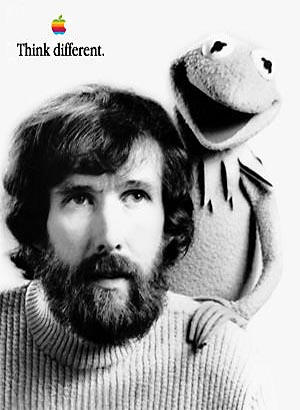
In some ways, it seems a bit strange — Steve Jobs’ flavor of creativity and imagination is vastly different than the messy, colorful and googly-eyed insanity of the Muppet Workshop — but Henson himself was an model for Apple’s 1997 “Think Different” campaign. Perhaps the difference between the two individualist imaginers isn’t so different as it first appears after all.
When CBS CEO Les Moonves Thursday told analysts episodes of “certain shows” would be sold for $1 on iTunes, then a network spokesman emphasized no deal with Apple had actually been signed, it only reinforced the skepticism silently being voiced toward the Cupertino, Calif. firm.
Caught between the anticipated ire from affiliates for selling popular programming online and the siren song of Apple customers with 125 million credit cards, networks don’t want to say ‘no’ – not just yet.