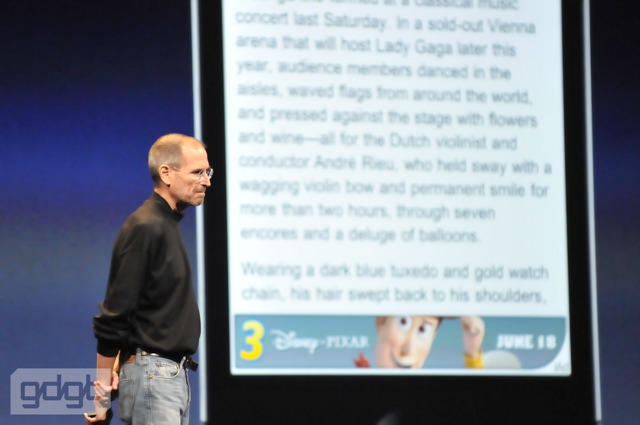
It’s hard to remember when one of Steve Jobs keynote speeches WWDC had a glitch, but the Demo Gods weren’t smiling on Jobs today. Thanks to network problems, Jobs had to ditch on a demo because of Wi-Fi trouble. But maybe it’s not some luckless Apple engineer’s fault: The same thing happened to Google during its developers conference last month at the same venue.
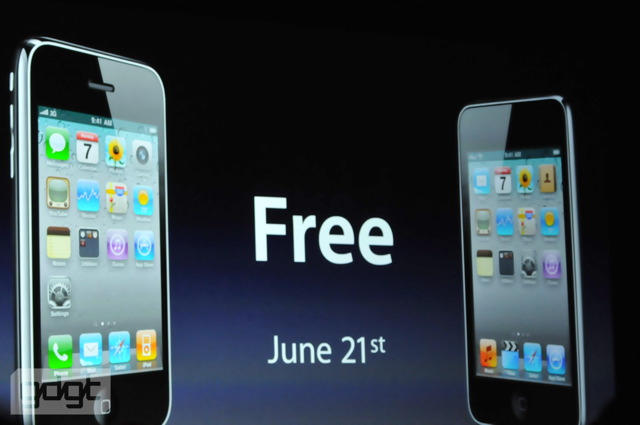
The new iPhone won’t be in people’s hands until June 24th, but existing iDevice owners who are looking forward to the incredible features of iOS 4 won’t have long to wait: it’ll be available for download to owners of the iPhone 3GS, 3G and iPod Touch on June 21st, just two weeks away.
The best part? It’ll be free to everyone. No longer will iPod Touch owners have to pay for an OS update. “We’ve finally found a way to get these upgrades for free to our iPod touch customers, and we couldn’t be happier.”
I’m sure iPod Touch owners, long screwed by update fees, agree. I know I do.
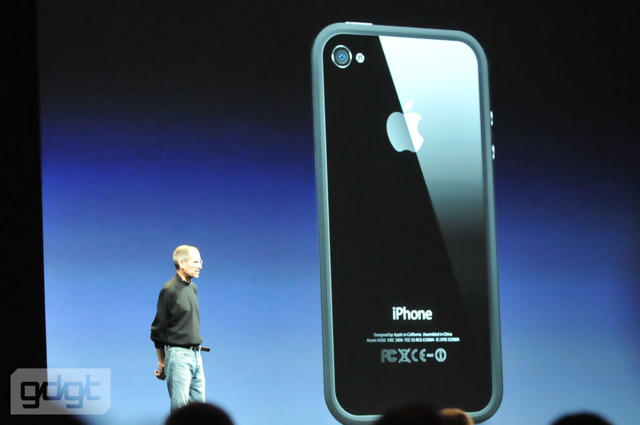
A couple months ago, Apple stopped selling cases on their online store, which implied they were getting into cases themselves.
They call their new case a “bumper” and it comes in numerous colors, including white, pink, orange and other spectrums of colors. It looks like it wraps around the sides of the device without protecting the back, hence the automobile terminology: it’s all about protecting the iPhone at its most vulnerable spot.
Additionally, Apple has just announced an official iPhone dock, which will cost just $29 and support charging and syncing.
Jobs has just completed outlining all of the iPhone 4’s revolutionary new features. Now to reveal what it’ll cost your wallet.
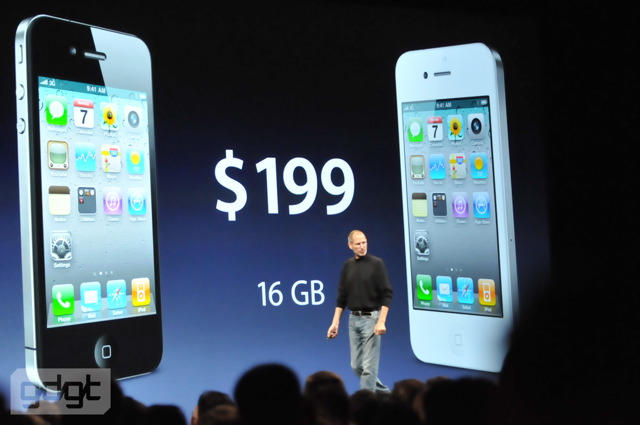
Coming in black and white, the iPhone 4 will cost $199 for the 16GB models, the same price as the 3GS. $299 gets you the 32GB iPhone 4.
Already in a contract? AT&T is allowing anyone with a contract expiring this year to be immediately eligible for a new iPhone at the same $199 – $299 price, as long as they top up their contract for two years.
Predictably, the 3Gs is becoming the new sub-$100 model, and will cost $99.
The iPhone 4 will be available on June 24th, with pre-orders starting on June 15th. It will immediately ship in five countries: the US, France, Germany, the UK and Japan, with 24 more countries following in August, and 40 more countries following in September.
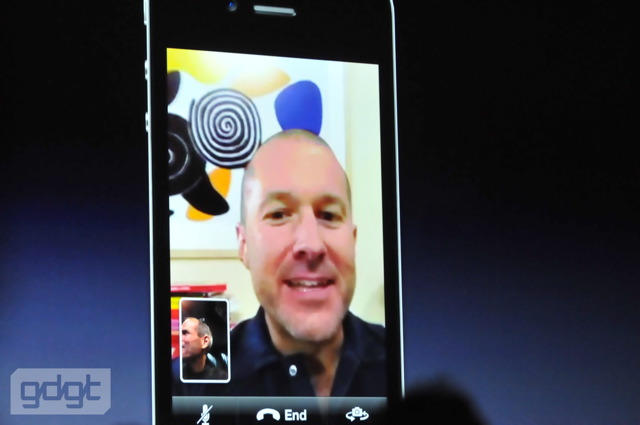
It’s almost over, but like usual, there just “one more thing” and while we all knew it was coming, it’s the first time it’s been directly confirmed: a front-mounted camera on iPhone 4 that allows for user-to-user video chat.
Calling Jonathan Ive on his iPhone 4 to demo the new iPhone’s video chat capability (after first having issues with a connection and yelling at the audience to turn off their WiFi), Jobs reminisced about growing up with the Jetsons and Star Trek, “dreaming about communicators and video calling. Now it’s real!”
Apple’s calling their user-to-user video calling solution FaceTime.
In addition to utilizing the front-mounted cam, FaceTime allows you to switch to the rear camera so the other person can see what you’re seeing. You can use FaceTime in either portrait or lansdcape.
FaceTime is iPhone 4 to iPhone 4 only (no other iDevice has a front-mounted video camera yet), and it works anywhere with WiFi. What a shock: AT&T’s 3G network just can’t handle it. Apple claims they’ll work with their carrier partners to get it ready later in the year, but look at AT&T’s abysmal record implementing tethering, and my guess we’ve got a long wait ahead of us.
Apple’s getting into the advertising game with their iAds network, and Jobs says the goal is Emotion + Interactivity. The idea is to make it painless for developers to put ads in their apps: just tell Apple where you want them and they’ll inject it themselves. Likewise, it should be painless for viewers to see them: tap them and it’ll expand. You’ll never be hijacked into the browser.
They’ve only been selling iAds for eight weeks, and already attracted a huge number of advertisers, including Nissan, Citi, Unilever, AT&T, Chanel, GE, Liberty Mutual, State Farm, Geico, Sears, JCPenny, Target, Best Buy, DirecTV, TBS network, and Disney.” Overall, iAds has brought in $60M in advertising, and makes up 48% of US Mobile Display Advertising Spending in the second half of 2010.
The demonstrated advertisements look pretty good, admittedly. Certainly more like interactive applications than musty old banner ads. They’re almost like mini-apps that dynamically download when needed into an existing program. The new interactive Nissan Leaf iAd is particularly impressive, which allows you to interactively compare a $1 of gas when driving the fully electric Leaf compared to other hybrids.
iAds probably isn’t going to be very good for consumers — I despair that there will be literally no reason for a developer not to put ads even in paid apps anymore, and that too much of the iPhone’s screen real estate will be taken up with advertisements — but it should be a windfall for both Apple and the developers taking part in the iAds ecosystem.
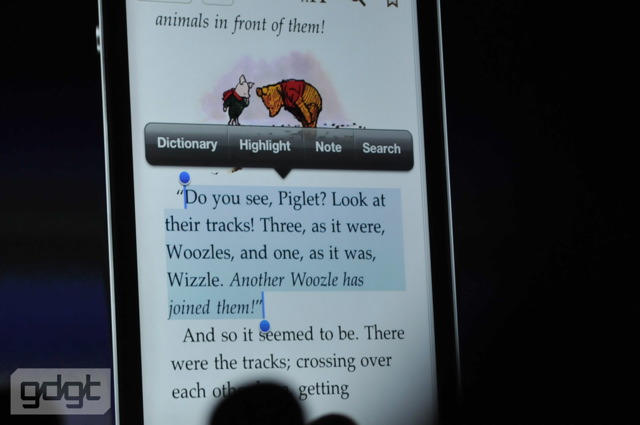
It’s made a huge splash on the iPad, so naturally, iBooks is coming to the iPhone and iPod Touch, with the same controls, same note taking features, same highlights, same PDF reading and same bookmarks.
Like the iPad version, you can purchase and download a book to all your devices for no charge, and automatically sync your place, bookmarks and notes.
Not so surprisingly, on the iPhone 4 retina display, iBooks looks gorgeous. And to think: this coming from the man who said that people didn’t read anymore.
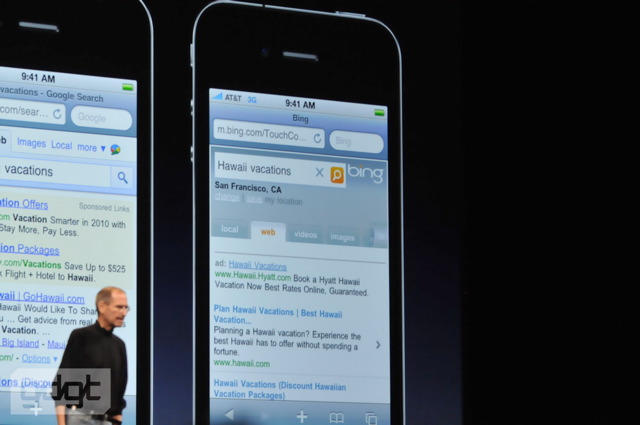
Apple may be warring with Google in the smartphone arena, but they’re not going to take it out on their customers: Jobs has just confirmed rumors that Apple was getting into bed with Microsoft and adding Bing as a search option to iOS.
Google’s still the default, but now you have another choice, and Bing’s doing some really snazzy things with the HTML5 presentation of results. If you like your search results to be pretty, it looks like Google’s going to have some catching up to do with Bing.
Oh, and the three of you who still default to Yahoo… you can still search with them too. Go nuts!
It has made less and less sense by the day that the iPhone OS would continue to be called that as non-iPhone devices begin to run it. Jobs has just confirmed the earlier rumor of an iPhone OS rebrand: starting with iPhone OS 4.0, it’ll just be called iOS4.
From a humble blogger’s heart directly to Cupertino: thank you, my benefactors. You don’t know how confusing it was to talk about iPhone OS for the iPad on a daily basis. Having “Phone” plugged into the name of an increasingly non-Phone operating system was just ridiculous.
Anyone else wonder if this is the first blush of a reveal of a new iOS-capable Apple TV?
Randy Ubillos, Apple Chief Architect of Video Apps, has just taken the stage to show off iMovie for iPhone, claiming it’s one of the most exciting things he’s ever worked on.
What’s iMovie for iPhone about? “Record HD video and edit with beautiful transitions and titles, all on the device you carry with you every day,” says Ubillos.
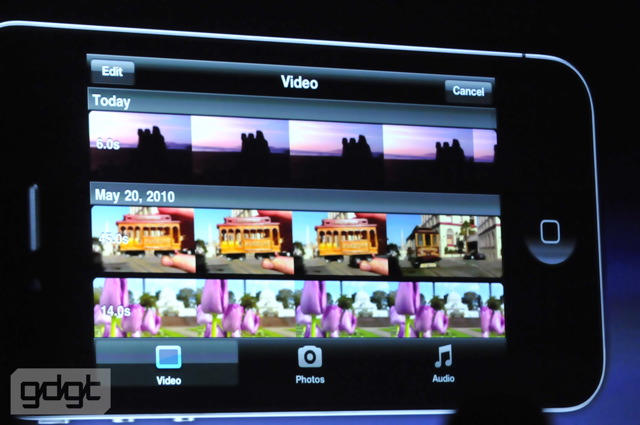
Once you bring up the app, you quickly get a list of all the project you have, and can just tap on a project to get into the editing environment. Clips are viewed along the bottom of the display: rotate the phone to landscape and you can record directly into the timeline, or choose from existing clips, which are dragged in. Pinch to change the scale of the timeline.
Photos can also be added, as well as transitions (entered with a scroll box) and even titles. The new camera records geolocation information and gets picked up automatically by iMovie and put into the screen as an option.
You can also add music tracks to your video from your iTunes library.
Wow. This is incredible. There’s just nothing like this out there right now. It’ll be available on the App Store for just $4.99.
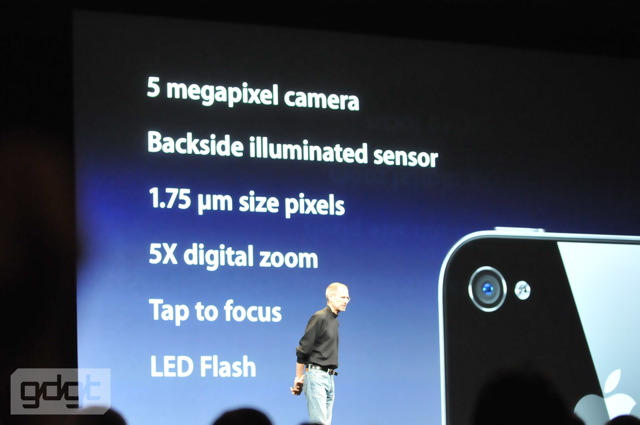
We all knew the iPhone was bound to get a better camera this year — it’s long flagged behind competing smartphone’s offerings — and so it has: Jobs has just announced the details of the iPhone 4’s new camera: 5MP, capable of 720p video recording.
Great news here is that Apple’s sticking to a sane five megapixels. Instead, they are trying to improve low-light photography on smartphones, which is typically abysmal, by getting more light to the sensor through back-illumination and an LED flash.
Additionally, the iPhone is getting HD video recording, with the new camera capable of 720p footage at 30 frames per second. To harness that power, Apple is also building building video editing software into the iPhone 4… with iMovie for iPhone!
Confirming that Apple’s not just dabbling in the chip game, Steve Jobs has just confirmed that the iPhone 4 uses the Intrinsity-designed A4 CPU, just like in the iPad.
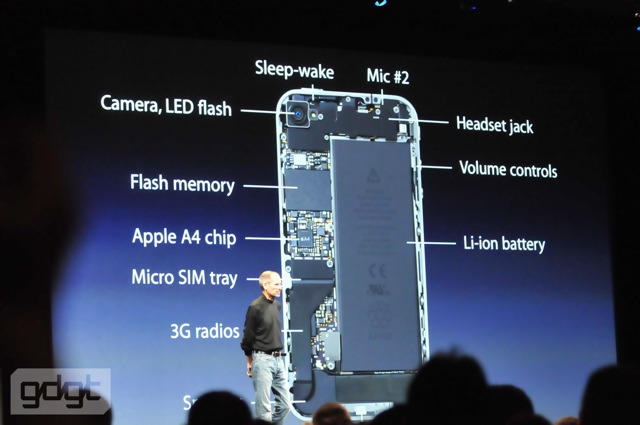
But that’s not where the hardware changes stop. Revealing the back of the device, Jobs shows that it is backed to the gills, and just like in the Gizmodo prototype, most of the iPhone 4’s internals are made up of battery.
The iPhone 4 will come with up to 32GB of storage, quadband HSDP / HSUPA with 7.2 MBps down and 5.8 Mbps up, dual mic noise suppression, 802.11n WiFi and GPS.
What kind of battery life are we talking? Seven hours on 3G, six on browsing through 3G, 10 on WiFi, 10 on Video, 40 on music and 300 hours standby.
The iPhone’s also about to get a lot more interactive with the addition of a three-axis gyroscope, which in combination with the accelerometer provides 6-axis motion sensing. Amazing! I can’t wait to see what app developers do with it.
While trying to show off the iPhone 4’s new retina display by comparing web pages, Steve Jobs encountered an unfortunate problem with the Moscone center’s WiFi.
Making a hat tip to Google’s problems at their IOKeynote, Jobs joked: “You could help me out by getting off of WiFi.” Unfortunately, his problems didn’t end there, as when he switched to a backup iPhone 4, he got the dreaded “Could not activate cellular network.”
Giving up on web pages, Jobs apologized: “I’m sorry guys, I just don’t know what’s going on. Scott, you got any suggestions?”
A perfect audience response: someone shouted out “Verizon!”
The second big thing about the iPhone 4, according to Jobs, is the revolutionary new display.
They’re calling it the retina display, and it quadruples, as reported, the pixel density of the last iPhone. You now get an industry leading 326 pixels per inch in the iPhone 4. It’s a marked improvement on the display in the 3GS in both brightness and clarity.
“There has never been a display like this on a phone,” says Jobs. “People haven’t even dreamt of a display like this. It turns out there’s a limit around 300px per inch that the human eye can’t differentiate between the pixels — text looks like you’ve seen it in a fine printed book, unlike you’ve ever seen on an electronic display before.”
“Once you use a Retina Display,” Jobs confidently brags,”you just can’t go back.”
And it’s here! Steve Jobs has just announced the latest iPhone, the biggest jump in core technology yet since the original: the iPhone 4. It’s the Gizmodo one.
“Some of you have already seen this,” he quips.
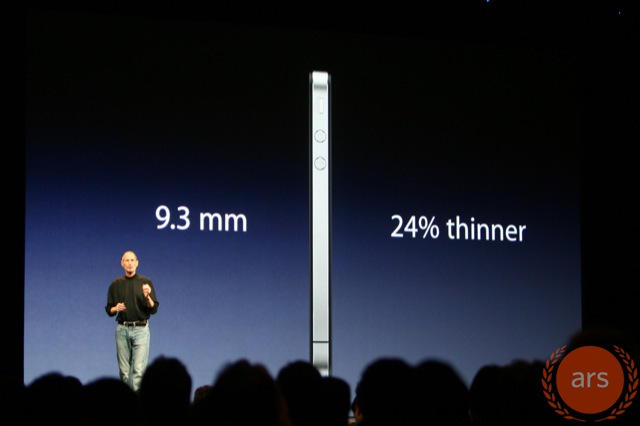
iPhone 4 will include over a hundred new features. Jobs claims it is extremely thin at just 9.3mm thick, 24% thinner than the 3GS, making it the thinnest smartphone on the planet.
Jobs claims it’s the most precise and beautiful thing Apple’s ever made, more akin to a beautiful old camera (?) than a smartphone of today. It’s a gorgeous amalgam stainless steel for strength and glass for optical quality and scratch resistance
The iPhone 4 has a micro-SIM on the side, with a camera and LED flash on the back. On the bottom, it boasts a microphone, a 30 pin connector, and a speaker. On the top, a headset, a second microphone and a sleep/wake button.
The biggest detail? There’s a stainless steel band that runs around the edge of the phone, which is integrated with the band system to give superior reception for BlueTooth, WiFi, GPS, 3G and all the other radio stuff.
We start out the week with some freebies for the iPhone and the iPad. For handset owners, the App Store has several free items, including “Zombie Parade,” a tower defense game. For iPad owners, try your hand at “MakePanic,” described as a “panic-inducing game.” We round out our top deals with a new t-shirt. If your “I went drinking with Gray Powell and All I Got Was This Lousy iPhone Prototype” tee getting a little frayed? Take a look at the “Slide to Unlock” baby doll t-shirt for women.
Along the way, we’ll check out a solar charger for your iPhone, some deals on used Macs, plus plenty of software for your favorite device. As always, details on these and many other items are available at CoM’s “Daily Deals” page right after the jump.
Back on stage after showing off three new iPhone apps, Steve Jobs gets into the meat of why we’re here — the iPhone — with a few statistics.
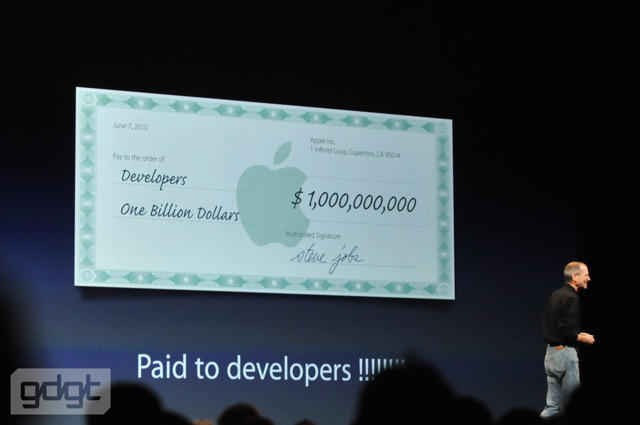
As of today, over five billion apps have been downloaded from the App Store, with over a billion dollars paid to developers to date.
It is one of the greatest things we get to do. And that’s what makes the App Store the most vibrant app community on the planet. 5 Billion downloads and a healthy ecosystem! We’re thrilled with it.”
Who can blame Apple? The App Store is revolutionary.
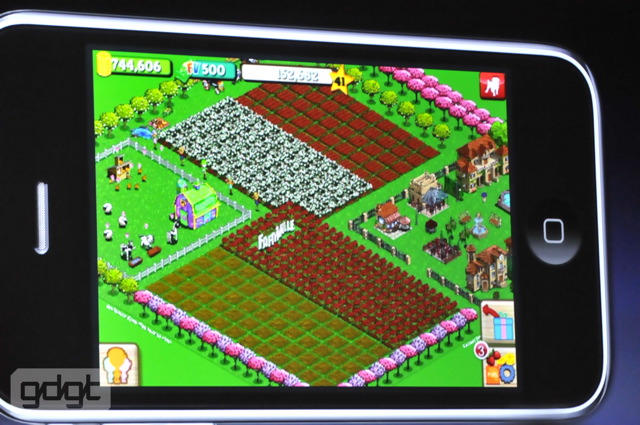
Eliciting a resounding “What the f***!” from a member of the WWDC audience, Zynga just took the stage and announced that the irritating Facebook phenomenon Farmville played by 35 million users a day is now coming to the iPhone.
It makes sense, actually: recent updates to Facebooks’ privacy settings, making it harder for apps to spam you, has seen Farmville lose millions of users in a month. It also makes sense because We Rule already proved how strong the concept of a Farmville clone on the App Store could be, at least as far as making money off of micro-transactions to hurry things along are concerned.
Oh, and say goodbye to withering crops! Push notification is fully supported.
As many of you know, the Steve Jobs keynote speech at the WWDC is going on right now. If you’re following along with our updates and updates from other sites, go join us on our Facebook page in the discussion section and post your thoughts, reactions, and comments about what he reveals today.
First, become a fan of the page, then join the discussion!
Here’s the link directly to our discussion forum on our Facebook page: Steve Jobs at the WWDC
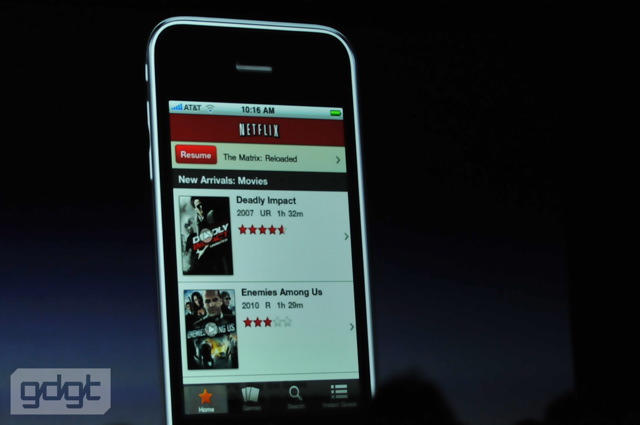
Netflix is already available on the iPad, but as the recent revelation that the iPad executable was a universal binary implies, it’s coming to the iPhone too.
The iPhone version uses adaptive vidfeo playback, and allows for seamless switching between 3G and WiFi networks. It’s coming this summer, and it’ll be free.
I guess they got around the performance issues, at least on the next-gen iPhone.
Apple wants people to know they’ve gotten a lot better about App Store approval, and Steve Jobs has just given some numbers to prove it.
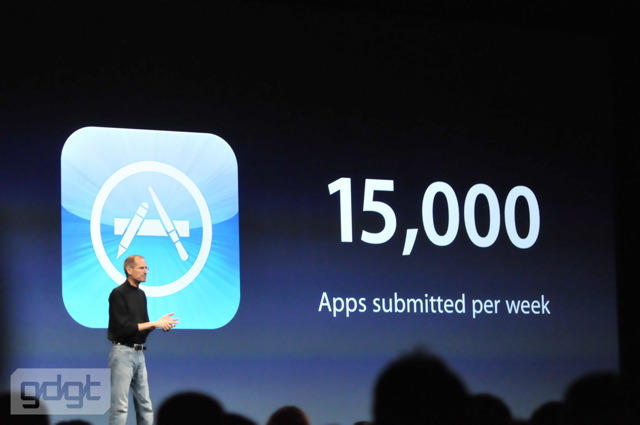
About 15,000 apps are submitted every week in thirty different languages. Jobs claims that an astonishing 95% of these apps are now approved within seven days.
What about the apps that aren’t? Jobs doesn’t want us thinking censorship: rather, the more common reason is that it doesn’t function as advertised, with the second most common reason that it is pulling from private APIs.
The third most frequent reason? “They crash. If you were in our shoes, you’d be rejecting apps for the exact same reasons.”
The point of this section of the keynote is clearly to make sure people don’t think Apple’s censoring. “Sometimes when you read some of these articles, you may think other stuff is going on,” Steve notes. True enough!
I wonder how much of that 5% is made up of jiggling boob apps, though.
Apple has just announced the initial figures of iBooks at this year’s WWDC, and in addition, they’ve got some great new iBooks features in the pipe.
In the first 65 days, users have also downloaded over 5 million books, or about two and a half per iPad… and five out of six big publishers in the United States claim that the share of eBooks going through the iBookstore is about 22 percent.
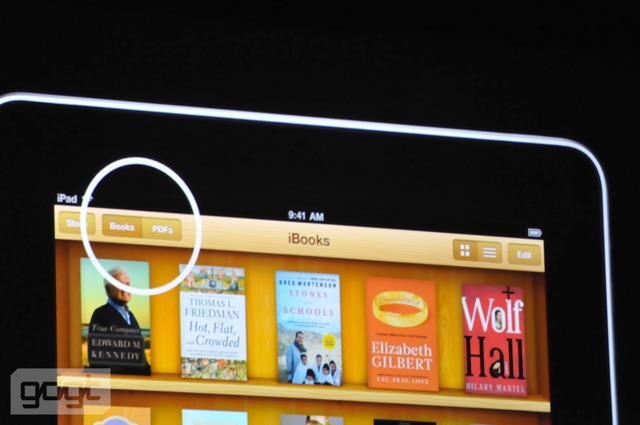
Next, some enhancements to iBooks. They’ve just added the ability to take notes to iBooks, as well as the ability to view and read PDFs. For PDFs, you get a whole new bookshelf.
That’s some good additional functionality that should make iBooks more interesting to people who live and breathe PDFs.
The iPad has been a huge success for Apple, and it was the first thing Jobs wanted an iPad-obsessed audience to know at this year’s WWDC.
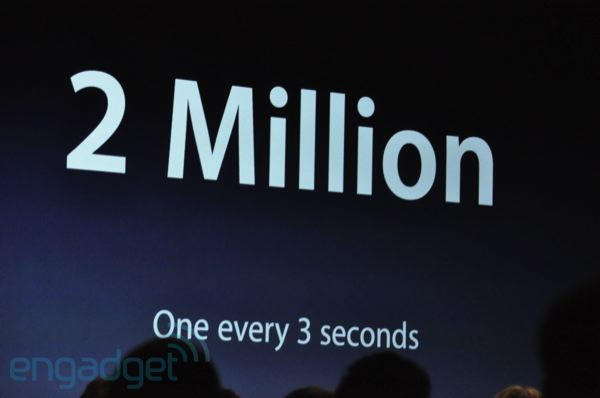
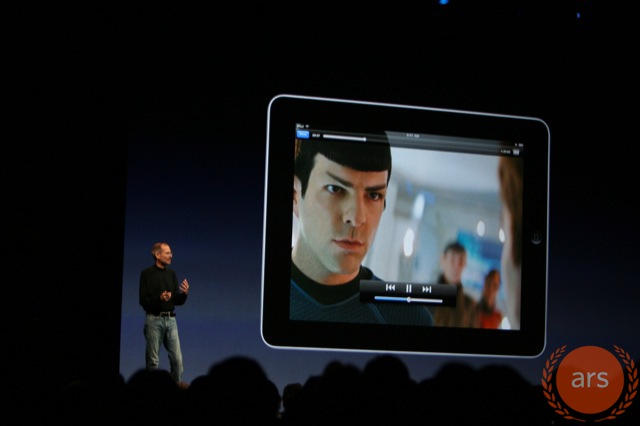
To date, Apple confirms they’ve sold over 2 million iPads, which is one every three seconds. It is now shipping in over ten countries, and Apple wants to prove that they’ve got a revolution on their hands by showing the WWDC audience a video reel of the great coverage the iPad has gotten worldwide.
Additionally, there are now over 8,500 native iPad apps in the App Store. Apps account for 35 million downloads in two months, or about 17 apps per iPad sold. The guys behind Wolfram Associates’ Elements says he made more on the app in the first day of the iPad launch than five years of Google Ads.