If you’re a Mac user on the Internet, chances are you’ve come across a few websites where embedded content isn’t displayed correctly. Instead you get an icon or an error message saying Missing Plug-In, often with few additional details about exactly what is missing.
While there’s no single installer which will solve all missing plug-in problems, there are a few common things to start with. If those don’t work you can delve deeper into non-common formats or the forgotten codecs of yesteryear.
You might think that the new MacBook Pro with Retina display breaks the bank as far as computers go, but compared to some of Apple’s older machines, it’s just a drop in the bucket. Apple has never had the most economical options for computers, but they’ve come a long way towards being affordable to most consumers. Don’t believe me? Forbes has compiled a list of the five most expensive Apple computers of all time.
Another Apple announcement, another de-emphasis on the Mac brand. It seems that every time Apple opens its corporate pie-hole, the venerable Macintosh brand drops down a notch in importance, and the Mac’s future demise seems more likely.
One of the design geniuses behind the original Macintosh software now works at Google, and led the team responsible for interaction design and implementation of the Google+ circle editor, according to a public post on — what else? — Google+.
Andy Hertzfeld “conceived, designed and implemented a compelling prototype for it almost single-handedly, and then wrote a fair percentage of the production javascript code with lots of help” from other Google engineers.
Hertzfeld’s post is meant to spread the credit around. But the truth is that the “circle editor” is the single coolest thing in Google+.
We went bonkers last week and gave out more free hardware in seven days than we ever have before. To mix things up this week we’re going to be giving out some beautiful software to enhance your Apple experience. Today we’re teaming up with the great people behind StackSocial who have given us three promo codes for their latest Mac Essentials Bundle. With eleven Mac apps worth $333 that we’re giving away for free, this is one of the best software giveaways we’ve ever had. You’ve got to play to win though, so here are the details on what you’ll win and how to qualify for the giveaway:
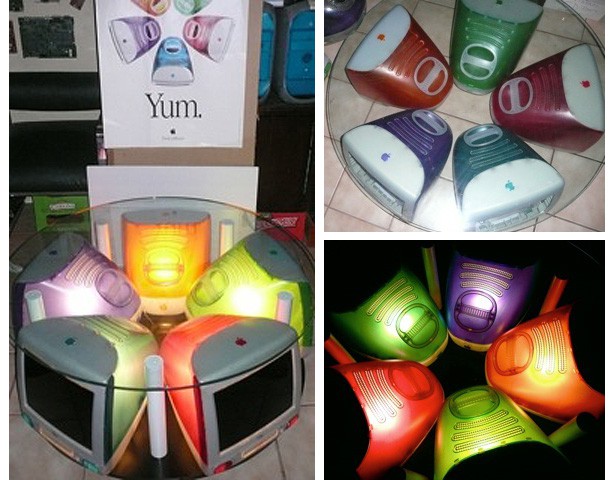
Classic Mac collectors are a creative bunch. Where others see digital trash, we see potential. Steve Abbott, curator of MacAbbott’s Mac Museum in Charlotte NC, has just created an innovative coffee table using those five-flavored candy-colored original iMacs in the style of Apple’s iconic Yum advertisement.
Steve stripped the guts out of five systems – blueberry, grape, tangerine, lime, and strawberry – added opaque white paper and light fixtures inside, then fashioned a table around them with a glass top and birch base. Reminds me of the kids tables inside Apple retail stores, with the retro glow of high tech lifesavers. The Yum coffee table is one-of-a-kind and for sale, bids start at $5,000; contact MacAbbott for details.
It’s happened to us all: You delete a file, folder or entire disk, then realize you’ve made a mistake. You reach for your backup – and you don’t have a backup. What now?
There are several utilities available to help recover deleted files under Mac OS X. Your chances of success depend on how the file was deleted and what you’ve done since then. Unfortunately you will also lose your original filenames, though some reconstruction is possible.
One of the biggest problems with physical media is that it breaks. As soon as your DVD gets a couple scratches it’s rendered un-usable and worthless. Copying a DVD with encryption isn’t as easy as it should be. The good news is that with this walkthrough Cult of Mac will show you how to do it.
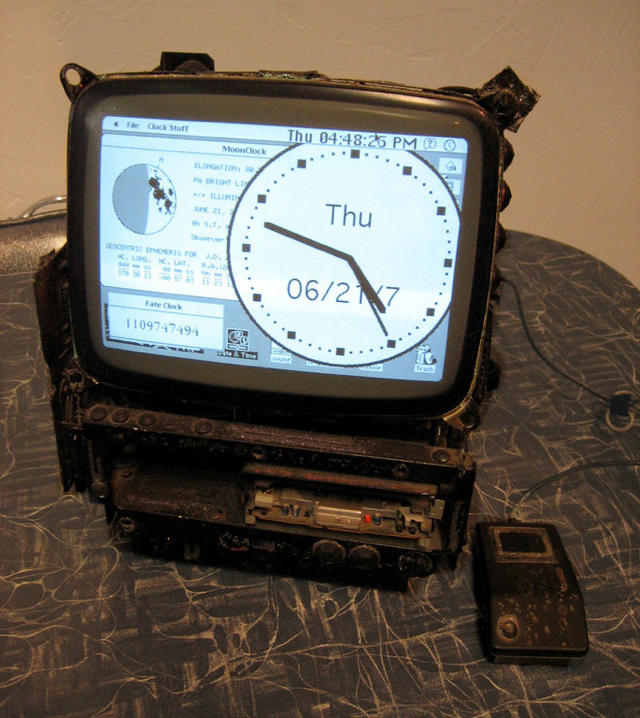
After scratching his head for awhile and wondering what to do with a Macintosh Classic II , Maker Matteo from Ithaca, New York repurposed his old faithful Mac into a shelf-top clock.
From appearances, it looks like the clock — which Matteo rather laughably calls “steampunk” in style — only came into being after its creator accidentally doused his Mac Classic in acid then shot with a bazooka, but the innards of the admittedly ugly timepiece work well enough: a 16MHz CPU, 4MB of RAM and a 20MB hard drive running MacOS 7 and a dozen different shareware and freeware clock programs, including one that counts down the seconds to Matteo’s death.
Yeah, it’s hideous, but we love it: this is just the kind of bizarro clock I can imagine discovering thirty years from now in the basement of an elderly and now quite eccentric Steve Wozniak. Great work, Matteo!
Ever been singing along to a new song and wondered just what the heck the lyrics really are? Searching for the lyrics on the internet isn’t the fastest of solutions to avoid lyric confusion. Here we’re going to show you how to utilize scripts and a widget to search out the lyrics for all of the songs in your iTunes library and automatically save them to song’s meta data, so that next time you can correct your friend when they sing “where’s my Asian friend,” when the lyrics really are, “what’s my age again.”
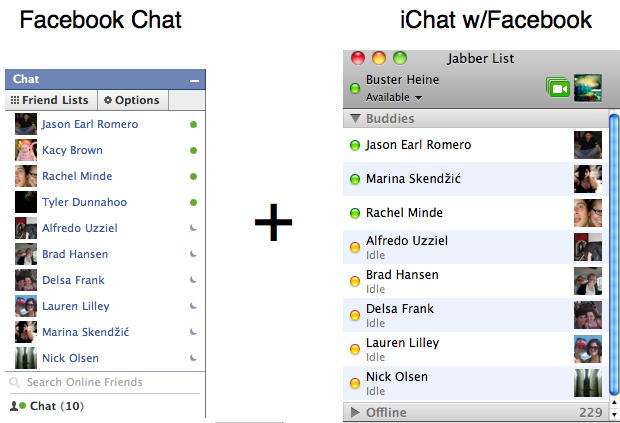
Tired of having to keep that browser tab open to Facebook just so you can keep chatting with your friends? It only takes five Quick Steps to integrate iChat with Facebook’s web-chat client and because Facebook uses the Jabber protocol it’s incredibly easy to set up and use.
Travel back in time with this classy look at the History of Apple Design. Matt’s Macintosh offers a loving paean to Cupertino’s Industrial Design trends through the decades.
Theatrically filmed and scored, it’s like Christmas Past and Present! [via RetroMacCast]
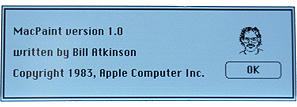
MacPaint by Bill Atkinson (Image: anoved via flickr)
Where would the Macintosh (and Computing) World be without Bill Atkinson? MacPaint, QuickDraw, HyperCard – Atkinson stands with the Giants. In homage of his recent donation of the MacPaint source code to the Computer History Museum, flickr artist anoved offers this portrait of Bill Atkinson created entirely in MacPaint. With tools like these, who needs Photoshop? Well done!
Does your small- or medium-sized business run on Macs? Are you a Mac IT-manager?
If so, we’ve got a new weekly feature for you: Macs at Work. Every week, we’ll answer your business-related questions, from setting up servers to running iPads in the enterprise. Macs at Work is brought to by Macuity, a Mac-focused IT consulting group located in Boston, MA.
This week, we have a question about Snow Leopard server for group calendar and contact sharing.
In this highly-entertaining final installment of his series about Steve Jobs, Macworld founder David Bunnell is taken by Jobs to his favorite lunch spot (you’ll never guess where it is). And for once, Jobs changes his parking habits.
At a posh dinner party, Steve Jobs eats a plate of raw vegetables with a blonde bombshell sitting on his knee. Instead of going to Macworld and plugging the Mac, he’s too busy partying with Tina the nymphette.
Part 13 of Macworld founder David Bunnell’s personal history of the first Mac: “My Close Encounters With Steve Jobs.”
In part 12 of Macworld founder David Bunnell’s story of the early Mac, Bill Gates is the only developer to actually deliver on his promises of software for the Mac. Microsoft’s Excel literally saves the Mac just when sales drop to nil, but at the same time Gates’ engineers are reverse engineering the GUI for the first version of Windows.
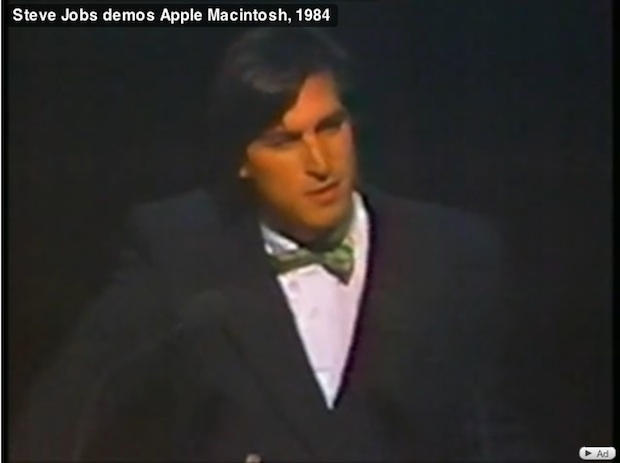
Steve Jobs at the introduction of the first Mac in 1984.
In Part 11 of Macworld founder David Bunnell’s memoirs, Steve Jobs triumphantly introduces the Mac to the world. “It sang to us. It performed mathematical calculations with the blinding speed of a Cray mainframe. It drew beautiful pictures. It communicated with other computers. It bounced rays off satellites and sent a subversive message to the Soviet Union.”
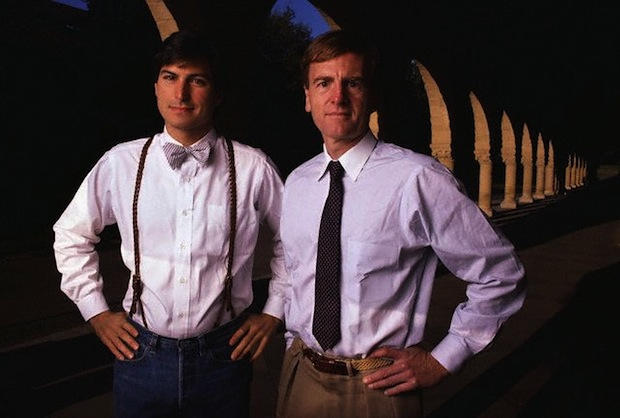
Steve Jobs and John Sculley, the former CEO of Apple. The pair were dubbed the
Steve Wozniak is unhappy at the Mac launch, which resembles “Woodstock for nerds.” Part 10 of “My Close Encounters With Steve Jobs,” a personal history of the original Mac by Macworld founder David Bunnell.
In part 9 of “My Close Encounters With Steve Jobs,” Macworld founder David Bunnell tells how he shouted “Steve Jobs is a fucking genius!” in front of a bunch of kids at a Super Bowl party.
Note: This is a guest column by David Yoken, founder of Macuity, a Boston Apple consultancy, who discusses the joys of providing IT and repair services to machines that “just work.”
Just got off a call with an architectural firm for whom we set up a brand new server last week. The typical conversation I have with clients is amusingly formulaic, and this one was much of the same:
Me: How’s everything going with your new server?
Customer: It’s really wonderful. We haven’t had any problems, and the transition has been nearly seamless.
Me: Super! I’m glad things are working out. I suppose now would be a good time to talk about a service and maintenance contract and schedule for your new equipment.
Customer: Well, we probably can handle most everything on our own. Apple makes it so easy, so we’ll be fine!
Me: Oh, umm…, absolutely! How about remote monitoring or help desk services?
Customer: Yeah, sure, but you probably won’t hear from us much on that end either. I think we can take it from here, but thanks!
On Friday, Pete called our attention to a lovely poem by Beat poet Gary Snyder called “Why I Take Good Care of My Macitosh,” which features lovely stanzas like:
And puts word-heaps in hoards for me, dozens of pockets of gold under boulders in streambeds, identical seedpods strong on a vine, or it stores bins of bolts;
And I lose them and find them,
Because whole worlds of writing can be boldly laid out and then highlighted and vanish in a flash at “delete,” so it teaches of impermanence and pain;
And because my computer and me are both brief in this world, both foolish, and we have earthly fates,
Based on Snyder’s poem, you might be tempted to conclude that the Apple experience is synonymous with the zen and jazz inspired wanderlust of the Beat Generation as a whole. You might be right.
Although Guy Day is, as pictured, about as far away from the har- boozing, womanizing, red-meat-eating Don Draper type as a 70s-style pompadour will get you, he was one of the country’s quintessential ad men for decades.
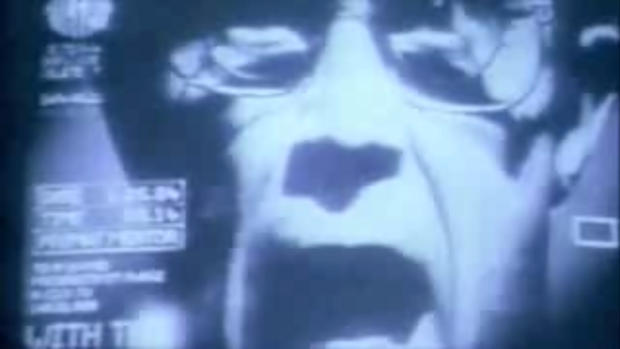
Everyone reading this blog knows his work: as the president of the acclaimed Chiat / Day advertising agency, Day was responsible for bringing together the team that created the hyper-Orwellian 1984 Super Bowl Macintosh ad.
Sadly, the Los Angeles Times is reporting that Day on Saturday, died in his sleep of natural causes. The timing is particularly depressing: a self-described “life-long agency ad man” who revolutionized Apple’s advertising strategies, Day, of all people, would be delighted by the marketing possibilities of the forthcoming Tablet.
Rest in peace, Mr. Day. You’ll always be remembered by this Mac fan for your art and for your work.









![MacPaint by Bill Atkinson [Image: anoved via flickr]](https://www.cultofmac.com/wp-content/uploads/2010/07/MacPaint-by-Bill-Atkinson.jpg "To Bill Atkinson, With Love and MacPaint")