Mobile menu toggle

Top stories - page 1022

What It Would Really Take For Apple To Crack the Enterprise Market

By

post-11577-image-38a00fd9f4ce843f1b243cc59be801e7-jpg

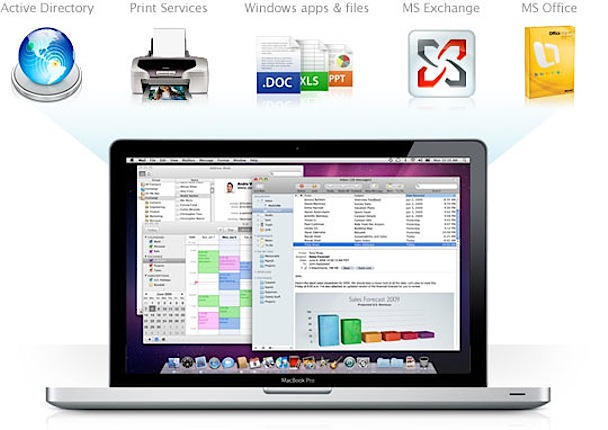
Outside of the iPhone brouhaha, much of the buzz at WWDC today has been about whether the system-level support for Microsoft Exchange e-mail and calendaring in OS X Snow Leopard and various encryption options for Mac and iPhone would finally allow Apple to make serious in-roads in corporate America. Well, at least if corporate IT guys will give them a chance, that is.

In spite of Lonnie’s optimism, I think Apple is just as far today from mainstream adoption in big business as it was yesterday and pretty much every day of its entire history. As I’ve written before, the Steves founded Apple in large part because they thought that the IBMs and HPs of the world were holding back the potential of computers to transform our society.

Consequently, the organization’s entire self-image and frame of reference over time has been that big business is all too willing to adopt mediocre technologies based solely on a reputation for reliability. Macs have long provided superior tools for creative endeavors like graphic design and video editing, which is why Macs have a huge niche in corporate marketing departments, but the same can’t be said for other business pursuits.

Apple has a huge opportunity right now to make serious in-roads in the enterprise market while corporations resist upgrading to Windows Vista and don’t yet know whether or not they can trust Windows 7. But Apple won’t make big gains unless they take more drastic measures, three of which I outline below. Bear in mind, I’m not saying this is what Apple should do, just that this is what it would take to succeed in business.

Start making cheap computers with standardized parts.From the early 1990s until the sale to Lenovo, IBM’s ThinkPad line of notebooks defined the look, feel and attitude of computers for business. They were black, rugged, and nearly identical in industrial design. A machine from 1999 looked pretty much the same as one from 2003. Corporate IT managers loved ThinkPads because people generally couldn’t tell if their co-workers had a newer or better machine than theirs — the exterior was always a constant. All that, and frequently replaced parts like batteries and power supplies were common across the decade. If it worked on one, it worked on another.

Recent years have seen the trend that IBM began extrapolated upon in the corporate market. These days, it’s not just that corporations prefer to buy identical machines for employees at all levels — they’ve also chopped their budgets for PCs dramatically while increasing spending on servers and data centers. And that means that low-cost strategy players like Dell and HP are winning with large-screen machines for less than $500 (or significantly less at large volumes). If Apple wants to even think about competing, it would need to get cheap quickly and make compromises that the company has diligently avoided over the years. And do you really think business wants a line-up of laptops without replaceable batteries? Not in this galaxy.

Why Apple Stuck With the Same iPhone Hardware Design

By

cult_logo_featured_image_missing_default1920x1080
iphone3gs_2up.jpg
Apple’s shocking new iPhone 3G S design.

No matter how great an Apple Keynote goes, there are always disappointments. Changes not made, rumors left unrealized. For this year’s WWDC, Apple actually managed to avoid most of these (other than anything that has to do with the strength of AT&T’s network or upgrade pricing for existing customers). We got a more powerful iPhone, meaningful upgrades to the unibody MacBook Pro line, and release announcements for both iPhone OS 3.0 and OS X Snow Leopard. Other than a few pipe dreams (Steve Jobs riding in on a white tiger, cold fusion-powered tabler), Apple did a great job by hitting a whole bunch of base hits. No home runs, but no strike-outs, either.

Except for one thing: the all-new iPhone 3G S looks exactly like a previous-generation iPhone, to the point that there is no way at all to tell the new 16 GB model from the model it replaces — even in the fine print on the back. This was a shock to many folks, myself included, who were expecting Apple to change things up with a new black frame to replace the familiar chrome and a rubberized matte case to provide a more durable experience.

Why? What could Apple possibly gain from letting its industrial design team copy and paste? Don’t they want us all lost in lust?

Of course they do — which is why Apple has been putting design resources into product lines that are either brand new or waning. The iPhone sells itself today. A specification bump alone is enough to set off an Internet frenzy about AT&T’s unjust policies (check Twitter if you don’t believe me), and there will be longer lines outside Apple Stores on June 19 to get what is ultimately an incremental upgrade to the iPhone than there were this weekend to launch the much-hyped Palm Pre. That’s with the case staying exactly the same — what could Apple possibly gain by throwing a ton of work into a redesign that can’t even alter the screen or home button?

Look at the current line of unibody laptops. A year ago, Apple’s notebook line-up was a complete shambles. MacBook Pros still looked like late-generation PowerBooks. The black and white MacBooks were under-powered and over-heavy. And Apple offered nothing to someone who wanted a small form factor and significant power. Apple Design first launched the MacBook Air in January and then rolled out its signature design elements into every single product in the family. That kind of design focus has made the unibody MacBook Pros some of the best computers Apple has ever made, in addition to being the best-selling in company history. The design team’s abilities transformed Apple’s line-up from long in the tooth to desirable in a few months.

So what’s Apple got the industrial team cooking up now? I can’t say with certainty, but people better-connected than me claim that the long-requested iTablet is real and on its way — exactly the kind of new to the world product that demands serious design attention from Jonathan Ive and team. The scenarios of use are different. A bigger exposed screen raises serious questions about protection. And, quite honestly, I don’t know if anyone outside of Silicon Valley will quite know what to make of it unless Apple designs it perfectly and makes it very clear how to use it and why you would want to. It needs attention to thrive.

Eleven days from now, when I pull my iPhone 3G S out of its box, I will be a little sorry that its back is glossy and fingerprint-laden. But I’ll be happier to know that Apple’s design team is working on something new, interesting and complex — exactly the kind of problem they’re brilliant at solving.

Apple and AT&T Royally Screw Loyal iPhone 3G Customers

By

post-11559-image-f75bcc3643a4f62721f10ac7cd85ce24-jpg

Stood in line last year to buy an iPhone 3G, and count yourself a loyal Apple customer? Well, we’re all idiots, because Apple and AT&T just fucked us royally.

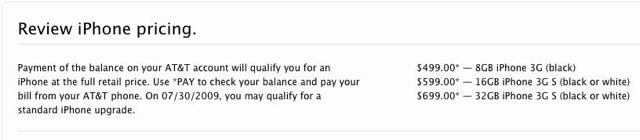
The iPhone 3G S is not going to be subsidized for current iPhone 3G customers. If you bought an iPhone 3G last year, the new iPhone is going to cost you $499 for the entry-level 8GB model, $599 for the 16GB version, and $699  for the 32GB.

Don’t believe me? Here it is in black and white on Apple’s website, literally buried in the fine print:

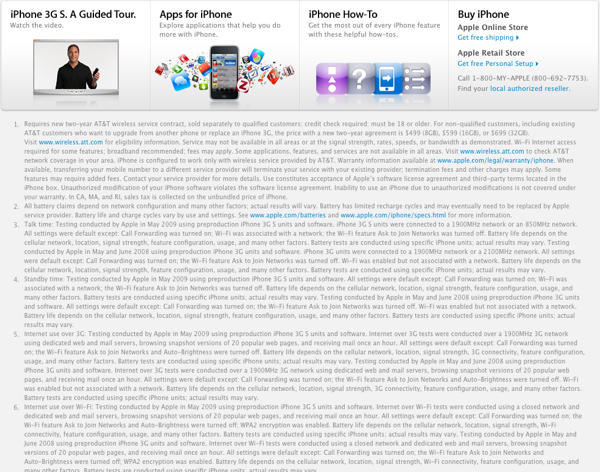
“For non-qualified customers, including existing AT&T customers who want to upgrade from another phone or replace an iPhone 3G, the price with a new two-year agreement is $499 (8GB), $599 (16GB), or $699 (32GB).”

Whether this applies to iPhone 3G customers after July 11, 2009 — the one year anniversary of the iPhone 3G launch — is unclear. Last year when the iPhone 3G went on sale, Apple and AT&T offered subsidized pricing to owners of the original iPhone (and had owned it for a year).

The prices advertised during today’s WWDC keynote — $199 (16GB) and $299 (32GB) — applies to “new and qualifying customers,” which apparently doesn’t include current iPhone 3G customers. I’ve put in a call to AT&T for an explanation.

UPDATE: AppleInsider suggests that AT&T will offer subsidized pricing for iPhone 3G customer after a year of ownership — I think. It is not 100% clear to me that this is what AT&T is saying.

UPDATE 2: I just checked Apple’s online eligibility tool, and it says I must currently pay the full retail price, but on July 30, I “may qualify for a standard iPhone upgrade.” What this means is also unclear. Is it the full $200 subsidy? I bought my iPhone 3G in late July, a couple of weeks after its debut. See the screenshot below.

UPDATE 3: iPhone 3G customers are eligible for the full upgrade price after about 18 months, reports Ars Technica, which spoke to an AT&T spokesman. Depends on the account. For those of us who bought the iPhone 3G in July, we likely won’t qualify for the full discount until December. Arse. It’s actually cheaper to cancel your current plan, pay the ~$175 penalty, and sign up as a brand new customer. That’s not how to treat early adopters. Where’s the nearest Sprint store?

iphone_upgrade

iPorn Comes to WWDC with Web App, Marathon After Party

By

post-11468-image-1d05de80cda5ac84920295ddf43b8df3-jpg

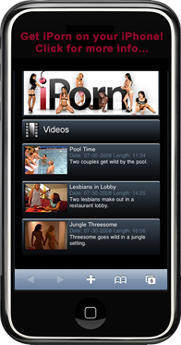
Taking Steve Jobs at his original word – that web apps would make the best use of iPhone and iPod Touch capabilities – iPorn launched Monday a new web app developed using Apple’s iPhone specifications and applying its unique accelerometer and touch navigation.

As Apple prepares to open the doors on WWDC in San Francisco on Monday and possibly announce a new video-capable iPhone, few may be as excited about the possibilities to come as the adult entertainment industry.

The iPorn app is loaded with social networking features such as high-res video streaming, the ability to post and share photos and videos, create member profiles, exchange private messages and more. Registered users can personally interact with amateur and professional adult performers via live video webcams, chat and mobile texting. Members can send adult videos from the website to their iPhone or iPod Touch-equipped friends. Versions optimized for other mobile phones, such as the Blackberry, Android and Palm Pre, are expected to follow later this summer.

To help celebrate iPhone 3.0 firmware and the possibility of video-capable mobile devices from Apple, iPorn is sending the iPorn Bikini Girls to Moscone Center in a high-tech iPorn-equipped vehicle for free photo ops with conference attendees. Later in the evening the company will host an (unofficial) 9-hour launch party at San Francisco’s famed Gold Club, just a block away from the conference site at Moscone Center West.

The party, which will go from 5:00 p.m. to 2:00 a.m., is open to WWDC attendees, investors, and media.

It’s no secret the adult entertainment industry has often been at the forefront of technology, producing some of the Internet’s most sophisticated websites and multimedia-rich user user experiences well ahead of many more mainstream and socially acceptable industries.

It’s therefore no surprise the porn industry will among the first fully equipped to let users get the most out of Apple’s innovations in mobile device technology.

DVDJon Mocks Apple On Its Own Turf

By

post-11463-image-03d700bbbef05cd0babf77b4599b4eb6-jpg
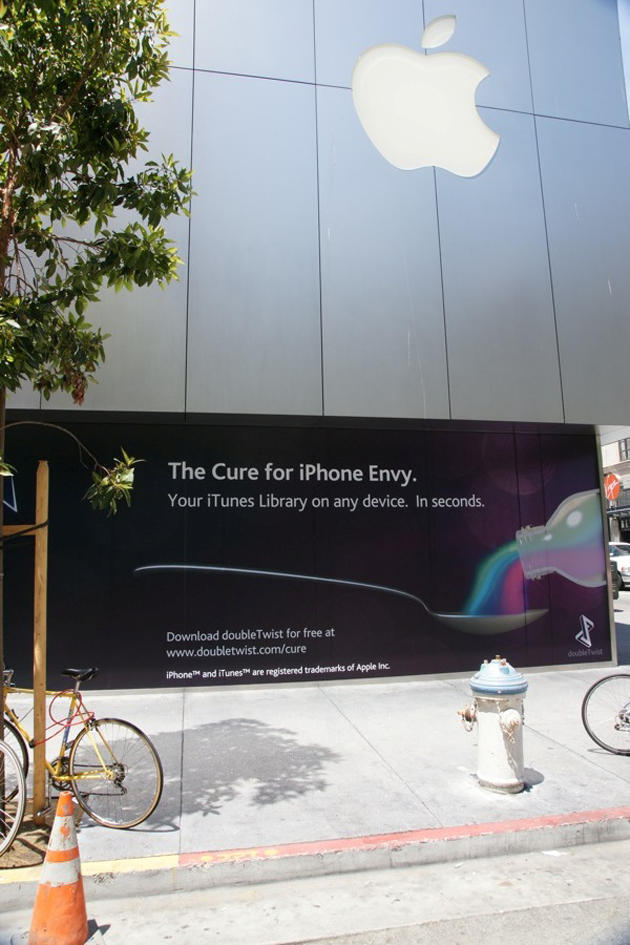
DVDJon's Mischievous Ad via TechCrunch

Jon Lech Johansen, the world-famous reverse engineer who earned the nickname DVDJon for cracking the CSS DVD-copy protection scheme years ago, again made headlines awhile back for his software program DoubleTwist, which removes old school iTunes Store DRM. That was a bigger deal in the years before every song on iTunes went DRM-free, but many users (myself included) have never paid the 30 cents a song needed to upgrade their older libraries — so DoubleTwist still has a purpose, if you for some reason want non-Apple hardware.

Anyway, all of that is a long pre-amble to highlight the above hilarious picture, which is DVDJon’s physical display ad for DoubleTwist, which was posted on the south-facing wall of the flagship San Francisco Apple Store. As it turns out, the ad wall is actually owned by the Bay Area Rapid Transit system and the ad doesn’t misuse any Apple trademarks, so it’s perfectly legal — even if it appears to show Apple endorsing a product that helps people to stop using iPods and iPhones.

The ad was taken down over the weekend, but DVDJon says it will return soon. Genius.

Via TechCrunch

Apple Removes Popular EDGE Game from App Store on Trademark Claim

By

post-11431-image-8e9615c576374d2a796a057ea74447d2-jpg

Edge, a way-cool game for iPhone and iPod Touch by Mobigame, has been removed from the iTunes App Store pending resolution of a trademark dispute being pressed by a guy named Tim Langdell, who claims to own worldwide rights to the use of the word ‘edge,’ at least in the realm of video gaming.

Langdell, whose company Edge Games last developed a video game in 1994, has a reputation in the gaming community as a ‘trademark troll’ and has gained the enmity of a number of gaming aficionados with his latest ploy against Mobigame.

The popular Edge title won the prestigious Milthon Award for Best Mobile Game in 2008 and is designated a Gold level game by Pocket Gamer.

The dispute, and Apple’s apparent policy of removing titles from the App Store at the whiff of legal action, make for a sad commentary on the revenue generated by app developers and what some are willing to do to exercise control over it.

[Daring Fireball]

How To Get the Most From Your iPhone’s Warranty

By

post-11368-image-cf39e3538d68ab99a34bd8e3b2528b2c-jpg
CC-licensed photo by Jeff Turner

By Jonathan Zschau

Apple released the iPhone 3G on July 11th, 2008, which gives you early adopters just a few weeks before your one-year warranty runs out.

What does this mean? It means you should give your iPhone a good hard look to determine if it’s in your best interest to take your iPhone to your local Apple Store to try to obtain a replacement.

There are at least 18 well-known defects with the iPhone, all of which oblige Apple to replace the handset for free. All are detailed are over the next few pages, including ways to test your iPhone to make sure everything is functioning properly.

Issues that Apple considers grounds for replacement include hairline cracks, discolored screens, dead pixels, flakey WiFi, dodgy GPS and crackly speakers.

If your precious iPhone is suffering from any of these problems, read on to make sure you’re properly prepared before you head down to your local Apple store and get a replacement. Hurry, before it’s too late.

New iPhone Spy Shot Emerges, Shows Forward-Facing Camera

By

post-11313-image-6a96a1a0ddda0697fd2aff61eb6d4ca0-jpg

A new spy shot claiming to show the next-generation iPhone has emerged, and it appears to show a forward-facing camera.

If the spyshot does indeed show the new iPhone, a forward-facing camera would be a cool but surprising feature. Although high on many iPhone users’ wishlists — it would enable iChat videoconferencing from anywhere — the feature seems too Dick Tracy to be true, especially with AT&T’s bandwidth-challenged 3G network.

A forward-facing camera was mentioned in a recent Apple patent granted April 16 — although this doesn’t mean much. Apple patents everything, and a ton of patented features never see the light of day.

Flight Control for iPhone gets major update

By

post-11296-image-471bad8fe70973e172cec7c9f922e7ea-jpg

In April, I got terribly excited about Flight Control, an air traffic control arcade-oriented ‘management’ game. The premise is simple: drag aircraft to landing areas. The reality is an intense arcade game where game over is a blink of an eye away.

Recently, I’d heard rumors of updates. But with the original game such a fantastic, simple and polished production, there was the worry that it’d be ruined under a pile of new features. That worry went away on playing Flight Control 1.2, which keeps the original’s gameplay intact but introduces two new airfields and new craft.

The beachside resort is the first new airfield, adding water landings to the mix. Initially, this seems little different to the original game, but the number of craft ramps up rapidly and the revised landing layout is tougher than the original’s.

flc2
The real star, though, is the intense and absurdly tricky aircraft carrier level. Military jets move just a tad faster than anything else, and you’re soon not only juggling that, but also a surprising twist when you realise what happens to landing areas on a moving ocean… Frankly, we’ll be shocked to see 10,000+ landing scores on this map for some time to come.

Overall, this is a triumphant update—a classic iPhone game made even better. The fact that it’s still under a dollar [App Store link], for a game that betters most other handheld titles out there, just goes to show what great value Apple’s platform can be for gamers.

TIPS: If you’ve any tips for dealing with the new airfields and getting high scores, please post in the comments below.

iPhone Rumor Round Up Chart

By

iphone

iphone

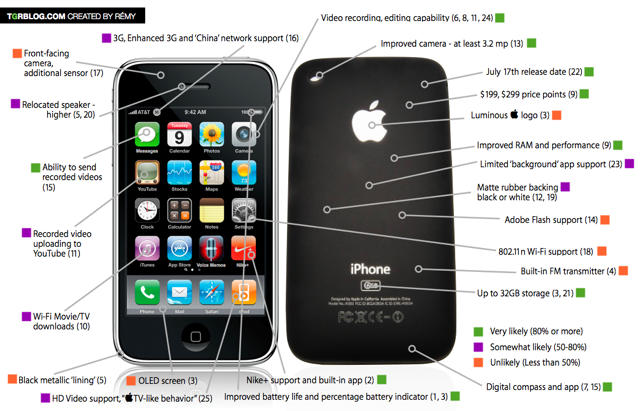
Kudos to Remy over at TGR for rounding up all the rumors about the next iPhone heading into WWDC with an easy-to-read infographic.

The legend lower right tells you what the probability of these changes will be from his point of view plus a source list of links for the rumors so you can decide for yourself.

We won’t know for sure until Apple’s worldwide developers conference kicks off June 8, but what do you think are the chances it’ll have a luminous logo (in this chart deemed “unlikely”),  improved camera (“very likely” ) and $199-$299 price points (“very likely”) ?

Via Device

Howto: Hack a Nike+iPod to Make a Wireless Car Key

By

post-11275-image-946e95a6aed8db57d777d8dc16d1923b-jpg

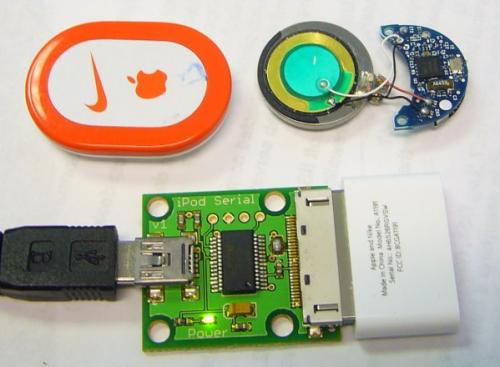
Hacker Nathan Seidle has rigged his car so that his Nike+iPod pedometer unlocks the doors wirelessly as he walks up to it.

“I hate keys,” he writes. “I am on a mission to dispose of them all.”

Seidle already uses keypads and wireless RFID cards to get into his home and office — the last key in his pocket is for his car.

So Seidle took a Nike+iPod sensor — the pedometer/transmitter that normally goes into your running shoe — and rigged up a simple proximity sensor inside the car to detect when it approaches. The Nike+iPod sensor is constantly transmitting a unique ID, which the car uses to identify Seidle and unlock the doors. He keeps the Nike+iPod in his pocket.

Seidle made the proximity detector inside the car from the Nike+iPod receiver (the part that normally plugs into the iPod) and an Arduino Pro Mini microcontroller board, made by his company, SparkFun Electronics, plus a few other bits and pieces.

The system, which Seidle calls the iFob, is an intermediate hacking project. He’s posted a detailed tutorial on the SparkFun website.

Unfortunately, the iFob doesn’t start the car; it just unlocks the doors.

“The system now works great!” Seidle writes. “When you’ve got a handful of stuff, it’s great to know the doors will automatically unlock as you approach. However, I still have use a key to start the car. The next step is get a big red button wired up for button start so that I don’t have to carry my key. Someday.”

Via GadgetLab.

Hulu’s Desktop Wants You to Keep Internet TV Out of the Living Room

By

cult_logo_featured_image_missing_default1920x1080

Hulu’s newly released Desktop application may or may not put Boxee on the ropes, but it could end up being the best thing that ever happened to the Mac mini.

Released Thursday by the popular television content aggregator whose major partners also happen to be some of the biggest Hollywood content producers, Hulu Desktop signals a major move away from the “online only” model that once served as a thin veneer of protection against the ire of cable companies that pay good money to get content from Hulu’s partners.

Still trying to have it both ways, Hulu issued comical Terms of Service with the desktop product that purport to prevent users from using the software on “Prohibited Devices,” to whit:

“You may not download, install or use the Hulu Software on any device other than a Personal Computer including without limitation digital media receiver devices (such as Apple TV), mobile devices (such as a cell phone device, mobile handheld device or a PDA), network devices or CE devices (collectively “Prohibited Devices”).”

In the real world, however, don’t be surprised to see news of an AppleTV hack by this weekend (if not before); and Mac mini users who employ that device’s excellent media server capabilities with a connection to plasma screens in their living rooms should be sitting pretty, too.

Will you use Hulu Desktop or stick with your web browser? Will you keep the content on your computer screen or take it into the living room? Let us know in comments below.

Will iPhone be the Death of Mobile Search?

By

post-11135-image-ec5be735416a467a240fdd4b04169bd9-jpg

iPhone applications and the increasing popularity of smartphones, driven especially by growth in the developing world, pose the greatest threats to the long-term relevance of mobile search engines such as Google and Yahoo, according to a report Monday at TechRepublic.

Jason Hiner, Editor in Chief of the widely read technology web portal, argues that a personal experiment he’s undertaken using his Apple iPhone leads to the inescapable conclusion that “trends [in mobile computing] add up to bad news for Google in mobile search because it translates into fewer people needing its search engine,” offering several pertinent examples of his own behavior in addition to statistics about the growth in smartphone use over the past year that bolster his thesis.

There’s little argument that iPhone changed the mobile phone game entirely with its arrival on the scene two years ago, as all the major mobile handset makers have since come to market with their versions of touchscreen smartphones to compete with Apple.

In addition, Apple revolutionized the environment for mobile software development by creating the App Store, which both provided a brand-new arena for software developers to work in and suggested a model for distribution that had previously been limited to the distribution of entertainment titles through the iTunes music store. Apple’s competitors Blackberry, Google (Android) and Microsoft (Windows Mobile) launched App Store-like marketplaces in response.

But does all of this development, do all of these trends in mobile computing spell the eventual end for search as a relevant tool on mobile platforms?

Certainly Google’s voice search functionality adds to its relevance and appeal on a mobile device, but as Hiner argues convincingly, limitations of mobile device screen sizes and challenges related to typing on small handsets do make traditional desktop search functionality far less appealing in the mobile environment.

What do you think? Do you use Google less on your iPhone? Should Google be worried about the trends in mobile computing as a great threat to its core search product? Let us know in comments below.

Safari Is Fat Hog That Spies on You — Porn Mode Doesn’t Work

By

post-11107-image-5519df20edd456b23cf89be3b762e080-jpg

Apple’s Safari 4 browser is a pig. It’s a resource hog that doesn’t clean up after itself — and it remembers every site you visit, even in “porn mode.”

Safari records every site you visit, even if you turn on the “Private Browsing” feature or clear the browser history. And the files it generates can consume gigabytes of disk space.

“This is a huge privacy concern,” writes designer and musician C. Harwick, from Chapel Hill, NC, who did some snooping in Safari’s hidden system folders. “With no good way of getting rid of them except manually (clearing the history doesn’t do it, and I don’t think resetting Safari does either), these hidden files are strewn all over the user’s hard drive unbeknownst to him waiting for snooping relatives (or more pertinently, law enforcement) to dig them up. I really like Safari, but I’m going to have to seriously consider using Firefox now (ack).”

Gallery: NYC Painted Impressionist Style On The iPhone

By

post-11091-image-3ac3d0c1549f14af5c9ed0a7b63e5fdf-jpg

David Leibowitz is a veteran fine art photographer who’s lately been making some pretty amazing art using his iPhone.

Based in NYC, Leibowitz’s pictures of the city look like a French Impressionist painted the scenes (hit the jump for more pictures). There’s nothing to indicate they were made using his iPhone and about $40 worth of apps from the App Store.

Leibowitz has a long history of using digital tools to make art. He started in the ’80s with a Polaroid camera. He’d hand manipulate the emulsion to create photographs that look also look like Imrpessionist paintings. But now he’s discovered the iPhone, and the results are not your typical iPhone art.

Hit the jump for some of Leibowitz’s latest pictures and an interview explaining how he makes iPhone art.

Think Irony

By

post-11051-image-fda3ed9034e806f817b4c025613e890a-jpg

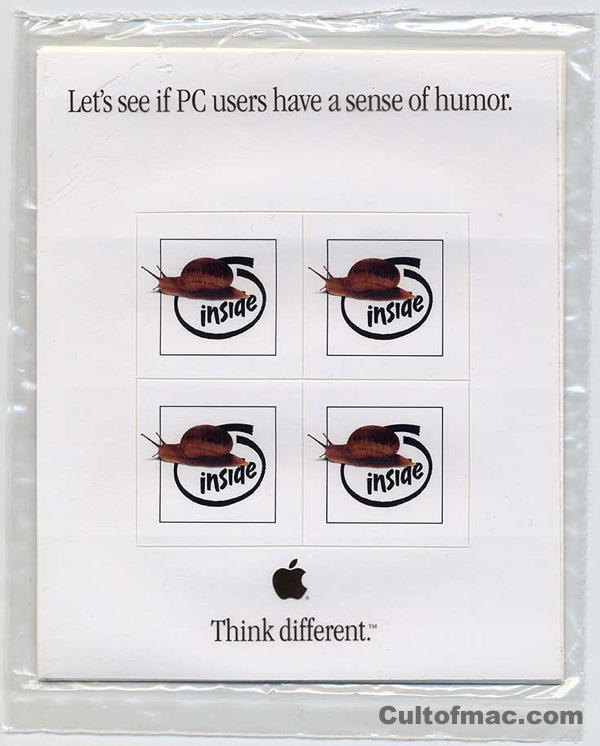
My friend Jeffy picked up this pack of stickers at a Macworld past. Do Mac users have a sense of humor ? Should they be printed up as stickers for MacBooks?

Glimpse Of Future: Unbelievaby Cool 3D Map of NYC For iPhone

By

cult_logo_featured_image_missing_default1920x1080

UpNext 3D NYC iPhone App from Danny Moon on Vimeo.

The 3D NYC iPhone App from UpNext is unbelievably cool. It renders Manhattan in 3D, allowing you to zoom up and down the city streets, in-between buildings, finding places to eat and things to do. The rendering is amazing — see the video above.

It overlays the subway map and crowdsources popular destinations. All this for only $2.99 from the iTunes App Store. Worth buying even if you don’t live in NYC.

Microsoft’s Ads Are Hurting Apple: Survey

By

post-10944-image-00e34947b20b373f7aaa6a2a5ed0826f-jpg

Chart: Silicon Alley Insider.

UPDATED: YouGov sent a little more info about the survey’s other metrics — posted after the jump. Basically, Apple still leads on quality and reputation, but MS has caught on value, satisfaction and willingness to recommend.

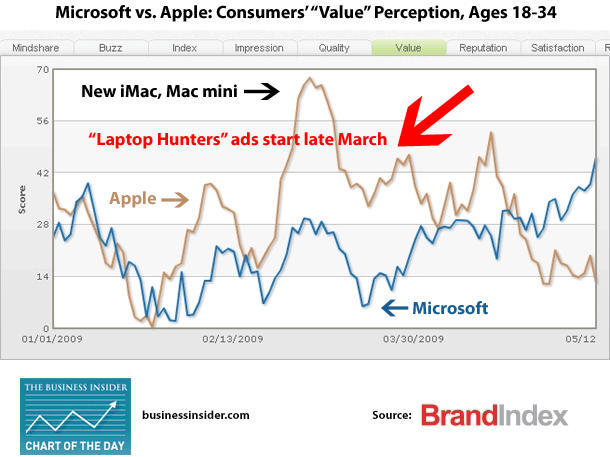
Microsoft’s “Laptop Hunters” ad campaign is hurting Apple, according to a new consmer survey by YouGov BrandIndex.

Redmond’s new ads portray consumers rejecting Apple’s laptops as too expensive. Though clearly a defensive reaction to Apple’s successful “Get a Mac” ads, they are nonetheless reinforcing the stereotype of the “Apple tax,” says YouGov.

“With the Laptop Hunters campaign, Microsoft is making an impact on the perceived value score in the mind of consumers, particularly young consumers,”  Ted Marzilli, global managing director of BrandIndex, said on Tuesday afternoon when I phoned him up.

YouGov is an international market research firm based out of London. Its BrandIndex survey queried about 5,000 people online from a pool of about 1.5 million, Marzilli said. It claims to be representative of the U.S. adult population.

Its latest survey shows a clear uptick in Microsoft’s “value,” and a clear downtick in Apple’s. The change coincides with Microsoft’s high-profile campaign.

Exclusive: Apple Is Building a New Helpdesk Operation: New Product, Or Growing Popularity?

By

post-10836-image-9bf0970b129129dc04b75d576e5a8f09-jpg

CC-licensed photo by Joohyun Jeon

Apple appears to be building a large, distributed helpdesk operation, either in anticipation of a major new product, or simply to sustain the company’s growing popularity.

Apple this summer is recruiting about 450 “At Home” technical support staff in at least six cities across the U.S., according to a document seen by Cultofmac.com.

Instead of locating these workers in a centralized call center, they will work out of their own homes.

“As a company who’s motto is ‘think different,’ our ‘work different’ philosophy offers you the opportunity to work independently in your home office,” the job ads said. “You will receive all the wonderful benefits of working for an amazing company without ever leaving your home.”

CoM’s Totally Unbiased Review of Windows 7: Debasing Myself So You Don’t Have To

By

post-10796-image-f63d21a15e7ac30557bb7da532780ff4-jpg

The first question that should leap to mind is: “Why on earth is CoM reviewing Windows?” Frankly, for many professionals, we have no choice. Many of us have to use Windows software in the course of our jobs, or at a minimum use web applications that require that bane to open standards developers everywhere: Internet Explorer.

There’s no easy way to do this, so lets just rip off the band-aid and see if there’s a scab underneath.

Exclusive: Steve Jobs Will Return, But Not For Long, Says Silicon Valley Psychic

By

post-10750-image-ee9c186c05fd0aef1e75cf3126484773-jpg

Like everyone else, I’m dying to know if Steve Jobs will be returning to work at the end of June.

Since I haven’t got a clue, and neither does anyone else, I figured I’d ask someone who might know. Not the usual blowhard pundits, but Barbara Courtney, a corporate psychic known as the “Seer of Silicon Valley.”

Personally, I’m very skeptical of psychic predictions, but Courtney has a long and storied history as Silicon Valley’s leading clairvoyant. Indeed, she’s the only person on record who correctly predicted Steve Jobs’ return to Apple back in 1997.

Speaking by phone from her home in Redwood City, Courtney said Jobs will return to Apple in June as promised — but he won’t stay long.

“My feeling is he will come back,” said Courtney. “I’m not seeing June as too soon.”

Jobs took six months medical leave in January saying his ongoing medical problems were “more complex” than suspected and he needed time off work to concentrate on his health. The company has promised several times that Jobs will return in late June as planned, but many are pessimistic.

On Tuesday, hopes were further dashed when Apple said the WWDC keynote in early June will be given by a team of executives led by head marketer Phil Schiller. The slot has traditionally been Jobs’, and many hoped (and are still hoping) he’d put in a surprise appearance.

Cult of Mac favorite: Saucelifter (iPhone game)

By

post-10781-image-e18ca346c8e928596f2bd67ab7ac7013-jpg

What it is: It’s Dan Gorlin’s Choplifter. With aliens! And a flying saucer!

Why it’s good: It’s Dan Gorlin’s Choplifter. With aliens! And a flying saucer!

Oh, all right, then—if that’s not enough for you, here’s why Saucelifter is great. It takes a fab classic arcade game (rescue groups of hostages from the enemy, avoiding your adversary’s vehicles and projectiles), subverts videogame conventions by having you piloting a UFO and saving alien buddies from nasty humans, and dresses the entire thing in beautiful vector-style graphics. Add a dollop of humor (“squishing of captives will desist immediately!” barks the tutorial if you land on hapless aliens) and beautifully calibrated tilt/multitouch controls and you have a minor iPhone classic, updating a 27-year-old gameplay concept that still appeals today.

Where to get it: Saucelifter’s available via the App Store, and there’s more information at the Saucelifter website. At the time of writing, the game’s on sale for just 99 cents—a bargain unless brilliantly updated Apple II classics make you cry.

Exclusive: Steve Jobs’ Amazon.com Account Hacked, Hacker Claims

By

post-10709-image-e98000e872dcf56e8260bad606f54cdf-jpg

CC-licensed picture by Ben Stanfield.

A hacker claims to have broken into Steve Jobs’ private Amazon.com account.

The hacker is trying to sell details of Jobs’ Amazon.com account to journalists, including Jobs’ purchase history for several years and his credit card number.

According to the hacker, who identifies himself as “orin0co,” Jobs is an avid online shopper. Jobs has purchased 20,000 items from Amazon.com in the last 10 years, the hacker says. That’s 2,000 items a year, or more than 5 items a day, every day.

“I got myself a hold of this information,” the hacker wrote in an email sent from a secure Hushmail account. “No one else has it. I didn’t misuse it, otherwise Mr. Jobs would long ago change his login detail, wouldn’t he?”

Latest Zune Commercial Claims It Costs $30,000 to Fill An iPod [SNAKEOIL]

By

post-10578-image-92aa90e619a537824e72daa2588dab4c-jpg

MICROSOFT SPOKESMAN: Hi — you look dumb. Would you like me to advance the dumbest possible argument for Zune ownership? See, it’s like this: iPods, though they’re really cool, cost money to get music on them! So you should pay a $15 monthly subscription for Zune music, which is basically free! You can trust me — I’m a financial planner. People in finance have never misled anyone!

APPLE BLOGGER: I had a music collection long before the iPod existed, dumbass. And who on earth owns an iPod classic these days?

YouTube via Ars via Engadget via Giz

Picture via Engadget