Mobile menu toggle

Search results for: wwdc

Why iTunes Radio Is Disappointing [Opinion]

By

itunesradio_hero_2x

With last week’s iOS 7 launch, Apple also released iTunes Radio, its long-awaited internet radio service that’s available for free on all iOS devices and iTunes on the desktop. While iTunes Radio was thought to be a Spotify-killer before Apple’s Eddy Cue unveiled it at WWDC in June, how it works is more similar to Pandora. You listen to stations based on artists or genres you like, and more importantly to Apple, you can quickly buy played songs through iTunes.

I’ve had access to iTunes Radio all summer through the iOS 7 beta, and I maybe used it for a total of 10 minutes. Since everyone got access last week, I’ve tried using it more to see how well it works post beta. My experience was largely one of frustration. It’s obvious that iTunes Radio still has a lot of growing up to do.

Why The Mac Has Nothing To Fear From iOS

By

OS-X-Mavericks-Features-MacBook


There’s a conspiracy among some Apple watchers: the ‘iOS-ification’ of the Mac.

The past couple versions of OS X, specifically Mountain Lion, have proven that Apple is not afraid to bring features from its mobile operating system to the desktop. Sometimes the borrowing is incredibly blatant, like the Mac version of Reminders, and sometimes the trend is more subtle, like when Apple inverted scrolling in OS X Lion to recreate the “natural” scrolling experience from a touchscreen.

Before the June unveiling of OS X Mavericks, it would not have been farfetched to look at the evolution of OS X and iOS and draw the conclusion that the two were becoming more alike. Now that we’ve seen Mavericks, it’s clear that OS X isn’t getting more iOS-ified like everyone feared. The two platforms are headed in different directions and while they share similarities, Apple does not appear to be on a mission of convergence. Cupertino has decreed that never the twain shall meet.

The Walled Garden

Compare iOS 7 to Mavericks, and the untrained eye could be led to believe that the two operating systems were designed by separate companies. iOS 7 is full of bright, unrestrained colors and abstract interface elements, while Mavericks largely still looks like the OS X we know and love. There are plenty of great improvements in Mavericks, but the general aesthetic of the OS is by no means a radical departure from Mountain Lion. Mavericks remains grounded, while iOS has been set free to soar into a new world of design.

iphone5-pf-pyramid_features_print

“Mavericks remains grounded, while iOS has been set free to soar into a new world of design.”

To Apple, iOS is the software used by its largest and most profitable customer base: iPhone, iPad and iPod touch owners. iOS is designed to appeal to the masses and offer a consistent experience from one device to the next. iOS 7’s aesthetic design may be incredibly different, even jarring, to users of past iOS versions, but the core philosophy behind the platform hasn’t changed in 2013.

Unlike OS X, the file system in iOS is totally invisible. You can send media and certain files in-between certain apps, but there’s nothing like a Finder equivalent—no ability to open a zip file’s contents like you can on the Mac. The innards of what composes iOS are kept hidden so you don’t sweat the small stuff, or more importantly, do something damaging to the smartphone you rely on every day.

Each iOS app is sandboxed, meaning that it is forced to operate within a silo of its own under Apple’s rules. App Store apps have limited ability to talk to each another and they definitely can’t take over all of the OS, like Facebook Home on Android. An analogy that’s commonly used is a walled garden. You can enjoy the experience, just respect the boundaries.

Apple approaches iOS in a fundamentally different way than OS X, and that’s a good thing for the future of the Mac.

“PCs are going to be like trucks.”

“PCs are going to be like trucks,” said Steve Jobs, hitting the nail on the head way back in 2010. Like the car industry has been revolutionized by the automatic transmission, power steering, and hybrids, the world of traditional desktop computers has been upturned by smartphones and tablets. “Trucks” will always be needed, just not as much. The Mac is still a cornerstone for Apple. It will never have the huge install base of iOS, but that doesn’t make it any less important. Since when has Apple only cared about taking as much market share as possible?

Mavericks
Mavericks is the first wave of a new age for OS X.

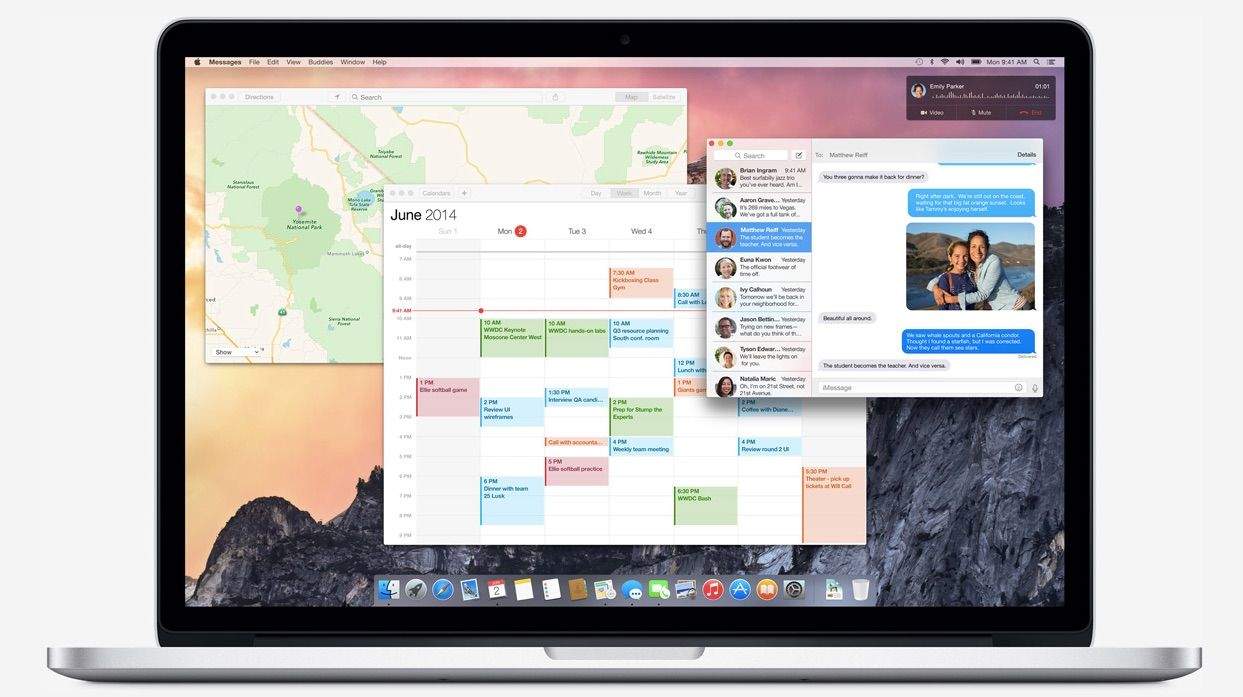
The recently unveiled Mavericks continues to bridge the gap between iOS with a couple of additions, like iBooks and Maps. But then there’s also plenty of new features for power users, like enhanced support for multiple displays, Finder Tabs, Timer Coalescing for more efficient CPU management, and App Nap for managing power. Apple has historically been about connecting the familiar with new, groundbreaking technology.

Word on the street is that Apple has given Mavericks less attention in recent months to devote resources to polishing up iOS 7 in time for its Worldwide Developers Conference (WWDC). That may explain why iOS 7 looks so different and Mavericks is more of an incremental upgrade to OS X. Now that Jony Ive is in charge of all software design at Apple, he surely has more tinkering to do with OS X if he wants to unify the company’s design language across platforms. He’s already stripped out most the garnish textures with Mavericks (“No cows were harmed in the making of this virtual interface,” said Apple’s Craig Federighi at WWDC), but there’s a lot of needed change for OS X to truly be ushered into the era of Ive.

osxmavericks

“The Mac is still a cornerstone for Apple.”

That doesn’t mean OS X will eventually dissolve into iOS, at least not for decades to come. While explaining the reasoning behind naming OS X 10.9 “Mavericks” on stage at WWDC, Federighi said, “We’re really excited about the future of the Mac, and we want a set of names that will carry us for the next 10 years.” Future versions of OS X will be named after special places to Apple in California. OS X is an inspirational product for the company and it has its own vision.

This is the first time in several years that Apple’s mobile and desktop platforms look so different from one another. Will our concept of “desktop computers” not exist years down the road? Thanks to the rapid pace of innovation in the tablet industry, probably. Will underpinnings of OS X fade into obscurity as the platform is phased out by iOS? Certainly not.

It’s nice to know that iOS and OS X can co-exist in the post-PC era. The future remains bright and full of possibilities.

Why iOS 7’s Kill Switch Won’t Take A Bite Out Of iCrime

By

Used with permission, thanks to Caprisco on Morguefile.com
Thanks to Caprisco on Morguefile.com

This article first appeared in Cult of Mac Magazine.

Apple devices are on the most wanted list for thieves who snatch smartphones and tablets out of the hands of distracted commuters in big cities.

This type of theft is so easy and generally without consequence that it’s become known as “Apple picking.” The Cupertino company has been on the forefront of trying to curb these crimes, dating back to the Find My iPhone app in 2010 and the new Touch ID fingerprint sensor for the iPhone 5s.  Apple has also added a new i0S 7 feature called Activation Lock, which many are dubbing the “kill switch.”

“As a consumer, I love the idea of a kill switch for the device that I, as the owner, can invoke, but giving that type of power to my carrier is another thing.”

In doing so, Apple has responded to further pressure from authorities who are inundated with cases involving iPhone and iPad crime. (See our investigation into lost and stolen iPhones on Craigslist for more.) But prosecutors in New York and San Francisco, where about half of all crimes involve smartphones, were initially lukewarm on the feature but say they are now optimistic after seeing it in action.

The industry insiders Cult of Mac sounded out, not so much.

“To really make this work, the ‘kill switch’ would need to be wired to carrier networks, so that as soon as the device’s IMEI shows up on the network, the device is disabled by the carrier,” said Tom Kemp, CEO of Centrify, a company that provides unified identity services across data center, cloud and mobile for businesses. “As a consumer, I love the idea of a kill switch for the device that I, as the owner, can invoke, but giving that type of power to my carrier is another thing.”

As smartphone use grows — nearly half of Americans own one — so has iCrime. According to recent comScore data, Apple owns almost 40 percent of the smartphone market, more than its next closest competitors Samsung and HTC combined, with 23 percent and 8.7 percent, respectively. But part and parcel with Apple’s success and their distinctive design aesthetic is the fact that Apple products are an easy targets for a quick snatch-and-resell.

“How much would mugging decrease if your wallet was worth $0? Essentially, that’s what Apple is doing with its new kill switch feature – making your smartphone worthless, ideally. But, who is it really worthless for in the end?” said David Anderson, director of product for smartphone insurance company ProtectYourBubble. “Smartphone thieves often resell stolen devices on the secondary market…Unknowing consumers will purchase devices from sites like eBay and Amazon to cut costs but (will) end up receiving a ‘killed’ device in the mail.”

Craig Ferenghi introduces iOS 7's new "kill switch" during the WWDC keynote.
Craig Ferenghi introduces iOS 7’s new “kill switch” during the WWDC keynote.

Companies that survive on tracing stolen gadgets are also not worried that the kill switch will sound the death knell for their businesses. “Unfortunately for consumers, Apple’s tracking and other anti-theft measures are also fairly easy to disable. People are going to continue to steal iPhones and hackers will find a way around the kill switch. It can be as simple as jailbreaking the phone,” said Ken Westin, founder of GadgetTrak. Most of GadgetTrak’s customers are tracing Apple devices — check out the live map — and use of the service has led to a few spectacular recoveries like this one from Kansas to Mexico.

Which brings up another point: whether Apple should be partnering with authorities rather than potentially enabling users to pursue their stolen iPhones

Maybe Apple should be partnering with authorities rather than enabling their customers to pursue their stolen iPhones.

Absolute Software, which says it has recovered 29,000 devices in 100 countries to date, recently launched a partnership with Samsung and says one with Apple is very possible. They work with police and discourage people from trying to get their gadgets back, rogue style.

“Deactivating a device with Activation Lock so that an unauthorized user is unable to use it or sell it can have a positive impact on deterring theft. However, the value of this capability is limited and could lead to encouragement of owners trying to recover devices from thieves themselves,” said Ward Clapham, vice president of recovery services at Absolute. “Self-recovery can be dangerous – even fatal. The best case scenario is for the user to rely on trained professionals to work with law enforcement to recover the device and pursue any criminal charges that may result.”

iPhone users who keep their smartphones mute in their pockets out of fear may find the new service makes it once again OK to stumble down a crowded sidewalk while checking email.

The iWatch might be a really popular theft target.

“With the kill switch, you will no longer feel unsafe using your iPhone on a city street. The kill switch makes the iPhone a much less desirable target for thieves — they’ll have to go back to nicking gold watches and fancy handbags,” says Dave Howell, founder and CEO of Avatron Software, which makes a number of productivity apps. “With this feature, Apple is responding to rising iPhone theft rates, but the company may also been preparing for the launch of the iWatch. The iWatch might be a really popular theft target. The kill switch is a neat, thoughtful feature but it won’t move the market-share needle.”

Howell, a former Apple software engineering manager whose team includes a number of veteran Mac programmers, says he doesn’t have any inside knowledge about the kill switch but that the service fits into Apple’s general ethos.

“I know Apple’s been working hard for some years to make iPhone as safe as possible…Apple has always garnered a reputation for designing for the benefit of users, even when it hurts sales. Certainly preventing theft will put a dent in replacement iPhone revenues.”

This article first appeared in Cult of Mac Magazine.

iOS 7 Is Now Available To Download

By

update

The wait is finally over. iOS 7 is now available to download, three months after it got its first unveiling at WWDC. You can download and install it either via iTunes on your Mac and PC, or by using the over-the-air Software Update feature baked into iOS 6.

iOS 7 Review Roundup

By

design_functional_gallery2

It’s been over three months since iOS 7 got its first unveiling at WWDC, and in just a couple of hours, it will be made available to the public. It’ll be completely free to download — no matter which iOS device you’re using — and Apple’s confident it will quickly become the world’s most popular mobile operating system.

iOS 7 is the biggest change to iOS since the original iPhone, introducing a colorful new design for the first time, and bringing lots of new features — including Control Center, improved multitasking and Notification Center, iTunes Radio, and AirDrop.

So should you be rushing to download and install it on your iOS devices as soon as it becomes available, or can you wait until all the fuss has died down? Well, we’ll be bringing your our review in stages over the course of the coming days, but to help make your decision super simple, we’ve trawled through the biggest and best iOS 7 reviews out this week and put together a helpful roundup.

iCloud.com Redesign Goes Live Ahead Of iOS 7 Launch Tomorrow [Gallery]

By

Screen Shot 2013-09-17 at 7.53.07 PM

If you head over to iCloud.com, you’ll notice that it has been completely redesigned to match the look and feel of iOS 7. The new iCloud website has been in beta all summer, and Apple has made it publicly available on the eve of tomorrow’s iOS 7 launch.

The web versions of Mail, Contacts, Calendar, Notes, Reminders, Find My iPhone, have all been revamped to match their iOS 7 counterparts, and the iWork suite is also available. Apple demoed the web versions of Pages, Numbers, and Keynote at WWDC in June. 

The Complete History Of The iOS Homescreen In One Simple GIF

By

iOS1toiOS7

Maybe this iOS comparison GIF isn’t  quite as mind-blowing as the one of Sir Jony Ive’s death stare devouring Forstall’s face, but pretty good nonetheless.

Some Apple detractors have bemoaned the release of iOS 7, claiming its not a big enough leap forward for Apple, but when you look at this GIF created by the Czech Apple blog LetemSvetemApplem, it’s pretty clear iOS 7 has the biggest UI changes of any previous version of iOS. Not to mention a slew of new features too.

Source: LetemSvetemApplem

Everything Apple Announced At Today’s iPhone 5s and iPhone 5c Event [Round-Up]

By

Screen Shot 2013-09-10 at 3.56.59 PM

Tim Cook and company rocked today’s keynote. As expected, the iPhone 5s was announced with a new processor, fingerprint sensor and motion chip alongside the new cost-conscious and brightly-colored iPhone 5c.

Craig Frederhigi spent some time on Jony Ive’s upcoming iOS 7, running through the main features, most of which we’d heard back at WWDC in June, including Control Center, Search anywhere, more textured ringtones and the like.

The two new models of iPhone were the focus of today’s event. CEO Tim Cook said that the iPhone business was getting so big they decided to replace the iPhone 5 with two new models. The iPhone 5c looks to aim directly at kids and perhaps budget-conscious consumers with bright colors and the ability to purchase contrasting soft rubber cases. The iPhone 5s is a tour-de-force of new technology, including the much-anticipated fingerprint sensor, Touch ID, and the new A7 and M7 chips.

The keynote was even more densely packed with info, of course, so we’ve broken everything down into tasty, bite-size nuggets of information so you can get essentials of what happened today without having to read 30,000 different blog posts.

Here’s everything that Apple announced at today’s keynote:

Apple Releases iOS 7 GM To Developers Ahead Of Public Launch Next Week

By

Screen Shot 2013-09-10 at 3.23.11 PM

After announcing that iOS 7 will ship to the public on Wednesday, September 18th, Apple has released the Golden Master version to developers.

iOS 7 has undergone 7 betas since its initial unveiling in June at WWDC, and today’s GM version marks the final iteration. The GM has historically been the same build Apple releases to everyone. Apple releases a GM to developers only in advance of the public release to allow time for final compatibility testing with apps in the App Store.

We’ll let you know what, if anything, has changed in the GM.