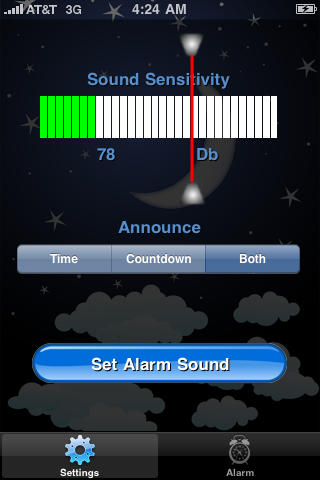
I have ridiculously sensitive eyes; the kind of eyes that feel like they’re being repeatedly stabbed with chopsticks if more than just the slightest bit of light hits them before they’ve had time to adjust.
So when I ran across the press release for Wake Up Now? describing an app that makes the iPhone call out the time, I was intrigued.
Police in rural England are offering kits that capture DNA traces so locals can mark high-tech valuables such as iPods in the hopes of preventing thefts.
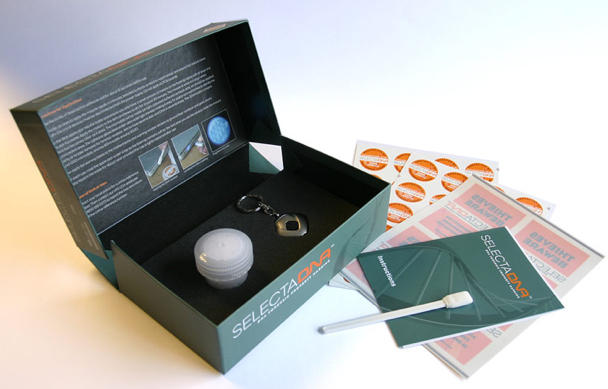
Similar to the home kit pictured above, the product made by Selecta consists of a water-based adhesive containing a locked-in DNA code, a UV tracer and a series of microdots which can be easily applied to property “such as a TV or an iPod,” police said.
The fluid marks the property with a unique code which is revealed when scanned with a UV light. The DNA marking allows police to place the burglar at the crime scene, which could increase chances of a conviction.
On Monday, April 12th, Adobe’s going to unveil their Creative Suite 5. We don’t know much what’s going to be different, except that Flash CS5 is finally supposed to allow developers to export Flash-based applications as App Store .ipa files.
That said, the video above gives a tantalizing look at one of the new features in Photoshop CS5: content-aware tools, which allow the program to make educated guesses on what you want to fill or replace a section of image with.
You need to watch the entire clip to see how impressive this is, but by the end of the video, CS5’s content aware tools have gone from simply plucking stray shadows and lens flare’s out of shots to seamlessly autofilling 30% of a missing panorama in just a few seconds.
Sure, these examples are obviously cherry-picked by Adobe to apply to the strength of Photoshop CS5, but if their content-aware tools are even half this good at release, CS5 seems like a must-have update.
We’ve reached mid-week with a number of Mac-related deals. First up is about nine iMacs from the Apple Store, including a $849 model with 20-inch screen and a 2.66GHz processor. Next we have a new batch of App Store freebies, including “Squism,” a puzzle game. We round out our top trio of deals with a bargain on Apple’s MagSafe power adapters for MacBook and MacBook Pro laptops. The 60-watt power adapters are priced at $35.95.
Along the way, we also take a look at MacUpdate’s Spring Bundle of Mac applications for $49.99.
As always, details on these and many other items are available at CoM’s “Daily Deals” page right after the jump.
The phone has not been completely eclipsed by Apple’s iPad when it comes to reading your daily newspaper or magazine. Tuesday, publishing giant Hearst Corp. inked a deal with Samsung, naming the cell phone maker its “preferred e-reading service partner.”
Samsung’s smart phones, such as its newly introduced Galaxy S, will include software from Skiff allowing owners to read newspapers or magazines on a phone’s 4-inch screen. Along with creating gadgets such as the 11.5-inch e-Reader device introduce during CES in January, Skiff makes e-reader software for computers, tablets and phones.
Forget all the talk about e-books, gaming and other applications on the forthcoming iPad. It’s only natural that the most ubiquitous media on the planet — advertising — is making plans how to best use the tablet’s 9.7-inch screen. Major publishers, automakers and retailers are preparing ad campaigns specifically tailored to the iPad’s unique characteristics.
PointRoll, an analytics firm, and AdMarvel, which delivers ads, reportedly will team up to develop interactive ads for the iPad, according to the marketing news site Clickz. Although the two ad players hesitate to name names of companies seeking to get their brand before iPad owners, they did provide a glimpse into what sorts of ads we might expect.
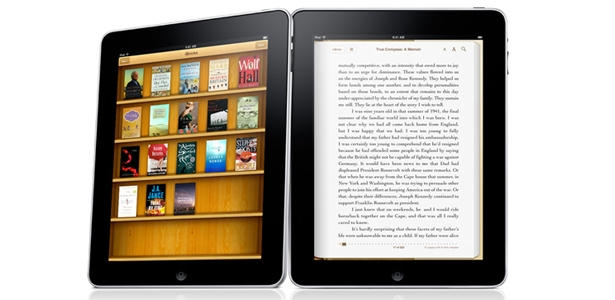
Despite what Apple and even my fellow Cultists of Mac tell me, for me, the iPad isn’t a compelling gaming or productivity platform (at least primarily) and it’s not a viable laptop or even netbook replacement. For me, the iPad is a thing, attractive lozenge of aluminum and glass that will usually sit on my living room table on top of the pile of magazines and newspapers that are usually placed there. Despite Steve Jobs’ assertion that people don’t read anymore, the iPad is an e-reader, first and foremost…. and it’s going to be the best e-reader ever released.
It does not appear that I’m alone in this opinion. comScore recently polled 2,176 iPad customers and discovered that over one-third of them said that they mainly thought they’d use the device as an e-reader.
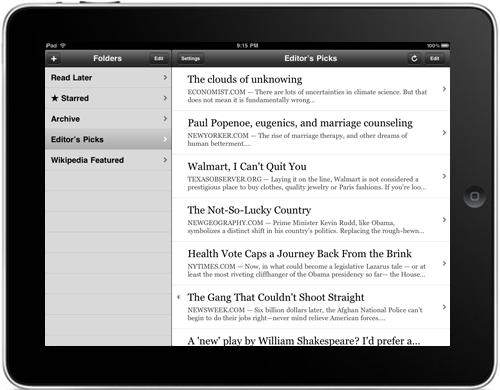
There are a few apps I find absolutely indispensable, and Instapaper Pro is at the top of the heap. When I find an interesting long article during the day (for example, this wonderful New York Times piece on the evolution of the science museum from wunderkammer to proslytizer) I just click Instapaper’s “Read Later” bookmark and give it the attention it deserves later, in a stripped down, paginated, ultra-readable iPhone-friendly format.
I’ve been eagerly anticipating what Instapaper developer Marco Arment had up his sleeve for the iPad version, and now he’s given users a sneak peek on the official blog. There’s no huge surprises here, which even Arment admits: “No multi-column reading, no fake book-page animations, and no giant newspaper graphics,” he says. Never the less, it looks perfect, right down to the dual-pane navigation view. Even better: Arment says that existing Instapaper Pro customers will get the iPad version for free.
Once Apple.de gets around to allowing me to buy an iPad, I think this is the app I’m most looking forward to giving a try. I intend on buying the stock 16GB iPad WiFi, and Instapaper is that rare app that actually gets better and more indispensable when you don’t have a mobile broadband connection. This is a must have program for everyone who loves reading, and reading’s going to be the thing the iPad excels at most.
In the wee hours of the morning, Nintendo very quietly announced the successor to its wildly successful line of Nintendo DS gaming handhelds: the Nintendo 3DS.
Following Nintendo’s recent trend of embracing bold and unconventional gaming hardware (e.g. the Nintendo Wii’s motion-sensing controls, or the original Nintendo DS’s dual screen / touchscreen approach) the 3DS, as its name implies, promises to bring full 3D without glasses to handheld gaming.
What’s of interest to the announcement for Apple fans, though, is the timing. Like many tech companies, Nintendo tends to announce its biggest products at industry events. The Nintendo DS is such a wild success for the company, they’d be sure to announce their follow-up handheld at a major expo, such as May’s E3 Expo.
Instead, though, Nintendo chose to announce the 3DS with a terse press release and a promise to give more details in May…. following right on the heels of a report that shows that the iPhone and iPod Touch have claimed 19% of the handheld gaming market from Nintendo, thanks to the App Store, in only 21 months.
This announcement has all the hallmarks of a hastily made pacifying gesture to Nintendo investors alarmed by Apple’s unexpected success in the handheld gaming market: “Don’t worry, we’re not resting on our laurels, we’ve got something new up our sleeves.”
I’m eagerly anticipating E3’s 3DS announcements. My guess is that the App Store has changed the mobile gaming development scene forever, and an integral part to Nintendo’s own strategy will be to extend their WiiWare downloadable games service to the 3DS while opening it up to public submissions.
No one here’s going to argue that the App Store can’t be arbitrary and borderline tyrannical… but you know, sometimes developers get what’s coming to them: Zits & Giggles, a high-brow dermatological simulator, has been pulled from the App Store after its creator, Tommy Refenes, told an audience at San Francisco’s Game Developer Conference that he “absolutely f***ing hate(s) the iPhone App Store.” And that f-bomb ain’t “fudge.”
Of course, there’s more to this than that. Refenes seems to have had an axe to grind with Apple, having raised Zits & Giggles price from $0.99 to $15.99 to $299.99 to $399.99 over a period of about six months. Shockingly, the app still managed to sell fourteen copies at the price of $299.99.
What was the point of all of this? To prove how crummy the App Store is because it’s not aimed at “real gamers,” apparently.
“My conclusion to all of this is that the people you’re selling games to on the App store, they’re not necessarily gamers. There are some games that sell very well on the App store, but for the most part, when you have stuff like Street Fighter and Assassin’s Creed, the are a way to sell a brand, just like the Tiger handhelds were,” said Refenes.
Something tells me that Apple couldn;t really care less about some punk kid mouthing off, and this is really about selling a zit-bursting simulator for more than the cost of a real-life visit to a dermatologist.
Whatever, though: I think this is one zit on Apple’s backside we’re all perfectly happy to see excised.