Mobile menu toggle

Search results for: Apple One

Analysts: Apple ‘Top 10’ Cell Phone Vendor As iPhone Grabs 2% Of Market

By

post-3027-image-0922d11ab8bbf84a7b2f906620d30db6-jpg

Apple’s iPhone was among one of the few bright spots in a gloomy third quarter for cell phone manufacturers.

Apple now has 2 percent of the global cell phone market during a time when cell phone makers scrambled to adapt to slowing consumer sales. In September, the Cupertino, Calif. company reported selling 6.9 million iPhones during the third quarter, a 516 percent jump over the previous year.

“Apple has become firmly established as a top ten vendor,” Strategy Analytics announced.

Analysts Thursday said global cell phone shipments either shrank or rose a tepid 5 percent to 8.5 percent.

Intel Execs Say Apple, iPhone Not Very Smart

By

post-4163-image-b35016baeebd663c2fd2aab2cb1bd650-jpg

Photo credit: Suzanne Tindal/ZDNet.com.au

Senior executives from Intel yesterday called Apple’s bet on ARM chipset technology for its mobile phone platform “not very smart.”

Pankaj Kedia, director of ecosystems for Intel’s ultra-mobility group told attendees at the Intel Developers Forum in Taiwan, “I know what their roadmap is, I know where they’re going and I’m not worried.”

Kedi appeared with Shane Wall, Intel mobility group VP and director of strategic planning, who said iPhone “struggles” running any application that “requires any sort of horsepower at all.” Their comments came on a day when Apple reported 4Q earnings and, in particular, sales of the iPhone roundly acknowledged as a “home run.”

Kedia tarred the entire smartphone market with the same brush, saying reliance on ARM technology makes “”the smartphone of today … not very smart.”

Of course Intel has a dog in this fight, as the chipmaker is known to be working on a mobility chipset of its own, known as Moorestown, and is likely feeling left out of Apple’s earnings party, having been rebuffed by the company’s purchase of P.A. Semi and its decision to develop iPhone ARM chips in-house.

Wall brushed off the success of the iPhone as a phenomenon combining clever UI and Steve Jobs’ knack for hype.

Claiming Intel processors achieve two to three times the performance of ARM equivalents, Wall said “”If you want to run full internet [on a mobile platform], you’re going to have to run an Intel-based architecture.”

For his part, Jobs joined an Apple earnings call yesterday for the first time since 2000 to celebrate the company’s success with the iPhone, telling those who wonder when Apple will start selling a less-expensive “netbook” computer that the iPhone is already leading that nascent market segment. He also said his company “had some pretty interesting” ideas if the category continues to evolve.

And so, the gauntlet in the mobile platform war appears to have been thrown. Let the chips fall where they may.

Via ZDNet

Is Apple penalizing iPhone devs who update their apps?

By

post-4141-image-4b4e018db2e289ac0431b51af41a2008-jpg

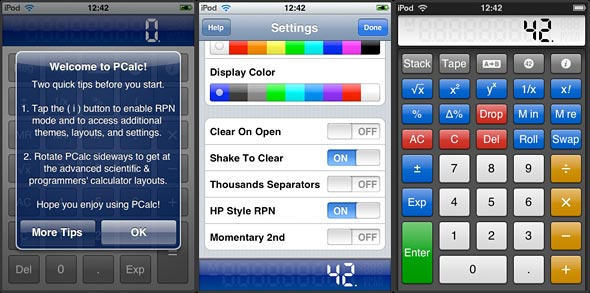
If you’ve not heard of James Thomson, he’s the chap behind advanced launcher DragThing and high-powered Mac calculator app PCalc. Seeing as iPhone’s calculator is a bit lacking, Thomson created PCalc for iPhone (which you can buy by clicking here), pictured above, and sales were swift.

However, on his blog, Thomson reported yesterday that PCalc 1.1 almost vanished without a trace. The reason? Apple had changed the way applications were displayed on the App Store, listing them by original release date rather than the date of the most recent update. Consequently, PCalc 1.1 languished on the last page of the Utilities section, since it was released very early on in the App Store’s history. Sales of the update, unsurprisingly, weren’t exactly speedy.

At the time of writing, PCalc now sits on page 4 of the Utilities section, with Thomson having manually changed the ‘Availability Date’ in iTunes Connect. “So, is this behaviour a bug, a loophole, or how it’s actually supposed to work?,” asks Thomson, noting that those who aren’t aware of this undocumented ‘trick’ are effectively being penalized in the listings.

This episode raises obvious questions. Is there a general misunderstanding regarding how application updates should be dated for their position in the ‘release date’ sort order? Or is Apple already sick of developers trying to regularly bump their apps to the top of the pile via tiny incremental updates, and therefore made changes that caught the likes of PCalc in the blast?

We very much hope the former is the case. It would be terrible if the ‘Availability Date’ fix is a loophole that Apple’s going to close. After all, if you’ve spent lots of time working on an application, what incentive do you have to fix bugs and add features if your creation will forever sit abandoned and forgotten, dozens of clicks away from the front door?

Opinion: The iPhone Is Apple’s Netbook

By

cult_logo_featured_image_missing_default1920x1080

gilest-20080924.jpg

A nice article by Mark Hachman at PCMag.com looks at Steve Jobs’ comments during the quarterly earnings conference call, and comes up with a promising line of thought.

Jobs, as we suspected and made plain here at the Cult a few days ago, doesn’t have anything against a netbook style Mac per se; he simply cannot see how Apple could produce one that wouldn’t suck. Or to put it another way:

“We don’t know how to make a $500 computer that’s not a piece of junk, and our DNA will not let us ship that.”

Jobs is waiting patiently to see what happens next to netbooks. I postulated last week that the Air would morph into a cheaper device (which I’ve no doubt it will), but perhaps I missed something more obvious: the iPhone will morph into a more flexible device. It’s already cheap (well, affordable at any rate).

There’s no hurry, at least not from Apple’s perspective. It is already making plenty of money from the products it has on offer right now, especially iPhones. And as John Gruber points out today, might soon be putting more focus on its phones than on any other part of the business – simply because that’s where the money is, and will continue to be for some time yet.

Which means Apple has time to watch how netbooks evolve, particularly how they evolve with regard to connectivity options, and this is an important factor, I think.

The first gen netbooks appeared with simple wifi connectivity, which is fine for a lot of people in a lot of circumstances. But the old fashioned “road warrior” (yuk, what a horrible phrase) needs connectivity from anywhere, and cannot depend on the availability of wifi networks. They need to be able to open their computer at a moment’s notice, and just get their online stuff done.

Right now, the only feasible way of managing that is via the telephony data network, 3G or otherwise.

So we’re now seeing new generation netbooks with 3G cards, and what’s interesting isn’t the tech inside, but the shop windows they’re appearing in. These netbooks are being sold from phone stores.

As the phone companies start selling contracts (and with them, heavily subsidised netbook computers), Apple will be watching to see just how much the whole arrangement sucks. Some people will end up with two contracts – one for their existing phone, one for their netbook. Some will have one contract, but still be using two devices, carrying around a separate phone handset.

So when Steve says: “We’ll wait and see how that nascent market evolves, and we have some pretty good ideas if it does,” – what ideas does he have in mind? Something that makes ownership of a tiny portable computer easier. The iPhone’s got the connectivity and the computing power to do what’s needed. All that it needs to get it competing with the netbooks is a keyboard, or something that makes the keyboard redundant.

Might Apple let us use normal Bluetooth keyboard with the iPhone? Possibly. Personally, I’d love that, but Apple doesn’t care about me. It wants to me products that really sing with cool, and I think that Steve Jobs would consider an iPhone propped up on a tabletop and controlled with a Bluetooth keyboard to be uncool.

Opinion: Apple Is Profit-Driven Just Like Everyone Else

By

cult_logo_featured_image_missing_default1920x1080

gilest-20080924.jpgNow we’ve seen them, now we know. The new MacBooks and MacBook Pros are quite nice in some respects, and quite frustrating in others.

What amuses me about the whole thing, though, is how astoundingly far-out some of the pre-event speculation was. It’s always part of the fun, exploring the gamut of people’s expectations and imaginations as they dream up the kind of product they’d like Apple to create for them.

My favorite this year was the iMac-as-docking-station concept, which showed an iMac-like monitor with a huge hole in one side, into which a folded MacBook could be slotted. A nice fantasy indeed, but still a fantasy. And Apple’s not in the business of fulfilling every fanboy’s fantasy.

No, Apple’s in business to make profit, like every other computer manufacturer. As such, it’s product development decisions are, and will be, driven by the profit they can be reasonably expected to generate.

Piper Jaffray: Apple Has ‘Never Done Cheap Well’

By

cult_logo_featured_image_missing_default1920x1080

Reaction is still coming in from analysts on Apple’s decision to drop the price of its plastic entry-level MacBook. While ThinkPanure and others believe the sub-$1,000 notebook isn’t enough to attract worried consumers, some onlookers told Cult of Mac the move was a good beginning.

“They’ve never done cheap well – but the $999 MacBook is a good start,” Piper Jaffray analyst Andrew Murphy e-mailed Wednesday.

Murphy said Apple is positioning Mac sales for a long economic slowdown. Wednesday, JPMorgan said Apple had “meaningful buffers” that could allow the company to ride out any initial impact. Analyst Mark Moskowitz pointed to the value of Cupertino’s brand and iPhone revenue expected later in 2009.

Although the price cut affects a legacy plastic MacBook, more than half of the consumers considering the $999 plastic MacBook will opt for the newly-unveiled $1,299 aluminum unibody design, Murphy wrote.

The upshot of Tuesday’s new products: a slight or no impact on Apple margins. The company is expected to announce third quarter numbers later this month.

Apple Launches Global iPhone Development Events

By

post-3690-image-9959e95f60f95d8225d9ef42b60ca931-jpg

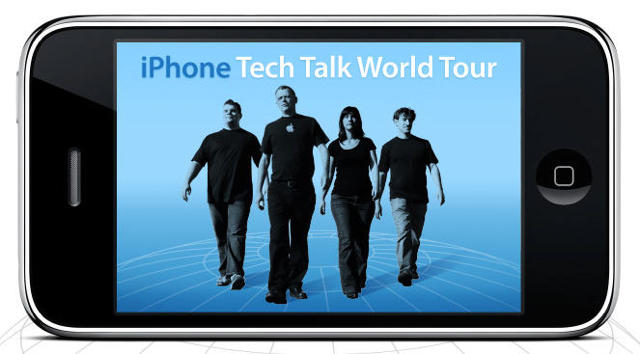
Apple engineers and “technology evangelists” are preparing a series of events in North America, Europe, India and Asia to teach you how to develop software for the iPhone.

Calling it the iPhone Tech Talk World Tour, the company has scheduled free seminars starting October 22 in San Francisco and Paris, continuing through early December in 22 additional cities world wide, to instruct would-be iPhone developers on the tools and technologies used to create iPhone applications. The one-day intensive sessions promise to reveal details on how to optimize your code, refine your user interface, and enhance the capabilities of your iPhone application – all things developers were presumably prohibited from sharing among themselves under the iPhone developers NDA.

Developers can register online to attend one of the events; Apple warns that space is limited.

Follow after the jump for a list of cities and dates and additional details.

A Third of IPhone Users Switched Carriers As Apple Leads Smartphone Sales

By

cult_logo_featured_image_missing_default1920x1080

Nearly a third of iPhone users switched carriers in order to buy the Apple touch-screen phone, researchers said Monday. The news comes as the iPhone leads smartphone sales between July and August.

Some thirty percent of U.S. smartphone buyers switched carriers to AT&T in order to purchase an iPhone in that period, market research firm NPD Group announced.

That compares to the 24 percent industry average for smartphone buyers.

Numbers Suggest Apple Beat Analysts Estimates With 7.5M IPhones Sold In Q4

By

post-3257-image-51976a43939106c79d21c2168a0a5b1e-jpg

When Apple CEO Steve Jobs announces fiscal fourth quarter iPhone sales later this month, a few industry analysts could be red-faced. An effort by iPhone owners points to Apple selling more than the 5 million a consensus of experts had predicted for the three-month period that ended Sept. 30.

In addition, the data could lend support to Jobs’ claim 10 million iPhones would be sold in 2008.

Ciarelli: Apple’s Lawyers Have Gone Soft

By

cult_logo_featured_image_missing_default1920x1080

Former Think Secret blogger Nick Ciarelli is writing about Apple once more, this time at Tina Brown’s new tabloidy Huffington Post clone, The Daily Beast.

In Not So Secret Apple, Ciarelli argues that Apple’s famously fierce legal attack dogs have calmed down somewhat since the day, a few years ago now, when his constant flow of Apple product leaks and scoops at Think Secret brought them crashing down on him, and his web site to a grinding halt.

Ciarelli interviews editors of several Mac and gadget sites and their opinion is unanimous: Apple realized that the lawsuits and cease-and-desist demands were generating nothing but bad karma, and only confirming that the clamped-on stories were true. So a new policy has been initiated, more leaks are emerging and in higher-profile media, and everything’s a little more relaxed in the legal department than it used to be.

He writes: “But maybe Apple has also realized that when it threatens, subpoenas, and sues web sites run by some of its biggest fans, its actions create a torrent of negative PR that ultimately tarnishes Apple’s brand.”

If that’s the case, I wonder if Ciarelli is tempted to return to Mac rumor-chasing? He was very good at it, after all.

(While you’re looking around The Daily Beast, be sure to read the hilarious and very open Q&A with Tina Brown, in which she explains what it’s all about, and says she’s not jealous of Arianna Huffington at all.)