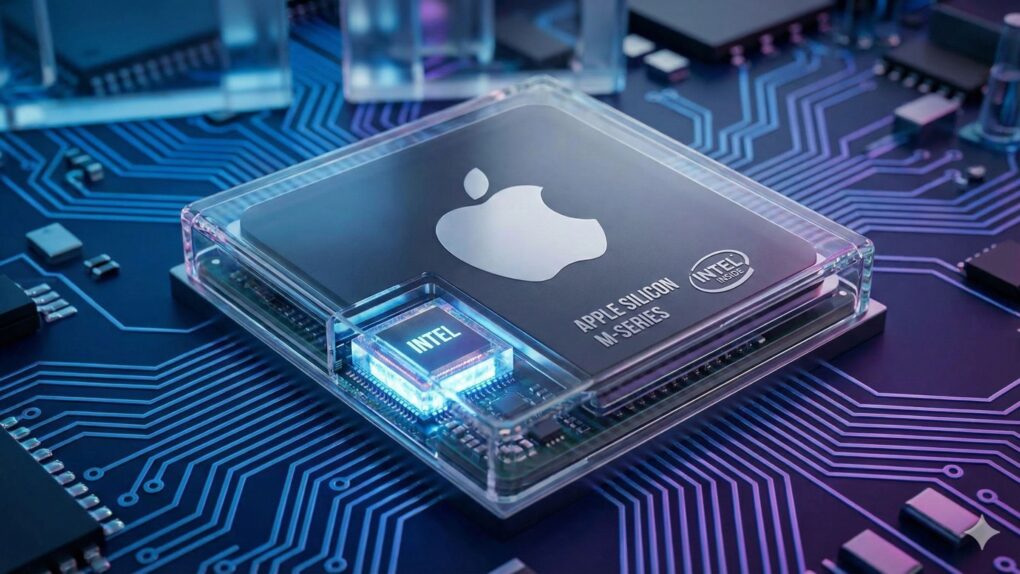
Apple CEO Tim Cook didn’t fly to Washington last summer to talk about Intel. He went there to keep Apple from getting hit with a 100% tariff on every chip the company imports. But somewhere in those meetings, the conversation shifted to an unexpected topic — Intel.
Fast forward a year, and Apple and Intel now have a manufacturing arrangement in the works. And according to a new report, the origin story is less about “engineering roadmap” and more about “the White House brought it up while Apple was trying to survive a tariff fight.”
Apple-Intel chips deal: What’s confirmed and what’s new
It wasn’t that long ago that Apple parted ways with Intel, whose processors had powered Macs since 2006. The switch to ARM-based Apple silicon began in 2000, and the rapid transition produced Macs that are both more powerful and more efficient than their Intel-based predecessors.
The move away from Intel also gave Apple far more control over its product roadmap. But now, AI-fueled supply chain constraints — and a surprising dose of politics — have driven a rapprochement between the two companies.
You may already know some of this story. Last year, Apple won a tariff exemption after pledging to invest hundreds of billions of dollars in the United States. The government then converted $9 billion in unpaid CHIPS Act funds to get a 10% stake in Intel, making Washington the chipmaker’s largest shareholder.
Later, President Donald Trump announced on Truth Social that Apple had “agreed to work with Intel to design and build its Chips in America,” sending Intel stock to a record high.
What’s new, according to a report from The Wall Street Journal last Friday, is the important detail that the Intel ask surfaced during the same meetings between Cook and Commerce Secretary Howard Lutnick in which Apple requested chip tariff exemptions. While the publication didn’t frame it as an explicit condition for tariff exemption, the timing, as per the source, wasn’t a coincidence.
The report says Apple might be planning to have Intel fabricate chips for both Macs and iPhones. A previous rumor from TF International Securities analyst Ming-Chi Kuo said the chipmaker would mainly focus on lower-end M-series chips.
Washington is closely watching Intel
This is where the report adds the most new texture. Intel CEO Lip Bu Tan has been rebuilding the chipmaker’s credibility with big customers like Nvidia and SpaceX. But what’s less known is how the government is involved in the day-to-day process.
As it turns out, Tan is reportedly visiting Washington once a month to meet with Commerce Department officials. He is also said to regularly talk to Lutnick over the phone about customer relationships.
Bill Frauenhofer, the administration’s semiconductor point person, reportedly receives quarterly briefings straight from Intel’s CFO. And the staff is also meeting Intel executives, both in D.C. and at the company’s headquarters in Santa Clara, California.
Trump even briefly called for Tan’s resignation. But the CEO won over Trump in an Oval Office meeting, with the president calling him a “winner.”
That’s an unusual level of hands-on federal involvement in a private company’s customer strategy. Last year, Republican Sen. Tom Cotton of Arkansas publicly criticized Tan over his investment ties to Chinese companies.
What does Apple-Intel chips deal mean for your next Mac or iPhone?
Don’t expect an Intel-powered MacBook Pro anytime soon. Apple’s chip transitions take years, and Intel’s newest manufacturing node is still in the testing phase.
Still, previous rumors hinted at a 2027 timeline for lower-end Intel chips in Apple products, a detail that predates this most recent report and hasn’t been confirmed.
But the strategic logic checks out against Apple’s public statements. Cook previously acknowledged that Taiwan Semiconductor Manufacturing Company’s constrained chip supply squeezed the iPhone 17’s availability. Also, Nvidia already passed Apple as TSMC’s biggest customer. Adding a second chip foundry to its supply chain could give Apple leverage it hasn’t had in years.

Anurag Chawake is a tech-focused writer specializing in smartphones, apps and consumer technology. His interest in computers began during the Windows 98 era, eventually leading him to explore everything from operating systems to mobile devices and PC hardware. Anurag previously contributed to The Indian Express, covering Apple, Android, gaming and the broader technology landscape.