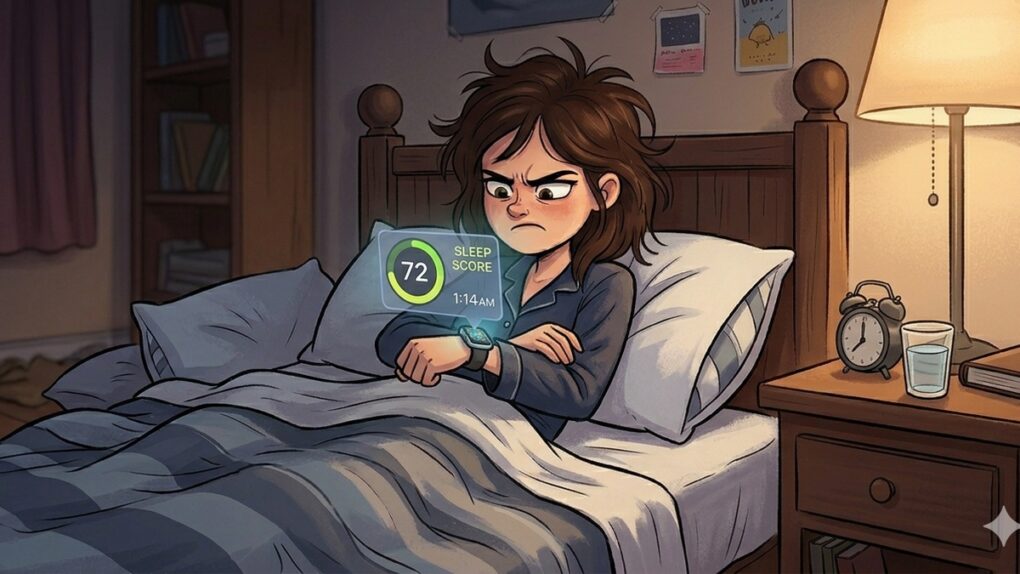
Each morning I wake up and check my sleep score on my Apple Watch. And then I wonder if it’s doing me any good. It’s certainly adding stress and hassle to my day.
That’s why I’m thinking of turning it off. Maybe you should, too.
Apple Watch sleep score is wonderful, until it isn’t
Apple’s sleep score, available through the Sleep features on the Apple Watch and tracked in Apple’s Health app, is designed to give users a simple, at-a-glance measure of how well they slept. It combines multiple factors such as total time asleep, time spent in different sleep stages like REM and deep sleep, consistency with your sleep schedule and interruptions during the night.
Rather than focusing on just one metric, Apple uses these inputs to create a more holistic view of sleep quality, helping users understand not just how long they slept, but how restorative that sleep was.
Apple says that over 5 million nights of sleep data from the Apple Heart and Movement Study were used to develop and test the scoring algorithms.
Sounds wonderful, doesn’t it? And if you have a sleep disorder, or suspect you might, I’m sure it is. Serious athletes tracking their recovery times can benefit as well. If you need your sleep score, you should absolutely get it.
But the thing is, most people don’t need to track their sleep. And doing so unnecessarily comes with drawbacks.
Table of contents: Problems with Apple Watch sleep score
- Think you slept well? Wrong!
- Can’t trust its results
- Apple’s sleep score turns rest into a report card
- The biggie: The Apple Watch charging hassle
- How to deactivate Apple Watch sleep tracking
1. Think you slept well? Wrong!
It’s not unusual for me to wake up feeling rested, check my Apple Watch, and see a low sleep score. So I immediately question whether I really feel rested. Shouldn’t I feel more tired? I have data right here showing I slept poorly.
So, a day that started with me feeling refreshed now has me looking for reasons to feel more tired. And I’m not even out of bed yet.
Tracking my sleep is supposed to help me. Being told I slept poorly isn’t helpful.
2. Can’t trust its results
Sometimes I go to bed knowing I’m going to get a completely inaccurate sleep score, and there’s nothing I can do about it.
See, if I take a nap during the day, I don’t go to bed at my regular time. There’s no point — I’m not tired, so I’d just stare at the ceiling for a couple of hours. But because I go to bed late, I’m automatically getting a low sleep score.
And there’s a larger issue. My Apple Watch is completely oblivious to naps. And because it can’t tell I’m zonked out on a couch for a couple of hours in the afternoon and factor that into my sleep score, I don’t trust it to accurately track my nighttime rest.
3. Apple Watch sleep score turns rest into a report card
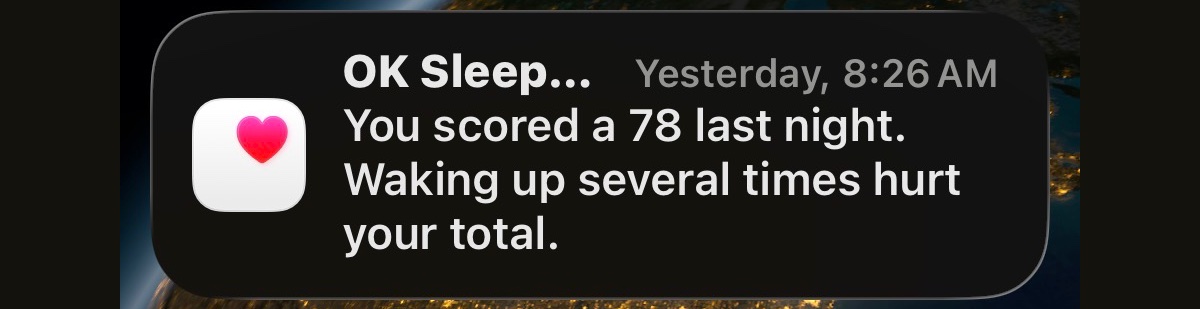
Screenshot: Ed Hardy/Cult of Mac
Plus, there’s a basic flaw in sleep tracking that makes the whole practice questionable. My Apple Watch succeeded in making me more active and healthy through gamification. It challenges me to put more effort into exercise. But I have little control over my sleep. I can’t put more effort into sleeping harder.
To increase my Move score, I can make myself go for a walk. All I can really do to affect my sleep score is go to bed earlier. When I wake up in the middle of the night, I can’t make myself fall asleep again — I assure you, I would if I could.
The result? Apple’s sleep score turns sleep into a test that I can fail for reasons beyond my control. It makes sleep more stressful, which is the opposite of what it’s supposed to accomplish.
4. The biggie: Apple Watch charging hassle
I could ignore all the other problems if tracking my sleep score didn’t make charging my Apple Watch a hassle.
I’ve worn Apple Watches for many years. I always charged them overnight while I slept, and woke up each morning with a watch that was ready to face the day.
But when I got the Apple Watch SE 3, I started tracking my sleep. I now need to wear the device all night, so I have to find a time to charge it in the morning. This means planning around exercising and making sure I get my stand time for the hour, etc. This isn’t a struggle, but it’s one more thing I have to think about — and it’s irritating because this is something I didn’t have to worry about before.
The Apple Watch is supposed to make my life easier, not add to my to-do list.
How to deactivate Apple Watch sleep tracking
Just so there’s no confusion, if you have a reason to track your sleep, then Apple’s sleep score is a great way to do it. But if you don’t, I’m suggesting that it might be more bother than it’s worth.
Put some thought into it. If you decide knowing your Apple Watch sleep score isn’t helpful, you can easily deactivate it.
To turn the feature off on your iPhone, open the Watch app, scroll down to Sleep, then toggle off Track Sleep with Apple Watch. Or on your Apple Watch, open the Settings app, then scroll down to Sleep and toggle off Sleep Tracking.

Ed Hardy has been writing full-time about tech for 26 years, and using it for much longer than that. His intro to Apple was a Macintosh SE/30 (which he still has), but now he uses a 13-inch iPad Pro as his primary computer.
That’s because he’s a “tablet first” type of guy. Rather than use a Macbook, he connects a keyboard case to the iPad. And instead of a desktop Mac, he connects his tablet to a 27-inch display and full-size keyboard. (So don’t try to tell him that everyone has to use a Mac to be productive.)
Before coming to Cult of Mac, Ed wrote for NotebookReview, TabletPCReview and Brighthand, as well as other sites.

16 responses to “4 reasons you should stop tracking Apple’s sleep score”
I’m pretty sure the sleep score does NOT take into account the amount of deep/REM sleep.
I agree with a lot of the article. But instead of turning off the feature, I simply just stopped wearing the watch overnight. Problem solved.
I have a sleep disorder that has me acting out my dreams sometimes which wakes me and sometimes not. I am certain that even the ones that happen while I am not awake get tallied as being awake. So if you have RBD beware of the score
“See, if I take a nap during the day, I don’t go to bed at my regular time. ”
Yeah, don’t do that. Apple’s sleep score is based on 3 actionable metrics presented right there in the score… Duration, Consistency, and without Interruptions. These have numerous scientific studies showing the benefits to each. You not going to bed at your regular time as a result of taking a nap is less healthy and thus justifiably lowering your score.
Apple’s sleep score give you a log of your habits that you can then use to correlate to other health metrics Apple provides, like HRV, resting heart rate, etc…
“All I can really do to affect my sleep score is go to bed earlier.”
No, go to bed at a consistent time that allows for a full duration and reduce things that may cause interruptions (sounds, light, too much drinking, etc…).
Before someone says “I can’t always control when I wake up in the middle of the night”, sure, and I can’t always run the 15 miles I have as a goal. The idea is to have a log of activity and do what you can to improve or review and correlate the results… not obsess over.
Apple did a really good job of providing a useful tool for those who understand it and use it properly as opposed to providing a woo score based on a pseudo-science proprietarily obfuscated algorithm others are using which are much easier to market, but far less actionable or based on science, while meanwhile still providing all of the same metrics (HRV, heart rate, etc…) that are available in such a device.
agree completely also love ur handle
I wore my Apple Watch 9 to two sleep studies and the results were not even remotely close.
FWIW, the sleep score I get from my Sleep Number bed is even worse. The numbers bear absolutely nothing to do with our perceived quality of sleep, and the comments generally don’t match the numerical score. My wife and I speculate that the app has two independent wheels, one for the number and one for the comment, and it’s only by pure accident that they ever match one another. I personally don’t wear my Apple Watch to bed, so I can’t speak to its performance in that regard.
Sorry for saying this, but this article is kind of useless… so, if the score is not reliable, why get irked with the results? And why turn it off? If you don’t use the watch during the night, it won’t track your sleep. Simple, right?
I get irked with the results because the sleep score is not reliable. An unreliable, irritating sleep score is not useful, so I’m thinking of turning it off. I hope this answers your questions.
What an inane comment.
The most sensible review of Apple’s sleep tracker that I have read. It is essentially useless for a real individual but the most damning thing was Apple deciding to re-cast the weighting. That immediately made my previous tracking of no value. I now only take notice of the range given for Heart Rate during sleep.
My biggest complaint with Apple sleep tracking is the weird “awake” times I get – last night for instance, it said I was awake from about 1am to about 2:45am, then asleep, then awake again from about 3:30am to about 4:30am – I might have rolled over around those times, but I was definitely not awake for 2.5 hours! I’m not sure where these “awake” glitches are coming from.
Another weird glitch, also along the lines of “awake” – when I got to bed I put the same show on every nigh, some times I barely make it through the opening title sequence, sometimes I make it halfway through – I never make it all the way to the end though. It will say I didn’t fall asleep for well past the end of the show sometimes. For all the publicizing that their sensors are “medical grade” there seem to be a lot of quirks in my data.
To be fair – it is not just Apple delivering poor sleep data. I recently gave up wearing my Oura ring for this same reason – I couldn’t trust the sleep data, and it was causing the stress you mentioned. I’ve been thinking for a few weeks that I might need to stop wearing my Apple Watch at night, and go back to my charge it while I’m sleeping routine. You might have just pushed me to that decision! THANKS!
I’m going to be the only one here who is surprised about the supposed accuracy of my watch tracking sleep. I wake up a lot at night, and if I wake up at the end of a dream, I note the time and I almost always find that the watch was tracking REM sleep at that time. It also is fairly accurate about the time I am awake (as far as I can tell). It’s hard to say anything about deep sleep, but I am pleasantly surprised about its tracking for me at least.
The actual score doesn’t mean anything for me. I look at each metric individually and see where it falls overnight. But I feel that you are correct, having a number acquainted with your sleep doesn’t really do anybody any good?
The sleep tracking is a good ides=a, but poorly implemented. I go to sleep at the same time every night. One night I woke up 3 times during the night, but still got a high sleep score. Another night I only woke up once, but got a low sleep score. Last night with 1 wake up I got no sleep score at all. One of the problems I’ve noted is that waking up in the middle of the night then going back to sleep looses all the data prior to waking up. It thinks you went to sleep from the wakeup time, resulting in a reduced time asleep. Other times it seems to ignore mid sleep wakeups and scores based on the total duration of sleep. Which is the behavior I would expect. It’s the inconsistency that is irritating, But like other commenters have said. No need to stress just don’t wear your watch to bed.
Whenever you get another Apple Watch, keep the old one and charge it during the day. Before bedtime swipe the watches. The old one will be used during the night to track your sleep. For me it tracks if my heart gets into ab-fb.