Leander has been reporting about Apple and technology for nearly 30 years.
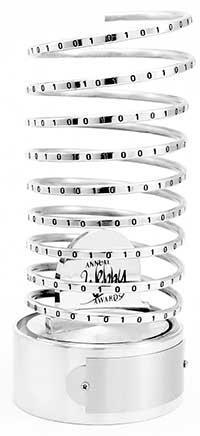
Before founding Cult of Mac as an independent publication, Leander was news editor at Wired.com, where he was responsible for the day-to-day running of the Wired.com website. He headed up a team of six section editors, a dozen reporters and a large pool of freelancers. Together the team produced a daily digest of stories about the impact of science and technology, and won several awards, including several Webby Awards, 2X Knight-Batten Awards for Innovation in Journalism and the 2010 MIN (Magazine Industry Newsletter) award for best blog, among others.
Before being promoted to news editor, Leander was Wired.com's senior reporter, primarily covering Apple. During that time, Leander published a ton of scoops, including the first in-depth report about the development of the iPod. Leander attended almost every keynote speech and special product launch presented by Steve Jobs, including the historic launches of the iPhone and iPad. He also reported from almost every Macworld Expo in the late '90s and early '2000s, including, sadly, the last shows in Boston, San Francisco and Tokyo. His reporting for Wired.com formed the basis of the first Cult of Mac book, and subsequently this website.
Before joining Wired, Leander was a senior reporter at the legendary MacWeek, the storied and long-running weekly that documented Apple and its community in the 1980s and '90s.
Leander has written for Wired magazine (including the Issue 16.04 cover story about Steve Jobs' leadership at Apple, entitled Evil/Genius), Scientific American, The Guardian, The Observer, The San Francisco Chronicle and many other publications.
He has a diploma in journalism from the UK's National Council for the Training of Journalists.
Leander lives in San Francisco, California, and is married with four children. He's an avid biker and has ridden in many long-distance bike events, including California's legendary Death Ride.
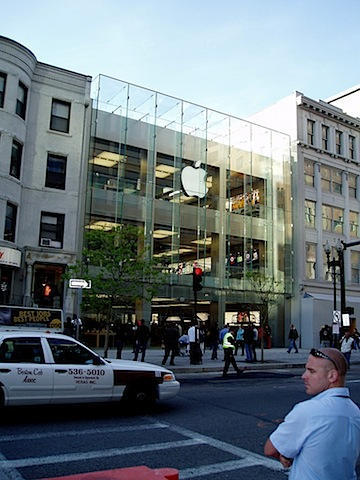
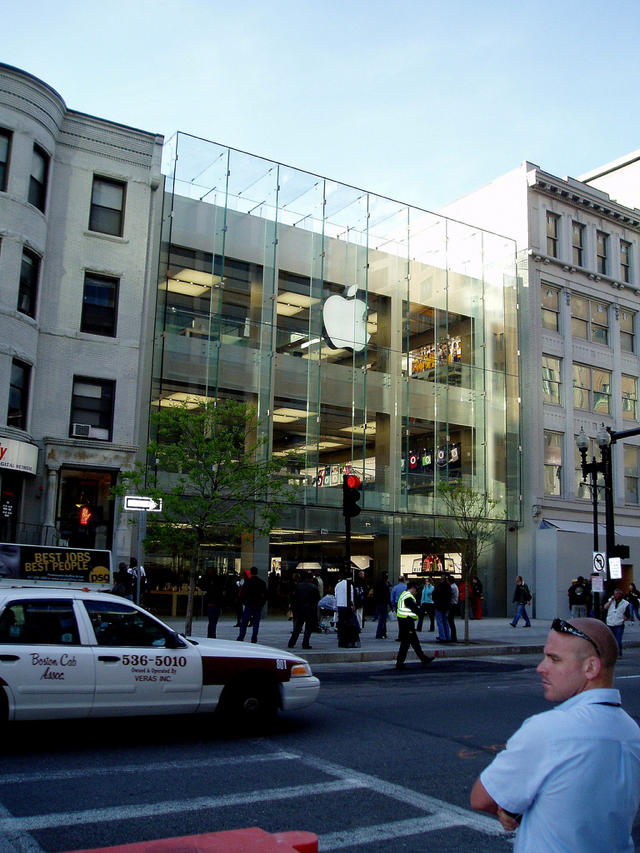
Here’s the striking glass facade of Apple’s new megastore on Boston’s Boylston Street. The store opens later today (See IFOApplestore’s coverage of the overnight campout), but is being criticised for not blending with surrounding buildings.
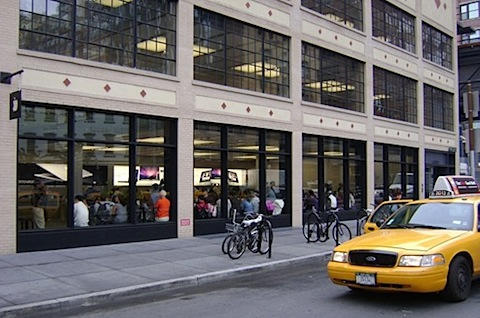
But check the picture below, which shows the lot before Apple. Which do you prefer?
Picture: The president of Ukraine, Viktor Yushenko, yakking on his iPhone. The iPhone is hot in the Slavic country. FromiPhone Code.
Used iPhones are worth more than $1,000 in Ukraine, according to the Craigslist buyer who just purchased my slightly scratched iPhone for (get this) $350.
The buyer, named Claude, is heading to Ukraine next week on business and everyone he meets will ask him for an iPhone, he says. He’s sold dozens of iPhones, new and used: It doesn’t really matter.
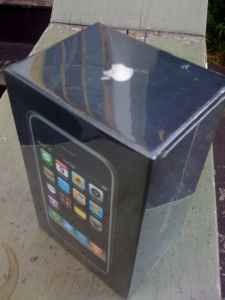
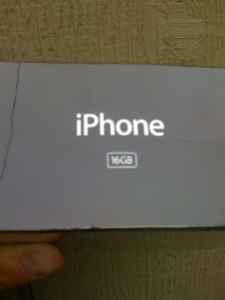
In fact, I sold him two iPhones: a virgin 16-Gbyte model still sealed in its box, and my slightly worn day-to-day iPhone, an original 8-Gbyte model.
I got $850 for both phones — $500 for the new one (it retails for $500 + $40 tax) and $350 for the used iPhone (it sells new for $400 + $34 tax. I paid $600 minus a $100 rebate).
I felt pretty good until Claude told me he’ll be getting at least $1,000 for the used iPhone in Ukraine, and more for the new one. WTF! — thanks for telling me!
Still, it’s not all gravy. Claude says he has to keep the iPhones on his person when passing through customs, or they disappear from his luggage. Likewise the chargers, cords and everything else. Plus, he has to bribe every official he meets.
Claude wasn’t aware there’s a new iPhone model expected next month (which is why I’m selling). Not that it mattered. He says he’ll take all and any iPhones I can send his way.
The lines are 30-people deep for an iPhone in NYC, Gizmodo reports. And that’s for the current generation iPhone — not version 2.0 excepted in a month.
It seems there’s lots of people desperate to get their hands on unopened iPhones — even a couple of weeks before older models are outdated.
A couple of months ago I bought a 16-Gbyte iPhone at the Apple Store, thinking I’d upgrade from my original 8-Gbyte iPhone. But then rumors of the iPhone 2.0 started catching fire, so I didn’t open it. With the release of a 3G iPhone looking likely in early June, I thought it better to wait.
Trouble is, I waited too long to return the unopened iPhone to the Apple Store, which has a two-week return policy. So earlier this week, I put it on Craigslist for $550 ($50 over retail) and crossed my fingers.
Boy, was I surprised. I’ve had several offers, many of them for the inflated price. Most of these buyers asked me if I had more than one phone.
The first offer came in just a few seconds after I posted the ad. The buyer, who I’m meeting this afternoon, wrote: “I will need as many as you have. no receipt needed if you know what I mean.”
The iPhone must be headed overseas. Apple has a policy limiting sales to five iPhones per customer — checked against their credit card.
I’ll be asking the buyer some questions this afternoon about his interest in buying multiple, unopened iPhones.
Macworld has some interesting, contrarian advice about buying a Mac these days.
A couple of years ago, pro users would never consider a low-end iMac or MacBook portable for work: it just wouldn’t be powerful enough.
But because Apple is using powerful dual-core Intel chips across its entire line, the difference between machines is blurring.
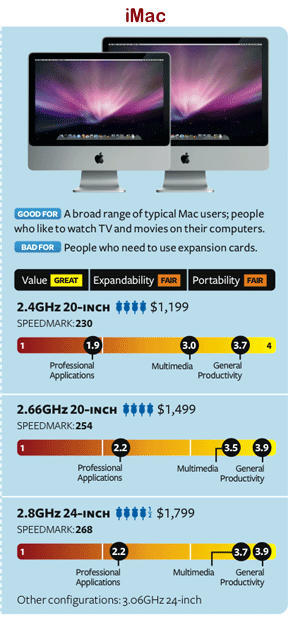
After running a battery of tests, MacWorld concludes that for most people, a new iMac or MacBook Pro is good enough — pro, power users included. The savings add up to $1,000 or more.
… for most mainstay applications, the high-end iMac and MacBook Pro models are plenty fast (the 3.06GHz build-to-order iMac even beat the Mac Pro in some of our tests). Even Adobe Photoshop, a heavy-duty program that conventional wisdom has long argued should be run only on a high-end system, works acceptably well on just about any Mac (unless you’re editing gigantic files).
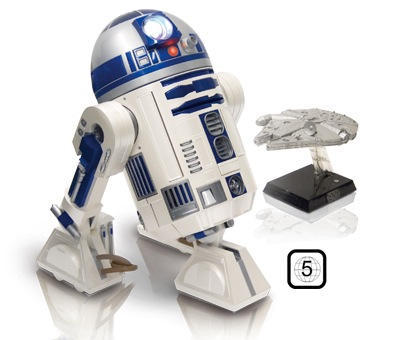
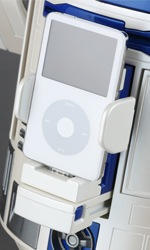
A new limited-edition, Europe-only R2-D2 DVD Projector now has an integrated iPod dock for projecting the Star Wars saga onto your living room wall. Earlier versions of the Artoo didn’t have an iPod dock. The projector is limited to 4,000 units, and costs € 2799 — about $4,300.The dock is compatible with the 1G and 2G iPod nano,* and 5G iPod with video.*(Facts corrected, thanks to reader Mario Panighetti)Link.
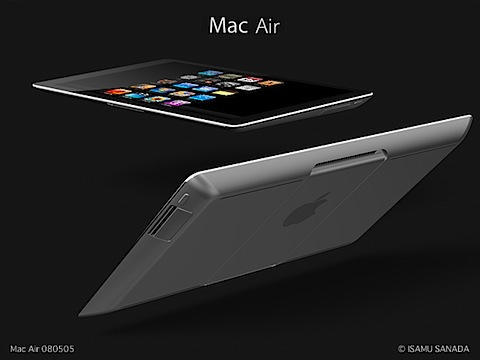
Isamu Sanada, the Japanese photographer who makes Mac mockups, has created a new design for a tablet Mac that blends the iPhone with the MacBook Air subnotebook. He calls it the Mac Air.
According to a rough translation of his site, the Mac Air also doubles as a desktop.
It hooks to a wireless keyboard and uses a wireless Time Capsule-like docking station as a hard drive. The dock includes a SuperDrive for playing and burning Cds/DVDs.
It boots into the iPhone operating system when a tablet, and OS X when used as a desktop.
It’s a great idea, but will Apple ever make such a device? Maybe. Sanada has once or twice correctly predicted Apple’s products in the past. As previously reported:
Isamu Sanada is a photographer by trade, but an Apple designer by calling.
Sanada is an amateur designer of fantasy Macintoshes. His Applele website is a popular showcase for dozens of speculative designs for future Apple machines.
In fact, Sanada is so adept at mimicking Apple’s look, he created a design for a new laptop that predicted Apple’s distinctive Titanium PowerBook G4 months before it came out.
“It’s hard to believe that one man revolutionized the operating system business in the 2000s, converting Windows’ extraordinary market dominance into the reviled seven-year ditch that is Vista, and squandering billions on confused advances into ill-understood peripheral markets like video gaming and music hardware
…. Wired.com’s Leander Kahney cuts through the salt-ringed tide marks that surround him to unearth secrets to his unbelievable results. It reveals the real Steve.”
Apple earned 6.6 percent of the PC market in Q1 2008, and saw 32.5 percent year-on-year growth in unit shipments, Gartner said. Overall, the PC market grew 3 percent year-on-year, Gartner said.
Apple trails Dell (31.4 percent market share), Hewlett-Packard (25 percent) and Acer (9.1 percent). While Dell grew 15 percent year-on-year during the quarter, Acer slipped 18.3 percent, Gartner said.
Acer is only 2.5 percentage points ahead of Apple, and Apple is positioned to regain the number-three slot, which it hasn’t held since the mid-nineties.
Worldwide, Apple failed to make the top 5 (HP, Dell, Acer, Lenovo, Toshiba).
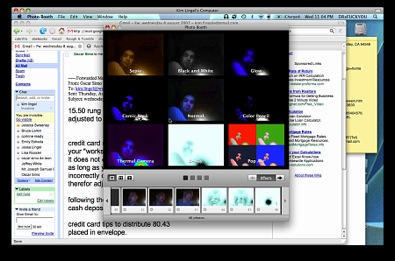
A Santa Cruz woman is using Leopard’s Back to My Mac remote control software to track a thief who stole her laptop.
The woman, named Joey, had her MacBook and iPhone stolen from her truck. The thief didn’t wipe the MacBook, and Joey was able to log on remotely every time the crook connected to the internet using Back To My Mac. Built-into OS X, Back To My Mac allows administrators to take full control of machines over the Net.
Joey was able to remove sensitive data; copy and delete files; and then spy on the thief using the MacBook’s built-in iSight camera.
The crook spends a lot of time in cafes using free WiFi to search file sharing networks for software, music and movies.
As the crook surfed the Net, Joey was able to compile a full profile for police, including his Gmail account, home IP address, mother’s maiden name, and even snap clear pictures showing the detail of his tattoos.
Santa Cruz police are reportedly issuing a warrant to arrest the thief.
Joey was documenting the entire process on a LiveJournal account, which has been taken offline, likely to prevent the crook from getting wind of his impending arrest.
The first movie starring stoner legend Ellen Feiss, the break-out star of Apple’s “Switch ads,” will air online on Monday, April 21. But don’t get too excited: it looks like a turkey.
Bed & Breakfast, an indie movie shot in France, will air at 9:30PM ET / 6:30 PM PT on TheDigitalLifestyle.tv, a 24-hour Apple-related Web TV channel.
Feiss stars as the girlfriend of an American guy lured to a castle owned by a former college roommate, or something. The movie was shot in 2006 and seems to have promptly disappeared. There’s no indication whether it’s a comedy, a drama or a slasher flick.
Feiss shot to fame in 2002 after slurring her words in an Apple Switch ad detailing how her dad’s PC ate her homework. The ad became an online sensation, and was parodied widely. Feiss was invited on late night TV and was offered roles in moveis and TV shows, but shunned Hollywood — until now.
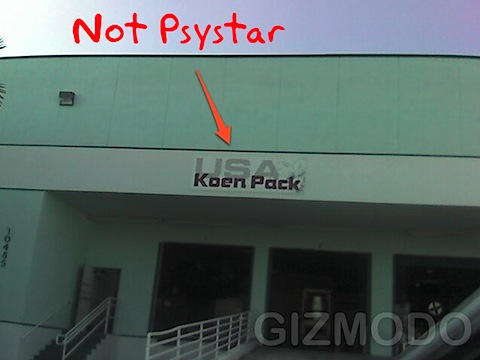
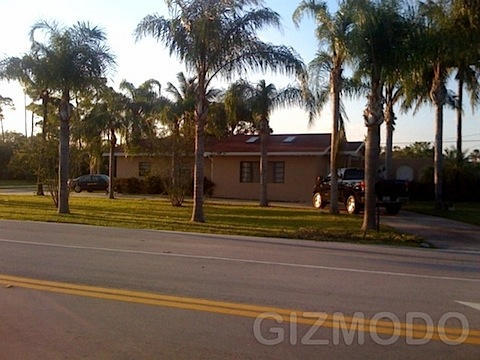
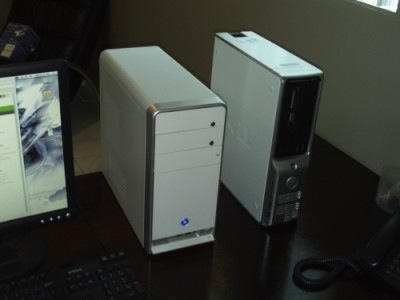
Trying to find out if would-be Mac clone maker Psystart in legit or not, Gizmodo readers went to the two addresses identified by the Guardian’s Charles Arthur (see below). As Arthur predicted, one address is a single-story home, and the other address is a warehouse, but it’s home to a completely different company.
The Gizmodo reader, Michael, snapped some pictures and talked to the warehouse manager, who has never heard of Psystar.
In addition, another Giz reader, Robert, pulled records from Florida’s corporate filing office and found that Psystar’s two principles, Rodolfo and Roberto Pedraza, are officers or agents of “a whole crapload of companies,” according to Giz. Only one of these companies is active: Floridatek.
A PC-versus-Mac shootout by Popular Mechanics scores the Mac way ahead in both price and performance. PopMech compared desktops and laptops, and not only did the Macs run rings around their Windows counterparts, they were cheaper to boot. The conclusion:
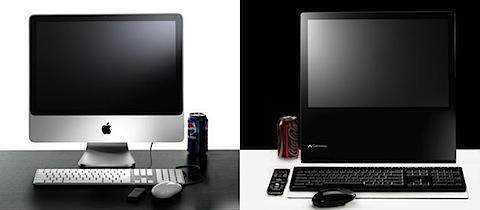
Our biggest surprise, however, was that PCs were not the relative bargains we expected them to be. The Asus M51sr costs the same as a MacBook, while the Gateway One actually costs $300 more than an iMac. That means for the price of the Gateway you could buy an iMac, boost its hard drive to match the Gateway’s, purchase a copy of Vista to boot–and still save $100.
My, how times have changed. A few years ago, the conventional wisdom was the opposite: PCs were cheaper and faster.
Somehow though, I don’t think conventional wisdom will change. Macs will always be regarded as premium computers — thanks to their fab design and quality fit and finish — even if that’s not actually true.
What Arthur found – or rather didn’t find — is extremely suspicious. No one answers the phone, and before this week, the company has left zero record of itself on the Web — Zero. No customer testimonials, no press releases, news stories or posts and comments on forums.
Also, the company changed it’s address on Tuesday while Arthur was writing his post. It moved from what looks like a suburban location to a more industrial one.
Writes Arthur: “But forgive me for being a bit sceptical, but isn’t it far, far more important whether the company has been around, has a reputation, and is going to deliver a machine? Isn’t it?”
Psystar says it has ported OS X to run on a $400 machine called the OpenMac — in violation of the OS X’s shrinkwrap license, which restricts the software from being installed on any non-Apple branded machine.
“What if Microsoft said you could only install Windows on Dell computers?” said the spokesman, identified only as Robert.
He continued: “What if Honda said that, after you buy their car, you could only drive it on the roads they said you could?”
But the spokesman seems to be confusing monopoly with abuse of monopoly. Having a monopoly is not illegal — abusing that monopoly is.
And although there’s no definitive court ruling on the enforceability of shrinkwrap EULA licenses (End-User License Agreements), Apple will likely sue under the more sweeping Digital Millennium Copyright Act (DMCA), which criminalizes the circumvention of copyright controls.
Apple has encrypted core segments of OS X — including portions of the Finder and Dock — in an overt anti-piracy effort, according to eWeek. Security researcher Bruce Schneier, said companies are using the DMCA as an anti-piracy measure, but also to prevent reverse engineering. Any attempt to break the encrypted code is in violation of the DMCA.
Psystar’s OpenMac claims to be a 2.2GHz Intel Core 2 Duo machine with 2GB of RAM, a 250GB hard drive, integrated Intel graphics, a DVD burner and four USB Ports. Most of the components can be upgraded.
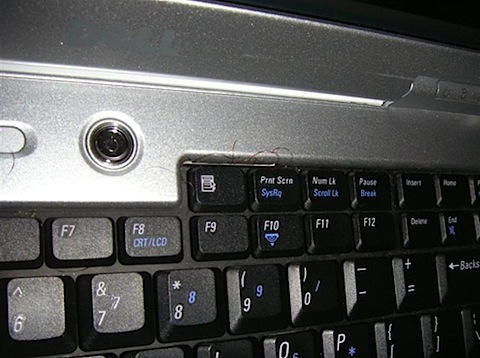
Here’s a great story from the Consumerist about Dell’s hairy customer service. Guy sends his Dell laptop to Texas for replacement, the new machines comes back with pubes in the keyboard!
When I opened up the new laptop, I saw the screen was scratched and dirty, and the keyboard was covered in debris. Wait, not debris….what is that? HAIRS!? Not just any hairs – these could only be described as pubes. I hate to be so crude, but pubes are pubes. Not the incidental curly hair, but rather mini-tufts between the keys. My only guess is that Ron Jeremy was the previous owner.
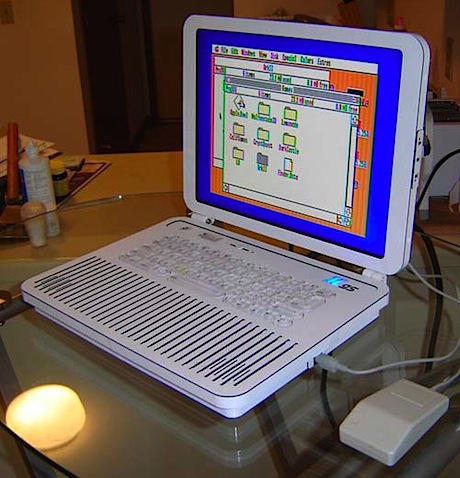
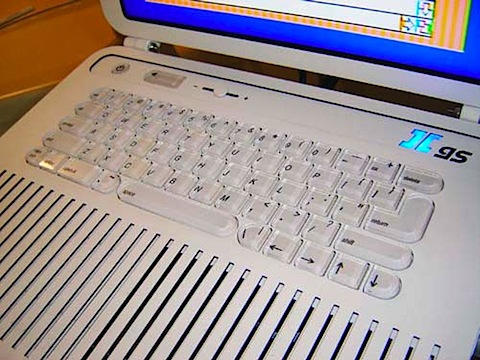
The amazing piece of engineer has a glowing blue logo that flashes yellow when the disk is busy. Heck even made his own keys for the board, laser-etching each key.
It seems like it must be in danger of bursting into flames at any moment, but Heck says it puts off no more heat than a pocket calculator.
Released in September 1986, the IIGS was a powerful computer for its time, with advanced color graphics and stereo sound — the GS standing for “Graphics” and Sound.”
Heck says the hack was requested by an unnamed party. My money’s on Woz.
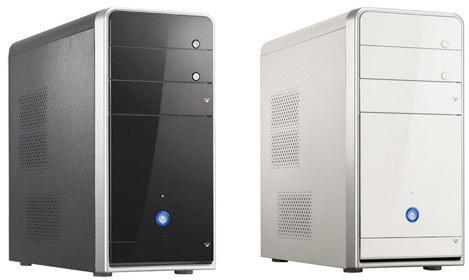
A company called Psystar is advertising a $399 pseudo-Mac called the “OpenMac,” which it claims is made from standard PC parts and is compatible with OS X Leopard.
Based in Miami, Florida, Psystar is courting a legal smackdown from Apple, which ended its official “clone” program in 1997 after Steve Jobs returned to run the company. Intended to grow the Mac platform, the clones instead took market share from Apple, seriously impacting its botttom-line.
Which is why Apple will likely pounce on Psystar: the Mac is Apple’s most profitable line, and the last thing Apple wants is a company producing low-cost knockoffs.
Apple will likely center on the use of Leopard: The operating system’s software license forbids it being installed on non-Apple hardware.
Psystar’s butt-ugly OpenMac claims to be a 2.2GHz Intel Core 2 Duo machine with 2GB of RAM, a 250GB hard drive, integrated Intel graphics, a DVD burner and four USB Ports. Most of the components can be upgraded with better graphics or bigger hard drives. Psystar says:
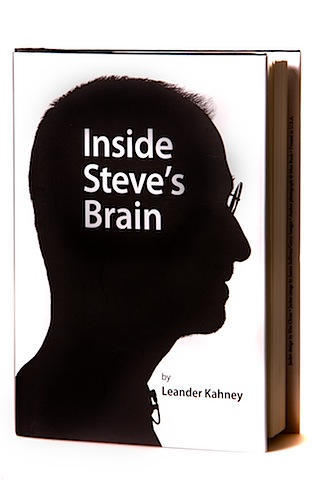
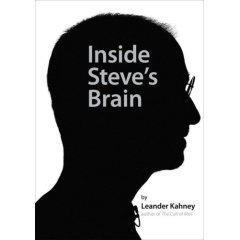
In his new book, Inside Steve’s Brain (Portfolio, 2008), however, Leander Kahney attempts to go beyond the obvious by offering a detailed, concept-oriented, blow-by-blow look at Apple CEO and what makes him tick–his history, his ideas, his ideals, his reasoning, his behavior, his relationships, even his footwear choices.
Kahney’s the right person for the job, too: He has an extensive history covering Apple and Steve Jobs since the early 1990’s, has written two previous books on the company, and has been running Wired’s Cult of Mac blog for ages.
Macworld is a tough audience, so I’m especially glad they liked it. The book is out next week.
From the department of “I’m-going-to-crow-about-it-because-no-one-else-will,” Wired.com has been nominated for a 2008 Webby award in the prestigiousNews category.
As the day-to-day editor of the site, it makes me enormously proud to be rated against such formidable competition. The Webbys are known as the “Oscars of the Internet.”
All told, Wired.com has been nominated for six Webbys this year: Wired.com for best news site, best copywriting and best home page, Danger Room for political blog, Game|Life for games-related website and Compiler for software website. Epicenter and Gadget Lab were also designated “Honorees” in the business and culture categories, respectively.
Apple has released new firmware updates for several machines, but offered no meaningful explanation of what the update does. Apple’s note is maddeningly cryptic:
This update fixes several issues to improve the stability of [MacBook Air. Macbook, MacBook Pro, iMac] computers
Apple also released an update for the Aluminum Keyboard, but this one at least includes a meaningful description of the changes:
This firmware update addresses an issue with the aluminum Apple Keyboard and the aluminum Apple Wireless Keyboard where a key may repeat unexpectedly while typing.