Leander has been reporting about Apple and technology for nearly 30 years.
Before founding Cult of Mac as an independent publication, Leander was news editor at Wired.com, where he was responsible for the day-to-day running of the Wired.com website. He headed up a team of six section editors, a dozen reporters and a large pool of freelancers. Together the team produced a daily digest of stories about the impact of science and technology, and won several awards, including several Webby Awards, 2X Knight-Batten Awards for Innovation in Journalism and the 2010 MIN (Magazine Industry Newsletter) award for best blog, among others.
Before being promoted to news editor, Leander was Wired.com's senior reporter, primarily covering Apple. During that time, Leander published a ton of scoops, including the first in-depth report about the development of the iPod. Leander attended almost every keynote speech and special product launch presented by Steve Jobs, including the historic launches of the iPhone and iPad. He also reported from almost every Macworld Expo in the late '90s and early '2000s, including, sadly, the last shows in Boston, San Francisco and Tokyo. His reporting for Wired.com formed the basis of the first Cult of Mac book, and subsequently this website.
Before joining Wired, Leander was a senior reporter at the legendary MacWeek, the storied and long-running weekly that documented Apple and its community in the 1980s and '90s.
Leander has written for Wired magazine (including the Issue 16.04 cover story about Steve Jobs' leadership at Apple, entitled Evil/Genius), Scientific American, The Guardian, The Observer, The San Francisco Chronicle and many other publications.
He has a diploma in journalism from the UK's National Council for the Training of Journalists.
Leander lives in San Francisco, California, and is married with four children. He's an avid biker and has ridden in many long-distance bike events, including California's legendary Death Ride.
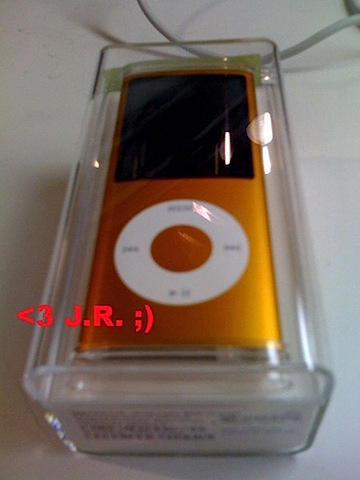
What appears to be a genuine spy shot of the new iPod nano has surfaced on MacNN (heavily Photoshopped and disguised for some reason) before it got picked up and surfaced for the wider public in this AppleInsider thread.
As rumored, the new nano appears to be taller than the current model, with a rounded body and screen. Presumably, the screen is designed for the iPod to be tilted to watch widescreen movies in landscape mode.
The device is expected to be unveiled at a Steve Jobs “Let’s Rock” special event in San Francisco next Tuesday. But fear not — there’s likely to be other surprises. Apple PR is telling journalists the event is a “big deal,” which implies there’s more than a tarted-up 2G-looking iPod.
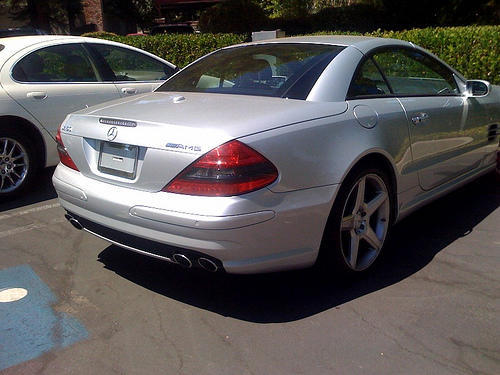
Snapper Rana Sobhany spotted Jobs’ Mercedes SL55 AMG parked in a handicapped spot at the Apple campus over the weekend.
“Mercedes? Check. No license plate? Check. Handicap spot? Yep, this is Steve Jobs’ car!!!” she writes.
Jobs, of course, has a long history of parking in handicapped parking spaces at Apple. The reports go back years, and have recently been documented on Flickr.
Since 2006, Jobs’ car has been snapped in handicapped parking spaces at Apple at least five times. See the pictures after the jump.
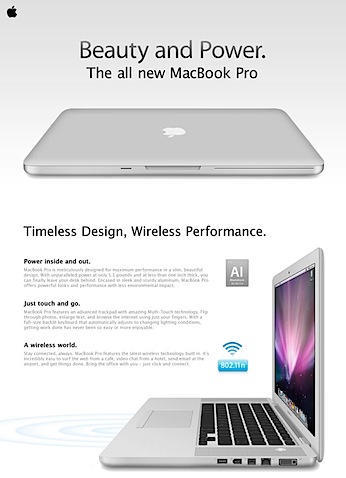
The picture above is burning up Digg right now. It supposedly shows the redesign of the MacBook Pro, which is expected to be refreshed any day now.
The new machine looks gorgeous. With smooth, rounded contours, it resemble the MacBook Air, and there appears to be the magnetic hinge borrowed from entry-level MacBook, which would be a big improvement on the Pro’s current latch/hook design.
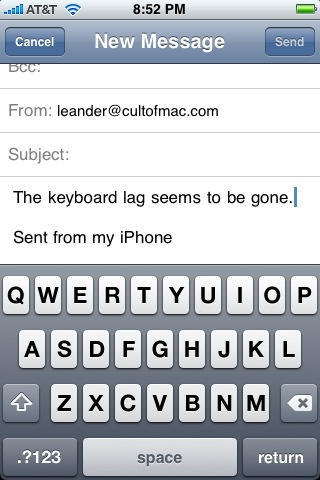
UPDATE: I just downloaded the 2.0.2 update myself, and overall, it does seem an improvement. Backup is now much quicker — less than a minute with my 16-Gbyte iPhone 3G (which has about a dozen third-party apps installed). Apps seem snappier. The Contacts app, which was annoyingly slow, now loads instantly and scrolls smoothly with no lags. Keyboard also seems much better. It used to hangup occassionally, especially in Mail, but so far no lags at all (however, many people report that the lag gets progressively worse until a hard reset). It’s too early to tell if 3G reception problems are fixed — but then I’ve not had consistent problems. It’s always been unpredictably spotty.
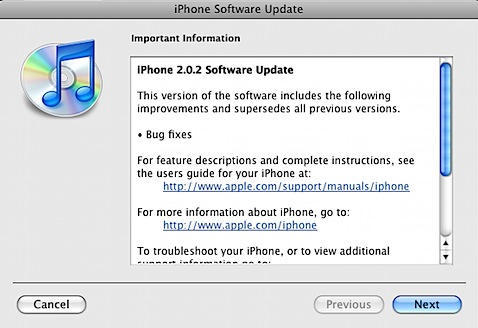
With widespread complaints of iPhone 3G reception issues, you’d think Apple would say whether the latest iPhone software update — version 2.0.2, released Monday afternoon — addresses connectivity problems.
But no. In inimitable Apple style, the release note for the 2.0.2 update says simply that it includes ‘bug fixes.” Nothing more. Thanks Apple. So helpful.
“I was getting none-to-2 bars on 3G here in my home, stationary position,” reports commenter Jettergear. “After the 2.0.2 I am getting nothing but a solid NO SERVICE.”
However, it’s not all bad. Others say that the painful lags with the onscreen keyboard and scrolling are much improved.
“The phone is A LOT snappier now,” reports commenter alangsam. “Contacts works much snappier. Email is much snappier – almost instant. SMS is almost instant. Overall BIG improvement.”
Kris Arnold’s pisstake of the Chris Cocker/Britney video starts off pretty funny — see the video below — but like the original, it goes on a bit too long.
Still, there’s some good lines:
“How f—ing dare anyone even think about selling their Apple stock!”
“All you people care about are Mac rumors, and stock shares! He’s human!… mostly… except his brain… we think.”
“You’re f—-ing lucky he even gave you the iPhone, you bastards!”
I just installed the whopping 250-Mbyte iPhone 2.0.1 update, and it seems to fix most of the problems everyone complained about. Among the highlights:
Everything runs much faster. Could be my imagination, but feels nice!
Typing is much faster. No more keyboard lag.
Infuriatingly sluggish Contacts app now loads fast and scrolls smoothly.
Syncing is much speedier. No longer backs up every app! TTF.
Google Maps app seems much faster. Loads quick, smoother scrolling and zippy zooming.
Overall, update procedure is pretty quick: It installs entirely new firmware, but songs, movies, contacts and other data is left untouched — so there’s no 45 minute restore to suffer through.
NetShare app is not deleted. My copy of NetShare works fine after the update. Be sure to sync everything, including apps, BEFORE updating. BoxOffice also seems to sync correctly, according to reports on other sites.
Blogger Chris Ainsworth tried to get his pet pigeon, Brisby, to play the popular iPhone music game, Tap Tap Revolution, a version of Dance Dance Revolution for your fingers. Unfortunately, Brisby wasn’t very good, leading Chris to conclude that pigeons suck at video games. But with the proper operant conditioning, the bird could probably be a killer Tap Tap player.
After all, psychologist B.F. Skinner in 1944 built an experimental guided missile that pinpointed targets by putting three pigeons in the missile’s nose cone.
The pigeons were trained to peck at an image of the target in the middle of a screen. If the missile wandered off course, the image of the target would wander out of the crosshairs. But when the pigeons pecked the screen to center the target, the missile would correct its flight.
Skinner’s Pigeon Project was judged impractical, but not the pigeons’ pecking skills. The birds performed well, pecking at the target up to 10,000 times in 45 minutes.
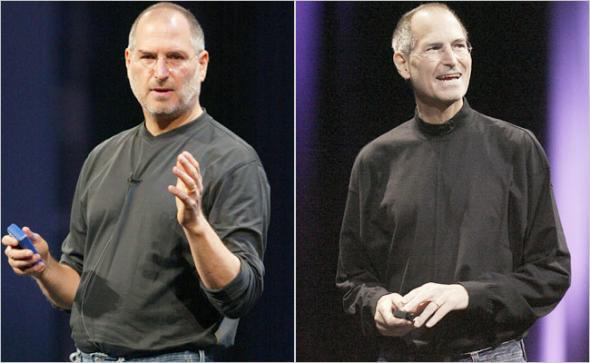
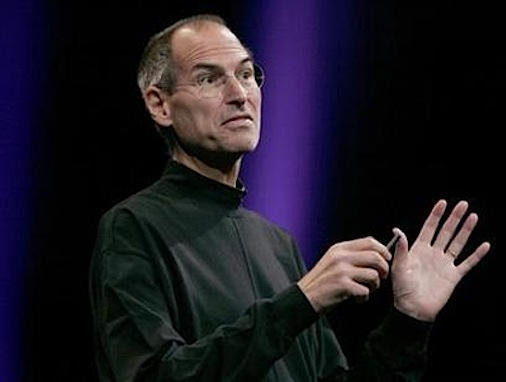
Steve Jobs does not have a terminal illness, the New York Times says, in an amazing story that Jobs refused to cooperate in the writing of — but actually did in his own singular way.
On Thursday afternoon, several hours after I’d gotten my final “Steve’s health is a private matter” and much to my amazement Mr. Jobs called me. “This is Steve Jobs,” he began. “You think I’m an arrogant [expletive] who thinks he’s above the law, and I think you’re a slime bucket who gets most of his facts wrong.” After that rather arresting opening, he went on to say that he would give me some details about his recent health problems, but only if I would agree to keep them off the record. I tried to argue him out of it, but he said he wouldn’t talk if I insisted on an on-the-record conversation. So I agreed.
Because the conversation was off the record, I cannot disclose what Mr. Jobs told me. Suffice it to say that I didn’t hear anything that contradicted the reporting that John Markoff and I did this week. While his health problems amounted to a good deal more than “a common bug,” they weren’t life-threatening and he doesn’t have a recurrence of cancer. After he hung up the phone, it occurred to me that I had just been handed, by Mr. Jobs himself, the very information he was refusing to share with the shareholders who have entrusted him with their money.
The app allows WordPress blogs to be edited on the iPhone and iPod touch, online and off.
It supports blogs hosted at WordPress.com and self-installed blogs (2.5.1 or higher).
There’s all the features you’d expect for mobile blogging — but best of all, there’s an auto-recovery feature that recovers posts interrupted by phone calls. Let’s hope it works.
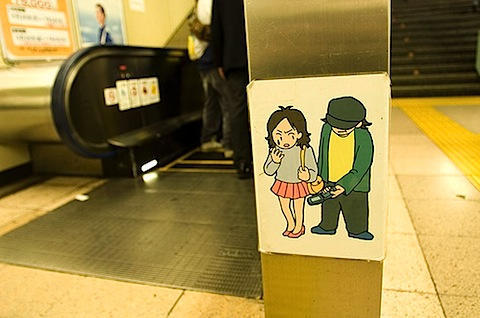
An upskirt warning poster in a subway station outside Tokyo.Photo by Jeff Epp.
The iPhone 3G in Japan has a special feature unique to that country: The camera always makes a conspicuous “shutter” sound when a picture is taken, even when the phone is set to “silent” mode.
The loud shutter sound is supposed to deter voyeurs from taking sneaky pictures up women’s’ skirts — or down their tops.
In Japan, upskirt and downblouse shots have become increasingly popular with the advent of high-resolution camera phones.
As a result, all cell phones sold in Japan make a conspicuous shutter sound, or say the word “cheese” when a snap is taken, according to Nobuyuki Hayashi, a tech reporter based in Tokyo.
On almost all new cell phones, the camera shutter sound can not be muted, Hayashi says.
“Some manufacturers have even put louder shutter sound,” he reports.
The shutter on the first iPhone sold in Japan could be muted in silent mode; an anomaly that many wondered whether Apple would correct in the iPhone 3G, Hayashi says.
Apple did: The shutter sound cannot be turned off, even in silent mode, Hayashi says.
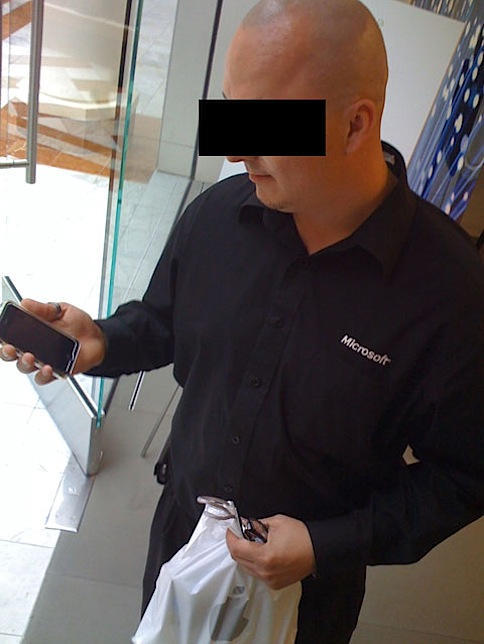
The very last iPhone 3G at the Stonestown store in south San Francisco was just sold to a guy in a Microsoft shirt!
I’m currently at the Apple store in the Stonestown mall, posting from an in-store computer.
I came down to pick up an iPhone 3G, but the last phone was just sold to this guy in a Microsoft shirt. WTF!
The guy, who is very nice, asked me not to use his name in case he gets into trouble at work. He is a trainer for Microsoft Microsoft trainer who works for a third party company.
Staff here at the Apple store say they have no idea when — or even if — they will get new stock of the iPhone 3G.
The concierge is sending people upstairs to a new AT&T store that is apparently taking preorders. The concierge says there’s likely a 21 day wait however.
I phoned other nearby stores in Sand Francisco and Burlingame, but they are sold out also.
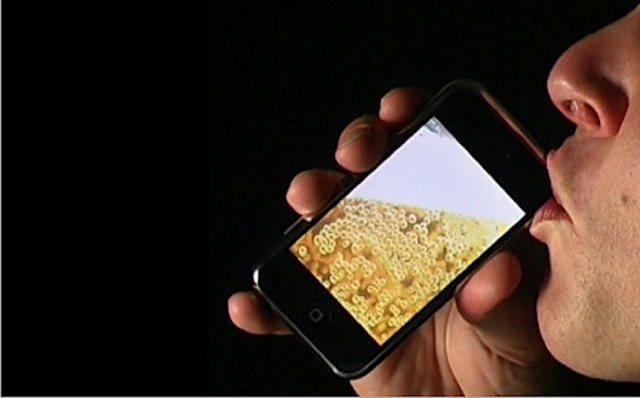
iBeer is a virtual pint for the iPhone and iPod Touch that is supposed to behave like a real pint of delicious bubbly beer, according to the developers.
Thanks to the iPhone’s accelerometers, it tips, pours and drains like a real pint. It even foams up when you shake the iPhone.
However, the $3 app is getting mixed reviews on the iTunes App Store. Some love it, but many say the fun lasts for about 30 seconds.
There are still long lines and at least a 3 hour wait to buy the iPhone 2 — four days after the device first went on sale.
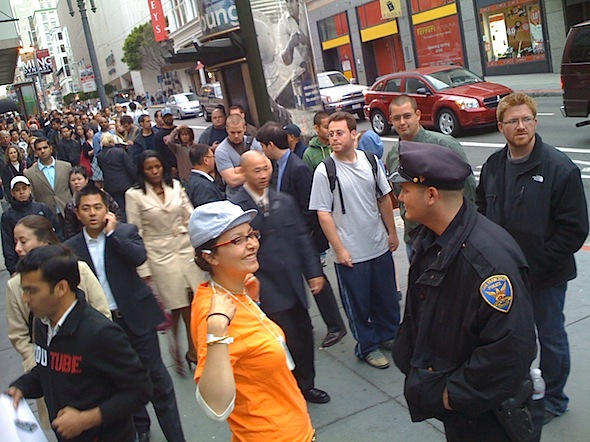
I went by the Apple Store near San Francisco’s Union Square on Monday evening. At about 7.30PM there was a long line of about 120 people stretching nearly the entire city block.
The concierge at the front door (pictured above talking to the cop) told me the wait was about 3 hours. The cop told the concierge to call if she needed any help later on. She just laughed. She was about to cut the line off — the store closes at 9PM.
She said the line had been like that all day — a work day for most San Franciscans. A coworker from Wired.com went to the store at lunchtime thinking they could walk right in and pick up a iPhone, and were flabbergasted to see there was still along line.
The problem is the activation procedure, which she said takes an average of 20 to 30 minutes for each customer — even existing AT&T subscribers. Unlike the first iPhone, no one is allowed to leave the store with an inactivated iPhone.
Earlier in the day, my wife went by another San Francisco Apple Store in the Stonestown shopping mall, where there was a line of about 25 or 30 people.
Everyone is concerned about Steve Jobs’ health, prompting the obvious question about succession plans at Apple. The company seems doomed without him. Who has the vision and drive?
But Apple will be fine without Jobs, although it won’t be the same.
I heard two interesting tidbits about the possible design of the iPhone 2 at the weekend:
Better Battery Thanks To Better Software
3G is generally assumed to be a drain on battery life because of the hardware, which sucks down juice, but it is actually the iPhone’s software that is the problem, according to engineers working on Google’s Android phone. According to a conversation reported to me by a colleague at Wired.com, Google’s engineers say the first iPhone OS was basically a hack. It was adapted from the desktop OS and had none of the advanced power-management features necessary to properly run the networking chips. But the iPhone 2 will have not only better integrated circuits, it will have proper power-management software also.
The iPhone 2 Won’t Have an All-Plastic Case
There are several rumors speculating that the iPhone 2 will have an all-plastic case, replacing the metal back of the current design. But an engineer I talked to last year said the metal cases of the iPod and the iPhone were probably designed to dissipate heat from inside the device . They were likely big heat sinks. And that’s why I doubt the iPhone will have a plastic back, because plastic doesn’t conduct heat as a well as metal.
The Guardian says that in some cases, the iPhone will even be free to new subscribers:
… the handset will be offered at lower prices – or even for free. Those who sign up for a contract costing £75 a month will be offered the handset for no extra charge, breaking with Apple’s earlier attempts to avoid the large subsidies common in the rest of the industry. Elsewhere, the gadget is likely to be subsidised to lower the price, which could drop from £269 to as little as £100.
UPDATE: RE: the comments below. I Photoshopped the image above for illustrative purposes. It’s not a spy shot. Also, my tipster said the iPhone will be subsidized, but he didn’t specify whether the subsidy will come from Apple, AT&T, overseas carriers, or all of the above. I can only guess that Apple will sell the iPhone 2 at a loss — to customers and carriers — and recoup the cost from monthly subscriber charges.
I just got a hot tip from a programmer at a major software publisher who claims to have seen the specs for the iPhone 2. This is unconfirmed, but according to the tipster, the iPhone 2 will be announced by Steve Jobs at Apple’s WWDC on June 9, and will much offer more for much less — and be thinner to boot. The iPhone 2 will have:
3G
GPS
2 x memory (16GB and 32GB)
22 percent thinner
Better battery life
The tipster says Apple will subsidize the iPhone’s price to better compete with RIM’s Blackberry. The London Times is reporting the same thing — that the iPhone will cost about $200 in the UK when it goes on sale in July.
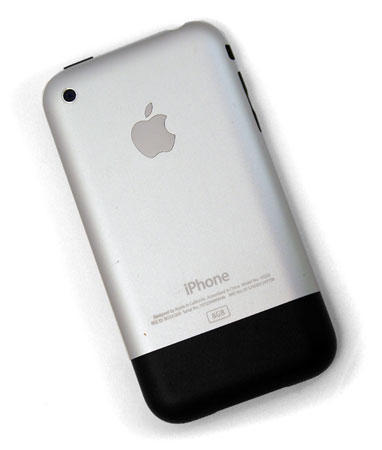
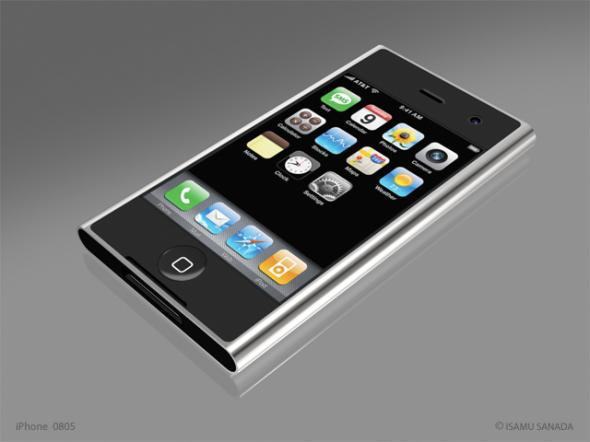
The maestro of mockups Isamu Sanada is at it again. Here’s his fab mockup of the second-generation iPhone. Note the forward-facing camera for videoconferencing.
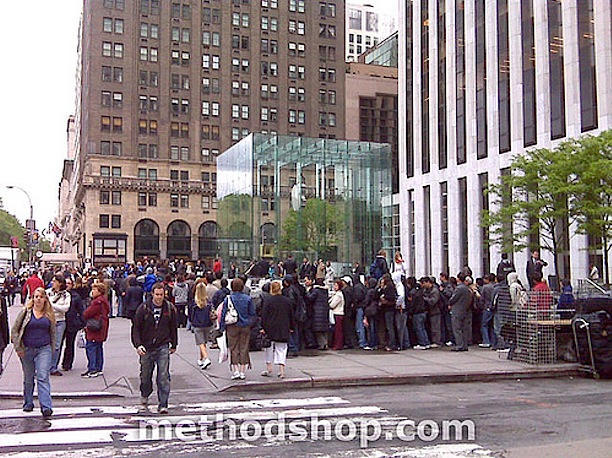
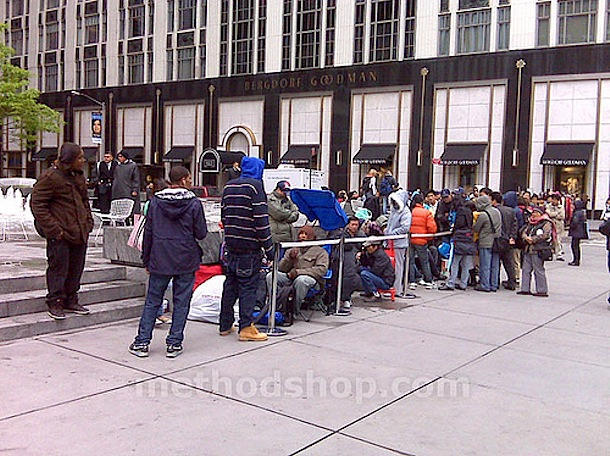
Blogger Jon Accarrino of Methodshop reports that lines are already forming in NYC for iPhone 2.0, which is rumored to be launched on June 9 (the first day of Apple’s WWDC and Steve Jobs’ opening speech).
Jon went by Apple’s 5th Avenue store this morning and found a line of about 50 people all waiting for iPhones — or so retail staffers told him.
Jon thinks the liner-uppers are already waiting up for the new iPhone.
Noting that many in line are Asian, Jon speculates they are from NYC’s Chinatown, and are being paid to wait in line. But I find it hard to believe that people are willing to pay a line-sitter for two weeks or more — especially when there’s no indication there will shortages, which prompted the lines first time around.
Reading between the lines of Jon’s report, I’ll bet they are being paid to snap up dwindling supplies of iPhone 1.0 to be sent overseas. As long as Apple places restrictions on the number of iPhones people can buy (currently 5) and there are not yet official channels, there’ll be demand for grey market iPhones.
Dennis Liu, creator of the clever OS X-themed music video that went viral last week, is looking for help with his next Apple-themed video.
On May 9, Dennis posted a music video he’d made for indie band The Bird & The Bee featuring his OS X desktop and dozens of applications. The video, featured below, has been viewed more than 600,000 times and written up on scores of blogs and websites.
Eleven days later, the video has earned Dennis several job offers and offers of work from Yahoo, Microsoft and HBO, he says. According to Dennis, the highlights of his “crazy” week are:
– Ranked #1 viral video at www.viralvideochart.com for 1 week.- Head nods from several known Hollywood producers and directors.- Talks to getting a manager/agent at a major talent representation agency- NYU, USC, and Berkeley requesting the video to show their film/new media students.- E-mails from major corporations, including marketing directors and employees of Yahoo, Microsoft, HBO, Pixar, Disney, and of course Apple.- Invited to screen at film festivals world wide, from the UK to Australia- Bird & the Bee enjoyed the video, going to their NYC concert in June 2nd.- An apple store manager in IL showed all her employees the video as an example to artfully show the power of the macs to customers.- The author of “Stickies” wrote to congratulate, as well as a lead developer of OSX. https://mooseyard.com/Jens/2008/05/stickies-makes-its-music-video-debut/- Many, many, many start-ups/unknown musicians looking for a director to shoot their next video/ad.
Dennis works at the NY ad agency BBDO, and used to work out of Saatchi & Saatchi NY shooting viral videos. More about Dennis here.
Next on the horizon, Dennis says he’s looking for help shooting another Apple-related viral. He writes:
“I have another really cool idea, very different from this one – but still with enormous viral potential for Apple. Would take probably twice as long to make, but could be very cool. But am trying to decide whether it’s worth the amount of work… especially when it’s all by myself. If there is a next time, I could appreciate a hand….”