Mobile menu toggle

Apple - page 47

Analysts: Apple is a Bad Economic Indicator

By

post-13340-image-7029d40908cc8c918250fa3982f9f15d-jpg

Apple is due to announce Wednesday its earnings for the quarter that ended June 27, and you know what that means: wild speculation by analysts followed by pouting and a drooping stock price when Apple out-performs expectations.

But lately, it’s gotten still more insane: now, these same analysts are trying to infer some read of the overall economic condition based on Apple’s earnings. Which, to me, is a comically fruitless exercise, because Apple operates in a different universe from most companies. It has radically differentiated offerings in all of its businesses, and its focus on innovation is such that it always comes out with a new market-defining product that the rest of the industry can’t match. Apple’s an especially bad indicator of the rest of the consumer tech sector during this recession. Apple doing well doesn’t mean that Dell’s in good shape, or vice versa.

BusinessWeek’s Arik Hesseldahl, a long-time Apple-watcher, has a very sober account of this lunacy, which suffers from the problems associated with a lot of traditional business reporting — in pursuit of balance, he can’t actually address the questionable premise that Apple, a company that was out-performing the market before it collapsed, might signify the end of the recession by continuing to out-perform the market.

I can say this much: Apple will have great earnings on Wednesday. And that means that it remains good to be an Apple stockholder, even as the rest of the world is in chaos. It doesn’t mean we’re getting back to normal anywhere else.

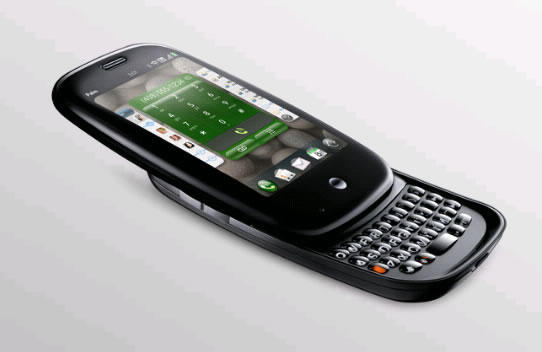
Apple Bars iTunes Syncing to Pre in Latest Update

By

post-13106-image-cd15b2649cca9290154c4d593c96fb97-jpg
Pre users will have to stay with version 8.2 to sync with iTunes

UPDATE: the original headline and a reference to “wireless” syncing in this article have been changed to correct a misunderstanding on the author’s part.

Apple has confirmed that Palm Pre will no longer be able to sync with iTunes versions beginning with the latest update, killing a sales feature that Palm had long relied upon in billing its phone as a major competitor to the iPhone.

“iTunes 8.2.1 is a free software update that provides a number of important bug fixes,” said Apple spokeswoman Natalie Kerris, in a BusinessWeek report Wednesday. “It also disables devices falsely pretending to be iPods, including the Palm Pre,” she continued, adding, “As we’ve said before, newer versions of Apple’s iTunes software may no longer provide syncing functionality with unsupported digital media players.”

For a device roundly touted as iPhone’s most worthy competition in the smartphone market, Palm’s Pre has not made many waves since being released on June 6 by Sprint, and remains hampered by an online app store with very little product.

There is some disagreement among analysts about how well the Pre has been received so far by the market, with some crowing that expectations have been more than met, while others say not so fast.

While the news of iTunes’ Pre lockout is no surprise, and Palm could still easily craft workaround allowing Pre users to sync with newer versions of iTunes, including using third party solutions to do the job, the lockout news is further evidence that Apple is not about to let up the pressure on a company now run by some of its former employees.

RIP: The iPod Classic May be at Death’s Door

By

post-13078-image-9198d5e4783c90831fdcf47f8588cc9e-jpg
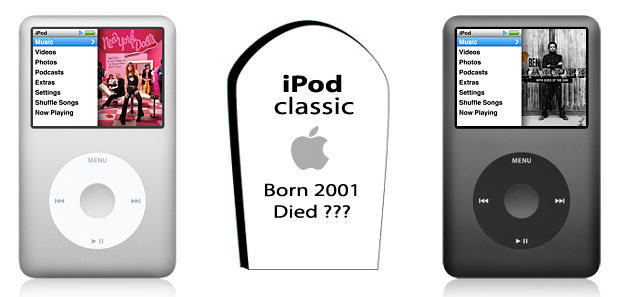
The iPod classic's days may be numbered.

As flash memory and solid state drives steadily become the storage media of choice for portable electronic devices, Apple’s iPod Classic – the device widely credited with kickstarting the company’s rise from the ashes of the John Scully era – may not survive to celebrate its 10th birthday in 2011.

1.8 inch hard disk drives manufactured by Samsung and Toshiba, the last two manufacturers standing in a once-robust market for small, high-capacity spinning disk drives, sit languishing in the supply channel, according to a report at Ars Technica, and industry trends do not bode well for the future of Apple’s signature gadget.

When Apple launched the first iPod in 2001, the hard disk was the only vehicle capable of storing large amounts of data flexibly at reasonable cost. Since then, however, advances in Flash memory and SSD technology have made those two storage options the industry standard for everything from netbooks to iPhones and the entire line of Apple’s portable music players, with only the Classic continuing to rely on the 1.8″ HDD.

The trend toward Flash memory and SSD technology has been building for at least the last couple of years, with Apple having been ahead of the curve when the company introduced its Flash memory-based iPod nano in 2005.

SSDs typically offer higher performance–often much higher performance–than hard-disk drives and are more durable since they have no moving parts. While the larger question of where the technology is headed remains somewhat in debate, in large part over concerns about data’s long-term reliability in SSD storage media and Flash memory’s eventual degradation related to writing, erasing and re-writing its memory blocks, the fate of the 1.8 inch HDD seems dire.

The industry’s current disdain for small-form HDD products, and Apple’s apparent design trajectory for its mobile PMPs and handset devices, suggest the time has come to prepare farewells for the iPod Classic.

AT&T Tethering Disabled in Latest iPhone Beta

By

post-13036-image-98100330f87db4a79a4539d930b3e574-jpg

Apple has disabled AT&T tethering in the latest iPhone beta released to developers on Tuesday.

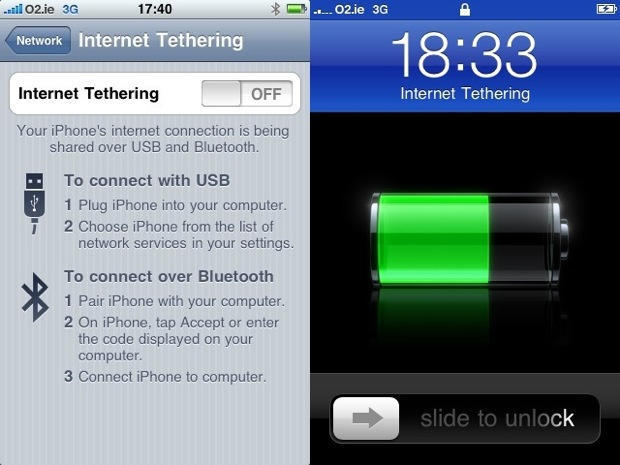
The iPhone OS 3.1 beta 2 disables a popular tethering hack for the AT&T network. The hack works on iPhone 3.0, even though AT&T does yet officially support it.

The hack enables data tethering (and sometimes MMS)  by altering the iPhone’s IPCC carrier files. It’s easily enabled by visiting sites like BenM.at using mobile Safari on the iPhone.

AT&T has promised tethering later this year, but has yet to release details. The company is expected to be enabled in late summer and cost about $15 extra.

Thanks QuickPWN.

How MacBook Pro Converted A Prominent Apple Hater

By

post-13027-image-afde91b764145e7cc48c85d7dfa464f0-jpg
John C. Dvorak

Image credit: Randy Stewart

And these children that you spit on
As they try to change their worlds
Are immune to your consultations
They’re quite aware of what they’re going through.
– David Bowie

One day, people may point to an article published Monday at PCMag.com (perhaps the preeminent Windows-foucused tech magazine around) by long-time Apple-baiting columnist John C. Dvorak, as a signal for the storming of Microsoft’s figurative Bastille.

“If I was going to buy a new laptop this minute, a MacBook Pro is probably what I’d get,” are words almost no tech watcher of the past 20 years would ever figure to come from Dvorak, the smart, engaging veteran columnist who has taken over the years a nearly perverse glee in stirring up the bee hive of Apple loyalists in tech journalism.

But that’s exactly what Dvorak had to say after seeing first-hand “all these whiz-bang features” of his son’s brand-new MacBook Pro that, he said, “make me realize that I have fallen behind.”

But don’t go thinking Dvorak has fully consumed the kool-aid or that his enmity for Apple will abate completely anytime soon. The real reason he’s kindly disposed to an Apple product at this point, aside from “that hard aluminum unibody that makes the thing feel like a rock,” is a piece of software his son required, DEVONthink, which organizes and sorts PDF files into manageable database blocks – and has no Windows-based counterpart. “It’s about as close to a killer Apple app as anything I’ve seen since VisiCalc in the late ’70s,” he gushed.

Of course no Dvorak piece would be complete without a pointed jab at something Apple, and he dutifully reported his son’s experience at the Apple Store as something akin to “a car dealership in the ’70s, with layers of various salespeople, each trying to screw you.”

“I actually think that the Apple Stores are barriers to sales, and people only buy Macs because the machines have clearly moved ahead in genuine usefulness,” he wrote, saying, “overall, it’s a pathetic indictment of the entire PC scene.”

Well, perhaps it’s a reach to tar the entire PC scene with the same brush, but clearly change is in the air and more and more people such as Dvorak’s kid are coming around to just how far Apple machines have moved ahead.

It’s at least a bright sign that someone like Dvorak has finally noticed.

Opinion: Understanding the Apple Rumor Mill is a Matter of Trust

By

post-12958-image-ae587d18f2fe8839c5c7ba082592a558-jpg
Image courtesy of Gizmodo

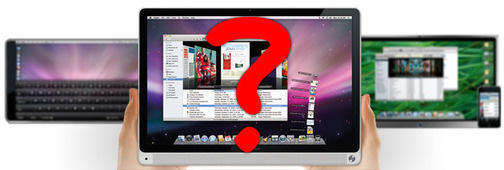
With new rumors about the much anticipated Apple tablet hitting Monday, it seems fair to ask how one is supposed to decode the storms of speculation that have long whirled around the company and its products.

Some thrive on rumor and innuendo about Apple – the largely well-regarded Macrumors attracts over 6 million unique visitors per month, AppleInsider nearly a million – and with Apple’s penchant for absolute secrecy over its design department and product development it’s no surprise whispers and baseless fantasy comprise much of what passes for “news” about Apple.

If Apple really is coming out with a tablet in October, or AT&T really is going to open tethering to the US iPhone market in September (a persistent rumor AT&T continues to deny with respect to both price and timing), does it benefit anyone to know about it now? And if it turns out there is (again) no tablet, or that tethering comes tomorrow for free (you wish), how does that affect the way one is supposed to receive the next rumored news item about what they’re up to in Cupertino?

These questions are one small aspect of the larger debate about the ways news and journalism are changing in the Internet age. Traditional news organizations have been cutting resources for true investigative journalism for years, in favor of selling ads and eyeballs with cheap sensationalism, in part because it often seems that’s what the public wants, but also because it’s easier to publish a rumor than it is to get at the truth or to take time to think about and craft a well-reasoned opinion piece.

Monday’s rumor about the Apple tablet originated with a report at the China Times, which is no tabloid sheet, and appears to be based on information about companies high up in the Apple supply chain that a respectable news organization would be able to source and confirm before printing as news. Do standards of journalistic ethics prevail at major news organizations in Asia? Have budgets for investigative journalism survived the impulse to feed the public’s insatiable desire for knowing what the future holds?

The answer to such questions holds the key to understanding how to receive a report about what Apple has up its sleeve. What you believe comes down to whatever you can know for yourself and who you can trust to tell you the truth. Ultimately, no one really knows until the lights come up at the next Apple “event” – and, after all, anticipation is more intoxicating than feeling you already know what’s coming.

iPhone Dropped in Swimming Pool Is Still Going Strong

By

post-12768-image-6c6ae5162d61f56f6f78dabf88c531b0-jpg

khena_kara_t

Two weeks after an iPhone 3GS was dropped in a swimming pool while recording video, the phone is still frickin’ working says its owner.

“I’m talking to you on it now,” says Khena Kara, the iPhone’s owner, speaking from his home in Nashville, TN. “It’s still going strong.”

Kara’s iPhone 3GS gained internet fame after Kara accidentally dropped it in a swimming pool while recording a video. The iPhone kept recording as it sank to the bottom, and as he fished it out. “It still frickin’ works!” he says in surprise as he pulls the iPhone from the pool. Kara posted the footage to YouTube, and it spread fast on blogs and Twitter. It has now been watched more that 500,000 times.

But many questioned the video’s authenticity. Most notably, Mashable wondered whether it was real.

“Yes, it’s real,” says Kara of the video. “It was the pool in my subdivision.”

Above is a video still of Kara taken from the iPhone video right after it was fished from the pool. And below it is a new picture of Kara taken with the same iPhone.

The new picture’s metadata appears to back up Kara’s story.

Justice Dept. Begins Peeking Into Exclusive Carrier Agreements

By

cult_logo_featured_image_missing_default1920x1080

The United States Department of Justice has taken the first baby steps that could eventually lead to an official investigation of the Telecom industry and the effects its exclusive carrier agreements have on consumer prices and choices, according to a Wall Street Journal report Monday.

The initial review looks to determine whether large U.S. telecom companies such as AT&T Inc. and Verizon Communications Inc. have abused the market power they’ve amassed in recent years, according to people familiar with the matter.

Largely moribund and hamstrung by internal politics and inefficiency during the Bush administration, DOJ under President Barack Obama has seen renewed relevance as an arm of the Federal government and has lately signaled business as usual could soon be ending for an industry left to its own devices during the past decade or more.

Many people have long decried exclusive carrier agreements that make popular gadgets such as Apple’s iPhone available only to consumers willing to sign multi-year service agreements with AT&T and likewise Blackberry’s Storm to those who’d sign with Verizon.

The Wall Street Journal quoted the Justice Department’s antitrust chief, Christine Varney, saying she wants to “reassert the government’s role in policing monopolistic and anti-competitive practices by powerful companies.”

iPhone Popularity Rockets Up Flickr Charts: UPDATED

By

post-12681-image-1de2d643f3d70b2ae67d896f60ce4cf2-jpg

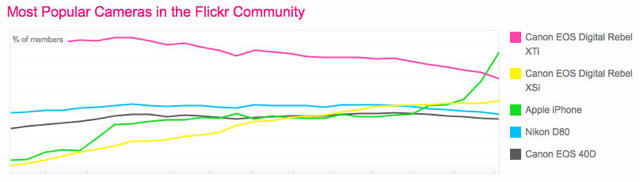
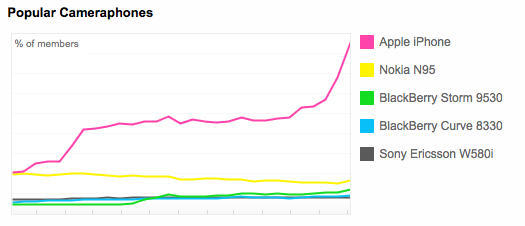
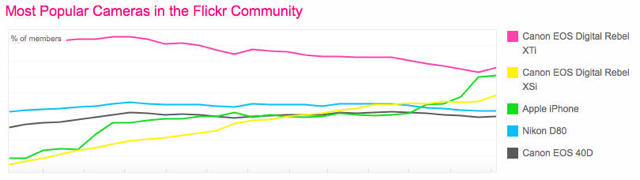
Apple’s iPhone has recently become the most popular camera on Flickr, one of the Internet’s most well-regarded photo sharing social media sites.

Expressed in “percent of members” terms, the iPhone has lately bested two models of Canon’s EOS Digital Rebel, of which the XTi had long been the clear favorite choice of Flickr members.

UPDATE: Since this post was originally published, the Flickr site’s graph has been changed, and now shows the iPhone is the #2 camera among Flickr members, resting just behind the Canon EOS Digital Rebel XTi, which has apparently enjoyed a bump in popularity for which the previously published graph did not account.

[Thanks Rafael, for the heads-up on the graph change!]

Among popular camera phones, the iPhone has outdistanced its rivals since its release two years ago and recently widened the gap between its nearest competitor, the Nokia N95, by a huge margin.

The data is to be taken with a grain of salt as anecdotal and largely unscientific, but it is interesting to note such graphic evidence of popularity for a phone camera that had been denigrated by many as one of the most pitiable features of Apple’s popular smartphone.

Apple recently upgraded the specs on the iPhone camera, giving it a boost in pixel capacity and adding both variable focus and video capabilities, which should only increase its attractiveness going forward.

popular_cameraphones.png

Copycats Target $30 Apple Earbuds, And They’re Near Perfect

By

post-12465-image-8c66354008020d61ea69054e78f38a13-jpg
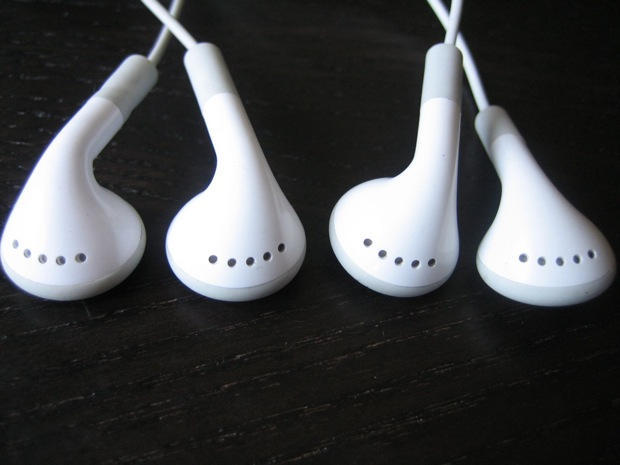
One of these iPhone headsets is from Apple; the other is a knockoff.

Spot the difference? One of these is a $30 iPhone Stereo Headset from Apple. The other is a $14 knockoff from the Philippines.

Thing is, the $14 copycat is as almost good as the original. It’s nearly physically indistinguishable. The sound is exceptionally good. And the microphone/remote works the same as it does on the genuine article.

Even the packaging is remarkably realistic.

Except there’s a few things that are off — a few minor details that give them away as fakes. Plus, they broke down after a week.

Secrets of the Counterfeiters: Interview With Shure’s Top Legal Eagle

By

post-12371-image-4a651ae301d3b15ab6f9bc8768feb7e8-jpg
The audio manufacturer Shure has battled knockoffs for years. http://www.flickr.com/photos/digaderfox/

The audio manufacturer Shure is known for its excellent headphones, which makes it a favorite target of counterfeiters.

In May, Shure helped Chinese authorities bust knockoff shops run by two Shanghai companies that were making copycat Shure headphones. The raids uncovered large quantities of Shure E2c and E4c earphones, which sell for about $70 and $170 respectively, as well as headphones branded JVC and Audio-Technica.

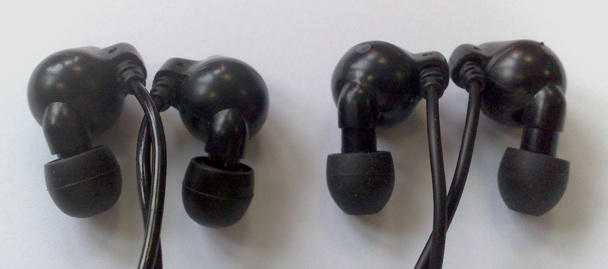
Unlike copycats of yore, today’s counterfeiters are amazingly sophisticated and accomplished, turning out high-quality knockoffs that in some ways rival the originals. Flickr user digaderfox bought a pair of fake Shures on eBay last year, and documented the surprisingly high quality of the knockoffs on the photo site.

Apple is also is becoming a target of copycats, with amazingly good knockoffs of iPhones and headsets coming onto the market.

SEE ALSO:

Marvel At the Ingenuity of the Chinese iPhoney, iPhone Knockoffs Now Near Perfect

Copycats Target $30 Apple Earbuds, And These Are Perfect

Paul Applebaum, Shure’s Executive Vice President and General Counsel, said counterfeiters are increasingly sophisticated. Some are setting up convincing factory-direct websites, or hijacking U.S. eBay accounts to make it appear goods are shipped domestically.

Full interview after the jump.

China’s Green Dam Internet Filter is Full of Holes

By

post-12587-image-f13c18cec21ebcaaeb36cd915c179ebe-jpg

For all of its public perception as a great censoring overlord, the Chinese government leaves plenty of wiggle room for computer manufacturers, including Apple, to avoid complying with recently mandated strict Internet filtering requirements.

While foreign and domestic makers of computers running Windows will eventually have to ship their machines with controversial Green Dam Youth Escort software, other machines running Mac OS X or Linux, for example, will be exempt from the mandate, according to a report at Yahoo Tech.

An Apple sales representative in Beijing indicated Green Dam is not being bundled with Macs sold at the Apple Store there because the software, which blocks pornography and “sensitive” political content, is not compatible with the Mac’s operating system.

In addition, a Lenovo spokesperson confirmed its computers running Linux are also being shipped without Green Dam and said the Ministry of Industry and Information and Technology is not requiring non-Windows machines to come with the program.

A source connected with Green Dam developers said they are testing the software on non-Windows platforms but did not indicate when or if an OS X compatible update might be released.

Updated: Employee Confirmed Shot In Violent Armed Robbery at Virginia Apple Store

By

post-12575-image-204ebff3ee4c82f8530a8bf271bdb3bc-jpg
Police at the Apple Store Clarendon in Arlington, Virginia, where an employee was shot during an armed robbery. Picture by Fox 5.

Updated: Police have confirmed that a 26-year-old female Apple employee was shot in the shoulder and injured at the Apple Store Clarendon in Arlington, Virginia, during a “violent armed robbery” at about 10.15AM.

The suspect rang a doorbell at the back service entrance and shot a female employee as soon as she opened the door, the Washington Post reports. A police spokeswoman said it is unclear if the employee had words with the shooter or put up resistance to the robbery.

According to the Post, only two employees were in the store at the time, the shooting victim and another employee who was in the main showroom. The other employee called police as soon as they heard the gunshot. It’s unclear if there were customers in the store at the time, the police said. The shooting occurred about 15 minutes after the store opened.

The shooting victim was injured in the shoulder. The injuries are not considered life-threatening, police said.

The suspect is described as a medium build black male, aged between of 35 and 45, with facial hair. He was wearing a dark baseball cap, a light-colored shirt and pants. He fled on foot, carrying a handgun.

Security camera footage of the shooting may be released to the public to help the search, police said.

The store is located in the tony Market Common outdoor shopping district, which is considered a quiet, safe area.

“I think it’s a sign of the times, the economy, when you have someone desperate enough to rob an Apple store in an area like this,” said a shopper who was planning to buy a new MacBook.

Apple May Treat Overheated iPhones Like Waterlogged iPhones: You’re SOL

By

post-12543-image-f7f80458274afb3e764d5cea22b1826e-jpg

As the issue of overheating iPhones heats up, Apple might be preparing to point the finger at iPhone owners who fail to keep their iPhones within acceptable temperatures.

Apple recently updated its knowledge base advising iPhone owners how to keep their devices within acceptable operating temperatures.

For many, this was not the answer they were hoping for because Apple’s solution to an apparent defect appears to be to place the burden on the user to ensure their iPhone’s temperature remains within an acceptable range.

What’s troubling about Apple’s position is that it sets the stage for Apple to adjust its iPhone service policy based on the argument that damage caused by overheating the iPhone is the fault of the iPhone’s owner — not Apple.

Remember how Apple resolved the problem with the iPhone’s oversensitive moisture sensor, which some claimed was activated by sweat?

That’s right, if you bought an iPhone with a defective moisture sensor that subsequently gets tripped by sweat or humidity you have to pay Apple $199 for a replacement under the theory that Apple cannot confirm that your iPhone was not exposed to water.

Sound familiar?

iPhone Overtakes Nokia in Smartphone Market Share

By

post-12526-image-223fdd8f67bb0d64e027f7c2b023f78a-jpg
iPhone hosts nearly half the ads served on mobile platforms.

Apple now has overall market share leadership in the worldwide smartphone segment, having overtaken former frontrunner Nokia based on browser calls for mobile ads. A recent report at BNet Technology cites AdMob statistics that show Apple with 49 percent of mobile ad traffic in the first quarter of 2009, compared to 32 percent for Nokia.

The market shift may have less to do with customer preferences for Apple’s hardware, however, as a recent smartphone industry analysis from Gartner notes; services and applications have become the primary drivers of smartphone success.

The stats appear to vindicate Apple’s approach to application distribution via the iTunes App Store. William Volk, CEO of entertainment and business apps vendor PlayScreen, said on a professional forum posting that “other stores simply aren’t matching the ARPUs [average revenue per user] of the Apple App store.”

The iPhone OS also enjoys a comfortable lead over every other mobile operating system, including Symbian, Research in Motion (RIM), Palm and Windows, with May numbers showing iPhones had 68% of the browser requests in the survey.

Apple Support Document Addresses iPhone Overheating Concerns

By

post-12512-image-0d79a3f9a7eeb25d2c17d1103b1c3fab-jpg

Apple has a support document called “Keeping iPhone 3G and iPhone 3GS within acceptable operating temperatures” to which the company has directed those with concerns about alleged overheating problems with 3G and 3GS models of the device.

In addition to offering practical advice such as “Don’t leave the device in your car” (as car interiors can exceed the recommended operating range of -20º to 45º C [-4º to 113º F]), the document also warns that CPU-intensive applications, such playing music or using the GPS while in direct sunlight may also overheat the iPhone.

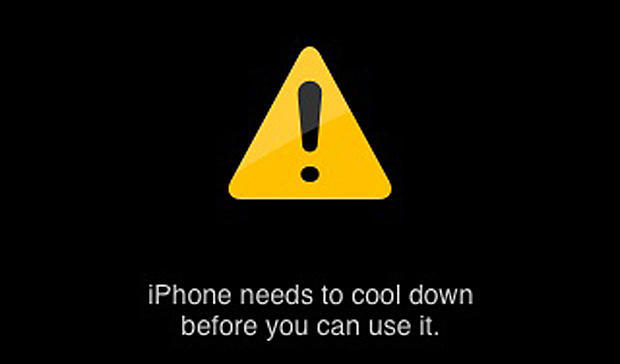
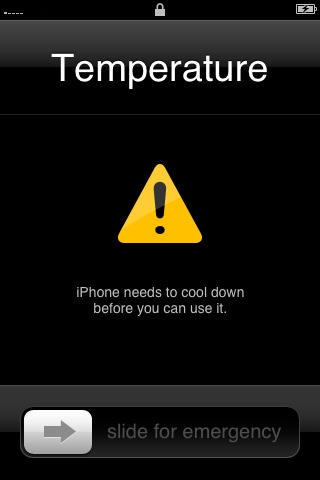
The OS has a temperature warning screen built in, that appears to indicate when the phone could be running into problems and may not work properly.

Using the iPhone in temperatures over 95 degrees can trigger the temperature warning, according to at least one report. “Low- or high-temperature conditions might temporarily shorten battery life or cause the device to temporarily stop working properly,” Apple warns in the support document, though it says when the temperature warning appears, the phone “may still be able to make emergency calls.”

Recent anecdotal reports of 3GS iPhones overheating, with some white models turning pink as a result, have led to speculation that Apple may have a recall situation on its hands, but the company so far is relying on the fact that “iPhone 3G and iPhone 3GS comply with the safety standard for Safety of Information Technology Equipment, IEC 60950-1,” and has had no further comment on the overheating issue.

[GearLog]

Apple Receives Middling Marks In GreenPeace Green Computing Survey

By

post-12445-image-a0d566179a817a854fc4cd2da37eedf8-jpg
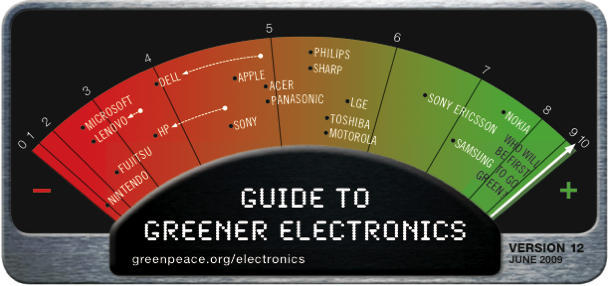
Despite touting its green credentials, Apple is ranked fairly low in Greenpeace's latest survey of green electronics.

Despite touting its green credentials in new TV ads, Apple is ranked fairly low in Greenpeace’s latest survey of green electronics.

Greenpeace’s quarterly green scorecard was released on Wednesday, and while Apple got high marks for reducing toxic chemicals, it got low marks for not supporting global recycling initiatives or using more recycled plastics.

Overall, Apple scored 4.7 out of 10, putting it in the lower half of a pack of 18 electronics manufacturers. Nokia came top with a score of 7.45, and Nintendo came bottom with a score of 1.

Apple has been advertising the green credentials of its new MacBook line in TV ads — proclaiming them the greenest laptops ever.

Greenpeace’s 12th Guide to Greener Electronics ranks tech companies on three main criteria: reducing overall environmental impact, eliminating toxic chemicals, and recycling efforts.

After 20 Years, Maryland Man’s Mac IIci Finally Dies

By

post-12420-image-cf376c5046c4aea971829bb7268004ad-jpg

Apple rightly has a reputation for making quality gear. The company doesn’t make junk that breaks down in a few months, or even years. Or even 20 years.

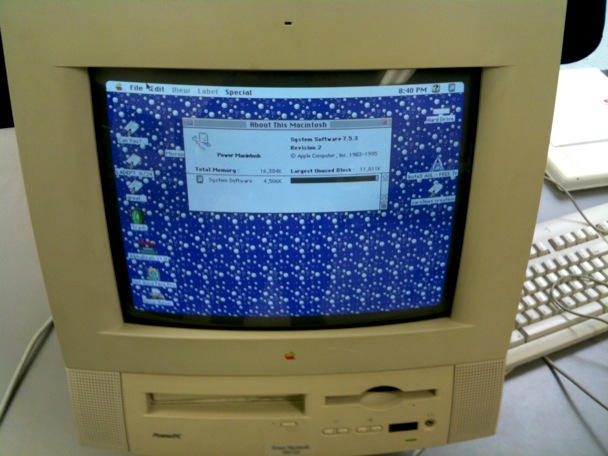
MacMedics, a repair shop in Millersville, Maryland, recently serviced a Macintosh IIci, which was on the blink after two decades of faithful service.

Introduced in September 1989, the Mac IIci is one of the most popular early Macs. It was the first to have built-in color video, three Nubus expansion slots, and a 40 or 80 MB hard disk. It originally sold for $6,700.

The machine was putting up funny patterns on the monitor. The client thought it was the screen, but it was actually the main logic board. He’d been using the machine for 20 years — 20 years! — and had no interest in upgrading to a modern Mac.

“Welcome to Macintosh” Lands a Coveted Comcast Pay Per View Slot

By

cult_logo_featured_image_missing_default1920x1080

Welcome to Macintosh, the feature length documentary that explores the many ways Apple, Inc. has changed the world, jumped from the international, independent film festival circuit to pay-per-view cable TV Wednesday.

The film, which relies on notable personalities associated in one way or another with Apple, such as Andy Hertzfeld, co-creator of the original Macintosh, and long-time Mac evangelist Guy Kawasaki, tells the inside story of what makes Apple different and will now be available to over 20 million subscribers to the Comcast cable network in both the Pay-Per-View section and the “Movie” section of Comcast’s On Demand service.

“The goal was to make a film that you can show to anyone, even someone that has never used a computer, and have them understand why so many people love Macintosh,” says Josh Rizzo, Co-Director. “Availability to all US Comcast customers goes a long way toward completing that goal.”

If you’ve seen it, you know Welcome to Macintosh is really a love song to Apple and though the film is in no way authorized, sponsored or otherwise approved by the company, it’s a good bet there will be cheering in Cupertino once the ancillary sales begin to roll in from people who come to Apple through having seen the film.

What’s New in the iPhone 3.1 Beta

By

post-12377-image-378eafe2f22ee8aa2fbf3af168013d46-jpg

The iPhone 3.1 beta has been released to developers, and includes some cool features, including Voice Control over Bluetooth.

Baseband has been updated to 5.08.o1, so don’t install the beta if your iPhone has been unlocked with the ultrasnow hack — it will permantly lock it.

The beta also allows edited videos to be saved as a copy, preserving the original. And MMS is on by default, but doesn’t work for AT&T subscribers.

The full list, via the QuickPwn website, after the jump.

Dream Job: Apple Advertising For 3D Modeler To Make Concept Products

By

post-12358-image-f82aadc374075fd5357cbef1fbc3dd22-jpg
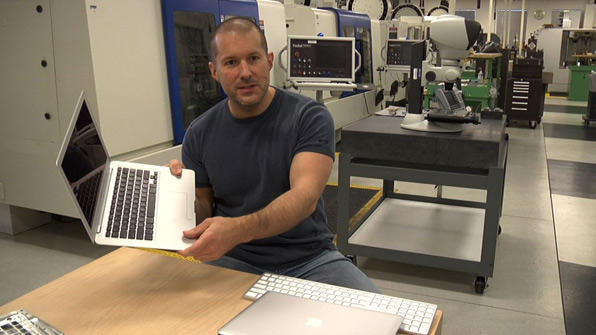
Apple is advertising for a rare job inside its design studio. The studio is ultra secretive. The new design documentary, Objectified, from which this still of Jonny Ive is taken, is one of the few films to shoot inside the studio.

Apple is advertising a rare job in its storied design department — and it’s a cool one.

Apple is looking for a computer modeling expert to make 3D renderings of concept products.

“CAD sculptor/digital 3D modeler needed to create high quality CAD models used in the industrial design and development of new products,” says the job posting on the Dezeenjobs website.

Headed by Jonny Ive, Apple’s design department is one of the most famous industrial design groups in the world. Employing about a dozen world-class designers, the studio is responsible for a string of trendsetting products, starting with the original iMac (which launched an industry see-through electronics) to the iPod and it’s iconic white earbuds.

Whoever gets the job will be one of the first people in the world to get a peek at whatever Apple is working on. Only CEO Steve Jobs and a handful of top executives get to see products in development.

The vast majority of Apple employees don’t see a final product until the day it is launched, even if they helped build it. Software programmers never see the actual hardware, and hardware engineers work on bulky prototypes housed in big polypropylene boxes.

Only the design department gets to see the final shape of the new product, and the studio is ultra-secretive. Housed in a nondescript building off Apple’s main campus, entry is limited to a chosen few. Even Apple’s previous CEO, John Sculley, was denied entrance. His electronic badge wouldn’t let him (he threw a fit).

The job sounds cool, but the job posting warns it is not a design job, nor a stepping-stone to a design job. Too bad.

The full job posting after the jump:

EU Gets Phone Makers to Adopt micro-USB Charger Standard

By

post-12320-image-f6b6d7469f09d0be014fdec1f07547bf-jpg
Micro USB Chargers will be standard for European smartphones

UPDATE: The headline and photograph in this article have been updated to correctly state the standard agreed to by the handset makers referenced in the story.

Major cell phone handset makers including Apple, Nokia and Research in Motion (RIM) have agreed to back a European Union initiative to support standard device chargers that will charge any phone through a micro-USB port, according to a Reuters report Monday.

The agreement among 10 companies controlling 90% of the cell phone market in Europe calls for phones compatible with standard charging devices to be available in Europe beginning next year, according to EU Industry Commissioner Guenter Verheugen, who said, “People will [no longer] have to throw away their charger whenever they buy a new phone.”

At its inception, the agreement applies only to data-enabled smartphones, perhaps the fastest growing segment of the mobile handset market, and will affect only devices produced for use in Europe.

Verheugen hailed the agreement as a boon for consumers as well as the environment and estimated it will help reduce tons of eWaste generated annually by consumers.

Significant unanswered questions remain: what took them so long, and where is the rest of the world in this deal? Do device manufacturers have to be cajoled by regulatory bodies continent by continent to adopt a standard that should have been in place at least a decade ago?

Steve Jobs Is Back At Work: Official Word From Apple

By

post-12318-image-db63dcac3b3ba9197057b016c758c997-jpg
Steve Jobs is back in charge at Apple HQ after a liver transplant. CC-licensed photo by Andy.

Steve Jobs is officially back at work after six-month’s medical leave, an Apple spokesperson just told Bloomberg reporter Connie Guglielmo in a phone interview.

“Steve is back to work,” said Apple spokesman Steve Dowling on Monday. “We are very glad to have him back.”

Jobs is working at Apple a few days a week and working from home the remainder of the time, Dowling added. Jobs reportedly returned to work last week, but Monday’s statement is Apple’s first official word.

Jobs took six month’s medical leave in January, promising to return by the end of June. Monday is June 29. During his absence, Jobs had a liver transplant in Memphis, TN.

LINK.

Dev Team Holds Off Releasing 3G S Jailbreak Code

By

post-12296-image-c4148b073870880269fac0e6ee30d545-jpg
iPhone 3G S jailbroken just weeks after release

The iPhone Dev Team, the tireless hackers who provide software to jailbreak iPhones, know how to unlock the iPhone 3G S, but have decided to hold off releasing the software publicly pending Apple’s next move in the two year-old cat and mouse game between the company and the rogue user community.

“We can jailbreak the 3GS right now,” said a statement at the Dev-Team Blog, “but making our jailbreak public at this point … would in fact be detrimental to many more people than it would help. So we feel it’s best to keep our version of the jailbreak out of Apple’s sights for the time being.”

The crux of the problem seems to be a Dev Team concern that Apple will soon release an update to 3.0 software that will close the ultrasn0w exploit released last week that jailbreaks iPhone 3G running 3.0 software, and that many people who want to get an iPhone 3G S don’t have one yet.

“Once the [3G S] jailbreak is out, Apple will fix the iBoot-family bug we use to accomplish it,” the blog post explains. “[Apple] will simply stop signing the old iBoots and only sign the fixed ones. If you bought your phone after Apple has done this, there’s nothing you can do…the jailbreak isn’t going to work for you.”

For now the team has decided to work on 3.0 software issues such as push notification and will wait and see what Apple does next.

[The iPhone Blog]

Apple: Porno Apps For the iPhone Will Not Be Approved

By

post-12200-image-fedcfff989e7c98719321234c43de7e9-jpg
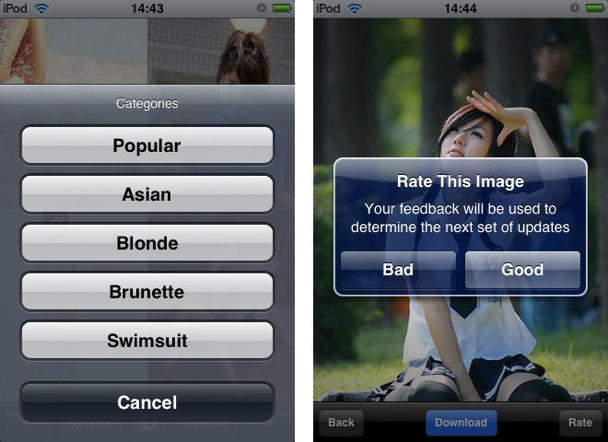
Apple has pulled Hottest Girls, the first iPhone porn app. Inappropriate apps containing pornography will not be approved in the future, Apple says.

Apple has spoken on the issue of porno iPhone apps, and it’s, ‘No way Jose.’

An Apple spokesman says the company will not approve iPhone apps with “inappropriate” content, especially pornography, despite the iPhone 3.0 age restriction system.

The question of porno apps arose after Hottest Girls appeared on the iPhone app store — the first app to feature saucy photos of naked women. Promising “2200+ sexy bikini babes and lingerie models,” the app is decidedly softcore. (The app disappeared for a few hours on Thursday, apparently because Apple had pulled it, but the developer had removed Hottest Girls voluntarily because of the strain on the image servers.)

Thanks to age restrictions in the new iPhone 3.0 OS software, mature apps can be blocked from download from the App Store. Many observers expected the App Store to be flooded with pornographic apps, especially because mobile porn is turning into big business. Juniper Research estimates the mobile porn market to be worth $3.5 billion by 2010. Growth will come from streaming video and video chat. The biggest market will not be the U.S., but Western Europe, Juniper said.

But now Apple says categorically it will not approve porno apps now or in the future. In a statement received by Cult of Mac, spokesman Tom Neumayr said:

“Apple will not distribute applications that contain inappropriate content, such as pornography. The developer of this application added inappropriate content directly from their server after the application had been approved and distributed, and after the developer had subsequently been asked to remove some offensive content. This was a direct violation of the terms of the iPhone Developer Program. The application is no longer available on the App Store.”