https://www.youtube.com/watch?v=Ah5S7R-h208
Here’s the promo video Steve Jobs just showed of during his WWDC keynote.

https://www.youtube.com/watch?v=Ah5S7R-h208
Here’s the promo video Steve Jobs just showed of during his WWDC keynote.

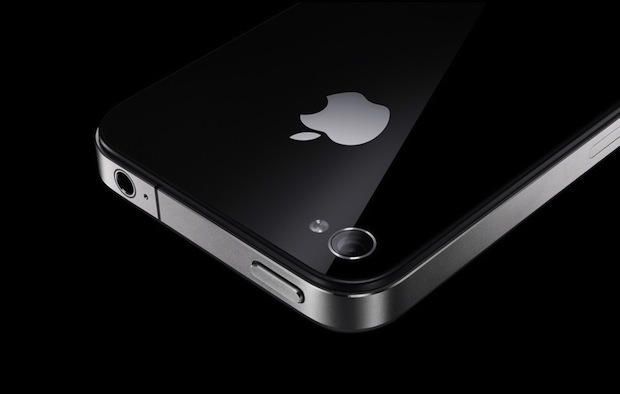
We’re 100% chugging the Kool-Aid on the iPhone 4 upgrade. What an amazing package:
We’ll be upgrading for sure, especially thanks to AT&T’s new upgrade plan.
What do you guys think?
https://www.youtube.com/watch?v=bmZkrdhOjeQ
It’s hard to remember when one of Steve Jobs keynote speeches WWDC had a glitch, but the Demo Gods weren’t smiling on Jobs today. Thanks to network problems, Jobs had to ditch on a demo because of Wi-Fi trouble. But maybe it’s not some luckless Apple engineer’s fault: The same thing happened to Google during its developers conference last month at the same venue.
[polldaddy poll=3312803]
As many of you know, the Steve Jobs keynote speech at the WWDC is going on right now. If you’re following along with our updates and updates from other sites, go join us on our Facebook page in the discussion section and post your thoughts, reactions, and comments about what he reveals today.
First, become a fan of the page, then join the discussion!
Here’s the link directly to our discussion forum on our Facebook page: Steve Jobs at the WWDC
On the eve of WWDC, a speculative story on mp3newswire.net suggests some interesting possibilities for Apple in the video and media space given the explosive adoption of iDevices:
In 1959 5,749,000 television sets were sold in the US, bringing the cumulative total of sets sold since 1950 to 63,542,128 units. This number supported, through advertising, three national television networks, ABC, NBC, and CBS (a fourth, Dumont, folded in 1956) and numerous local independent stations. Television was big business by the start of the 1960’s.
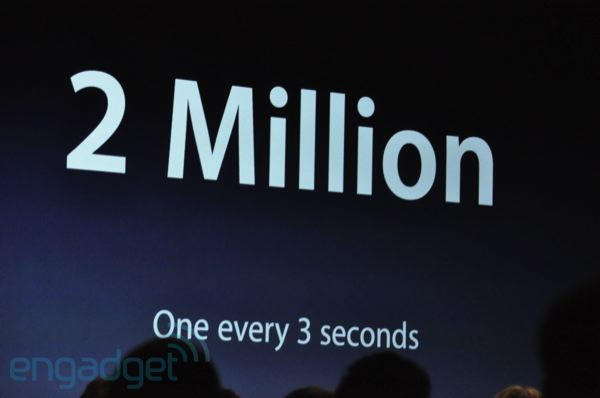
Now here are another set of numbers. As of April this year Apple sold 75 million iPhone and iPod touch units, devices capable of delivering video via Wi-Fi and 3G connectivity. Add to that figure 2 million iPads and counting. By the end of the year Apple should have about 90 million smart mobile devices in the wild.

As an indirect response to Adobe’s own We campaign, Apple has unveiled a wonderful new sandbox playground advocating HTML5, which allows users to play around and do a number of things in their browsers that they might not even know HTML5, CSS3 and JavaScript can do.
It’s a lot of fun as a playground, and certainly shows what HTML5 can do. The only problem? It’s only viewable on Safari: try to run it on any other HTML5-capable browser and you get a message prompting you to download Apple’s own browser.

Children are excellent arbiters of the truth, their reactions are honest and straightforward. In the case of the iPad, those reactions include excitement and awe.
Apple has noticed. After a group of students from Wesley Chapel, Florida was photographed trying out some iPads at their local Apple store, the images made their way to Apple. The company just sent 13 free iPads to some very lucky students, and may use the pictures in an upcoming ad campaign.
Kudos all around – a win for everybody here! Thanks to AppleInsider for the tip.
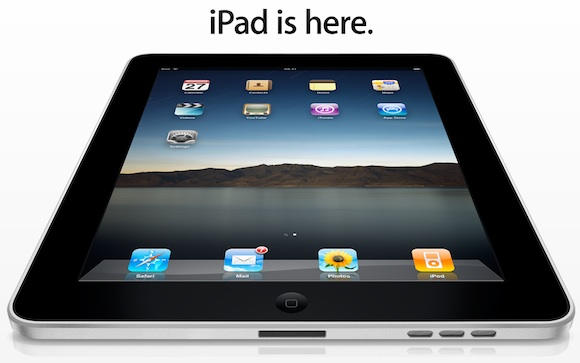
Despite offering tethering for laptops, AT&T will not allow you to tether your iPad to your iPhone.
An AT&T spokesperson told TechFlash “it won’t be possible to tether the iPhone to the iPad to share Internet access.”
Tethering your laptop to your iPhone — an option built into the upcoming iPhone 4.0 OS — will be possible via USB or Bluetooth. But the iPad’s Bluetooth profile for tethering is not enabled.
TechFlash: AT&T: No iPhone-iPad tethering
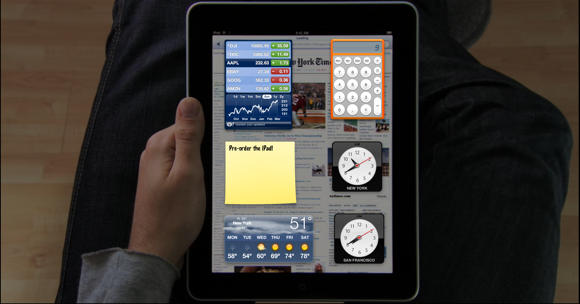
According to Apple Insider, Apple has started to cull programs on the App Store that offer Dashboard-like widgets to the user.
The most tangible evidence of the purge comes from Developer Russell Ivanovic, whose MyFrame app was removed by Apple for including widget support.
Going straight to Steve Jobs, Ivanovic received this reply: “”We are not allowing apps that create their own desktops. Sorry.”
Apple Insider speculates that this might be preparation work for Apple to introduce their own widgets in iPhone OS 4.0, although surely we’d have seen some evidence of that in beta form by now.
An equally valid reason Apple may be shutting dashboard apps down is because of their strict ban against interpretive code, which is essentially what a widget is.

This is a guest commentary by Shawn Ahmed, a anti-poverty campaigner. It was originally published here.
Last week, Apple surpassed Microsoft to become the world’s biggest tech company. As someone who used to spell Microsoft with a dollar sign, I can’t believe what I’m about to say: this is a bad thing for the world.
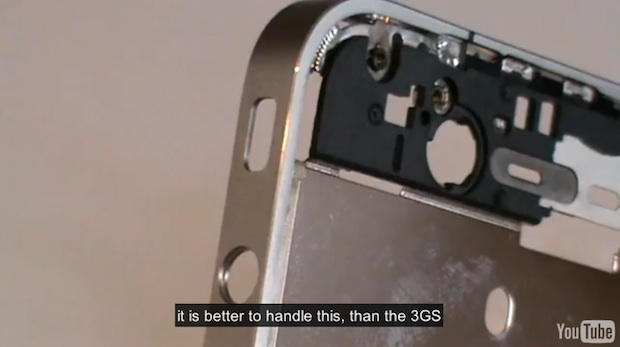
The iPhonePortugal website has posted two videos taking a closer look at the chassis of the new 4G iPhone. There are no surprises, but it is interesting to see how closely the industrial design of the iPhone 4G matches the iPad and new MacBook Pros.
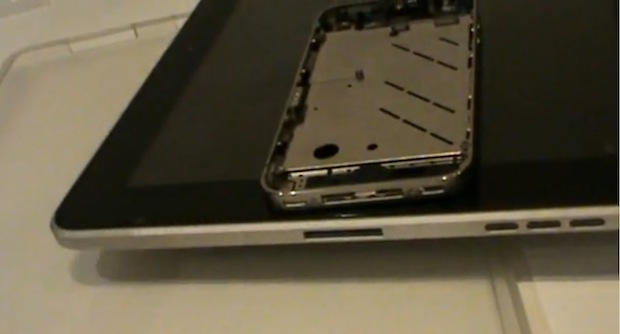
Like the white iPhone case showcased by PowerBook Medic, these seem to be spare parts, purchased in China. iPhonePortugal is at pains to point out the parts were obtained legally:
These parts were purchased in China by one of our readers (weren’t stolen or found) then delivered to us. We will not reveal the price.
Are those parts genuine? We can not know but we can tell for sure those parts are perfect, have no defects, not faulty at all, there is not even one single difference between the 2 copies we have.
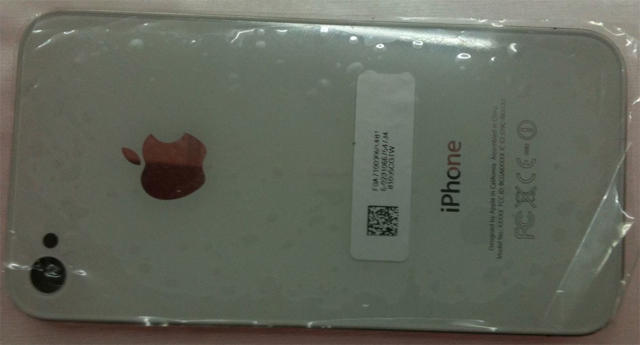
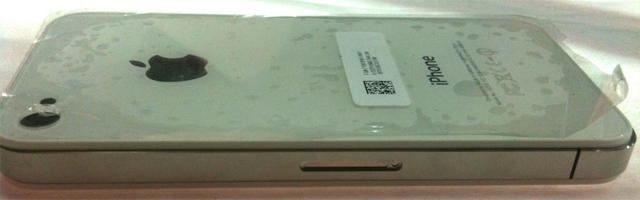
Rumors of a white 4G iPhone are long in the tooth, but here’s what appears to be proof that Apple will offer a white version of the next iPhone — photos of a white case that were sent to PowerbookMedic.
These are pictures of what appear to be spare parts –PowerbookMedic is a repair shop — but don’t appear to be the final versions. The text on the back is placeholder text. As well as the back case, PowerbookMedic also has images of a white front panel and some chassis parts.
The 4G iPhone is likely to be introduced at next week’s WWDC.
Anyone think white is becoming passé?
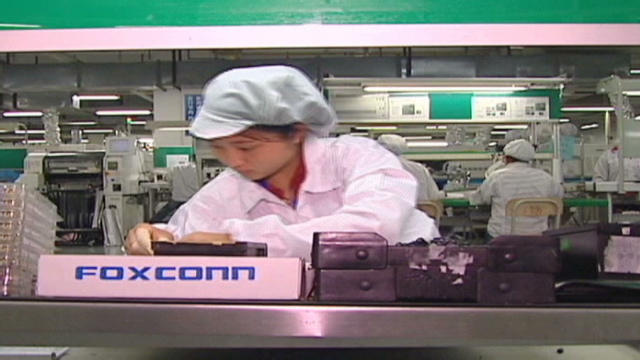
Although Steve Jobs seems to think the Foxconn suicides are being overblown, Apple’s “all over” the problem, a new email exchange reveals.
Responding to an Apple fan who forwarded Jobs an e-mail campaign protesting the way Foxconn workers are being treated in China, Steve responded:
“Although every suicide is tragic, Foxconn’s suicide rate is well below the China average. We are all over this.”

Whether in line with the national average or not, the recent slate of suicides at Foxconn has been a public relations nightmare not just for the Chinese electronics manufacturer, but for their partners as well.
Now, a report from Chinese site Zol.com.cn suggests that Cupertino might be taking the well-being of their subcontracted workers into their own hands: they claim that Apple will subsidize the wages of Foxconn employees working on their products with a profit-sharing scheme.
According to the article, Apple believes the main reason for the suicide jumps is low wages, and so they are prepared to offer roughly 1 to 2% of the profits of Foxconn-produced Apple products to the employees who have worked on them.
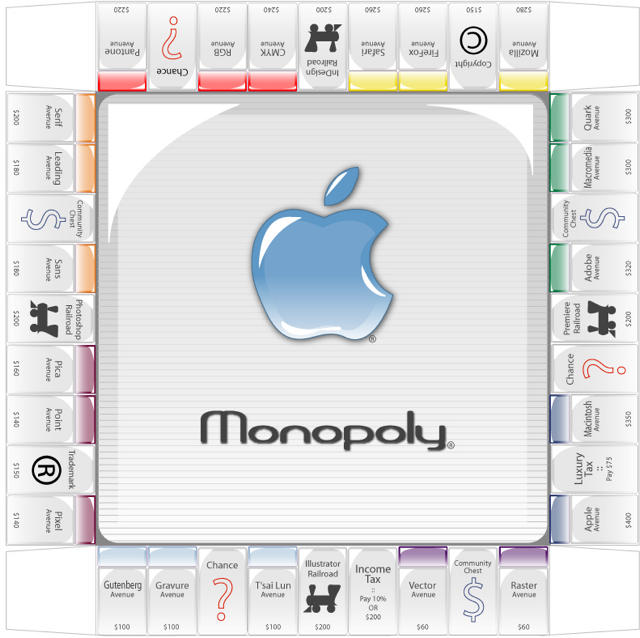
Uh oh. The Department of Justice just keeps on moving their anti-trust magnifying glass farther and farther away from Apple’s competition with Amazon, blowing up the pores on the whole iTunes apple skin. The DoJ is now reaching out to Hollywood as they investigate their anti-trust case against Cupertino.
According to the New York Post:
“The [Justice Dept.] is doing outreach,” said one Hollywood industry source. “You can’t dictate terms to the industry. The Adobe thing is just inviting the wrath of everybody.”
Added a senior source at a media company: “If Apple thinks it’s going to increase its monopoly with the iPad, it should look at the history of other walled gardens.”
While the DoJ is just “investigating” right now, an anti-trust case — scurrilous or not — is pretty much inevitable at this point: Apple is now the biggest tech company in the world, and since so many big, powerful companies are now smaller than them, they’re going to lobby to knock Apple down a few notches in whatever way they can.

The rash of suicides at Foxconn are not due to harsh working conditions but the plight of China’s migrant workforce, says an open letter signed by a dozen Chinese sociologists.
The letter blames the string of Foxconn suicides on the social problems faced by China’s vast class of migrant workers.
Originating from poor rural areas, Chinese migrant workers are often rootless and isolated, cut off from friends and family. Instead of finding good jobs in urban factories, they are often too poorly paid to settle in their new cities, and have limited access to education and healthcare. With no prospects at home, they are stuck. The sociologists call it the “path of no return.”
We have made them live a migrancy life that is rootless and helpless, where families are separated, parents have no one to support them, and children are not taken care of. In short, this is a life without dignity.
The sociologists note that at the end of 2008, the population of Shenzhen exceeded 12 million, but only 2.28 million were registered as permanent residents. The giant Foxconn plant, which employs upwards of 600,000 workers, is located in Shenzhen.
The sociologists call on Foxconn and the Chinese central government to boost wages, and improve access to housing, eduction and healthcare. They also say demand workers be given a “voice,” which presumably means unions.
We call on every enterprise, to make a conscientious effort to increase migrant workers‘ pay and rights, and allow migrant workers to become true “citizens of the enterprise”.
Here’s the full text of the open letter:

Fake Steve tears down bullshit claims that the Foxconn suicides are below China’s national average (see Fast Company, ZDNet, Daring Fireball, Wall Street Journal, Alley Insider and others).
Working together with our colleagues in the PRC’s propaganda ministry we have developed a great new counter-narrative that we’ve been pushing pretty hard in background conversations with friendly hacks. Basically it’s the notion that Foxconn’s suicide rate is actually below the national average of China, meaning that if you’re working at Foxconn you’re actually less likely to commit suicide. That’s right. The truth is, we are actually saving lives in China.
Fake Steve continues:
But, see, arguments about national averages are a smokescreen. Sure, people kill themselves all the time. But the Foxconn people all work for the same company, in the same place, and they’re all doing it in the same way, and that way happens to be a gruesome, public way that makes a spectacle of their death. They’re not pill-takers or wrist-slitters or hangers. They’re not Sylvia Plath wannabes, sealing off the kitchen and quietly sticking their head in the oven. They’re jumpers. And jumpers, my friends, are a different breed. Ask any cop or shrink who deals with this stuff. Jumpers want to make a statement. Jumpers are trying to tell you something.
Fake Steve: Our new spin on the Foxconn suicide epidemic
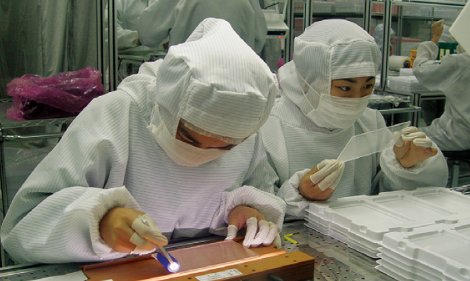
Although still lower than the national average, Apple’s manufacturing partner Foxconn’s worker suicide problem is becoming such a public relations nightmare, so it’s understandable that their announced plan to raise wages for about 420,000 factory workers is being seen by many as a way to mitigate worker deaths.
The pay raise is substantial: each worker will currenly earning $131 a month will get a 20% pay hike. On Foxconn’s part, they claim the pay hike has been planned for some time… but it’s hard to believe the recent publicity about worker conditions hasn’t, at the very least, pushed this plan onto the fast track.
Employees seem hopeful. “[The pay hike] may help the suicide situation, because we workers just need money and the financial pressure on us is great,” one worker said.

“It is a long game,” Microsoft CEO Steve Ballmer told reporters on Thursday in response to Apple overtaking his company on the stock market. “We have good competitors but we too are very good competitors.”
He added: “I will make more profit and certainly there is no technology company on the planet that is as profitable as we are.”
“Let’s see what happens as I am still pleased that 94 times out of a 100 somebody picks a Windows PC,” he said.
Microsoft shares closed at $25.01 on Wednesday, giving it a market cap of $219.18 billion. Apple closed at $244.05, a market value of $222.07 billion.

The Windows era is over announces Joe Wilcox at Betanews. Is it?
He certainly makes a compelling argument. Like other tech behemoths before it, Microsoft’s products are simply being rendered irrelevant by new technologies, new ideas, and new products that have come out of the blue and swept them aside.

The Asian electronics giant Foxconn is in full damage control mode after yet another suicide at one its giant Chinese factories, which cheaply pump out electronics for Apple and others. But one of the company’s representatives made an unfortunate statement when talking about the conditions at its factories:
“There is a fine line between productivity and regimentation and inhumane treatment,” said Louis Woo, an aide to Mr. Gou at Hon Hai. “I hope we treat our workers with dignity and respect.”
But of course, that’s not true at all. There’s a huge difference between productivity and inhumane treatment, not a “fine line.” And it’s that gap that makes all the difference.
Foxconn has a reputation for a stressful and oppressive work atmosphere. Employees are paid relatively well, but are pushed hard to produce and are not allowed to talk to each other during work, according to reports. The work is repetitive, mind-numbing and robotic. Stress, isolation and hopelessness: it’s a recipe for trouble.
Apple and the other tech companies that are Foxconn’s customers must bear some responsibility here. It’s time Apple stepped up its annual audit of contractors and lived up to its promise of “ensuring the highest standards of social responsibility.”
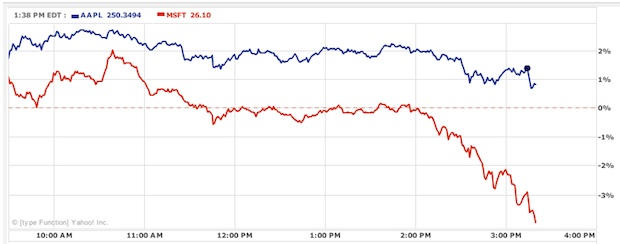
In one of the biggest and unlikeliest turnarounds in business history, Apple is the most valuable company in technology, passing Microsoft in market capitalization.
Apple’s market cap has passed $227.1 billion — ahead of Microsoft’s $226.3 billion. Apple is up about 1.8% today, and Microsoft down about 1%.
Of course, this may change tomorrow, but for the moment, Apple is the new king of technology.
What a difference a decade makes, when Apple was on the ropes and Microsoft look unassailable. Now, Apple is clearly at the forefront of the next huge wave in tech: mobile. Microsoft isn’t even in the game.
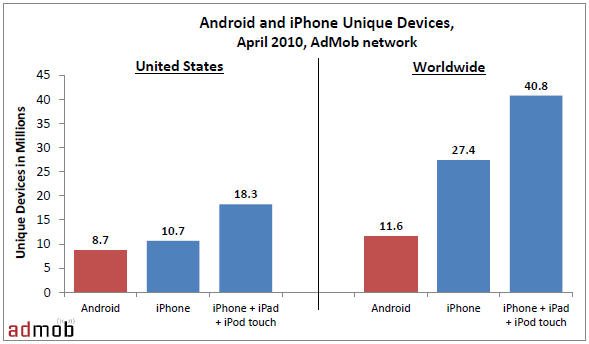
There are twice as many iPhone OS devices in use as Andorid devices, the mobile advertising company AdMob estimates.
AdMob’s April Mobile Metrics report analyzed the number of unique Android and iPhone devices in its network. The company found that in the US, there were 10.7 million iPhone devices and 8.7 million Android devices. Include the iPod touch, and there are 2 to 1 iPhone OS devices compared to Android. Overseas, the gap is even wider: 3.5 to 1 iPhone devices compared to Android.
The numbers are illustrative because both platforms are growing fast, but there little idea how many are in day-to-day use. For example, Apple has sold 85 million iPhones and iPod touches in the last three years, but doesn’t say how many are in use. At its recent developer conference, Google boasted that it is activating 100,000 Android devices a day. Gartner estimates that Apple’s OS now powers 15.4 percent of global smartphones, while Google’s Android has 9.6 percent of the market.
AdMob says its numbers are good beceause they are based on actual data, not estimates, and it has a large sample size.