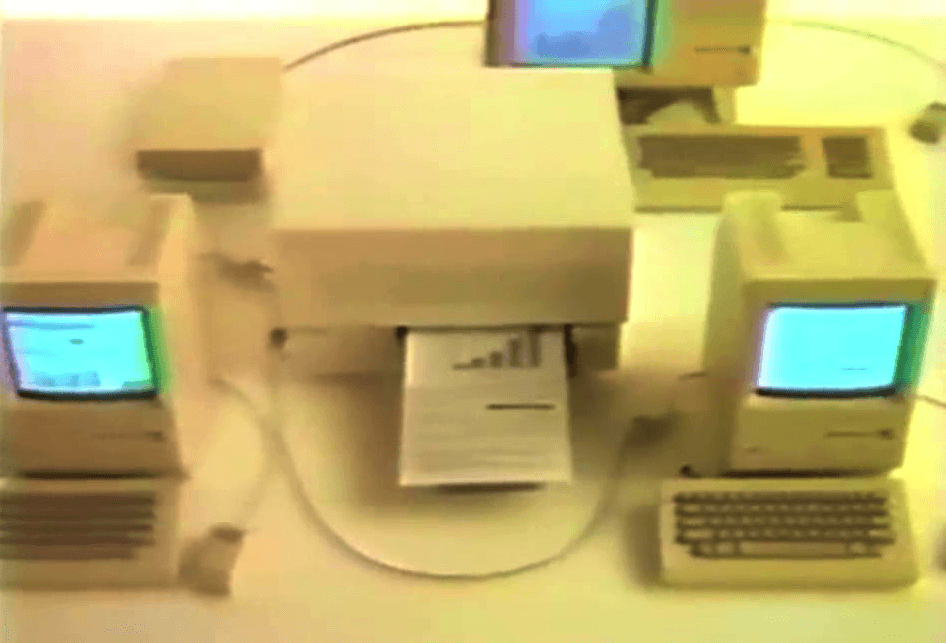
 January 23, 1985: Apple introduces The Macintosh Office, a combination of hardware and software that represents the company’s first real attempt at cracking the business market dominated by IBM.
Macintosh Office allows Macs to talk to one another. And Apple introduces amazing new devices like the LaserWriter printer that work with the business-oriented platform. Sadly, things won’t work out quite as Apple hopes.
The Macintosh Office: Personal computers come of age
The need for Macintosh Office speaks volumes about the way the personal computer world evolved during its first decade.
When hobbyist machines like the Altair and, later, the Apple II, began shipping in the mid-1970s, few people seriously thought personal computers deserved a place in the business world. Machines aimed at home tinkerers, these early personal computers held little appeal for people working in big companies with access to IBM mainframes.
By the early 1980s, however, things had changed. IBM entered the PC market. And software like the Apple II’s “killer app” VisiCalc showed that personal computers served a very different — but still important — purpose.
Slow start for the Macintosh
When it arrived in 1984, the original Macintosh took personal computers one step further. But despite the buzz the Mac created, sales proved disappointing. A year after the launch, Apple had only sold 250,000 Macs. Worse yet, developers often overlooked Apple’s computer because of its relatively small reach.
Macintosh Office was an attempt to change that. On January 23, 1985, Apple announced the AppleTalk Personal Network and LaserWriter printer, the first of numerous products that (the company promised) would fall under the Macintosh Office brand.
Costing $50 per connection, AppleTalk allowed Macs to share peripheral devices. It let up to 32 computers and peripherals talk to one another within work areas of 1,000 feet.
LaserWriter launches desktop publishing revolution
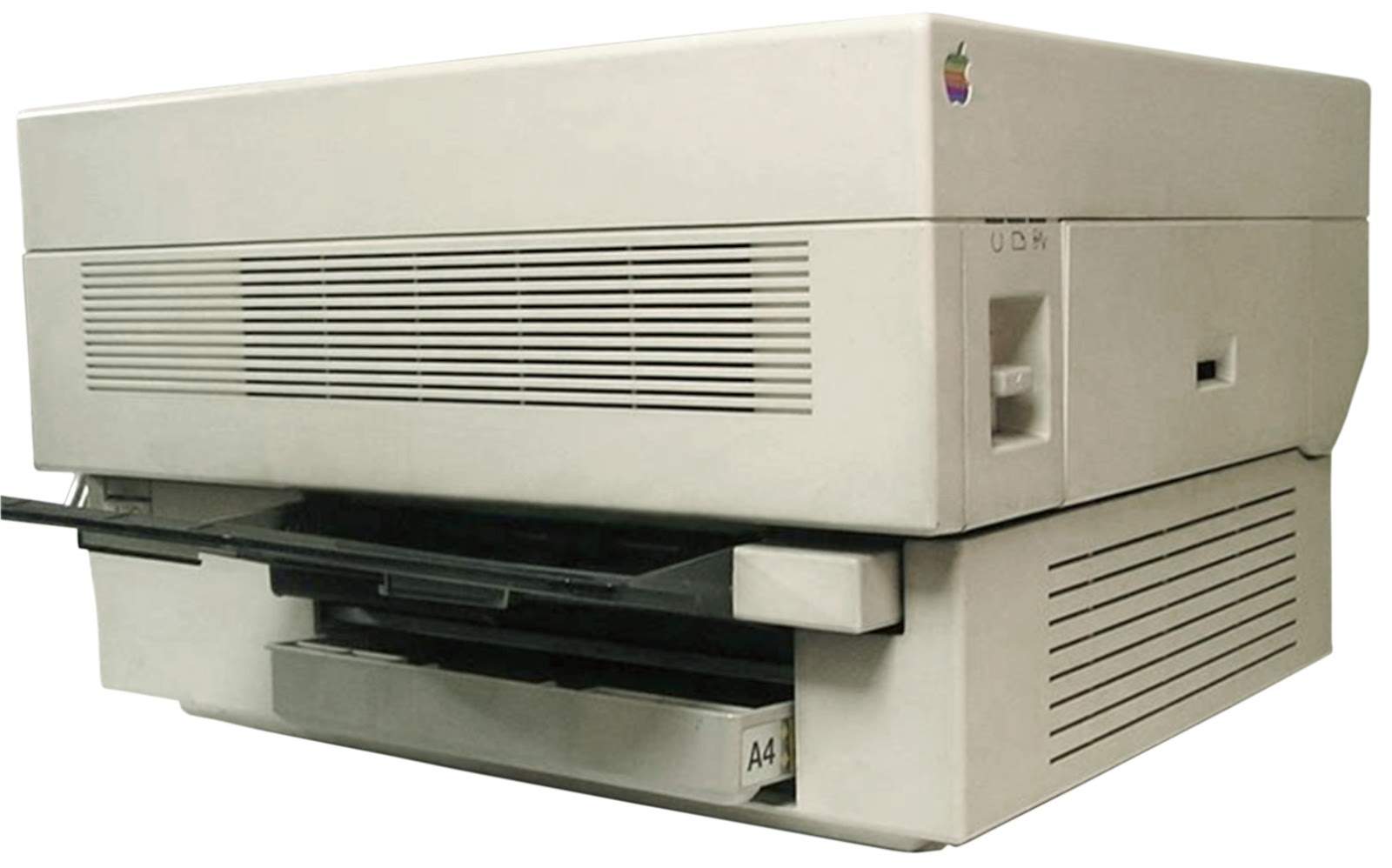
Photo: AppleTimeline
This connectivity, in theory, would make it feasible for Apple to produce Macintosh Office products like the $6,995 LaserWriter (the equivalent of more than $21,000 today), with the rationale that dividing that cost among multiple users would make it a far more attractive option. Apple promised that the LaserWriter would be the first of many great products that would be similarly shareable among large groups of users.
The LaserWriter stood out as a (relatively) super-fast laser printer in an age of dot-matrix printers. More importantly, the LaserWriter allowed users to print exactly what they saw on their screens — a massive breakthrough in 1985. And the LaserWriter worked well alongside Aldus’ PageMaker, early desktop publishing software that appeared around the same time.
Finally, Apple announced that Macintosh Office also would include a file server, with 20MB-to-40MB capacities. It would allow files and emails to be transferred among Macs.
So did Macintosh Office work?
To owners of personal computers in the 1980s, all of this sounded astonishingly futuristic. To put things in perspective, the Mac offered a crazily ahead-of-its-time graphical user interface. With the Macintosh Office, these computers could talk to one another and even share similarly advanced hardware peripherals. (Remember, Wi-Fi didn’t exist at the time.)
All these technological advances enabled a version of Apple co-founder Steve Jobs‘ later “digital hub” strategy.
However, things did not pan out quite as planned. AppleTalk promised the capability to connect machines without the need for a centralized router or server. Mac users could easily set up a network and then maintain it without much difficulty. Unfortunately, AppleTalk’s transfer speeds were very, very slow — about 1/10th the Ethernet speeds developed at Xerox PARC in the 1970s.
Apple also failed to achieve the type of success with the LaserWriter that would let the company launch a slew of other high-cost, high-end shareable hardware accessories. (However, Apple did release the LaserWriter II in 1988.)
Additionally, the file network suffered from big delays. (It didn’t ship for several years after Cupertino’s announcement.)
Last but not least, Apple launched Macintosh Office with the disastrous “Lemmings” ad. That unfortunate follow-up to the fantastic “1984” Macintosh commercial lent the stench of failure to a project that doesn’t deserve to be remembered like that. Particularly since it helped launch the desktop publishing revolution.
Did you use the Macintosh Office?
Do you remember the Macintosh Office? Were you running a company with Macs, or working on them in a business capacity, in the mid-1980s? Leave a comment below.

Luke Dormehl is a U.K.-based journalist and author, with a background working in documentary film for Channel 4 and the BBC. He is the author of The Apple Revolution and The Formula: How Algorithms Solve All Our Problems … and Create More, both published by Penguin/Random House. His tech writing has also appeared in Wired, Fast Company, Techmeme and other publications.

5 responses to “Today in Apple history: Macintosh Office gets down to business”
AppleTalk was extremely cool at the time. I set up a school with shared folders and so-on, including a system where grade level teachers could save student writing projects and photos / art in folders that could be accessed by the teacher in charge of school publications for all grade levels, who would then view student work by grade, copy selected items to a staging folder, and then access the selected items to drop into a Word doc that she used for creating a twice-a-semester publication for the school.
Yes, it was slow by today’s standards, but it was very cool, particularly for a small business or home office. Back then I used to run a couple of Macs and a nice HP printer over AppleTalk. All you needed was a couple of cheap adapters and a couple of RJ-11 telephone cables.
It was shortly after this that Apple started building 100-baseT into motherboards of the machines.
I had a blast setting this up at home … I wired each room so that the entire family was connected – to each other, to a LaserWriter printer — and I could administer the network using my LC. Fun project. Yes, by ethernet standards it was slow, but fast enough to get the job done. Fun times!
I agree that by the standards of the time Appletalk network speeds were just fine for a small office. Remember those were the days when a 1.4k floppy disk was still pretty cool.
And networking was easy! Combine a couple of Macs, a laser printer (the HP 4m+ was the ticket!), some PhoneNet connectors and some plain old phone wiring, and we were good to go!
I remember using AppleTalk. Yes it was slow but for most of the buildings I was in Ethernet was a fantasy. It was quirky and in hindsight a bit weird, but it beat the heck out of “sneaker net”. A bunch of us on the U of MN campus used a DA called Broadcast. It let you send a three line text message to any other computer that had Broadcast on it. Amazingly cool for the time.
Once again Jobs/Apple tried to corner the market with proprietary networking, whilst TCP/IP proved to be the open medium that took account of the field. Thus the failure of the Macintosh Office.