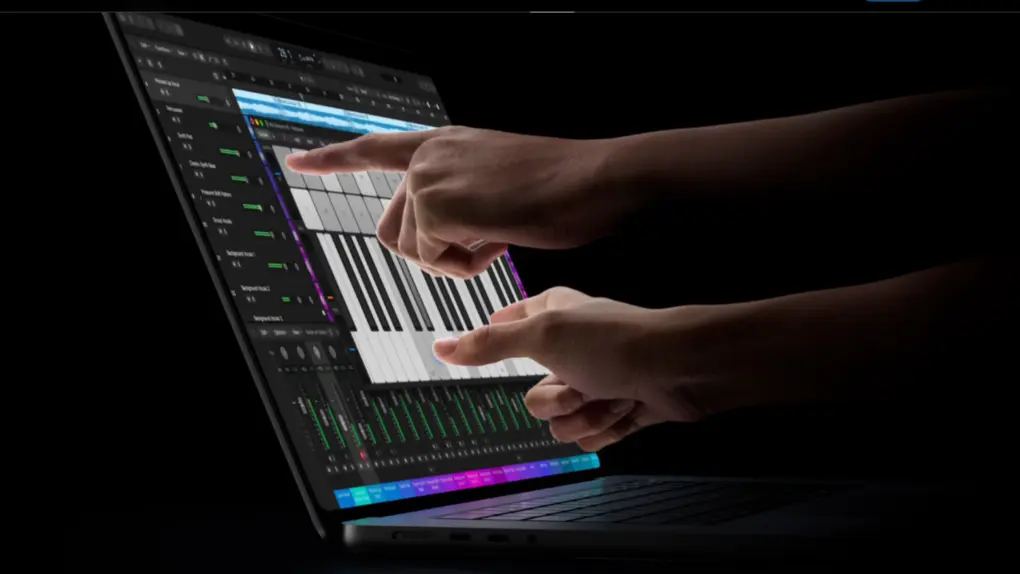
Apple might add touchscreens to all its high-end MacBook Pros next year, leaving only the entry-level 14-inch model with a traditional display.
The rumor that Apple will make touch standard on every MacBook Pro with a Pro or Max chip comes just days after the company unveiled its first touchscreen MacBook Pro.
Apple’s non-touch MacBook Pro lineup is shrinking
Apple claimed for years that adding a touchscreen to a Mac would be some sort of abomination. But that went out the window last Wednesday when the company unveiled the awkwardly named MacBook Pro with PROLED XDR Display.
The first touchscreen Mac comes with a lighter, thinner design and either M5 Pro or M5 Max processors inside. However, Apple left non-touchscreen versions of the MacBook Pro with those same processors, introduced earlier this year, in its expanded product lineup.
Bloomberg’s Mark Gurman reported on the plan to slim down MacBook Pro options in his Power On newsletter Sunday. He predicted Apple will phase out the non-touch M5 Pro and M5 Max models when second-generation touch MacBooks arrive in 2027. Gurman previously said those second-generation models will run on M7 Pro and M7 Max chips with advanced AI capabilities.
The entry-level 14-inch MacBook Pro is said to be the exception. It will move to the base M7 chip and adopt the thinner, lighter design with slimmer bezels, but won’t add a touchscreen. That model currently runs an M6 chip and starts at $1,999.
The first touchscreen MacBook Pro costs $400 more than non-touch version
The new touchscreen MacBook Pros come with a tandem OLED display. Apple also replaced the screen notch with a Dynamic Island (although the laptops lack Face ID).
The 14-inch touchscreen model with M5 Pro chip starts at $2,899, while the 16-inch version starts at $3,399. The touchscreen configurations cost $400 more than the matching non-touch models.
Although Apple made the PROLED models thinner and lighter, hardware changes to support touch seem modest at best. The display doesn’t fold back to be used like a tablet, and the laptops lack Apple Pencil support. Apple did redesign the hinge to make the screen steadier when you tap, though. And you also get video stabilization to smooth the camera feed during calls.
Why Gurman says touch might take over MacBook Pro
Gurman says he’d be surprised if Apple kept making non-touch versions of its high-end laptops. Managing two sets of Pro and Max MacBook Pros burdens Apple’s engineering, marketing and manufacturing teams, he says. With prices just $400 apart, convergence makes sense.
He adds that making all Macs touchscreen poses little risk to iPad sales. Nothing in the touch Mac would stop someone from buying an iPad, and closer ties between the two might push more people to buy both.
Plus, Apple marketing chief Greg “Joz” Joswiak says the younger crowd — which grew up using iPhones in a touch-centric world — views a touchscreen as basic functionality.
“Most pros own an iPad, and almost every pro owns an iPhone,” Joswiak told Wired after the touchscreen Mac launched. “So this is something that they’re natural with. There’s a generation of young creators and young people using our MacBook Pros that expect to touch.”
Open for preorders now, the touchscreen MacBook Pro with PROLED XDR Display will come to stores and arrive at customers’ doors this Friday.

Anurag Chawake is a tech-focused writer specializing in smartphones, apps and consumer technology. His interest in computers began during the Windows 98 era, eventually leading him to explore everything from operating systems to mobile devices and PC hardware. Anurag previously contributed to The Indian Express, covering Apple, Android, gaming and the broader technology landscape.