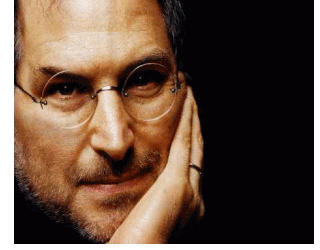
Steve Jobs New Yorker Cover Art
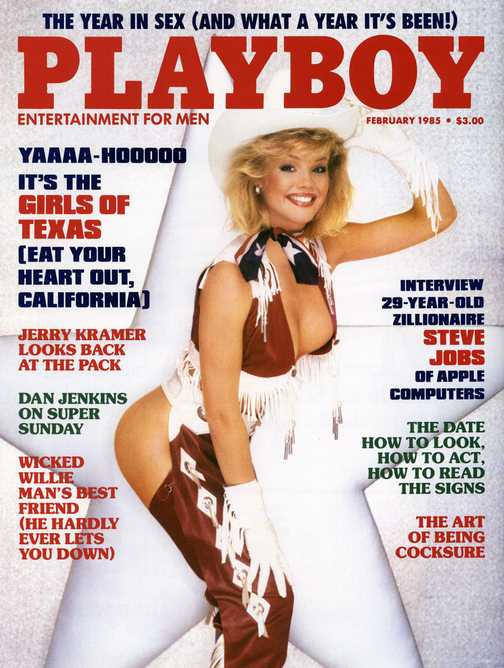
Back in the dark mists of Time before the internet, Playboy magazine was among the more popular media vehicles serving up a stimulating cocktail of news, opinion, creative writing, gadget reviews and naked flesh. And over the years, the Playboy Interview gained quite a reputation for getting the most interesting newsmakers and personalities of the day to open up about their lives and philosophies in ways other mainstream publications could never quite match.
The Playboy interview with Steve Jobs was published in the February 1985 issue of the magazine, just a little more than a year after the debut of the Macintosh and a few short months before the Apple CEO would be ousted from the company he helped found. The long piece finds a 29 year-old Jobs at the top of his intellectual game and elicits commentary that, looking back on it now, makes Jobs appear both prescient and consistent in his views and in his dedication to Apple’s success.
Follow after the jump for a few choice comments from the interview and be sure to click through to the full piece from the Playboy archive.
Via Edible Apple
Times they have changed: a quarter of a century ago, reporter Michael J. Miller was on the West Coast bureau of Popular Computing. (Now he blogs for PC mag.)
A few choice extracts about his trip down to Cupertino to see the first Mac:
“I met with Steve Jobs, who was then Apple Chairman and heading up the Mac project, along with key designers including Burrell Smith, the original hardware designer and software designers Andy Hertzfeld and Bill Atkinson.”
“Most of the time I was meeting with other members on the team, but I remember Jobs coming in — he was very charismatic: intense, proud of the work and a bit prickly about any criticism. He and his folks were quick to put down the IBM PC and its clones for not pushing the envelope and settling for “mediocrity.”
“Jobs and the team were rightly proud of the new machine, which was very different from the IBM PC that then dominated the industry. Maybe it was the famous “Steve Jobs Reality Distortion Field,” but even then I was entranced by the new machine and the possibilities it offered – particularly the graphical user interface.”
Miller’s trip down memory lane — complete with anecdotes about the Mac II, Apple’s first laser printer and the role of industrial design at Apple — is well worth a read.
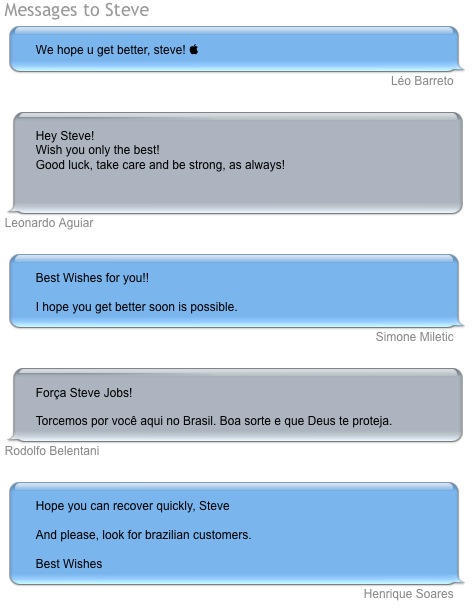
I can’t decide if this is a delightful sign of the caring Mac community, or if it’s a sickening sign of people who can’t just leave a sick man alone.
Look, over here: it’s Prayers for Steve. Except most of them aren’t prayers, most are simply “Get well” messages. You can add yours. There are, of course, Google ads at the bottom. Could be worse: they could be plastered all over the top and sides too.
I don’t know, maybe I’m being too grumpy. Is this a good idea? You tell me.
Image via Flickr, used with permission
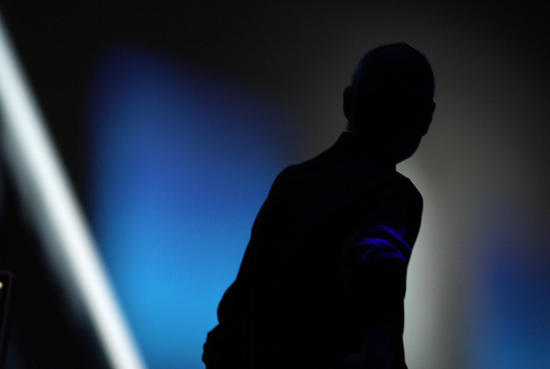
Steve Jobs is in a no-win situation right now. Either he’s healthy and he keeps coming to work every day and the question on everyone’s mind remains, “is Steve really healthy?” or, he’s not healthy and he takes some time to go get better, and the question on everyone’s mind remains, “how long is Steve going to live?” In either case, Apple is deprived of the singular focus of its driving force; in either case no one stops wondering about his health.
Many hope beyond hope that Jobs will regain his health and his drive and his focus, that he will return to Apple this summer, or sometime, and lead the company to many more years of innovating and producing products that “put a ding in the universe.”
Some believe his decision Wednesday to absent himself from the day-to-day operations at Apple signals the beginning of the end, that he is taking time to spend with his family and to prepare for his inevitable death coming sooner rather than later. And many wish him all the peace and comfort he can find in the love of those closest to him if such should indeed be the case.
What’s certain is there will be oceans of ink poured into writing about Steve Jobs and the unique place he has made for himself in his life and times. Whether he dies tomorrow or lives another twenty, thirty, fifty years, he has assured for himself a legacy of renown unlike anyone of his generation.
He’s been called a tyrant and a diva, a rock star and a king – and such superlatives are not out of proportion to the impact he has made on the way people live, not only in contemporary times, but on the way people will live long after he is gone.
I saw on Wednesday a piece about Jobs, written by music industry analyst Bob Lefsetz, who laments his feeling Jobs’ demise is imminent, saying his death “will be like the loss of Lennon. We will feel collectively that we’ve lost something that can’t be replaced.” And I have no doubt many will feel that way.
But the fact is, music didn’t die with the passing of John Lennon, as sad and incomprehensible as his death was, and as big and unfixable a hole as there seemed to be in his absence. His work lives on, for one thing, but also his example and his influence continue to inspire songwriters and musicians a generation later. The John Lennon Educational Tour Bus, ironically, had a prominent place just a week ago at Macworld, where Jobs’ presence was so sorely missed.
The day Steve Jobs dies may seem, as Lefsetz wrote, “like one of those great teen songs, where the lover dies and the singer just can’t move on.” But, like Lennon, his work will also live on. His example and his influence will continue to inspire people in many walks of life, I daresay, for generations to come. And that is something to be happy about.
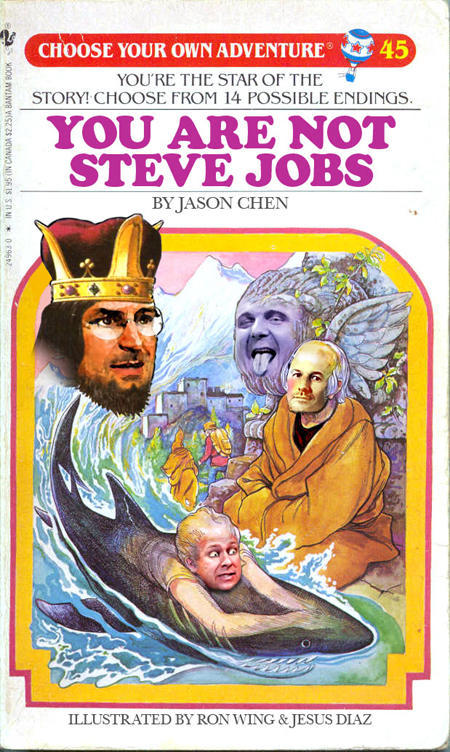
Back in December, Gizmodo blogger Jason Chen put up an entertaining spoof of the iconic children’s book series Choose Your Own Adventure, in which the game is to pick Apple’s next CEO.
Perhaps you saw it. Even if you did, my guess is that you didn’t think it was quite as poignant then as it seems today. Chen probably didn’t think, either, his post might enjoy the second life it’s getting out of Jobs’ announcement Wednesday that he’ll take a leave of absence from day-to-day Apple affairs until June.
It is clever, and it’s fun, and everyone can use a little adventure now and then.
Via Gizmodo
Photo: James Merithew/Wired.com
While I was researching Inside Steve’s Brain, I read everything I could lay my hands on about Steve Jobs, including just about every book and magazine article published in the last couple of decades. One of the most striking things was how many times Jobs mentioned death as the driving force in his life.
Over and over Jobs said he was driven to make an impact before his time ran out.
It was such a recurrent theme, I thought of devoting an entire chapter to the subject in the book. Jobs had an obsession with death to rival Emily Dickinson’s.
Even in his twenties, Jobs obsessed about death. He told former Apple CEO John Sculley he was convinced he would live a very short life and urgently needed to have an impact before he died. Sculley thought this was why he was so driven and ambitious, according to Sculley’s autobiography. Of course, Jobs lived much longer than he suspected.
Best known perhaps, are Jobs comments during his 2005 commencement speech at Stanford:
“Remembering that I’ll be dead soon is the most important tool I’ve ever encountered to help me make the big choices in life,” he said. “Because almost everything all external expectations, all pride, all fear of embarrassment or failure – these things just fall away in the face of death, leaving only what is truly important.”
It’s comments like this that makes me pessimistic about today’s news that Jobs is stepping aside, even if he claims it is only temporary.
For the last four decades, since Jobs cofounded Apple in his bedroom, he’s worked like a horse — rising early, taking short vacations, avoiding parties and sacrificing holidays to prepare for Macworld.
Work and family — that’s all he does.
I think he’s now focusing on his family.
I hope it’s not the case, but I suspect Jobs will not return to Apple.
Today’s announcement makes me think he’s focusing on “what’s truly important” — his family.
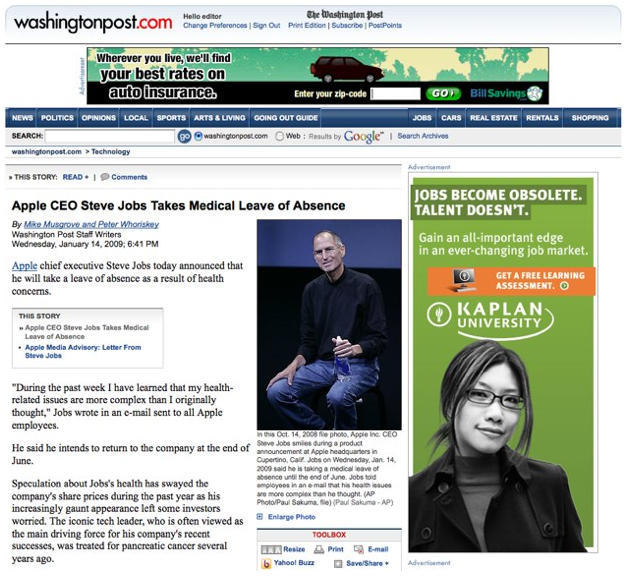
The ad targeting algorithm they use over at the Washington Post has either got a sick sense of humor baked-in, or perhaps the instance of the ad running with the story above is a stone cold coincidence. Either way, it’s a chance to seek levity in a bit of a heavy moment for the Apple community.
Godspeed, Mr. Jobs.
Via TechCrunch
“Dear Apple Community,”
“For the first time in a decade, I’m getting to spend the holiday season with my family, rather than intensely preparing for a Macworld keynote.
“Unfortunately, my decision to have Phil deliver the Macworld keynote set off another flurry of rumors about my health, with some even publishing stories of me on my deathbed.”
→ You journalists are assholes too.
In an open letter addressed to the Apple Community, Steve Jobs said Monday that he has an easily treated hormonal imbalance. The statement, designed to quiet rumors spurred by the Apple CEO’s increasingly gaunt public appearances, came a day before a high-profile keynote at Macworld Expo that Jobs handed off to a colleague.
“A hormone imbalance … has been ‘robbing’ me of the proteins my body needs to be healthy,” Jobs wrote. “Sophisticated blood tests have confirmed this diagnosis.”
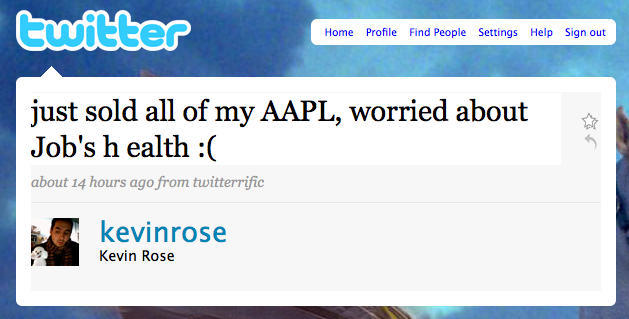
Digg founder Kevin Rose announced his concern for Steve Jobs’ health Tuesday, but there’s always a subtext to such public displays of empathy. We’re not sure what it is in Rose’s case, but a few guesses are he:
a) puts way too much stock in what he reads on Gizmodo
b) is more worried about getting publicity for his own Internet venture
c) is a typically clueless amateur money manager
d) lives to see his name on the Internet
e) all of the above
On top of which, he’s either a very careless typist or an embarrassingly poor speller.
The kind Apple fanatics at iPhone Savior have done the great public service of creating Apple and Steve Jobs-themed Christmas eCard templates and posted them over at Flickr for anyone who still has a few last minute greetings to get out.
You can use a pre-made card like the one above, or choose from two styles of hi-res blank cards and add your own graphical text message to express your holiday sentiments and your love for all things Apple in the same vehicle.
As they put it over at iPhone Savior, “Sincerely wishing everyone an iPhone 3G for Christmas and some sweet dreams of Steve.”
Via iPhone Savior
I’m a shy and retiring Englishman, so tooting my own horn doesn’t come naturally, but my brash American wife insist I post this: USA Today named Inside Steve’s Brain, my book about Steve Jobs, one of the best business titles published in 2008.
Says USA Today:
“Offers insightful nuggets on Steve Jobs, who helped create personal computers and digital music while moonlighting as a modern-day Walt Disney at animation studio Pixar.”
Link: Year’s best: These books meant business in 2008
Links: Inside Steve’s Brain on Amazon, Barnes & Noble, and 800CEORead.
Every time I say this, some people start getting all shirty and saying: “Yes it is! Steve matters!”
After my Don’t Panic post yesterday, there were similar comments, like this one: “Yeah, actually Steve Jobs health is our business. He made Apple, he revived Apple and he brought Apple to it’s current massive success. Steve Jobs IS Apple. Without him the company has a far smaller chance of survival.”
I completely disagree with this line of thinking, and here’s why:
Politics, not platelets, are why Steve Jobs is turning over the Keynote responsibility to Phil Schiller at next month’s Macworld Conference & Expo, according to CNBC correspondent Jim Goldman.
Citing “sources inside the company,” Goldman writes that Jobs’ demurral from the Keynote address for Apple’s last appearance at the venerable trade show in San Francisco is assuredly not a product of any inability on his part to perform for health reasons, but is rather a result of the company’s “trying to separate itself from Macworld for some time.” Amid the growing trend of big companies scaling back participation in traditional trade shows world wide, Apple has also in recent years taken the lead in producing its own product release events, such as the ones that introduced the company’s new iPods this summer and new notebook computers in the fall.
Apple also directly reaches millions of visitors who come weekly to its growing chain of world-wide retail stores, and millions more who receive the company’s carefully designed and controlled messaging through visits to the company’s iTunes stores.
Knowing how the Apple-interested universe’s collective pulse begins to race with every inkling of Jobs’ mortality, it’s no surprise to see Monday’s announcement generate lots of speculation and extra volatility in the movement of the company’s stock price. As Goldman writes, however, the party to be concerned about is not Jobs, and not Apple, but Macworld. For some time now it’s been fashionable to imagine scenarios about Apple in the inevitable post-Jobs era. But will there even be a Macworld in the post-Apple era?
Just in time for getting a little bit of the backstory before the 25th Anniversary of Mac kicks into high gear, Computer Shopper has a great look back at the very early years of Apple Computers by Editor in Chief Emeritus Stan Veit. We’re talking early enough that Steve Jobs was willing to give away 10% of the company for $10,000, according to Veit.
The long article is well worth a read for Veit’s inside take on the two young, “long haired hippies and their friends” who eventually revolutionized the world. It’s not an especially flattering portrait of Jobs, though it’s had plenty of company on that score over the years. The article does contain some great early pics of Jobs and Woz and some of the earliest Apple gear.
Via Edible Apple
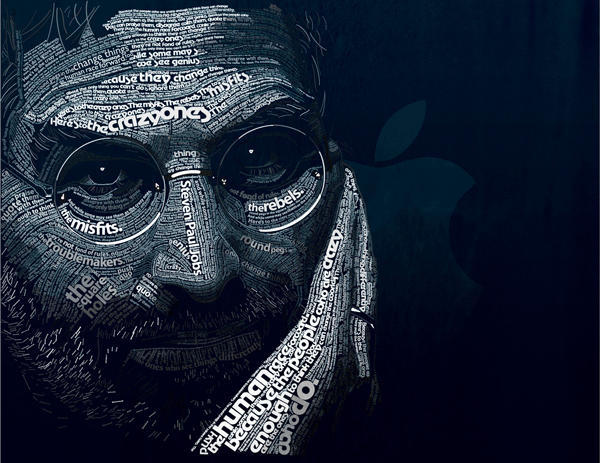
Image © Charis Tsevis
UPDATE: With thanks to reader James of RetroMacCast, credit is due to the original creator of this and many other wonderful mosaix-technique portraits, Athens, Greece-based artist, Charis Tsevis. You can download and listen to a podcast interview with Tsevis here.
Flickr user mic.imac has a fascinating portrait up of Steve Jobs, comprised entirely of artfully arranged Apple products. The portrait echoes a theme that runs through the upcoming Welcome to Macintosh documentary my colleague Nicole Martinelli wrote about on Monday, which is that the people who work at Apple give themselves entirely to the work of designing and producing the products the company makes.
Of no one is that statement more true than Steve Jobs. As CoM founder Leander Kahney says in the documentary, “Apple is Steve Jobs.”
Tonight’s episode of The Simpsons had fun at the expense of Steve Jobs and Apple fans everywhere.
Via Edible Apple
There’s loads of wonderful stuff in the Google LIFE photo archive, and Gruber’s warning is apt indeed: it’s a time-sink.
Needless to say, Apple has a presence within that archive.
How many times has Steve appeared on the cover of Time? Five, it seems: once in the early days, a second time in a candid shot, the third time with the first gen iMac, next reflected in the screen of a G4 iMac, and finally as the man who knows what’s next.
Earlier this week I seem to have touched a chord with a post about Tony Fadell’s “transition agreement” and the reimbursements Steve Jobs gets from Apple for expenses incurred in the operation of his private plane.
Several readers took me to task for illustrating the post with a hastily-cadged, photoshopped fake of a Gulfstream jet with a big Apple logo on it, which is fair enough, if somewhat lacking in the sense-of-humor department.
With thanks to reader Hihosilver, who sent in a real picture of Jobs’ plane on the runway at the San Jose airport, I was led to a couple of interesting airplane fan sites, where more pics of the Apple CEO’s gorgeous jet can be found. For your pleasure and amusement then, here’s a gallery, so the next time you see a Gulfstream Aerospace G-V at cruising altitude or taxiing on a runway near you, you’ll be able to tell if it’s likely to have Steve inside.
The most memorable product placement on US network TV in the last month was for the iPod, which appeared in the Sept. 18 episode of “Supernatural.”
Quick recap: in the show, brothers Sam and Dean Winchester travel the country investigating paranormal escapades in a 1967 black Chevy Impala.
In the product placement scene, Dean asks Sam about the Apple iPod hooked up to a jack in their car.
Dean is not impressed with the iPod (“you were supposed to take care of her (the car), not douche her up”) and chucks it into the back seat.
Nielson says it was the most recalled product placement in a broadcast network scripted series for the period between September 15 and October 12.
They gauge the number of views who can remember a product placement 24 hours after seeing the show.
The other top two memorable product placements were Tupperware (Cold Case) and Playboy (Two and a Half Men). There’s a joke in there somewhere, don’t disappoint me.
Via TV by Numbers

JPMorgan Wednesday upgraded Apple to Overweight from Neutral, arguing the company is protected from the cold winds of a consumer downturn.
“We think that Apple’s brand and market share momentum offer meaningful buffers” despite 70-75 percent of Cupertino’s sales relying on the consumer, analyst Mark Moskowitz told investors this morning.
Acknowledging even Apple won’t come away unscathed from the current slowdown in spending, Moskowitz wrote “Apple likely has a backstop beyond the first round.”
Photo credit: Wired
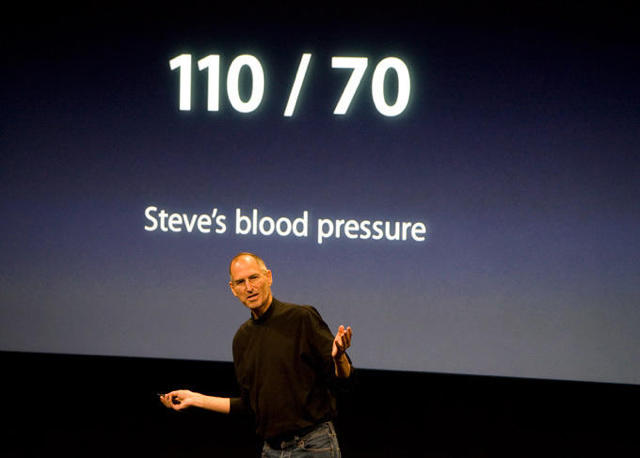
Before the QA at Tuesday’s MacBook rollout, Steve Jobs said there’s a few things he wouldn’t talk about: Apple’s latest quarter, the global financial meltdown, and his health.
With that he put up a slide showing his blood pressure: a healthy 110/70.
“This is all I’m going to talk about on my health today,” he said.
Image by lodev via Flickr
Maybe it’s a perk of being consistently named among the most influential people of one’s era.
Perhaps it’s bravado borne of having put a ding in the universe.
Whatever it is, Steve Jobs seems to think nothing of driving a car without license plates and parking in handicapped parking spaces, as the picture above, captured on September 30th by Flickr user lodev shows.
The pic is but the latest in an ongoing parade of evidence Jobs is prone to park wherever he pleases.
It almost begs us to start a Spot-Jobs-in-the Blue-Zone contest, doesn’t it?
Guess which one is Steve? Clue: The only one thinner than Sir Mick.
Steve Jobs is hobnobbing with Sir Mick Jagger in Brussels, according to the EC press service.
Jobs met with Sir Mick at an online commerce roundtable to discuss “opportunities and barriers” to online retailing in Europe, the EC says. Other bigwigs included EC competition commissioner Neelie Kroes and the heads of LVMH, Alcatel, eBAy, Fiat and EMI, and others.
The business leaders met on Wednesday.
Jobs may be in Europe to attend Apple Expo in Paris, which just opened, although Apple doesn’t have a booth at the show.
The annual Apple Expo trade show is the biggest Apple-oriented show in Europe. Until 2003, Jobs has delivered a keynote speech there. But as Apple has expanded its chain of stores around the world, it has been pulling out of more and more conferences: Macworld in New York, NAB in Las Vegas and Apple Expo in France.
“Apple is participating in fewer trade shows every year, because often there are better ways for us to reach our customers,” an Apple spokesman told Macworld.

More details and pictures after the jump.