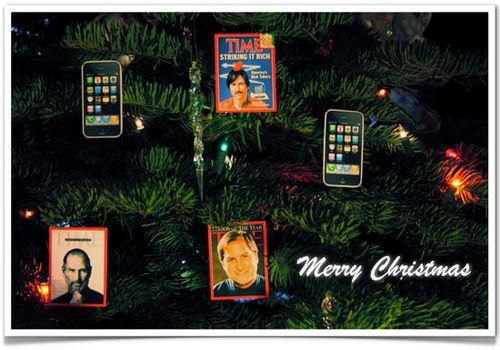
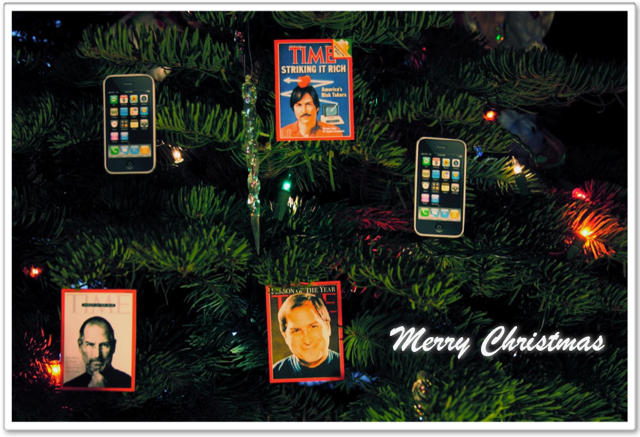
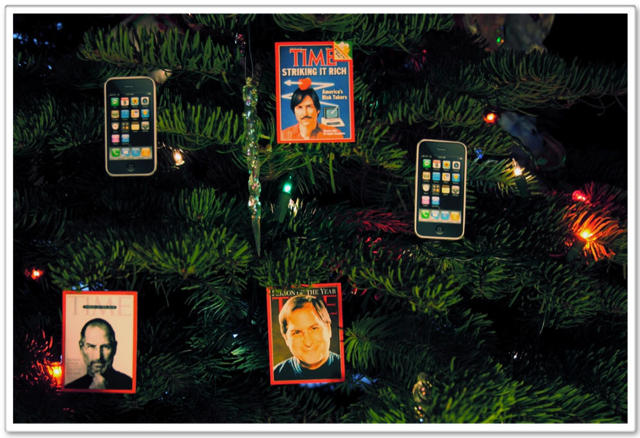
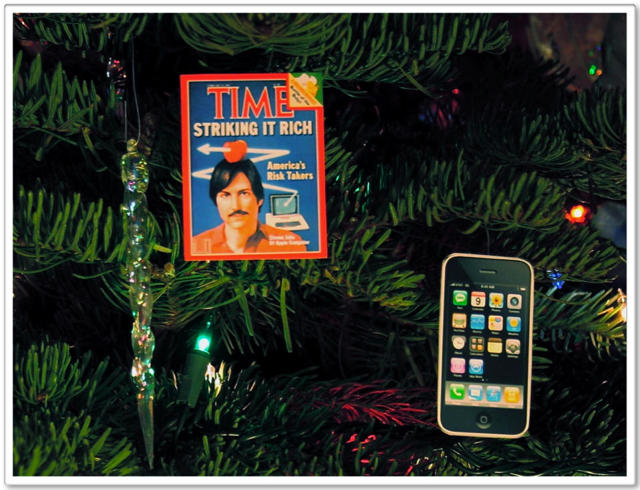
The kind Apple fanatics at iPhone Savior have done the great public service of creating Apple and Steve Jobs-themed Christmas eCard templates and posted them over at Flickr for anyone who still has a few last minute greetings to get out.
You can use a pre-made card like the one above, or choose from two styles of hi-res blank cards and add your own graphical text message to express your holiday sentiments and your love for all things Apple in the same vehicle.
As they put it over at iPhone Savior, “Sincerely wishing everyone an iPhone 3G for Christmas and some sweet dreams of Steve.”
I’m a shy and retiring Englishman, so tooting my own horn doesn’t come naturally, but my brash American wife insist I post this: USA Today named Inside Steve’s Brain, my book about Steve Jobs, one of the best business titles published in 2008.
Says USA Today:
“Offers insightful nuggets on Steve Jobs, who helped create personal computers and digital music while moonlighting as a modern-day Walt Disney at animation studio Pixar.”
Every time I say this, some people start getting all shirty and saying: “Yes it is! Steve matters!”
After my Don’t Panic post yesterday, there were similar comments, like this one: “Yeah, actually Steve Jobs health is our business. He made Apple, he revived Apple and he brought Apple to it’s current massive success. Steve Jobs IS Apple. Without him the company has a far smaller chance of survival.”
I completely disagree with this line of thinking, and here’s why:
Politics, not platelets, are why Steve Jobs is turning over the Keynote responsibility to Phil Schiller at next month’s Macworld Conference & Expo, according to CNBC correspondent Jim Goldman.
Citing “sources inside the company,” Goldman writes that Jobs’ demurral from the Keynote address for Apple’s last appearance at the venerable trade show in San Francisco is assuredly not a product of any inability on his part to perform for health reasons, but is rather a result of the company’s “trying to separate itself from Macworld for some time.” Amid the growing trend of big companies scaling back participation in traditional trade shows world wide, Apple has also in recent years taken the lead in producing its own product release events, such as the ones that introduced the company’s new iPods this summer and new notebook computers in the fall.
Apple also directly reaches millions of visitors who come weekly to its growing chain of world-wide retail stores, and millions more who receive the company’s carefully designed and controlled messaging through visits to the company’s iTunes stores.
Knowing how the Apple-interested universe’s collective pulse begins to race with every inkling of Jobs’ mortality, it’s no surprise to see Monday’s announcement generate lots of speculation and extra volatility in the movement of the company’s stock price. As Goldman writes, however, the party to be concerned about is not Jobs, and not Apple, but Macworld. For some time now it’s been fashionable to imagine scenarios about Apple in the inevitable post-Jobs era. But will there even be a Macworld in the post-Apple era?
Just in time for getting a little bit of the backstory before the 25th Anniversary of Mac kicks into high gear, Computer Shopper has a great look back at the very early years of Apple Computers by Editor in Chief Emeritus Stan Veit. We’re talking early enough that Steve Jobs was willing to give away 10% of the company for $10,000, according to Veit.
The long article is well worth a read for Veit’s inside take on the two young, “long haired hippies and their friends” who eventually revolutionized the world. It’s not an especially flattering portrait of Jobs, though it’s had plenty of company on that score over the years. The article does contain some great early pics of Jobs and Woz and some of the earliest Apple gear.
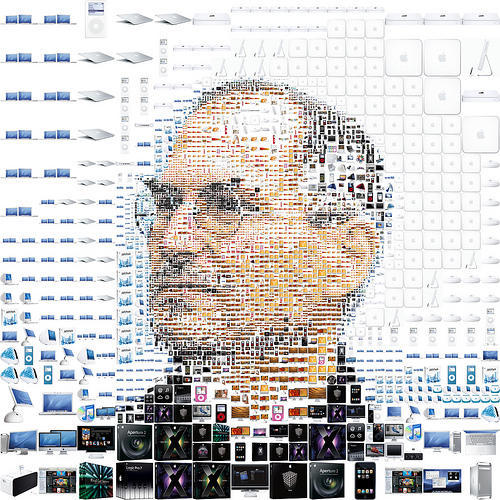
UPDATE: With thanks to reader James of RetroMacCast, credit is due to the original creator of this and many other wonderful mosaix-technique portraits, Athens, Greece-based artist, Charis Tsevis. You can download and listen to a podcast interview with Tsevis here.
Flickr user mic.imac has a fascinating portrait up of Steve Jobs, comprised entirely of artfully arranged Apple products. The portrait echoes a theme that runs through the upcoming Welcome to Macintosh documentary my colleague Nicole Martinelli wrote about on Monday, which is that the people who work at Apple give themselves entirely to the work of designing and producing the products the company makes.
Of no one is that statement more true than Steve Jobs. As CoM founder Leander Kahney says in the documentary, “Apple is Steve Jobs.”
Earlier this week I seem to have touched a chord with a post about Tony Fadell’s “transition agreement” and the reimbursements Steve Jobs gets from Apple for expenses incurred in the operation of his private plane.
Several readers took me to task for illustrating the post with a hastily-cadged, photoshopped fake of a Gulfstream jet with a big Apple logo on it, which is fair enough, if somewhat lacking in the sense-of-humor department.
With thanks to reader Hihosilver, who sent in a real picture of Jobs’ plane on the runway at the San Jose airport, I was led to a couple of interesting airplane fan sites, where more pics of the Apple CEO’s gorgeous jet can be found. For your pleasure and amusement then, here’s a gallery, so the next time you see a Gulfstream Aerospace G-V at cruising altitude or taxiing on a runway near you, you’ll be able to tell if it’s likely to have Steve inside.
The most memorable product placement on US network TV in the last month was for the iPod, which appeared in the Sept. 18 episode of “Supernatural.”
Quick recap: in the show, brothers Sam and Dean Winchester travel the country investigating paranormal escapades in a 1967 black Chevy Impala.
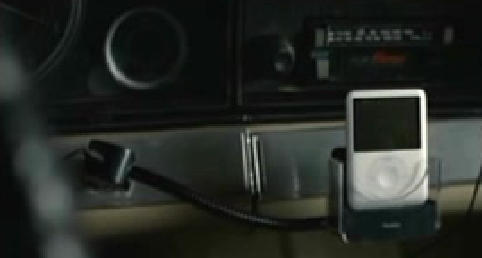
In the product placement scene, Dean asks Sam about the Apple iPod hooked up to a jack in their car.
Dean is not impressed with the iPod (“you were supposed to take care of her (the car), not douche her up”) and chucks it into the back seat.
Nielson says it was the most recalled product placement in a broadcast network scripted series for the period between September 15 and October 12.
They gauge the number of views who can remember a product placement 24 hours after seeing the show.
The other top two memorable product placements were Tupperware (Cold Case) and Playboy (Two and a Half Men). There’s a joke in there somewhere, don’t disappoint me.
JPMorgan Wednesday upgraded Apple to Overweight from Neutral, arguing the company is protected from the cold winds of a consumer downturn.
“We think that Apple’s brand and market share momentum offer meaningful buffers” despite 70-75 percent of Cupertino’s sales relying on the consumer, analyst Mark Moskowitz told investors this morning.
Acknowledging even Apple won’t come away unscathed from the current slowdown in spending, Moskowitz wrote “Apple likely has a backstop beyond the first round.”
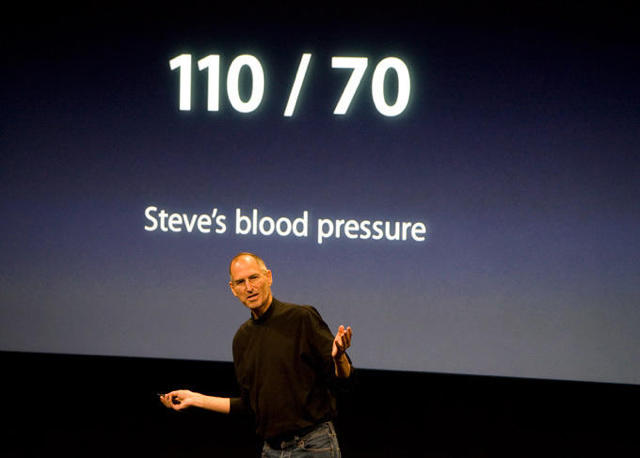
Before the QA at Tuesday’s MacBook rollout, Steve Jobs said there’s a few things he wouldn’t talk about: Apple’s latest quarter, the global financial meltdown, and his health.
With that he put up a slide showing his blood pressure: a healthy 110/70.
“This is all I’m going to talk about on my health today,” he said.
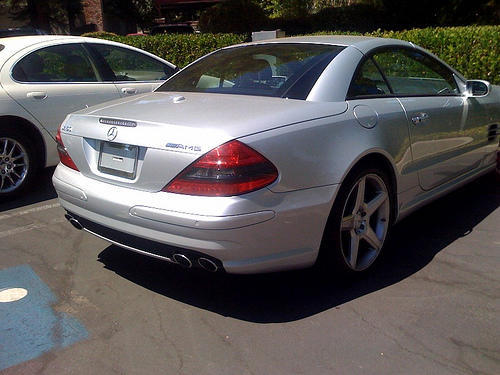
Whatever it is, Steve Jobs seems to think nothing of driving a car without license plates and parking in handicapped parking spaces, as the picture above, captured on September 30th by Flickr user lodev shows.
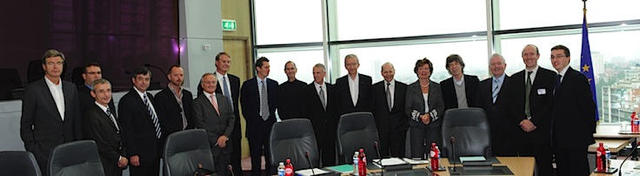
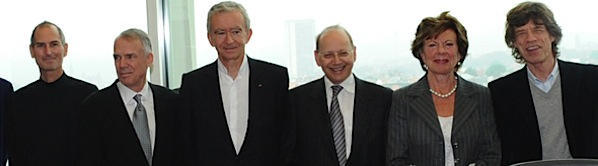
Jobs met with Sir Mick at an online commerce roundtable to discuss “opportunities and barriers” to online retailing in Europe, the EC says. Other bigwigs included EC competition commissioner Neelie Kroes and the heads of LVMH, Alcatel, eBAy, Fiat and EMI, and others.
The business leaders met on Wednesday.
Jobs may be in Europe to attend Apple Expo in Paris, which just opened, although Apple doesn’t have a booth at the show.
The annual Apple Expo trade show is the biggest Apple-oriented show in Europe. Until 2003, Jobs has delivered a keynote speech there. But as Apple has expanded its chain of stores around the world, it has been pulling out of more and more conferences: Macworld in New York, NAB in Las Vegas and Apple Expo in France.
“Apple is participating in fewer trade shows every year, because often there are better ways for us to reach our customers,” an Apple spokesman told Macworld.
Among the little-noticed aspects of Steve Job’s “big event” in San Francisco yesterday, Apple’s “greening” of the iPod line may have the most far-reaching effect on its business and on the technology industry in general. Electronics companies have been long derided by environmentalists for using toxic chemicals and materials and Jobs made a public promise to phase out PVC and BFRs from all of its products by the end of 2008.
Today, Greenpeace, a leading environmental advocacy organization is congratulating Apple for leading the electronics industry toward a more earth-friendly future. “Greenpeace congratulates Apple for phasing out harmful chemicals in its new, much greener iPods,” said Greenpeace International campaigner Casey Harrell. “It shows – once again – that there is absolutely no reason why a high-performing electronics product needs to be toxic in order to be popular, effective and affordable – these are the cheapest iPods yet,” Harrell also explained.
The new line of iPods announced yesterday are all free of terribly toxic chemicals such as PVC, BFRs, mercury and use arsenic-free glass. Greenpeace acknowledged the upgrades indicate Apple is serious about meeting the commitments of its environmental policies, but also urged the company not to become complacent.
“We hope that this is only a teaser of what is to come with all future product announcements, from iPhones to Macs,” said Harrell, adding, “What we’d really like for Christmas is to see Apple remove toxic chemicals from all its products, and announce a free, global recycling scheme. Now, that would make a very tasty green Apple indeed!”
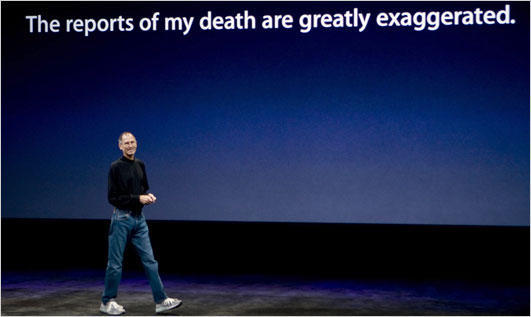
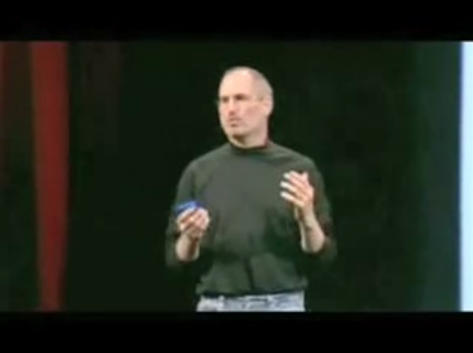
Steve Jobs took the stage this morning for Apple’s “Let’s Rock” event, bounding into the lights like a rock star himself. My grandmother would say he looked svelte, but most importantly, he seemed energetic and strong.
We’ll be back later in the day with a full reaction and analysis of Apple’s news, but the big news is Steve looks ready to keep on truckin’.
All eyes and ears of the Apple universe are tuned to San Francisco’s Yerba Buena Center for the Arts, where, in a few hours, Steve Jobs’ “Let’s Rock” event gets underway. Will it be just a music announcement focused on a refresh of the iPod product line and a new version of iTunes with bigger, better bells and whistles? Will Steve Jobs himself – and his state of health – become the story?
Lonnie spoke yesterday about these questions and more with Talking HeadsTV’s Justin Young:
Is Apple’s ONLY Debuting iPods And iTunes At “Let’s Rock?”
Will Steve Jobs’ Appearance Trump Any News At iPod Event?
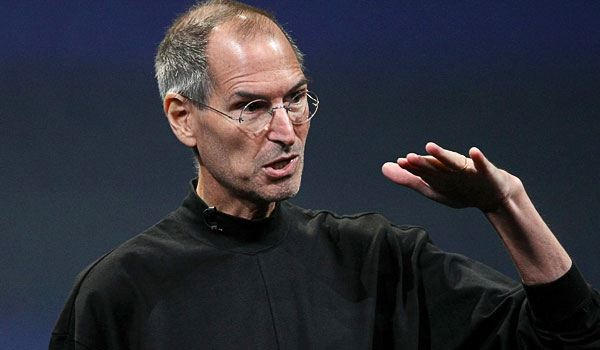
On Tuesday morning Steve Jobs will take the stage to deliver one of his singular infomercials. He’s expected to introduce a new iPod, but the only thing I care about is how healthy he looks. Sod the iPod, how’s Steve Jobs?
Jobs’ health has been the burning issue surrounding Apple this year. The company is firing on all cylinders (except the odd glitch like MobileMe) but the CEO’s health is an ongoing issue of extreme concern that will not go away. All eyes on Tuesday will be looking to see how healthy Jobs looks –and fingers crossed he’s OK.
After the jump: did Jobs treat his cancer at Greens veggie restaurant in SF?
Crews working at the front of Yerba Center for the Arts.
SAN FRANCISCO — There’s a lot of busy bees preparing for Apple’s special “Let’s Rock” event on Tuesday.
Two days before Steve Jobs hosts a special press event, the Yerba Buena Center for the Arts is humming with Apple staffers, TV crews and scores of security guards. See the pictures below.
A crew of three or four hung a huge silhouette iPod poster over the Center’s facade, while half-a-dozen Apple staffers watched from the curb, fussing over the details.
The center is lousy with Apple security guards. There’s a guard posted at every one of the center’s half-dozen doors — back and sides. The guard pictured below stood inside a door at the back, which appeared to be securely locked. Apple seems to be taking no chances that nosy bloggers might break in for a sneak peek of what Jobs is going to announce.
Around back, several Apple staffers were busy setting up computers in an office at the rear of the center.
At the side, there’s already a large satellite TV truck parked on Third Street (again, carefully guarded). A San Francisco police officer has parked his patrol car at the back of the TV truck. Presumably, SFPD will be stationed there for the next two days.
Though Apple has held special events at the Yerba Buena center before, the preparations for Tuesday’s event seem more elaborate than just a new iPod nano would warrant. I may, however, be imagining things. I’ve got a bad cold, and I’m as high as a kite on DayQuil.
An Apple security guard at the back of Yerba Center for the Arts.
Nasty glitch today on the newswires. It seems Bloomberg updated its readymade obituary for Steve Jobs, which sent the article to all of the organization’s subscribers. Most prominent figures have their obits written up in advance, but they usually don’t get sent around unless they, you know, actually need to be used. As a former copy editor, I remember well the day that Pope John Paul II died, which sent every newsroom in the world into a tizzy.
Anyway, a totally false alarm, even if it comes during a renewed period of concern about Steve’s health. It’s interesting reading, but I won’t post it here.
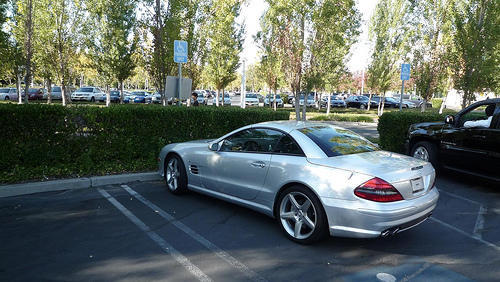
Snapper Rana Sobhany spotted Jobs’ Mercedes SL55 AMG parked in a handicapped spot at the Apple campus over the weekend.
“Mercedes? Check. No license plate? Check. Handicap spot? Yep, this is Steve Jobs’ car!!!” she writes.
Jobs, of course, has a long history of parking in handicapped parking spaces at Apple. The reports go back years, and have recently been documented on Flickr.
Since 2006, Jobs’ car has been snapped in handicapped parking spaces at Apple at least five times. See the pictures after the jump.
Steve Jobs told the Wall Street Journal users downloaded over 60 million iPhone applications and rung up sales of close to $30 million in the first month the AppStore was open for business.
While many of the iPhone applications available at the AppStore are free, paid apps such as Sega Corp.’s $9.99 Super Monkeball game helped bring in nearly $9 million to the top ten developers selling apps on the store. In all, Apple will distribute over $21 million in revenues from the 70% cut of sales developers make for software sold through the AppStore.
Jobs said the early results point to the success of Apple’s strategy to invest in the AppStore as a means of differentiating the iPhone among competitors in the smartphone handset market. He speculated on a potential $1 billion marketplace, saying, “I’ve never seen anything like this in my career for software.”
“Phone differentiation used to be about radios and antennas and things like that,” Jobs said. “We think, going forward, the phone of the future will be differentiated by software.”
The Apple CEO also confirmed reports of a “kill switch” in the iPhone’s software that would allow the company to remotely disable software users had previously paid for and installed on their phones. He argued that Apple needs it in case it inadvertently allows a malicious program — one that stole users’ personal data, for example — to be distributed to iPhones through the App Store. “Hopefully we never have to pull that lever, but we would be irresponsible not to have a lever like that to pull,” he said.
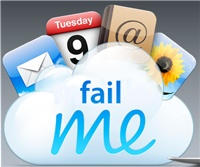
Man, Apple is really trying to make things right today. First, the company released iPhone OS 2.0.1, which everyoneseemsto agree fixes virtually everything wrong with the prior release (except cut, copy, and paste, of course), and now, it comes to light via Ars Technica that Steve Jobs himself apparently sent out an e-mail announcing the reorganization of the Mobile Me team, saying the internet services suite is “not up to Apple’s Standards.”
The new leader of a combined internet services team will be Eddy Cue, the current iTunes honcho. Jobs noted that the company intends to make Mobile Me into “a service we are all proud of by the end of this year.” That might be possible, but I’m beginning to wonder if the computer side of the equation will ever offer the true Push syncing that was originally promised. Web and iPhone are there, but not the local client apps.
But it’s good to see that even this high-flying Apple crew can admit its mistakes. It was never a good idea to try to launch Mobile Me, the App Store, iPhone OS 2.0 and the iPhone 3G on basically the same day. Is it any wonder that all four of those major hardware, software and service launches experienced some growing pains? Had Mobile Me merely offered over-the-air iPhone syncing at launch, as Jobs suggests in his e-mail, the rest of the suite could have been saved for a 2009 launch with a Snow Leopard Mail and Calendar combo optimized for Push. Let’s hope Apple really takes this to heart — iPhone software development had a negative impact on the launch of Leopard, and the quadruple launch of July 11, 2008 messed up, well, everything. Let’s get some discipline and make the best technology products in the world even better!