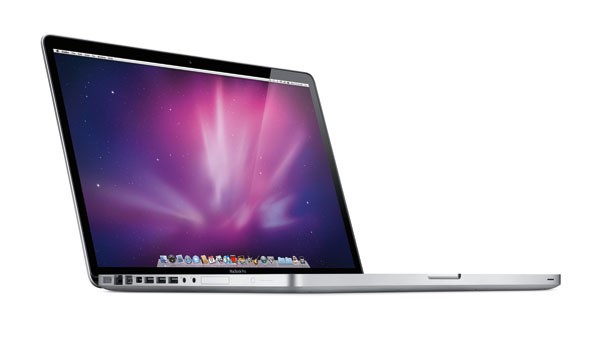
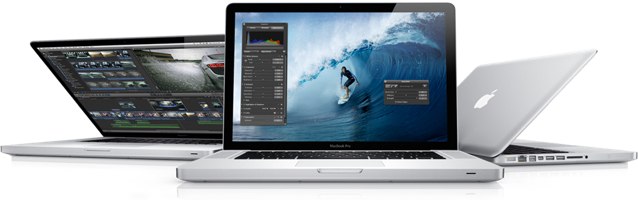
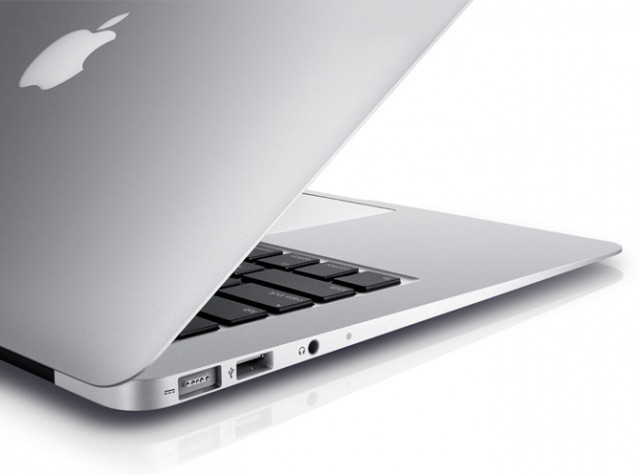
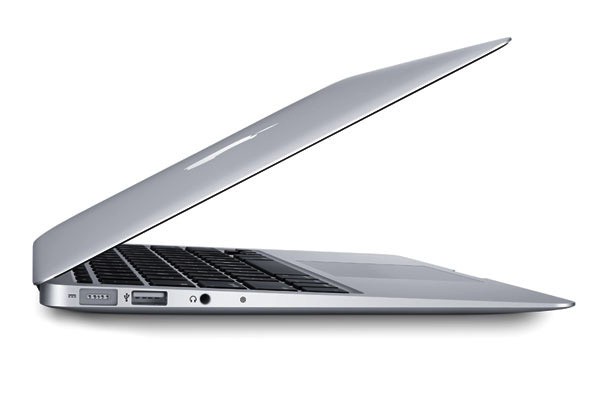
Apple introduced updated MacBook Air and Pro models alongside a totally new MacBook Pro design today at WWDC. Every time one of the laptops was addressed during the keynote, no mention was made of a 17-inch model. Apple only talked about updates for the 13-inch and 15-inch MacBook Airs/Pros.
Now Apple’s new MacBook Pro listings make no mention of the 17-inch model. It looks like the largest MacBook Pro has been axed once and for all.
Wow! Apple just unleashed a thunderstorm of new products and software on the world. Our heads are still spinning trying to keep up with all the new awesome features but we’ve managed to compile a list of everything Apple just announced at today’s WWDC keynote so you know all about the goodies coming your way. Take a look and see what you might have missed.
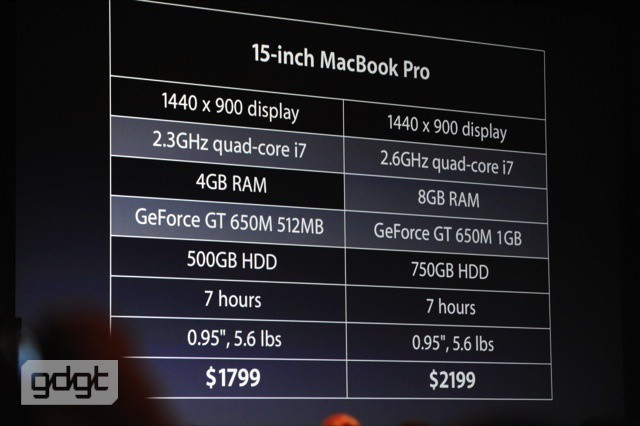
Following a refresh to the MacBook Air lineup, Apple’s Phil Schiller unveiled a revamped MacBook Pro today at WWDC12. The updated machine boasts Intel Ivy Bridge 2.7GHz (turbo boosted up to 3.7GHz), USB 3.0, Nvidia GeForce GT 650m graphics, and 7 hours of battery life.
The 13-inch MacBook Pro spec upgrade costs $1199, while the 15-inch will sell for $1499. The 15-inch is offered in $1799 and $2199 models with beefier quad-core chips. The outwards design of these upgraded MacBook Pros have stayed the same.
The new Retina display MacBook Pro looks incredible. But can you afford it?
Following those specifications for the new Mac Pro and the new MacBook Pro that we reported on earlier, the specifics for the Retina display MacBook Pro and the new MacBook Airs have now also been leaked. In addition to Intel’s Ivy Bridge processors for all models, highlights include up to 8GB of RAM and up to 512GB of SSD storage for the MacBook Air, and up to 768GB of storage for the MacBook Pro.
Apple’s World Wide Developer Conference is swiftly approaching (June 11th!), and we know they have some big announcements up their sleeves. Will we see new “Air like” Macbook Pros with SSDs and no DVD drives? Are updated iMacs with Retina displays on the horizon? And what about iOS 6? We tell you what we know on our brand new CultCast.
And then a segment we love: listener questions! You’ve tweeted at us and we’re ready to answer all your queries.
Our all-new CultCast is on iTunes now — subscribe to listen and read on for our show notes!
When Apple introduced the MacBook Air without an optical drive, everyone freaked out. “How on earth will we be able to watch all of our DVDs and listen to our CDs?” cried the internet. And sure, totally disowning physical media with a disk drive-less laptop may have been a little preemptive of Apple back in 2008, but the times have changed since then. We live in a world of digital media and digital software distribution. The success of services like Netflix and the Mac App Store proves that.
With rumors saying that Apple will introduce new and improved Macs in the coming weeks, what can we expect? Faster processors? Solid-state hard drives? Retina displays? While these features certainly seem to be on the table, there’s also the chance that Apple’s next-gen MacBook Pro will sport significant physical changes. Namely, we could finally see the optical drive retire from the MacBook line once and for all.
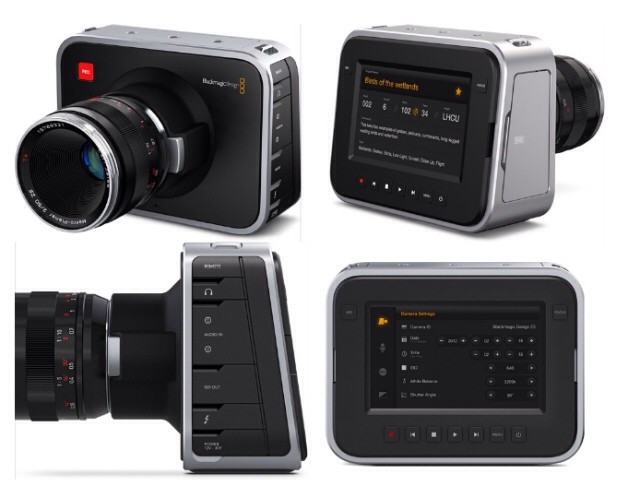
The Blackmagic Cinema Camera is calling itself a “digital film” camera, and with a 2.5K sensor and a 13-stop dynamic range, that description mightn’t be far off the mark. Amazingly, it’s also cheap — in the relative terms of movie cameras, that it. The Blackmagic comes in at “just” $3,000.
New MacBook Pros will look more like the current Airs
Apple apparently already has slimmed-down 13 and 15-inch MacBook Pros in production. The redesigned cases drop the optical drive, but storage will still be plentiful and CPUs will be more powerful than those in the current MacBook Air lineup, say the rumors.
Police forensics training for Macs in Middletown, Delaware.
If you’ve ever taken apart an Apple device, you know what delicate work it can be.
Imagine trying to extract incriminating child pornography photos from a laptop and you’ll understand why tools that help you see what’s on the device before opening it up are increasingly important in law enforcement.
If you want to take great photos that you can play around with later, you shoot RAW. And if you want to take great video, ready for the kind of post-processing punishment exacted on it by adding visual effects, you also shoot RAW.
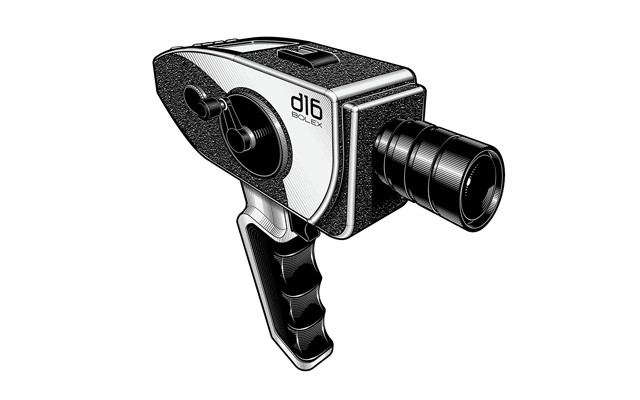
However, while you can get a RAW-shooting stills camera for under $500, a RAW-capable video camera is professional only, running to tens or even hundreds of thousands of dollars. Until now. Joe Rubinstein will sell you a Digital Bolex for just $2,500. In the movie world, that’s like finding a Nikon D4 in your cereal box.