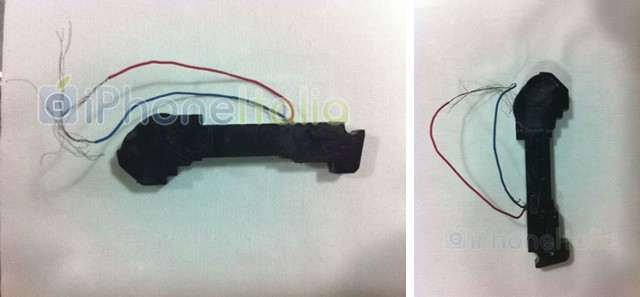
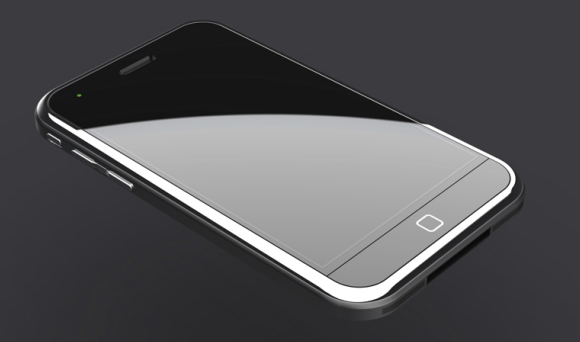
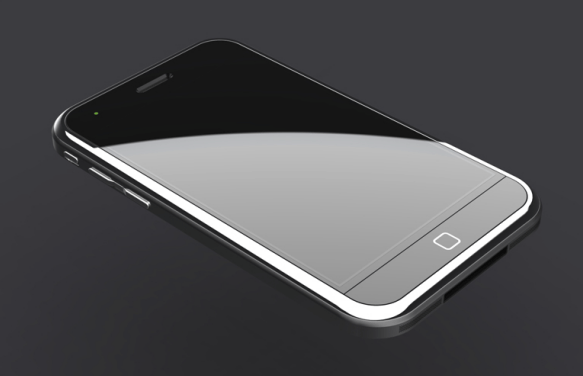
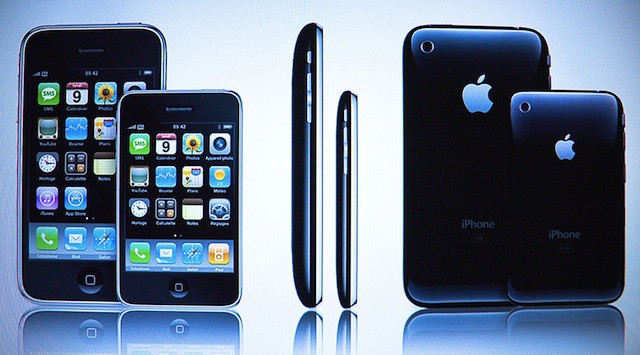
A handful of components said to come from the guts of the next iPhone have hit the web. Or they might just be a piece of junk taken from some tinker’s pockets. If they’re for real, though, consider at least a couple of the juicier rumors about the hardware of the iPhone 5 debunked.
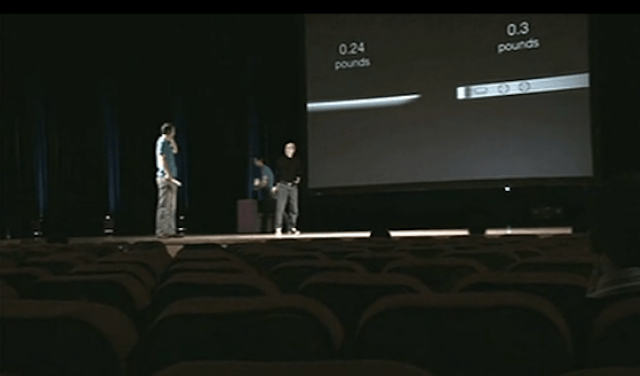
If you haven’t had a good laugh today, you should check out this video that’s been circulating of “Steve Jobs” rehearsing his iPhone 5 introduction keynote.
It’s absolutely hilarious to me that anyone would think this video is real, especially after hearing Steve say the iPhone 5 is going to have its own version of smell-o-vision. I also didn’t realize Steve Jobs sounded a lot like George W. Bush, but he does in this video.
The best part though is when Steve decides it’s time to suit up in his “go-time” sneakers, does a quick in-place foot shuffle, then compares the airy weight of his newly donned sneakers to the lightness of the new iPhone 5.
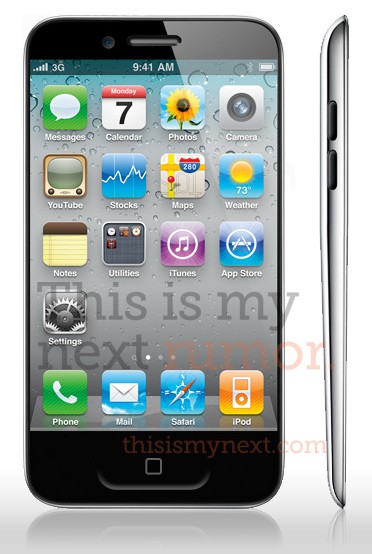
New design: Apple is testing several prototypes (we all know this) and one of the leading candidates for the iPhone 5 is thinner than the current iPhone 4 and looks “more like the iPod touch.” It has a teardrop shape – thinner at the bottom than the top, like the new MacBook Air.
Gesture-sensitive Home Button: The Home Button will be bigger and will understand a gestures. “Our sources say that gestures are definitely coming in a future version of iOS,” says
Larger screen: the screen will go up to 3.7-inches, not 4-inches as rumored. It will keep the current resolution, dropping pixel density goes from 326 to 312, but will still be a Retina Display (it’s still above 300ppi).
No Bezel: Screen will be edge-to-edge, occupying the entire front of the iPhone. That means no bezel (or almost no bezel).
Hidden earpiece & mouthpiece: The earpiece and sensors are behind the screen itself.
Inductive charging: It may or may not have wireless inductive charging. Crystal ball is cloudy.
NFC: Likewise it may or may not have NFC.
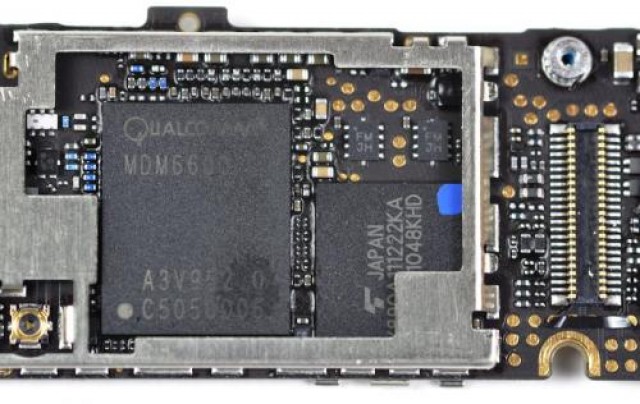
Global radio chips: It’ll be based on Qualcomm’s dual GSM/CDMA Gobi chipset, which means it’ll work on a ton of GSM and CDMA networks worldwide, most importantly in China.
Joshua Topolsky warns, however, that none of this is set in stone: “Keep in mind that this info isn’t fact — we’re getting lots of threads from lots of places and trying to make sense of the noise. The versions of devices our sources are seeing could be design prototypes and not production-ready phones. Still, there are strong indications that Apple will surprise a public that’s expecting a bump more along the lines of the 3G to 3GS — and this is some insight into where those designs might be headed.”
Right now, there are effectively two iPhone 4s: the CDMA version and the GSM version. From an American viewpoint, one runs on Verizon, the other runs on AT&T, but are otherwise identical handsets… yet because of the vagaries of cellular communication technologies, these handsets are actually tangibly different phones.
This isn’t the sort of situation Apple likes. They avoid forking hardware as much as possible, and if they are forced to fork a product — as they did with iOS when the original iPad was released — they converge those tines into a single product as quickly possible (in this example, iOS 4.1).
So we know that eventually, Apple just wants to make one iPhone that they can sell on both CDMA and GSM networks. And according to Verizon Chief Financial Officer Fran Shammo speaking at their quarterly earnings conference call, that iPhone will be the iPhone 5, a truly “global device.”
Verizon CFO Fran Shammo, asked about the sluggishness of the company’s ARPU growth in Q1, when the iPhone was introduced – growth was just 2.2%, compared to 2.5% in Q4, remarked:
“The fluctuation, I believe, will come when a new device from Apple is launched, whenever that may be, and that we will be, on the first time, on equal footing with our competitors on a new phone hitting the market, which will also be a global device.”
The technology’s already there, of course. Inside the Verizon iPhone 4 is a Qualcomm chipset that would technically allow the CDMA iPhone to run on any GSM or CDMA network around the world, but it’s not a chipset design issue alone: there’s also the antenna to consider.
If Shammo’s right, expect the tines to converge again in September, when Apple releases the iPhone 5. And expect the iPhone 5 to have a very different antenna design at that.
Three people with knowledge of Apple’s supply chain have revealed that the iPhone 5 will feature a faster processor and will begin shipping in September, according to a new Reuters report. The device will look similar to the iPhone 4 and will go into production around July/August.
The rather short report doesn’t really give us any juicy details, and only ties in with previous rumors that have already suggested the next-generation iPhone will feature a faster processor, and will ship before the end of 2011.
Other reports have speculated the device will boast an 8-megapixel camera, increased storage options, a dual-mode wireless chip to support both CDMA and GSM carriers, and will be capable of shooting 1080p video. Some have also claimed the device will feature an aluminum rear casing, similar to that of the iPod touch.
The faster processor will inevitably be Apple’s new dual-core A5 chip which features in the iPad 2.
Whether it comes in June or it comes in September as the latest rumors suggest, people aren’t really expecting the hardware to be a shock. It’ll definitely pack Apple’s new A5 SoC as boasted by the iPad 2; it might boast a Qualcomm baseband allowing the same hardware to run on both CDMA and GSM networks; it will probably have a revised antenna design to mitigate the chances of Antennagate II. These are no-brainers.
Analyst Ming-Chi Kuo’s of Concord Securities supports this view of the next hardware, with a twist: she says that the iPhone 5 will be announced in September and start production that same month, but not be released until October.
Kuo’s got a pretty good record here. In the past, he successfully forecast the quality (or lack thereof) of the iPad 2’s cameras, as well as predicted that the white iPhone 4 wouldn’t be released until April of this year. Hardly Criswellian soothsaying, but not bad.
Kuo also claims that when the iPhone 5 is released, it will boast an 8MP camera sensor. We’re guessing he’s talking about this one, which not only will allow the iPhone to shoot in 1080p video, but will also improve image quality by affording the smartphone 35% better low light sensitivity.
Remember all the anticipation and hype surrounding Verizon and the iPhone? Speculation morphed from ‘if’ to ‘when’ to now how much effect will adding the carrier have on Apple’s revenue picture. Now a prominent Apple watcher is writing Verizon’s launch of the iPhone 4 was ‘disappointing.’ Instead, the true test of how much oomph Verizon puts into iPhone sales may not come for months, when some expect Apple will introduce the iPhone 5.
“In some ways, we see the iPhone 5 as the true Verizon iPhone launch; the first time Verizon customers will have access to a new version of the iPhone,” writes Piper Jaffray’s Gene Munster. He believes many Verizon customers stood on the sidelines, waiting for the iPhone 5 “instead of buying the mid-cycle iPhone 4.”
With the February release of the Verizon iPhone and the Schiller-claimed shipment of the white iPhone 4 “real soon”, rumor consensus at this point has the iPhone 5 pegged for a September launch instead of a traditional summer unveiling.
Could it end up being even later than that, though? A new analyst report says that it might slip later, with iPhone 5 production only set to start in September.
Here’s a shocker: Apple is playing its cards close to the vest about a product launch. That’s the opinion of one analyst who tells investors Friday he is “suspicious” of all the talk the Cupertino, Calif. company may delay the iPhone 5 until later this year.
“We are increasingly becoming suspicious around continued reports of a delayed iPhone 5 launch into September/October versus the typical June/July time frame,” writes Brian White of Ticonderoga Securities. Why the suspicion?
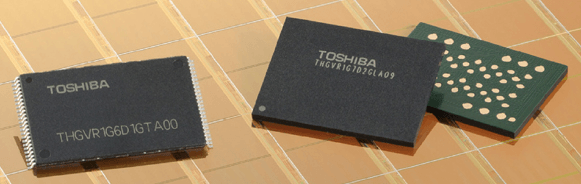
Toshiba unveiled its new SmartNAND flash memory on Tuesday with support for flash chips up to 64GB. With a next-generation 24-nanometer process, the new design has a better memory controller that speeds up the read and write process, and is more space efficient – perfect for devices like the iPhone.
It’s possible the new SmartNAND could replace the Samsung flash memory in the current iPhone 4 and allow for a 64GB iPhone 5. Apple has already moved away from the Samsung flash since the launch of the iPhone 4, choosing Toshiba’s NAND flash for both the forth-generation iPod touch and the iPad 2.
The 32GB and 64GB SmartNAND options won’t start being mass produced until at least June, which could be one of the reasons why the launch of the iPhone 5 may be delayed until September – as recent rumors claim.
A 64GB iPhone 4 prototype was recently discovered on the Chinese grey market, and reports at the time ruled out a 64GB forth-generation device, suggesting instead that Apple was testing the larger flash memory for a forthcoming iPhone.