The New York Times and the Wall Street Journal both agree that a CDMA iPhone is coming to Verizon in January, and their agreement on the matter has one of Apple’s strategic leaks written all over it. But when the iPhone comes to Verizon, will it be boasting 4G mobile internet speeds?
Don’t count on it, says Steve Cheney of Techcrunch, who reports that the Verizon iPhone to debut in January will be unable to access Verizon’s LTE network.
About two weeks ago, Steve Jobs told a college journalism student to “leave Apple alone.” That e-mail exchange left a bad taste in people’s mouths; it was pretty rude. But that hasn’t been my experience at all.
I also wrote to Jobs about the same time complaining about the problems I’ve had with my iPhone 4. But instead of being told to leave Apple alone, Steve got his people right on it.
I received a phone call from Steve’s Corporate Executive Relations (his A-Team of executive ninjas who get shit done), and a week later, I’ve got a new iPhone 4 after receiving extra special customer service.
I’ve had continual problems with the iPhone 4’s proximity sensor ever since I got my first iPhone 4 on launch day back in June. Cut a long story short, I’ve spent weeks dealing with Applecare and Genius Bar Geniuses, and three replacement handsets. It’s been a frustrating and irritating experience. Finally fed up, I sent the following email to Steve himself.
Along with the Sun in the morning, you can count on a Verizon Wireless iPhone story appearing almost daily on the pages of Apple watchers. Not to disappoint, two Wall Street analysts have released a report suggesting Apple needs to join forces with the wireless carrier to fend off the growth of Android.
In five quarters (or roughly just over one year), Android’s growth could outnumber the installed base of iPhones, according to Bernstein Research analysts Toni Sacconaghi and Pierre Ferragu. Indeed, the analysts say the Android platform has gone from 60,000 phones sold each day seven months ago to 200,000 phones per day. That sort of growth makes the analysts believe Android could singly push smartphone sales. By 2011, Apple and Android will control 52 percent of smartphone sales, the two analyst contend.
Photo by San Diego Shooter - http://flic.kr/p/7vQiCq
Apple may not be as happy with Intel’s decision to buy iPhone chipmaker Infineon as we were early told. The rumor mills are churning out this intriguing speculation: Apple may turn to Qualcomm to build its iPhone 5, a “world phone” able to support more network technology.
Choice of baseband chips, the component used to “talk” to mobile networks, is often a hint to what carriers a handset-maker plans to support. By picking Qualcomm over Infineon, Apple may signal its intention to open its popular cell phone to players besides AT&T.
Today is iPhone 4 day and like the rest of you I got up early today. I’d say way to early since it was 4:00 am and I was surprised to find out that my alarm clock on my iPhone could be set to such an early hour. The engineers at Apple HQ in Cupertino could not have done a better job on that alarm, but for once I was wishing they’d screwed it up since I think it should be a crime for an alarm clock to ring before 5:00 am.
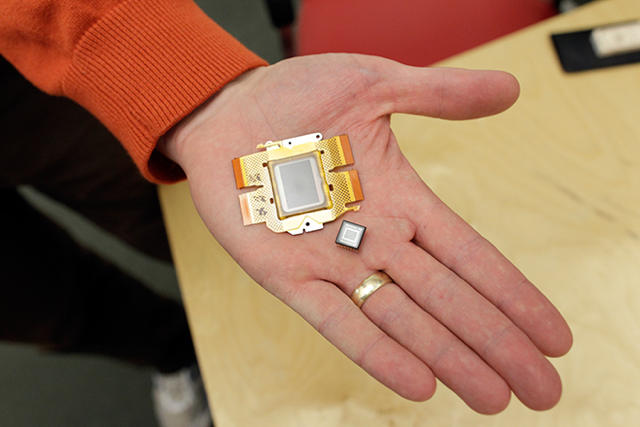
Cell phone cameras are unmitigated garbage. By nature, the CMOS chips have to be small, which means less surface area to suck in light. That’s fine in an emergency, or to snap a lip-pursed Snooki shot of some girls you met at the bar, but right now, you’ll simply never take a snap with a cameraphone that equals the picture quality of even that five-year old digicam lurking in your obsolete gadget drawer.
Worse: all too often, cameraphone makers try to compensate for the terrible image quality of their chips by cramming more megapixels into the chip, which fools buyers into thinking they are getting a better camera, but counter-intuitively just makes image quality even poorer. What’s needed is better chips, not more megapixels.
So it’s exciting to see OmniVision come out with a new, RAW-capable CMOS sensor for cellphones. Shooting in RAW means that no data is lost when your phone converts the image data from the CMOS into a JPEG, so it should improve image quality… especially given the OmniVision sensor maxes out at 5 megapixels.