The folks at ChannelFlip do a good service, if only to distract us from iPhone news and MobileMe angst.
iPod Soundblaster Roundup
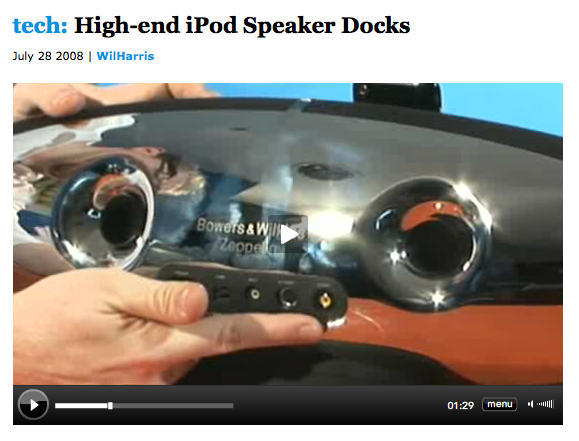

The folks at ChannelFlip do a good service, if only to distract us from iPhone news and MobileMe angst.
Speculation regarding the “state of the art new products” to which Apple CTO Peter Oppenheimer alluded in last week’s earnings’ report began in earnest Monday as AppleInsider, Ars Technica and others weighed in on the nature and likelihood of the lineup we can expect to see officially announced sometime in the next six to eight weeks.
Will it be a Mac tablet, new notebooks sporting new chipsets, new iterations of iPod, a ripening of Apple TV – another iPhone release?
Whatever it is, we’re sure we can’t wait for it.
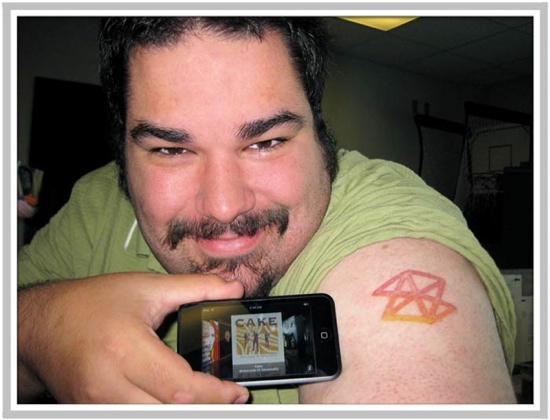
Hey, remember Steven Smith, the obsessive Zune fan who went so far as to decorate his body with not one but three Zune tattoos? Well, the thrill is gone. On Wednesday, he announced that he was trying to get his Zune tattoos removed, claiming that Microsoft pulled back on a deal to bring him up to Redmond as an honored guest (a claim MS denies). Now, he’s moved onto the iPod way. First, he bought an iPod classic, then he swapped it out for a 16GB iPod touch. As he told iPhone Savior:
“It’s super thin and does some really neat stuff like tilting to go into cover flow,” Smith said. “I also like watching movies on it. I can go anywhere to get iPod accessories, that’s not the case with Zune stuff in Iowa.”
I am shocked — SHOCKED — to learn that Zune accessories are tough to find in Iowa. After all, they’re, um, also impossible to find in San Francisco. The writing was on the wall with Zune, long ago, of course. If not after it took nine months to sell the first million, then certainly after it took another year to sell the next million, even with multiple product lines available. But this is just insult to injury. When Zune Guy leaves, it’s time to kill the platform.

In the UK, it’s sometimes difficult to tell what Apple thinks of the country. On one hand, you’ve got it building one of the finest Apple stores in the world on Regent Street. On the other, Apple didn’t show up to the MacLive Expo last year, which has resulted in a name and focus change to CreativePro Expo, leaving the UK without an Apple Expo of its own, and also disregarding consumers.
Professionals will either have to go to Paris or put up with a lot of Windows on display (during prior ‘joint’ shows of this kind in Britain, the balance was weighted at least two-to-one in favor of Windows), but at least consumers shouldn’t have too many problems accessing Macs, due to the British mainstream continuing to embrace Apple products.
Time was that Macs in the UK were some mysterious device that you could only sample by braving a typically snooty Mac reseller–and that’s if you could find one. Now, Apple has a bunch of its own stores, several branches of the John Lewis department store carry Macs, and upmarket high-street retailer Marks & Spencer also offers Apple products (including iMacs) in its larger stores.
However, the most telling example of the potential for Apple’s resurgence in the UK is found in the Argos catalog released this weekend. Argos is the largest retailer of general goods in the UK, with over 700 stores, which are basically fronts for warehouses. The idea is that you grab a cataglog, take it home, mull over purchases, and then select and pay for items in-store, where they’re picked up from the collection desk.
Although Argos has an online service, akin to the likes of Amazon, its high-street presence means it’s arguably just as important in the UK from a retailing perspective. And the point of this post? Argos now stocks Macs.
In the latest catalog, three flavors of MacBooks are on offer, along with the 20″ iMac. Although pricey compared to the PC junk Argos also carries, the Macs really look the part, shouting ‘buy me!’ from the page. So now, perhaps for the first time ever, Macs–rather than just iPods–are truly accessible to everyone in the UK.

Steve Jobs does not have a terminal illness, the New York Times says, in an amazing story that Jobs refused to cooperate in the writing of — but actually did in his own singular way.
On Thursday afternoon, several hours after I’d gotten my final “Steve’s health is a private matter” and much to my amazement Mr. Jobs called me. “This is Steve Jobs,” he began. “You think I’m an arrogant [expletive] who thinks he’s above the law, and I think you’re a slime bucket who gets most of his facts wrong.” After that rather arresting opening, he went on to say that he would give me some details about his recent health problems, but only if I would agree to keep them off the record. I tried to argue him out of it, but he said he wouldn’t talk if I insisted on an on-the-record conversation. So I agreed.
Because the conversation was off the record, I cannot disclose what Mr. Jobs told me. Suffice it to say that I didn’t hear anything that contradicted the reporting that John Markoff and I did this week. While his health problems amounted to a good deal more than “a common bug,” they weren’t life-threatening and he doesn’t have a recurrence of cancer. After he hung up the phone, it occurred to me that I had just been handed, by Mr. Jobs himself, the very information he was refusing to share with the shareholders who have entrusted him with their money.

Apple has posted a job opportunity for a position it calls “iPhone Security Engineer.” An “exceptional individual” will get the chance to “have a major impact on Apple’s embedded operating system products,” according to the job posting.
Job requirements and useful experience include “passion for developing “proof of concept attacks, industry exposure to and knowledge of OS security and UNIX internals” and “involvement in reverse engineering and security communities.”
The company appears to be taking seriously recent criticisms of its nonchalance toward patching iPhone security holes and its less-than-full-embrace by the enterprise community.
Who says crime doesn’t pay?
Via Ars Technica
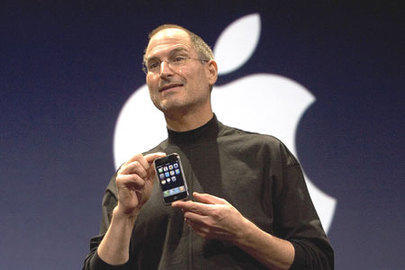
Phot courtesy ZD Net
Piper Jaffray analyst Gene Munster issued a report Friday indicating Apple, Inc. Board of Directors should be obligated to inform shareholders of any material changes in Steve Jobs’ health that could impact his abilitiy to maintain his high-profile, active role in the company’s operations.
Citing the nature of Jobs’ public appearances and his active participation in the development of products like Macs and iPhones as aspects of Jobs’ role that make him material to the company’s performance, Munster wrote,”we believe that Apple’s board has a responsibility to disclose any changes that may impede him to continue to serve.”
Apple shares have been buffeted in trading since the company’s quarterly earnings call earlier this week, when CTO Peter Oppenheimer replied to questions about Jobs’ health by saying the topic is “a private matter.” A subsequent New York Times article indicated Jobs has recently been reassuring close associates that he remains cancer free in the wake of surgery earlier this year to deal with problems that had been causing him to lose weight.
Munster’s report today was meant to assure Piper Jaffray’s clients there is “no reason to believe that Steve Jobs will not continue to serve as Apple’s CEO,” and reaffirm Munster’s buy rating and $250 price target for Apple stock.
Via AppleInsider

Microsoft is taking a leaf from Apple’s playbook and re-organizing its major online services division to create a tighter link between hardware and software.
Microsoft has reorganized it’s Platforms and Services Division, responsible for products like online search and Internet Explorer, to more closely follow Apple’s “whole widget” approach of closely tying hardware to software and online services.
In a memo to employees, Microsoft CEO Steve Ballmer explains:
“In the competition between PCs and Macs, we outsell Apple 30-to-1. But there is no doubt that Apple is thriving. Why? Because they are good at providing an experience that is narrow but complete, while our commitment to choice often comes with some compromises to the end-to-end experience. Today, we’re changing the way we work with hardware vendors to ensure that we can provide complete experiences with absolutely no compromises. We’ll do the same with phones–providing choice as we work to create great end-to-end experiences.”
It sounds like Microsoft is going to try and replicate what it’s done with the XBox and the Zune — exert more control over hardware, software and cloud services.
For decades, Microsoft has thrived by selling its software to third-party vendors who build with commodity components and compete fiercly on price. This model works well when selling to businesses, whichare concerned with price and interopability, but increasingly, ordinary consumers are the grwoth market for the PC industry, and consumers care more about ease-of-use, reliability and good design. These of course, are Apple’s strengths.
Ballmer doesn’t seem to be suggesting that Microsoft bring hardware in-house, but rather initiate a tighter pairing between Microsoft’s software and the company’s third-party hardware partners. Examples of this kind of hardware/software alliance include Real Networks and Sandisk, which have teamed to make MP3 players; and Netflix and LG, which are collaborating on an online movie service integrated into LG’s TVs.
Ballmer specifically mentions phones, which are increasingly becoming mobile computing devices that could threaten Microsoft. Microsoft is rumored to be working on a Zune phone to rival the iPhone (and soon, Google’s Android).
Windows XP and Vista users who update to iTunes 7.7 — the version required to access the App Store — receive a complimentary control panel applet for Apple’s MobileMe online sync and storage service, and some are not happy about it.
Some PC users have been surprised to notice a “MobileMe Preferences” panel in their new version of iTunes, which makes no mention of installing additional software in the Software Update notice used to download iTunes. Users who are not already MobileMe subscribers are taken to an Apple marketing site with details about the service when they click on the “Learn More” button under a “Try MobileMe” heading in the control panel.
Apple’s decision to include the MobileMe pitch with iTunes without telling users caught the attention of Stopbadware.org, an anti-malware advocacy group founded by Google Inc., Lenovo Group Ltd. and Sun Microsystems Inc., which complained in April when Apple bundled Safari 3.1 into a Software Update notice to Windows users who had not previously installed the browser on their systems. Apple subsequently agreed to separate updates for already-installed programs from offers to install new software.
Maxim Weinstein, manager of Stopbadware.org., stopped short on Monday of calling Apple’s newest move a repeat of the Safari incident. “We haven’t had an opportunity to look at it, so we don’t have a formal evaluation,” he said. “But our guidelines require and the [user] community expects that when an application installs new or different functionality that users are notified and able to consent to that.”
Via Computerworld
Walter Mossberg, the Dean of MSM technology writers, has pronounced MobileMe “way too ragged” to be considered reliable.
His frank and unsentimental review of Apple’s web services product goes beyond the launch difficulties that have kept Apple’s support forums humming with angry subscribers and which prompted the company to extend members’ $100 annual subscriptions by 30 days last week. Citing his experience in extensive testing and interaction with Apple’s support team, Mossberg chronicles a list of half a dozen problems that make the service tedious, sluggish and unpredictable.
Apple engineers blame Microsoft Outlook quirks for issues related to calendar and address book synching and say they are working on fixes for other problems.
If you’re wondering whether it might be a good time to head to the nearest Apple Store to join the queue for a new iPhone, the folks at Top Muffin offer a comprehensive iPhone Availability Tracker.
The page is powered by data from Apple’s own availability widget and is updated every 15 minutes. The accuracy of Apple’s availability information has been questioned by some in the chaotic first two weeks since the 3G model launch, prompting Top Muffin to recommend calling stores first to confirm stock on-hand.
The Computer Science Department at Stanford University will offer a course in iPhone programming in the Fall Semester, according to its latest course schedule.
It is unclear at this point whether Apple will object to the course offering under the terms of its SDK confidentiality agreement.
Via TUAW


It’s no news that The Secret Diary of Fake Steve Jobs is off-line after what has to be one of the most entertaining runs in recent memory. That said those of you longing for just one more dose of dry wit and satire FSJ-style need wait no longer.
Dan Lyons, the creative genius behind FSJ has opened another blog — this time in his own name. Personally, I find it even funnier now that doesn’t have to voice his satire through the mask of FSJ and can just be himself.
Dan’s new blog can be found at: https://realdanlyons.com/blog/

A number of third-party iPhone application developers are unhappy with continuing restrictions imposed under the Nondisclosure Agreement (NDA) they signed when they joined Apple’s Software Developers Program.
Perhaps some innocently assumed once the AppStore launched their iPhone applications into the wild the terms of the NDA would magically disappear. Others may have simply failed to read the document they were signing.
In any event, a few have put together a website to express their frustration. Be aware the link may be NSFW, depending on your place of employ. The argument seems to be that inability to talk freely with one another about their challenges and successes hampers the advancement of the platform, though, we’re guessing Apple’s legal department thought of that one before drawing up the document.
Via TUAW

Wall Street’s reaction to Apple’s traditionally conservative guidance by the brain trust that drives the US equities markets has further convinced me that most of these jokers (and our economy) would be better off if they all just played roulette. Taken with the bitter pill that better than 80% of fund managers out there can’t manage to beat the S&P 500, and it’s no small wonder that the investment banks are falling out like teenage girls at a boy-band concert.
Apple’s business strategies are as foreign to Wall Street as fiscal accountability, but there is no denying Apple’s success.
Hit the jump, and I’ll explain the top five reasons why Apple is not just the best consumer products company, but one of the best run companies out there period.
AT&T has authorized stores in its Northern California region to begin taking iPhone pre-sale orders with a promise of 72hr availability, according to the manager of one of the region’s busiest stores. In an email sent to store managers this morning, the wireless carrier said stores could promise customers they would have a phone in 3 days if they sign up for new service or upgrade their eligible hardware in-store and pass the requisite credit checks to establish a new two year service contract. Customers get a call from the store in three days when their phone arrives and are required to return to the store to complete service activation and pick up the handset.
The store manager said all AT&T retail stores in his region have been out of stock since the first wave of phones sold out in the days after its initial release on July 11. “It’s a marketing ploy by Apple,” he said, responding to a question about the lack of inventory at AT&T stores. “They release one or two hundred thousand phones and spread them all over and then do it again once those are sold out.” Describing the scenes of chaos in his store in the days after the launch, he said, “We actually prefer direct-ship. It keeps the crowds down so we can service our other customers and we don’t have to call the police to help with crowd control.”
Long lines are still present at the few Apple Stores in the country with inventory today, as iPhone buyers remain wiling to stand in line for two to three hours to make purchases directly from Apple.
Earlier today AT&T said iPhone 3G sales during the first twelve days were nearly double that of last year, despite shortages that have seen backorders up to three weeks at some of its retail stores nationwide. A company spokesman confirmed the official policy indicating a 13 to 14 day wait on direct-ship orders this afternoon, but indicated some regions could have greater availability than others.
Steve Jobs has been reassuring associates and colleagues about the state of his health, according to the New York Times. After undergoing treatment four years ago for a rare form of pancreatic cancer, Jobs is “cancer-free,” according to sources close to him, but he did undergo a surgical procedure this year to address a problem that was contributing to a loss of weight.
A great deal of speculation over Job’s health and uncertainty regarding his future prospects as CEO of Apple contributed to a sharp decline in Apple’s stock yesterday, after the company reported solid earnings and a muted outlook for the next quarter on Monday after the markets closed. Today AAPL is trading at $164 per share, $2 higher than yesterday’s close, but up $18 from yesterday’s intra-session lows.
Much of the speculation surrounding Jobs’ health began in response to his appearance at the WWDC conference last month, where he appeared wan and quite thin. According to an industry executive who spoke with Jobs and was a source for the Times report, Jobs had run a high fever for the week preceding WWDC. Apple had previously said that Jobs had come down with a “common bug” which was treated with antibiotics, and additional speculation and concern were sparked by remarks in the Monday conference call, in which the company said Jobs’ health is “a private matter.”
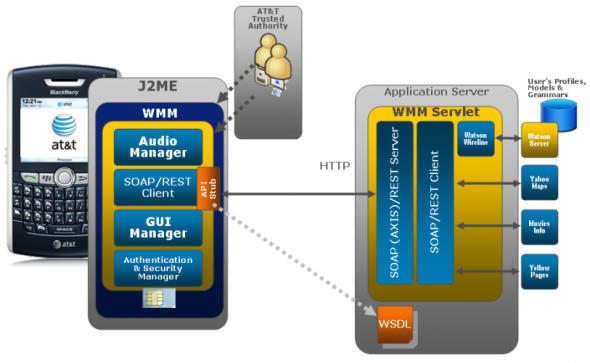
 AT&T Research Labs is testing a web based application that will bring limited voice control functionality to the iPhone. The so-called Speech Mashups, based on AT&T’s WATSON speech recognition engine, is a web service requiring high-speed wireless access to the internet in order to allow voice control of certain functions, such as entering text into web forms. The service appears to fall well short of meeting the demand for voice dialing, expressed by many as a must-have feature in a mobile phone.
The lone voice dialing application available on the AppStore appears to be Speechcloud Voice Dialer, whose 300+ commenters have thus far given it a 2.5 star rating.
The AT&T Labs chart below shows the complexity of delivering its web-based Speech Mashups solution, though, with the prevalence of speech recognition capability so widespread among other mobile handset manufacturers, we wonder what it is about Apple’s device that has made voice dialing such a difficult hurdle to clear.
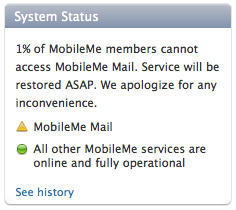
Apple’s support forums are hopping today with customers angry about continuing problems with the rollout of MobileMe web services. The MobileMe Mail category has over 13,000 messages that have been viewed more than 50,000 times, with many of the messages expressing anger and frustration over a mail server crash and unexpected fiber-optic line problems that have left some subscribers without email access for as many as five straight days, according to AppleInsider.
Apple’s system status message acknowledges the MobileMe Mail issue but claims only 1% of its subscribers are affected. If that’s the case, the problems would appear to have struck a particularly vocal 1%.

We were writing just last week that Apple’s lawsuit against Psystar could be the final stake in the heart of Mac clone computer makers. Some ideas are just too irresistible to die, we guess, because here comes a guy named Elijia Samaroo and his company, Open Tech, Inc waving a new red flag in the face of Apple’s legal department with the promise of an “open” computer that runs OS X.
Open Tech claims to be aware of the legal problems incurred by Psystar and intends to avoid them by not pre-loading its machines with OS X, the blatant violation of Apple’s licensing terms that should prove Psystar’s undoing. Open Tech says it plans to simply configure a system for the intended OS — Windows, OS X , Linux, Ubuntu — and provide a “do-it-yourself” kit that will help with whatever OS a customer buys separately.
Grab the popcorn and soda, and recall the ending of Basic Instinct.

Mock up via Flickr
Piper Jaffray analyst Gene Muntster wrote for his clients today “We believe there is an 80% chance Apple will introduce redesigned MacBooks and possibly new MacBook Pros at lower price points. Specifically, Apple may re-enter the $999 price point (currently $1099) with the MacBook, or test the $1,799 price point with the MacBook Pro (currently $1999).” Thus, the news from yesterday’s stellar earnings report is all about Apple’s future – new products on the horizon and facelifts for old friends.
The consensus appears to be that Apple will be slashing prices on on Macs in an effort to increase market share that has moved Mac into third place in the US and has Apple knocking on the door of 10% among all US computer buyers.
Additional speculation about new products in the pipeline – Oppenheimer referred in yesterday’s hour-long earnings report to Apple’s penchant for introducing “state of the art new products at price points our competitors can’t match” – has people salivating about a multi-touch Mac, a new iPhone-like PDA, new mid-to-low priced Mac workstations and more.
Whatever it is – whatever they may be – Apple’s new products are likely to follow in the mold of the company’s decade-long success introducing, in Oppenheimer’s words, something with “technologies and features that others can’t match.”
Mock up via Flickr
Recent questions regarding Steve’s health have renewed calls for a succession plan at Apple. While I hardly give two shakes over the “Industry Concerns” cited in the recent New York Post article, I would go a little further and suggest that what Apple needs is not a ‘Succession Plan‘, but a new CEO.
As startling a statement to make as that is, hold the flames for just a few more moments, follow me after the jump to find out why.
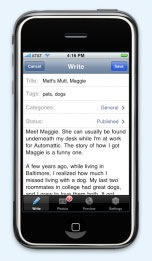
The WordPress app for iPhone has just gone live on the iTunes App Store. Here’s the direct link to the WordPress app.
The app allows WordPress blogs to be edited on the iPhone and iPod touch, online and off.
It supports blogs hosted at WordPress.com and self-installed blogs (2.5.1 or higher).
There’s all the features you’d expect for mobile blogging — but best of all, there’s an auto-recovery feature that recovers posts interrupted by phone calls. Let’s hope it works.
More details here on the iPhone WordPress site.

UPDATE: Apple’s stock is being punished because of concerns about Steve Jobs’ health, plus the company’s cautious guidance about Q4. Jobs didn’t participate in the earnings call, leading analysts to ask whether he is OK. Apple CFO, Peter Oppenheimer dodged the question. As Wired.com reports: “Andy Hargreaves, consumer electronics analyst at Pacific Crest Securities, said the lack of response from Oppenheimer regarding Jobs’ health only adds to investors’ doubt. “Not addressing Steve Jobs’ health perpetuates the fear that it’s a real problem,” Hargreaves said.”
Well, Apple just had another record quarter, with earnings jumping by 31 percent and revenue by 38 percent. The company sold more Macs in the third quarter than it has at any point in company history. It is performing better as a company than it ever has, and in a down economy.
So how does Wall Street respond? By knocking the stock price down by more than 10 points. Why? Because Apple’s guidance, or “made-up numbers to please whiny Wall Street analysts,” is below where the analysts believe it should be. Now, this might seem like rational behavior. If Apple is below Street consensus, the company must be headed for unanticipated trouble, right?
No. Not at all. Apple always sets expectations low and then jumps way beyond them. Take this quarter. Apple set earnings guidance at $1 per share. Analysts pegged it at $1.10 per share. Instead, they managed $1.19 per share. And the same thing keeps happening as far back as you can look. As Andy Zaky notes, Apple does this all the time, and they always beat their own guidance and the Street consensus, too. It’s just how they roll.
So why is it obvious to everyone except Wall Street traders that Apple always understates its guidance? Power is one hell of a drug, I imagine.
Picture via Imageshack

Steve Jobs at WWDC 2008. Photo by MacsimumNews
During Apple’s earnings call, a question was asked about Steve Jobs’ health.
Answer: “Jobs has no plans to leave Apple. Steve’s health is a private matter.”