Right, what have we got this week? First there’s Listen. Maybe the name iShell was already taken. So what does it do? You pick a shell and hold it up to your ear, then “close your eyes, take a deep breath, and relax. You’ll feel the weight of the world lift off your shoulders.”
I have a confession to make: despite my worldly exterior, I am a gigantic comics geek. I have a pull list, I can name everyone who has ever been a member of the Justice League, and I had a letter published in Green Arrow #101.
At this point in my life, I finally have the budget to buy a decent number of comics, but this has actually made things much more complex. After all, now I don’t have time to memorize which new books I want to read. Unless a preview makes a real impression on me, I forget I ever wanted to read it.
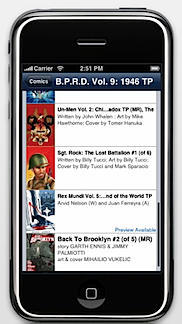
Thankfully, as it does for most of life’s problems, the iPhone has an answer. It’s called Comixology, and it’s a beautiful thing. Basically an app version (and companion) of Comixology.com, the program allows you to view lists of all the comics being released in a given week, preview artwork and story pages for many of them, and then “pull” interesting books so your local retailer will have everything cool waiting for you the next time you stop by.
It can also bring in podcasts, news, columns, and reviews. It’s pretty much one-stop nerd shopping.
I haven’t had time to get this synced to my actual comics pull list yet, but I’m planning to soon (my local comics impresario is an adviser to the project), and it’s awesome just as a memory-enhancing tool in the first place.
Plus, it doesn’t make farting noises. That alone sets it apart from the App Store pack.
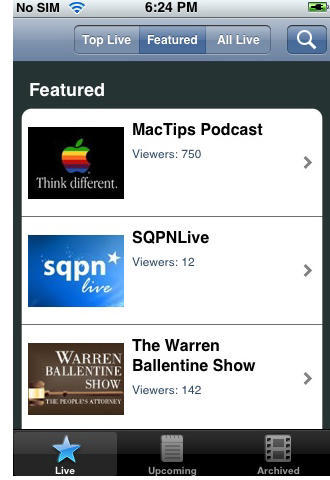
Apple approved Ustream’s AppStore live video streaming app on iTunes Monday evening, just in time for what is likely to be the most photographed, videoed and broadcast US Presidential Inauguration ever, on Tuesday in Washington, DC.
Get Ustream’s free app on your iPhone, and if you can find yourself an open WiFi connection between 10am and 3pm (EST) Tuesday, you’ll be able to catch live footage of Barack Obama’s inauguration as the 44th president of the US.
Ustream’s TV-in only breakthrough may seem small potatoes to legions of iPhone jailbreakers, who’ll be able to use iPhone’s TV-out capabilities to broadcast Obama’s historic inauguration from their iPhones; it’s also quite something for mainstream iPhone users to now be able to receive live video on their mobile devices.
It figures, then, with up to 5 million people in Washington DC for Tuesday’s pomp and circumstance, a few jailbroken live feeds ought to be accessible to those who know the right people.
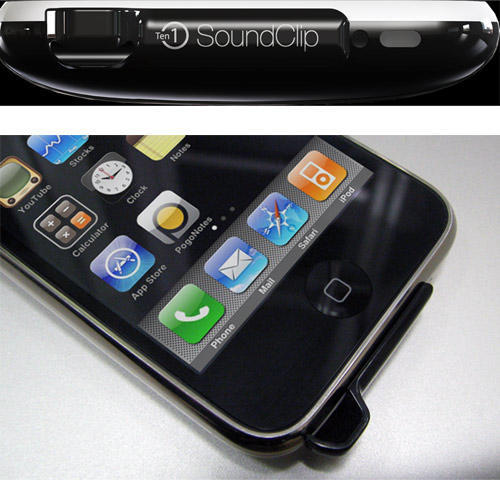
Sound Clip is such a thoughtful design solution to limitations that make iPhone’s speakers almost suck, it’s a wonder they didn’t think of it first in Cupertino.
A conical deflection chamber that reflects volume towards the user instead of away, the device is said to amplify sound by 10dB between the 5kHz and 20kHz frequencies. The SoundClip fits in the iPhone’s 30-pin dock, and also helps prevent users from blocking the iPhone speaker with their hand when playing a game.
For $8 and a barely perceptible modification to the iPhone’s svelte form, you can improve its sound appreciably.
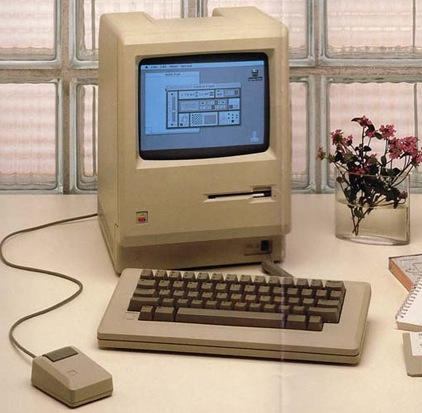
You may have heard that this coming Saturday, January 24th, is a special day in the hearts of Mac aficionados. It will mark the 25th anniversary of the Macintosh computer, the machine that turned Apple into a global brand and kick-started the line of computers that has ended up as today’s line up of Pro, Mini and MacBook.
And what we’d like to do to celebrate the Mac’s birthday is find someone who is still using one.
Is that you? Do you have an original Mac that still boots up? Do you still actually use it for anything?
If you have, or if you do, let us know.
We will EITHER: send a media squad to your home to interview you. Top photographers will take pictures of you and your original Mac for use in magazines like Vogue, Playboy, Country Living, Knitting Monthly and possibly even Wired. A real time satellite link will be set up between your home and the White House so that Barack Obama himself can send congratulations and ask you questions about that 8 MHz Motorola 68000 processor. We will also send you a pony.
OR: We might write a post about you.
So, like we said: got a (working) original Mac? We want to know.
Look, it’s about time we confessed something: writing all this gubbins about computers is hard work. Bloggers need breaks.
Especially all the Jobs rumor-mongers who have been working FLAT OUT for the last few weeks, typing up the first thing that pops into their heads in order for readers (and the mainstream media, let’s not forget them!) to have something to talk about.
Now Steve’s gone for some well-deserved rest and the wind has been knocked out of the bloggers’ sails somewhat. We need change.
No, not Presidential change. Something simpler. Something to automate this whole business of writing anything-we-damn-well-please about Steve Jobs, his health, and how the World Might End if he isn’t in charge of Apple any more.
So we turn to our friends at MacJournals with heartfelt thanks, because they have knocked up a quick Steve Jobs story template that any journalist or blogger can use to save time from now on.
Microsoft may unveil two mobile services February designed to counter Apple’s iPhone App Store and MobileMe, a blog claimed Monday.
Citing unnamed “sources close to Microsoft,” Neowin claims the software giant will unveil SkyMarket and SkyBox at next month’s Mobile World Congress.
SkyMarket, like Apple’s App Market, will offer a site for Windows Mobile users to download applications. In September, Microsoft began advertising for a Product Manager for SkyMarket. The service would be tied to Redmond’s Windows Mobile 7.
Want the power and Windows compatibility of Firefox with the sleek look and style of Safari? Since the update to Firefox 3, it’s been difficult to find a good theme to transfer Safari’s UI experience. Luckily, takebacktheweb.org has two excellent themes that will make you feel much more at home in Firefox.
The GrApple Yummy theme is almost an exact copy of Safari, right down to the tab stylings. GrApple Delicious is slightly different, mostly in the look of the tabs. The feel of Safari is still there though, so this might be a nice middle ground. It could definitely be handy in telling the applications apart if you have both open at the same time, as I do when I’m testing web site compatibility. Both themes come in “blue” and “graphite” styles.
Apple announced Monday it will reveal sales for the first quarter of 2009, covering between Sept. 28th through Dec. 27th of 2008.
The results will be released at 4 p.m. Eastern and 1 p.m. Pacific, the Cupertino, Calif.-based company said. The figures will also be available through a Quicktime rebroadcast.
The numbers are highly anticipated as analyst attempt to predict how successful Apple was during the important holiday shopping period. Wall Street consensus is for a $9.75 billion quarter, pushing the upper limits of Apple’s guidance range of between $9 billion and $10 billion.
Toronto police have posted a security cam video of a $20,000 (about $16,000 USD) iPhone heist on YouTube in hopes of identifying the criminals.
Two armed robbers made a mid-morning visit to a cell phone store on November 1 2008, forcing staff to fill garbage bags with iPhones.
The first suspect is described as male, black, about 25 years old, around five foot nine with a slim build and wearing a dark green cloth jacket with some fur trim around the hood.
The second suspect is about the same age, height and sex, with a medium build. He was wearing dark clothing and had a white cloth covering his face.
In the YouTube video narrated by the investigating detective, you can sort of make out the iPhone boxes at one point when one of the staffers drops them on the floor as a gun is pressed into his back.
Anyone with information is asked to call the hold-up squad at 416-808-7350, or Crime Stoppers at 416-222-TIPS (8477) or use the website 222tips.com.
Men’s fashion shows are keeping things busy and taxis scarce in Milan this week. Designers are dealing with the luxe hangover with new sober designs; Bottega Veneta wants to move its expensive leather goods by putting the focus on how useful they are for toting small electronics.
“Designer Tomas Maier took pains to explain the functionality of iPod-friendly bags. A projection would have helped to convey the details.”
It’s hard to imagine perpetually broody models opening up the bags like the one above on the runway to show the handy-dandy iPod pockets “Price is Right” style, but as Menkes later notes, if you believe in the quality of the Italian fashion house known for its woven leathers, you’ll just have to take thier word for it.
Steve Jobs, who last week took a six-month medical leave of absence as CEO of Apple, reportedly wants to remain on Disney’s board of directors.
Jobs, Disney’s largest shareholder, has been on the Walt Disney board since 2006.
The decision became public Friday, when Disney released a proxy statement, according to the Wall Street Journal.
Questions about Jobs’ ability to serve are already be raised, according to the Financial Times. A board member must serve 250 hours a year, according to the newspaper.
Barack Obama is a Mac. At least that’s how the NYT described his style, approach, manner — naming rival Hillary Clinton a PC about a year ago.
The soon-to-be 44th president of the United States, who addresses citizens via YouTube and Twitter, is also a Mac user who has been spotted flashing an iPhone, keeps up with his family via iChat, whose “O” logo was designed on a Mac and whose campaign was powered by MacBooks.
Obama has said they’ll have to pry the Blackberry out of his hands and, in addition to the more obvious firsts, may be the first president to put a lap top in the Oval Office. (It would give him something in common with Russian President Dimitry Medvedev, who has been photographed doing official business on his MacBook.)
Do you want to see a Mac on the desk of the Oval Office or is the choice of First Laptop a non-issue?
This Apple keyboard concept has an induction charge and sync on the right hand side for an iPhone or iPod and six programable OLED keys much like the Optimus Maximus Aux keyboard.
The mock-ad lists the price as $79. Worth the price for going wireless?
How about this uber-nerdy wood and brushed aluminum USB keyboard that features real Scrabble tiles for your next Mac mod project? The points score is slightly edited to show each key’s secondary function, but we think it’s just about the coolest thing we’ve seen this late on a Sunday night.
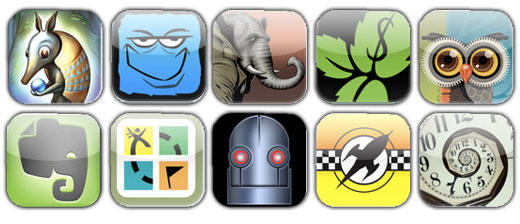
When there are more than 15,000 apps vying for one’s favor like so many new puppies in a box, deciding which ones to try might well come down to picking the ones with the cutest mugs. And of course, how does the AppStore display its puppies, uh, mugs? With galleries of app icons, that’s how.
So, unless you’re hip to some strong word of mouth on a particular app, or you know a few of the 500,000 iPhone app developers newly minted in the past year, you might as well start with something like the “50 iPhone Apps With Icons That Don’t Suck” approach taken by Dr. Macenstein.
A quick browse through the doctor’s post reveals worthy apps may in fact come with worthy icons, such as Dizzy Bee, the highly addicting tilt game, seeker, a free business and residential listings search app, and Rocket Taxi – Cab Finder, an app that uses GPS or WiFi to help you find the nearest cab company.
I feel the doctor went a little strong to the games section with his picks, but the AppStore is overweighted with games, so maybe it makes sense. What do you think? Would you check out an app based on its cute icon alone? What are some of your favorite iPhone app icons?
Steve Wozniak gave his own unique and valuable perspective on Steve Jobs, Jobs’ health and Apple culture in an interview on NBC11 in San Jose over the weekend, saying, “What [Jobs] says, we ought to accept,” referring to the public’s insatiable curiosity about the Apple CEO. “No matter how much he gave, in explanations and explanations and explanations, there [are] a lot of people that keep wanting more and more.”
In addition to defending Job’s public statements on his health and the culture of privacy at Apple generally, Woz allowed that “Apple has some incredible people…followers of the Apple mentality, followers of Steve himself,” who will lessen the impact of a short six month absence. “The products coming out of Apple, out of tech companies, have a long tech pipeline…they work their way through for a year, year and a half…Those products are in the pipeline, they’re not going to be disturbed.”
Woz even spoke of an epiphany he had in the shower, about how Jobs’ medical leave might benefit Apple: “He wants a rest. The rest and peacefulness. What do you do when you rest? Sometimes your mind floats. A person like him works out better concepts and products and ways the future could be and way we live our lives better than any individual could. Probably a great thing for Apple.”
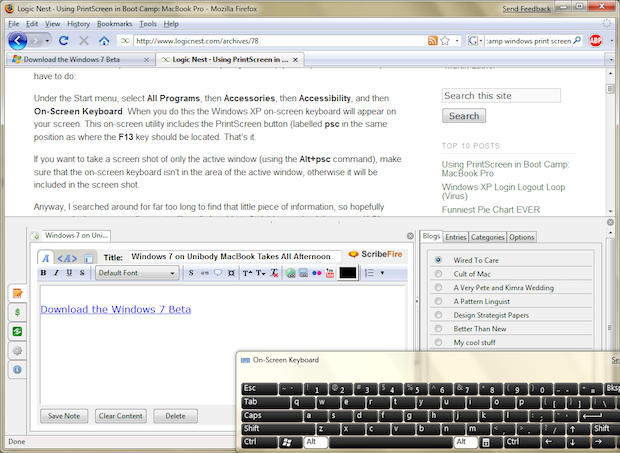
Having read a few of the tutorials on how to install the new Windows 7 beta on a Mac with Boot Camp, I decided to take the plunge myself today on my still sparkling-new unibody MacBook 2.4 Ghz. (This post is actually being written in Firefox on Windows 7 — eww)
And what I learned is that you had really better be prepared to spend several hours to get it working properly. The link I’ve provided above is pretty handy, but it has some tricks to it that will not be immediately apparent without some trial and error. Read on to make the essential tweaks to the tutorial needed to make it work on MacBooks, not just MacBook Pros, read on!
I’ve received two “friend tech support” complaints about slow Internet access and seeing lots of ads for Vimax on just about every website all of a sudden. Today, I found the solution thanks to an article on Boing Boing referencing an Apple Support thread on the issue.
The software causing the problem is related to your DNS. Instead of showing your usual ads, they’re replaced with the offensive advertisements. Mulder on the Apple Support thread provides this insight and fix:
“Reinstalling Mac OS X will not solve the problem, as it’s not with anything in OS X. If you have no Trojan Horse, then it would seem your ISP is doing this. So try this:
Open System Preferences > Network > Configure > TCP/IP and paste these two DNS servers into that field:
208.67.222.222
208.67.220.220
click Apply Now and quit System Preferences. Then restart Safari and see if the problem continues.”
Results as follows: “Its worked zoop!! Zoop!!” and “I too obtained immediate results – thank you!“. If you have any problems, consult the thread itself for details on the debugging process and solution.
As a student, one of the main advantages of having a laptop is that you can study in quieter places with fewer distractions. As a photographer, you’re probably excited about using your laptop for tethered shooting on the go.
Here’s the paradox: if you try to shut the lid to focus on your term paper while you’re listening to music, or want to put your laptop in your backpack while you’re shooting, everything turns off.
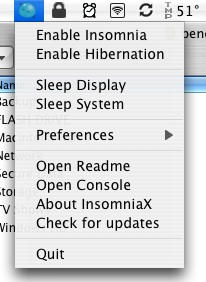
Thanks to InsomniaX, you can get complete control over the system’s sleep cycle in a neat little menu item. To get this functionality on my old iBook I completely disassembled it and removed the bits that detect when the lid is closed. You don’t want to do that!
Download InsomniaX! Go ahead and listen to your music! Fill your hard drive with photos direct from your camera! The world is your oyster.
Ustream is bringing streaming webcam video to the iPhone, perhaps in time for you to watch the historic inuaguration of President Barack Obama from the nation’s capital next Tuesday, if Tim Cook can make a little rain in Cupertino over the weekend.
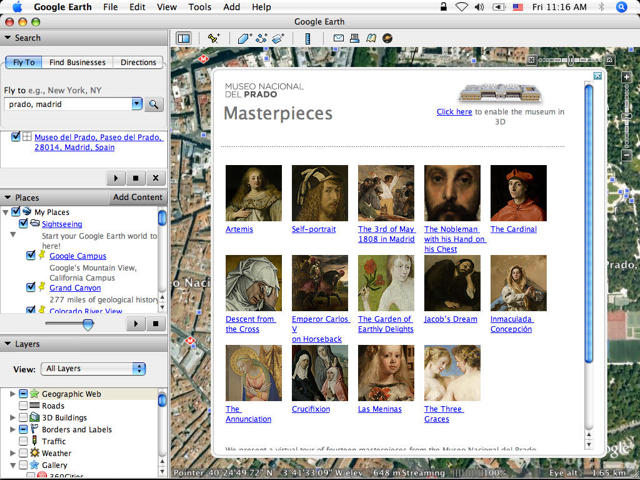
Proving it really is the coolest company on the web, Google unveiled this week the Prado layer in Google Earth, an amazing bit of functionality that lets users zoom into almost any spot on the planet for a detailed view of what’s to be found there using the company’s earth mapping product.
The Google Earth Prado layer also includes 3D models which allow you to fly around the Prado buildings to experience the museum as if you were actually there. The paintings have been photographed in very high resolution and contain as many as 14,000 million pixels (14 gigapixels).
The iPhone version of Google Earth is not yet updated to support this feature, so you’ll have to use your desktop earth to get there.
As Wall Street looks forward to Apple next week reporting revenue for the holiday period, Goldman Sachs analyst David Bailey thinks Cupertino may encounter problems with the March quarter.
Apple’s double-digit growth rates may well sputter as the company “will undoubtedly be affected by softer consumer demand” for its pricier products, Bailey told investors Friday.
The analyst told clients Apple’s revenue for the March quarter will be between $7 billion and $8 billion. Wall Street is forecasting $8.24 billion in revenue for the period.