UPDATE: One year on, and my view of the platform for gaming has changed somewhat—read Why Apple is Right to Pitch iPod touch as a Games Console to Beat the DSi and PSP Go.
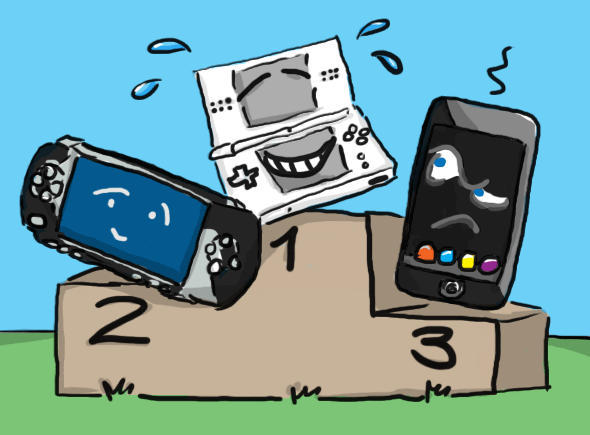
The iPod touch segment of Let’s Rock was particularly notable for Apple’s attempts to position the device as a major gaming platform. “It’s the best portable device for playing games,” claimed Jobs. Apple’s website now calls iPod touch the ‘funnest iPod ever’, and talks about its ‘hundreds of games’. This emphasis on gaming, along with the demonstrations we’ve seen from various developers, appears to be positioning iPod touch alongside Sony’s PSP and Nintendo’s DS, rather than talking about mobile gaming as though iPod touch has any relationship whatsoever to a certain smartphone and cell-phone gaming in general.
There are arguments in favor of this belief. Games have proved phenomenally popular on the App Store. They’re also cheap, relatively plentiful, and simple to get on to your iPhone or iPod touch. Also, crucially, Apple’s solution betters Sony’s and Nintendo’s by allowing updates to games—something owners of the abhorrent DS port of The Settlers no doubt wish were true of their platform.
The problem is, iPod touch is only ever going to be a niche concern in the gaming space. Find out why after the break…
1. A lack of controls
We’ve mentioned this in the past, but iPod touch’s lack of standard controls is a real problem. Although alternate control methods drive innovation—something proved by certain titles on the Wii and DS—forcing them on developers restricts output and hampers usability.
Case in point 1: Real Soccer 2009 was demoed at Let’s Rock, showing an on-screen D-pad and buttons. To control the game, you have to obscure part of the display. Even if you can deal with this limitation, you get no tactile feedback from the device, unlike with a standard controller, and so you must keep looking to ensure your thumbs are in the right place. Do you look at your controller while playing games on other platforms, or the game itself?
Case in point 2: Even when it comes to tilt controls, the sensitivity of many titles causes problems when using iPod touch as a truly mobile device. Playing on the train or bus can become a chore for any titles that aren’t touch-screen-only—something that doesn’t affect other major handheld gaming platforms.
2. Dumbed-down content
I’m a fan of what’s now hatefully called ‘casual gaming’—I can’t be bothered reading a manual or learning how to play something. I just want to jump right in, and for that iPod touch appears great. However, games to date have an overt lack of depth, and are often driven by gimmicks. Instead of the full experience, most of the titles are like the mini-games found on other (even handheld) platforms, and the limited control methods compound this problem—tilt, tilt, tilt, meh.
3. Expensive hardware
Gaming isn’t just for kids, but kids sure have a lot of gaming devices bought for them. iPod touch is simply too pricey, fragile and problematic (such as with its other applications, not least the web browser) for parents to give one to their kids. The PSP suffers with these problems to some extent, too, but it’s notably more rugged than the iPod touch, and the DS is comparatively bullet-proof. And when it comes to the inevitable ‘device being dropped down the stairs or on to the tarmac’ followed by the equally certain ‘kid crying until a replacement is furnished’, you can bet most folks would rather stump up 130 bucks for a new DS than almost twice that for the cheapest iPod touch.
4. Not fit-for-purpose
The Nintendo DS was designed as a gaming device, and despite Sony’s ‘media player’ rhetoric, so was the PSP. iPod touch was designed as a media player (or, you could argue, as a smartphone, with the phone bit subsequently being wrenched out). Apple is usually very focussed, designing devices and software for specific purposes, but this isn’t one of those occasions. It’s unlikely a device not designed for games can ever become a truly major gaming platform.
5. Apple’s track record in gaming
Apple’s never been terribly interested in games, and when it has entered the market, it’s been a disaster. Pippin, anyone? Even with Apple’s gaming boasts of late, the selection for the Mac is mediocre, and rumors suggest that Jobs himself just isn’t interested in this market. This puts off developers, making them overly cautious of supporting the platform.
This is the one thing that could conceivably change rapidly, not least when dollar signs start lighting up in front of eager executives’ eyes, but the other points mentioned hamper any hope of iPod touch being anything but a distant third in the battle for handheld king—at least unless Apple has more than one fairly major change of direction.

Craig Grannell was once Cult of Mac’s designer and an occasional contributor. Find out whatever he’s doing now on Twitter @CraigGrannell or his website, craiggrannell.com.

