Today’s deals include half-a-dozen new App Store freebies, refurbished MacBooks for under $600, and Apple’s ongoing Back to School hardware sale, which throws in a fee iPod Touch with a computer purchase. Plus many more.
Details of these and other Daily Deals can be found on the CoM Daily Deals page.
UPDATE: Rogers denies there’s an 8GB iPhone 3GS. It’s a formatting error, a spokesman told Gizmodo and Electronista. “There is no 8GB 3G s iPhone,” the spokesman emailed. “There is a formatting error on our website. It is being corrected asap.” Too bad. There was the Boy Genius memo though, which hasn’t yet been strenuously denied by Rogers.
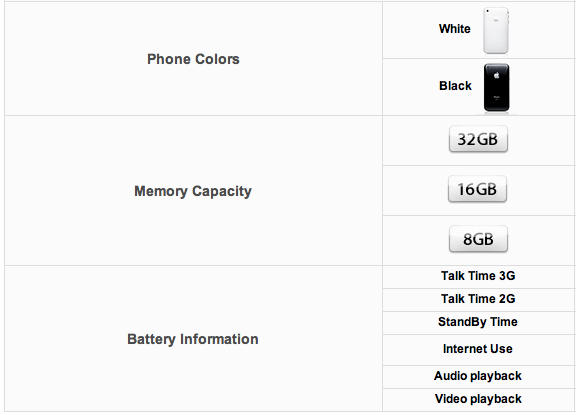
The existence of an 8GB model of Apple’s hot iPhone 3GS looks more likely if you take a gander at this webpage from Rogers Wireless of Canada.
There it is in full public view in a comparison chart — the iPhone 3GS is available in 32GB, 16GB and — now — 8GB.
The lower-capacity 3GS was rumored last week when photos of a Rogers’ internal memo were published by Boy Genius Report. The memo said the company would sell through all of its older iPhone 3G stock before offering the new 8GB 3GS.
Whether the new phone will be offered outside Canada isn’t clear, but seems likely. It’s also likely to be lower-priced, perhaps replacing the current 8GB iPhone 3G, which is sold by AT&T for $99 with a contract.
Entrepreneur Jason Calacanis is giving the finger to Apple. CC-licensed photo by Eirik Solheim. http://eirikso.com/
Entrepreneur Jason Calacanis, the dog loving, Tesla driving, indefatigable self-promoter, is forsaking Apple products in his fury at some of the company’s recent actions, like banning the Google Voice app — The Case Against Apple-in Five Parts.
While he has a couple of points, he’s wrong about the rest. In fact, the things that Calacanis rags on are the things that make Apple and the iPhone great, and he’s misguided not to embrace them. Here’s why:
Apple is rumored to be adding Blu-Ray to the iTunes, but why would it undercut its brand new online HD rental service?
New rumors this weekend suggest that Blu-Ray may finally be coming to the Mac. But while Blu-Ray is high on many people’s wish list, the rumors just don’t make sense.
Citing a “pretty reliable source,” Boy Genius Report says Blu-Ray is coming to iTunes 9, maybe as soon as September. The rumor jibes with a particularly vague story on AppleInsider suggesting that new iMacs will get new features (yeah, it’s almost sounds like self-parody), possibly Blu-Ray.
But although Blu-Ray format is gaining popularity, it’s unlikely to come to the Mac, ever. Here’s why:
Displaying an impressive level of tech savvy, Ice-T took a claw hammer to an old PowerBook he’s getting rid of.
In this 4-minute video, you can watch Ice-T smash his old PowerBook to bits. At first, it seems the former rapper is getting revenge on a glitchy machine.
“This Mac gave me a lot of hell,” he says. “It’s kinda like payback.”
But as the video goes on, it’s clear Ice-T is trying to remove and destroy the hard drive, which he’s afraid might fall into the wrong hands.
“I’m gonna get this hard drive out of here, make sure none of my secrets are in here, if somebody should find this computer,” he says.
In the comments, Ice-T takes a lot of flak for destroying the machine (and a bunch of racist garbage). The geniuses on YouTube rip him for not taking the machine to an eWaste facility and releasing toxins into the environment.
While the toxins criticism might be on target, Ice-T was right to destroy the hard drive first. Data is incredibly easy to pull off old hard drives, whether the drive has been erased or not, even in multiple passes. There are plenty of cases of identity theft from old machines. And just weeks ago, journalism students were able to buy a drive full of government secrets from a dump in Ghana.
As the actor knows, the one sure-fire way to destroy all data on a hard drive is to destroy the hard drive. “There’s probably a better way to do it, but i just said, ‘fuck it,'” the Law & Order actor says.
In fact, if recycling an old laptop, it’s a good idea to drill several holes into the case and right through the hard drive before taking it to an eWaste facility (Only if the drive can’t be easily removed obviously, which is the case with many older PowerBooks and iBooks).
Pay no attention to the glitches and errors! We’re moving to a new host.
I’m in New York with my family on a work vacation (I work, they vacation), and have just spent a miserable week sweating in my skivvies in a hot, humid Harlem apartment trying to move this site to a new host.
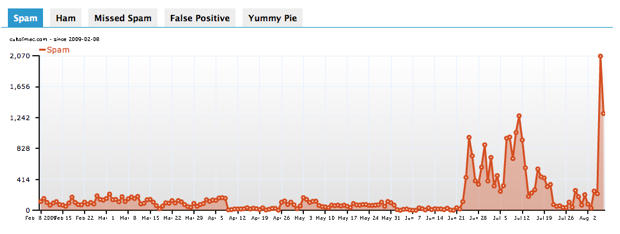
You may have suffered from a few database errors this week and last. It was so bad on Thursday, a couple of readers on Twitter suspected we were under DDoS attack, like Twitter itself that day. We weren’t, but we were being hit by spam bots — and still are. There was a big spike in spam traffic last week and a huge one this week. See the chart below.
Whether the spam is causing the database errors or not, I don’t know. I suspect it’s a combination of the spam, the growing traffic and the crumminess of the current host. As we’ve grown, we’ve attracted hack attacks that infected the site with spam and Windows viruses. The support has been hopeless, which is what you get with the cheapest hosting plan on the planet. It’s time to move up to a bigger, better host.
We’re moving to Laughing Squid of San Francisco. It’s a local, independently owned firm, run with quiet competence by the redoubtable Scott Beale (Here’s Scott’s great Laughing Squad blog). Laughing Squid is home to a lot of companies and people I like and admire. It’s plugged into the tech and arts community, and renowned for its support and reliability.
I did most of the moving work myself, so fully expect it to melt down. In fact, I’ll flip out if it works. If you’re reading this, it must have worked. So fingers crossed, and please let us know if you spot anything that needs fixing. Thanks for your patience.
Sadly, CrunchFu doesn't yell at you in a comedy Far-East accent.
It’s Friday and it’s time for our weekly digest of tiny iPhone reviews, courtesy of iPhoneTiny.com, with some extra commentary exclusive to Cult of Mac.
APP OF THE WEEK
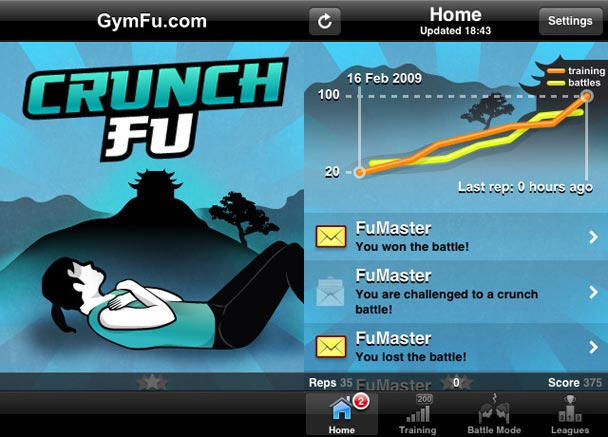
CrunchFu: Effective and surprisingly fun fitness aid. Kind of like Nike+ for crunches. 4/5 $2.99 https://tr.im/vUFR
Flyloop: Sweet and surprisingly frantic high-score game. Draw lines & loops to ‘snare’/combine butterflies. 4/5 $0.99 https://is.gd/22g9j
CameraBag: Trendy camera effects (Lomo, Holga, 1970s, 1960s, etc.) and 1200px per edge output. Good quality. 4/5 $1.99 https://tr.im/vCb5
Electrogravitron: Excellent multitouch/accelerometer game where you shepherd blue dots into defined zones. 4/5 $0.99 https://tr.im/vLsv
Lots of decent apps this week, including the infuriatingly addictive Doodle Jump, the hippyesque Flyloop (catch those butterflies, man), Electrogravitron—only second to Eliss in multitouch gaming terms—and CameraBag, which remains one of my favorite iPhone image-manipulation apps.
App of the week is CrunchFu, though, for providing a means for cheapskate iPhone owners to get fit and have some fun at the same time. It takes the same basic principle as Nike+, turning exercise into an online videogame. League tables and online battles ensure you stay engrossed rather than giving up. And if you’re no fan of crunches, GymFu offers similar apps for squats, pull-ups and push-ups.
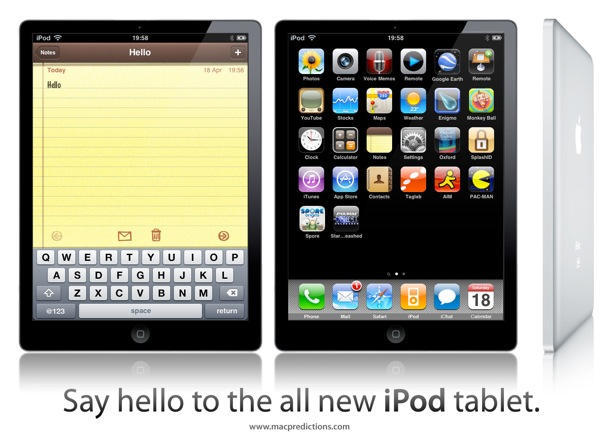
An iTablet mockup from Graham Bower of Mac Predictions: http://www.macpredictions.com/2009/04/ipod-tablet-mockup.html
Apple’s upcoming iTablet will be a hit and run the iPhone operating system, according to new report out of Wall Street.
Analysts at Piper Jaffray say the upcoming iTablet will be released in 2010, will cost about $600, and will shift about 2 million units in its first year.
“Last week we spoke with an Asian component supplier that has received orders from Apple for a touch-screen device to be fulfilled by late CY09,” the report says. “This data point underscores our thesis that a tablet will likely launch in early CY10.”
The tablet will also run the iPhone/iPod Touch OS — not OS X, the report predicts. CoM believes the tablet will run OS X, which will be the “killer app” that cements the tablet’s success. Apple appears to be prepping Snow Leopard, the next version of OS X, for touchscreen devices.
“Apple could choose to simply run the current App Store apps on the larger device, with enough usable space for multiple apps to run (multi-tasking),” says the investment firm.
The report continues: “Key apps, like Safari and Mail, could be made larger to make use of the larger screen resolution, making Apple’s tablet appealing for more extended use, and the company could continue to leverage its primary asset in mobile computing, the App Store, in this scenario. We believe this is the most likely scenario given the success of the multi-touch platform and the App Store ecosystem, which could be accelerated with a tablet device.”
The analysis says Apple will reap extra revenue from the tablet that hasn’t been included in most forecast models.
“While at first glance this may appear to address a niche market, we believe the addressable market is larger than that of the Apple TV, of which Apple sold about 1.2m in its first year,” the report says.
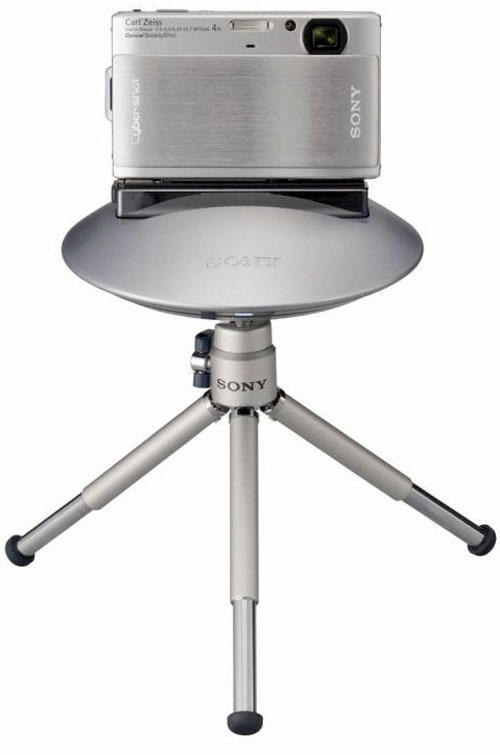
Have you ever gotten to a party and forgotten your camera? We’ve all witnessed a great moment and thought: ‘I wish I had my camera ready.’ Well, worry no more because now Sony has the perfect party camera that automatically takes pictures. The Party-shot camera dock uses a face-detection BIONZ image processor to find your friends and snap away.
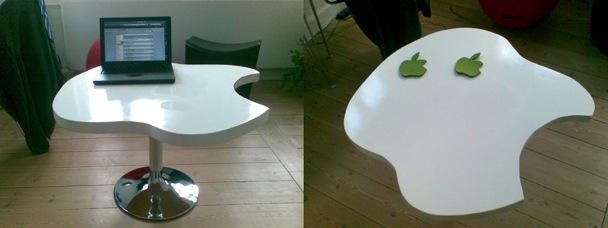
A nice DIY effort from Denmark, this logo end table is the latest in Apple-inspired furniture we at CoM go nutty over.
This table comes to us from ilove code, not new to Apple-related decor projects, who put it together with help from his mom. The table top is made from medium-density fiberboard (MDF), the logo stands on an old bar-stool.
Especially like how the apple bite might facilitate use as a computer table, depending on the height.
Apple senior vice president Phil Schiller took the time to craft a lengthy, detailed statement of the company’s position with respect to criticism leveled Wednesday by this site and others, over the App Store review process Matchstick Software’s Ninjawords application endured on its way to appearing as a 17+ rated selection on the iTunes App Store in mid-July.
As it had been initially reported on Tuesday evening at Daring Fireball, Apple “required” Ninjawords — an iPhone dictionary app that delivers Wiktionary.org content to iPhone and iPod Touch users — to censor certain vulgar content in order to gain approval as a title in the App Store, and yet the company still gave the app a 17+ rating, which requires purchasers to provide proof of age before they can purchase apps so rated.
In a response published Thursday to Daring Fireball author John Gruber, Schiller clarified certain facts and the chain of events that led up to Ninjawords finally appearing on the App Store after having first been rejected by Apple review staff. As Gruber acknowledged Thursday, in actuality, Apple reviewers merely suggested that Matchstick Software developers wait to re-submit their application until Apple had in place Parental Controls (ie: 17+ ratings) on the App Store and in no way suggested that content on the app had to be censored in order to gain Apple’s approval for sale.
Because Parental Controls were not yet available at the time Matchstick wanted to take its product to market, the developers acted of their own accord to censor the app’s content, hoping it would thereby pass Apple’s review process.
As Gruber wrote, “it really came down to bad timing around the launch of parental controls.”
Matchstick spokesman Phil Crosby told Gruber via email, “17+ ratings were not available when we launched, which means at that time, it was simply not possible for our dictionary to be on the App Store without being censored. Given the options of censoring or sitting on the side lines while our competitors ate our lunch, we chose to launch.”
All in all, one can take it as a good sign that Apple cares enough about public perception of the App Store and its often-criticized review policies for Schiller to explain the company’s position so clearly as he did to Gruber.
It’s even better to know that Apple finds — as Schiller put it — “Wiktionary.org is an open, ever-changing resource and filtering the content does not seem reasonable or necessary.”
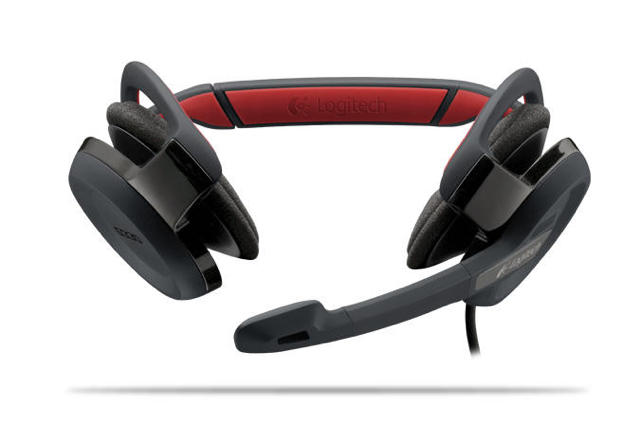
Logitech Thursday introduced the G330 gaming headset, designed to “combat fatigue” with a claimed ‘first-of-its-kind” behind-the-head design and a silicon-lined headband with pivoting ear pads to relieve pressure points.
Sorrell just got the MiFi — a mobile, battery-powered WiFi hotspot that can share a high-speed cell connection with several devices via WiFi. It’s sold in the U.S. by Verizon for $100. (Requires a two-year contract and a monthly plan costing $40 or $60 — 250MB or 5GB of data, respectively.)
The MiFi is fast and reliable, he says, and can be used with an iPod Touch to make Skype calls and play music streaming from Spotify’s fantastic music library.
“The real point is that if you have a mobile Wi-Fi hotspot in your pocket, it is going to be cheaper than an iPhone contract pretty much anywhere, and can not only enable your iPod Touch to have an always on connection, but let you make Skype calls and stream music without having to worry about the usual iPhone size limits, as you’re on Wi-Fi. You can also share the connection with five machines in total, including a netbook, for true on the go video calls and (gasp) Spotify.”
Setup was a little tricky and he’s not been using the setup long, but Sorrel thinks the combo could be all he needs. He’ll be testing his new setup in coming weeks and promises to report back.
If you’re running Leopard, hit Command + Shift + 4 and then the space bar, and you’ll see an icon of a camera that harks back to Steve Jobs’s days at NeXT.
The decades-old icon is one of the last visible vestiges of NeXTStep, the old operating system that laid the foundation for OS X in the late ’90s.
The camera icon looks dated, but it’s pretty good by today’s standards. Look at some of the Windows icons from the same period.
The NeXTStep camera can be found in the Resources of the Grab tool (in the Utilities folder) and comes in several different versions with eyes, stopwatches and camera flashes.
Other holdovers from NeXT in Leopard include various system sounds, including Basso, Frog, Funk, Ping, Pop, and Tink, as one commenter notes at Robojamie.net, which first pointed out the camera icon.
And as another commenter says, there’s another old icon in: /System/Library/Frameworks/AppKit.framework/Resources/NSMultipleFiles.tiff
It doesn’t seem to be used anywhere though.
Steve Jobs founded NeXT in 1985 after he was booted from Apple. He had the company build advanced workstations, hoping to drive Apple out of business. But its black magnesium NeXT Cubes were too expensive except for select clients in academia and the CIA. NeXT eventualy dropped the hardware to concentrate on the its state-of-the-art software and operating system, which Apple bought in 1996 as the foundation for the Mac OS.
Apple got a lot from NeXT: Jobs came on as an adviser, and eventually took on the CEO role. A lot of Apple’s top executives came from NeXT and so did lot of its technology. As well as basing OS X on NeXTStep, Apple has built a lot of its online offerings on NeXT’s WebObjects, including its first online store, the iTunes Music Store, its DotMac website and the iPhone App Store.
Philadelphia police are trying to identify a woman jogger wearing an iPod who was crushed to death Wednesday night by a falling tree.
Chief Inspector Scott Small of Philadelphia Police says a 30-foot-long tree branch fell on the woman from 50 feet above as she ran at 6:35 p.m. on Forbidden Drive, a popular gravel trail through Wissahickon Valley Park in the Northwest part of the city.
Police suspect she didn’t hear it coming because of her iPod, which they could still hear playing when her dead body was found.
The mystery jogger sustained head injuries, what appears to be a broken neck and a compound fracture of her right leg.
The woman police are looking for help to ID is described as white, in her late 20s or early 30s about 5-feet-5 and weighing 120 pounds.
I’d sent a follow-up question, asking Newsgator’s VP of Marketing about the expected pricing structure; here’s the answer, directly from Brent Simmons himself.
“The switch to in-app ads for NetNewsWire is not to make up for lost revenue from NewsGator Online nor is it about the economy.
“It’s common for consumer products to feature free, ad-supported versions and paid, ad-free versions. For example, Tweetie and Twitterrific — two very popular Twitter clients, as you know — offer free and paid versions. And FeedDemon, our RSS reader for Windows, has had ads for some time.
“This strategy gives people the chance to still use the app for free — while still giving a company a way to make money, which is a good thing. We felt the time was right to do follow this strategy with NetNewsWire. So there will be a free ad-supported version, and soon we will release a paid, ad-free version. (The two will have the same features: the only difference will be the ads.)
“We haven’t finalized pricing yet, but we’re looking at a range of $15 to $20, with special introductory pricing at first.”
So there you have it. Will you pay 15 to 20 bucks to remove ads from NetNewsWire? Your thoughts, as always, are welcomed.
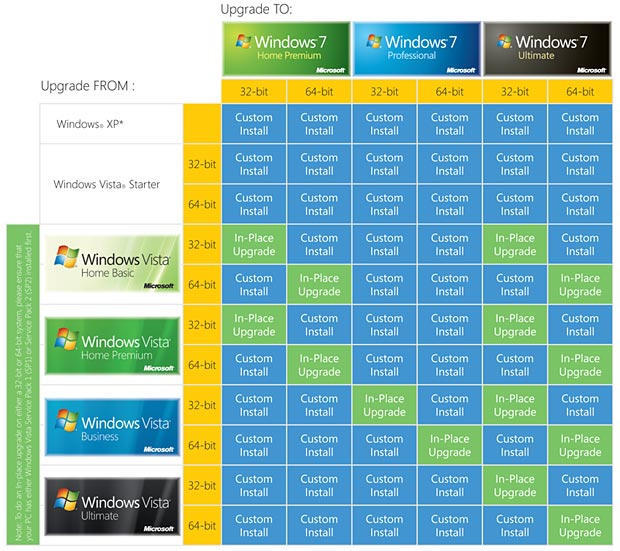
Walt Mossberg yesterday revealed Microsoft’s official chart that explains how you can upgrade your version of Windows. And I use the word ‘explains’ in its loosest possible sense, since Microsoft’s chart looks like this:
Clearly, this is a great example of how extra choice doesn’t always benefit the consumer. And for what it’s worth, all those blue boxes are boxes of doom—‘in-place upgrades’ (green) means the install will keep your files, settings and programs intact, but the more common custom install (blue) refers to a clean install, which will force a user to move their files, install the OS, replace their files and reinstall their apps. (And then, presumably, curl up into a ball in the corner of the room and weep uncontrollably.)
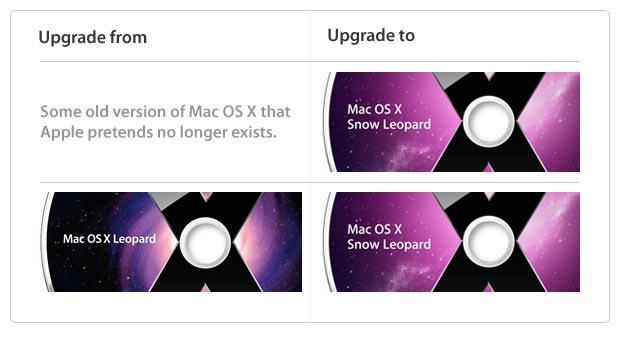
I thought it’d be useful to create a Mac equivalent for Snow Leopard. If you’ve got an Intel Mac, the upgrade path regarding installation is certainly a lot simpler:
And this is simplified even further if you’ve got a PowerPC Mac:
Just one day after earning congratulations for pulling the developer’s license of a prolific producer of useless (and possibly copyright-infringing) applications, propriety demands Apple receive a major Bronx cheer for the way the company treated Matchstick software and their Ninjawords iPhone Dictionary application.
The degree of censorship and hassle Apple forced Matchstick developers to endure in order to get their nifty $2 app listed on the App Store, as reported Tuesday at Daring Fireball, is simply unconscionable.
In recent weeks, Cult of Mac has reported a number of stories showing many holes in the tattered shroud of respectability with which Apple attempts to proclaim the innocence and purity of all things that might ever appear on the iPhone. The tale behind Ninjawords’ (iTunes link) tribulations would seem to set Apple’s high-water mark for institutional hypocrisy to date.
As Daring Fireball author John Gruber put it so well: Apple requires you to be 17 years or older to purchase a censored dictionary that omits half the words Steve Jobs uses every day.
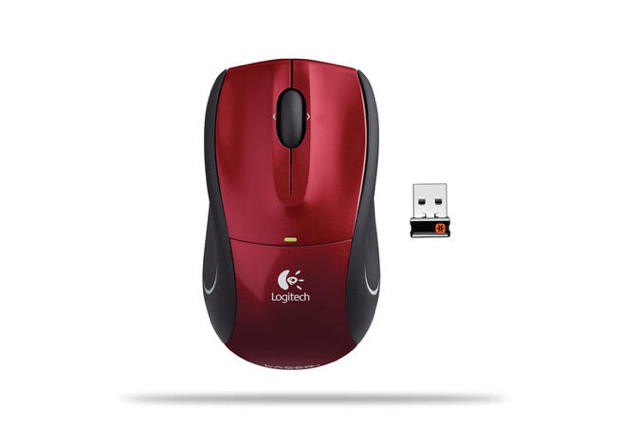
Logitech Wednesday introduced the M505 a new wireless mouse. The ergonomic laser device has a 15-month battery life and is compatible with the company’s Unifying USB receiver which allows you to add different mice and keyboards without additional receivers.
Ready to head-butt your Mac from the onslaught of everyday annoyances?
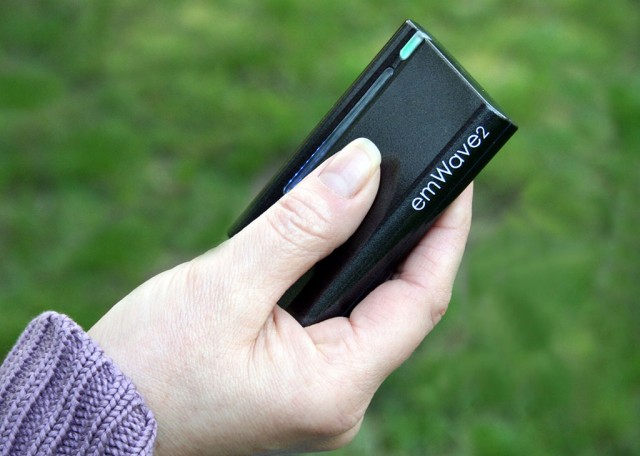
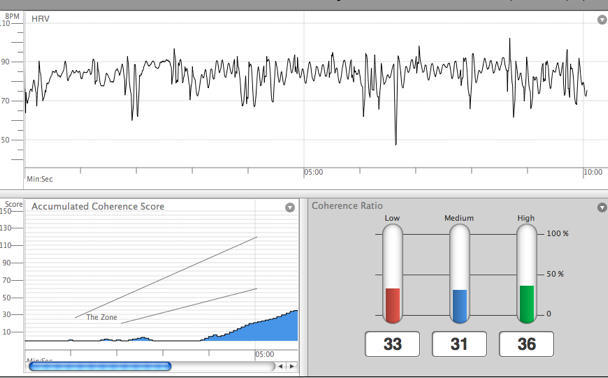
Use it for something better: emWave is a handy stress reducer just released in a Mac version that charts your heart rate and trains you to relax.
It’s the brainchild of Doc Childre, who founded a company called HeartMath in 1991 to create medi-gadgets for people seeking relief from stress and looking for greater mental clarity.
What is it?
Billed as a “Stress Relief System,” it promises big but comes in a small package. You get an ear sensor for your heart rate that plugs into a USB key and a software program that monitors your heart rhythms and breathing, plus a CD training guide. Initially unimpressed, after taking emWave through its paces for 10 days, I’m convinced nirvana may be something other than a band.
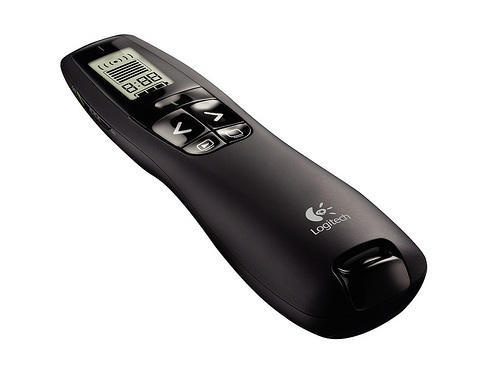
Have you ever been in the middle of pitching your $100 million start-up and you interrupt your patter to inform the room of angel investors to turn to the next slide? That’s the situation Logitech hopes to avoid with two wireless professional presenter gadgets introduced Wednesday.
What, you may be wondering, is going on over at Newsgator?
In a recent statement, the company (which owns NetNewsWire, the desktop RSS reader that pretty much defined the category on OS X) announced a fundamental change to its service: from August 31st, it will switch off the web-based RSS reader known as Newsgator Online for consumer users.
Newsgator’s existing desktop apps, including NetNewsWire, will continue to work. But if you want them to sync with other RSS readers, you’ll have to have a Google Account and do it via Google Reader, which will become your web-based viewer, replacing Newsgator Online.
And all this, of course, has consequences for users of NetNewsWire. A new public beta is out now, which supports the Google-based sync.
It also includes ads, distributed via The Deck. This last change has not been trumpeted with quite as much enthusiasm by Newsgator – advertising is not mentioned at all in the blog post that announced the changes.
Cult of Mac got in touch with NetNewsWire’s developer and mastermind, Brent Simmons, to ask him: what’s going on? And why the ads?