From the way Apple protects its iTunes business to theirefforts to block Google from competing equally on the iOS mobile advertising marketplace, Cupertino’s been provoking a lot of anti-trust talk lately.
Now it looks like the first official investigation into Apple’s business practices is about to be underway, courtesy of the U.S. Federal Trade Commission, who has completed negotiations with the Department of Justice to examine whether Apple’s limitations on software that can be submitted to the App Store unfairly harms competition.
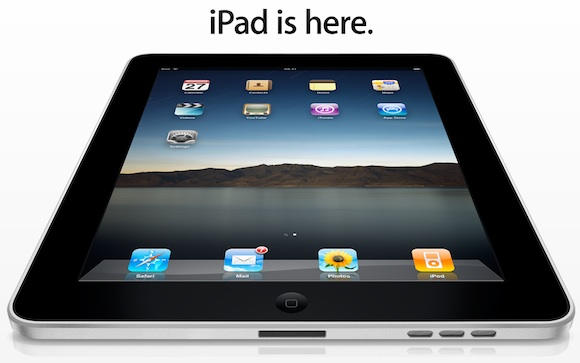
In the last three months, the hippest flight accessory has become the iPad, as legions of travelers have brought the magical future of computing on board to the envy and occasional derision of those less fortunate. Well now, soon you won’t need to own an iPad to feel superior to those suckers lugging around “books.” At least if you live in Australia.
Jetstar, the low-cost subsidiary of Qantas, has announced that it will make iPads available to its passengers for $8.40 per flight, allowing them to watch a small selection of movies, play games and read some pre-loaded e-books. No Internet access, sadly.
Still, it’s a lot more appealing than paying extra to rent headphones, no?
Like a Norman Rockwell painting trying to hit you with a bazooka, Valve’s fantastic team-based multiplayer game Team Fortress 2 is now available on Steam for Mac. Even better? It’s free to play this weekend for everyone with a Steam for Mac account, and if you want to play after, Valve has discounted the game by 50%.
I’m away from home right now, but my Steam name is “DrCrypt” if anyone wants to add me (be gentle… I suck). Also, when I get back, I’ll look to set up a Steam “Cult of Mac” group.
We close out the week with three hardware choices for our top deals. First up is anothe MacBook Pro from ExperCom. This time it is a 2.8GHz Core 2 Duo with 17-inch screen for $2,147. There is also a deal on a number of Macs, including an iBook G3 running at 500MHz for $189.99. Finally, we have a deal on a 2GB iPod shuffle for $35.
Along the way, we’ll check out several cases and skins for iPads, as well as the latest batch of App Store freebies. And, if you are into this year’s World Cup, there is a deal on a FIFA World Cup 2010 app for the iPhone or iPod touch.
As always, details on these and many other items are available at CoM’s “Daily Deals” page right after the jump.
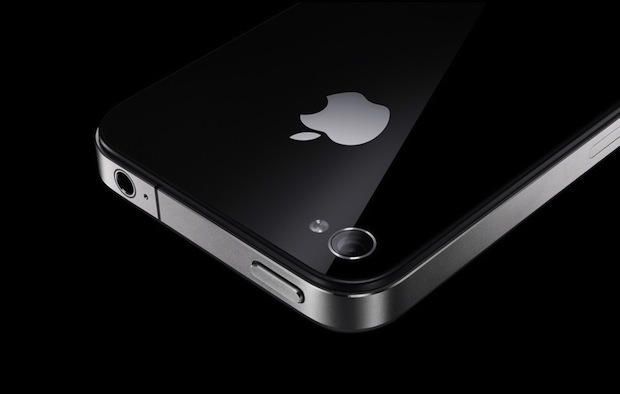
Apple newly-introduced iPhone 4 could be a record-breaker. Apple is accumulating millions of iPhone components, expecting its latest handset could break 10 million units sold in one fiscal quarter, reports suggested Friday.
Since May, Asia Optical has shipped an average of 3 million VGA lenses for the iPhone 4’s front-facing digital camera, according to the supplier’s chairman, Robert Lai. Apple’s orders mean up to 30 percent higher revenue for the company.
U.S. federal investigators are now looking into the breach of 114,000 e-mail addresses of iPad owners using AT&T’s website. The FBI said Thursday it was aware of a breach in AT&T’s online security and has begun an investigation.
Wednesday, carrier AT&T acknowledged the email addresses of iPad owners were compromised after a security group announced they had discovered a flaw in AT&T security allowing email identities to be gathered.
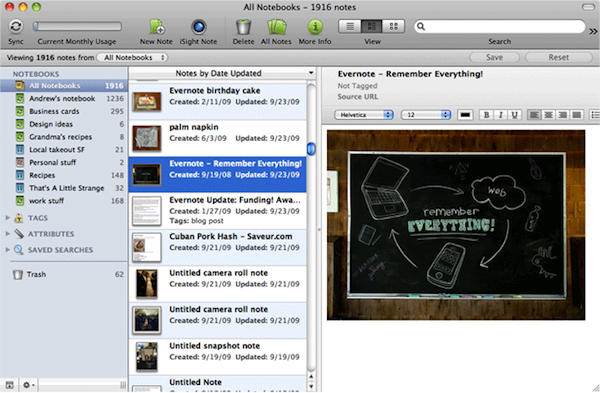
Whole civilisations have risen and fallen while the Mac community has discussed notebook applications. Everyone has tried different notebooks, and everyone has their own preference.
It’s hard to pin down just one, because the best ones each offer something unique; as a result, there might be a few mentioned in this series. But the first to qualify is Evernote.
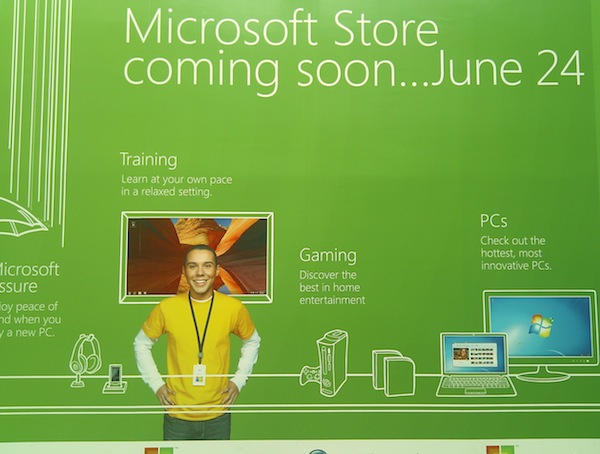
Boy! Come the iPhone 4 launch date of June 24th, which electronics store do you suppose is going to have the biggest line snaking out the door? Microsoft’s new store opening in San Diego’s Fashion Valley Mall selling an exciting array of obsolete Windows Mobile 6.5 smartphones, or the Apple Store selling brand new iPhone 4s just four blocks away?
The MacBook Air is a beautiful machine, but with a puny hard drive, no optical drive and one USB port, sometimes its paucity of ports and specs can put the pinch on you.
The Apricorn Aegis NetDock aims to help you supplement your MacBook Air’s specs by umbilicaling your USB port to an attractive little box that merges four USB ports (two of them powered), a dual-layer DVD burner and a 500GB hard drive (or, if you prefer, an empty 2.5-inch SATA hard drive enclosure).
It’s pretty tiny, too. The Apricon Aegis NetDock is only 6.25 x 5.75 x 2.125 inches. The only real problem is it requires a power cord, but powering all of this off of a single USB port is a bit much.
The Aegis Netdock costs $189, or just $89 if you supply your own hard drive.
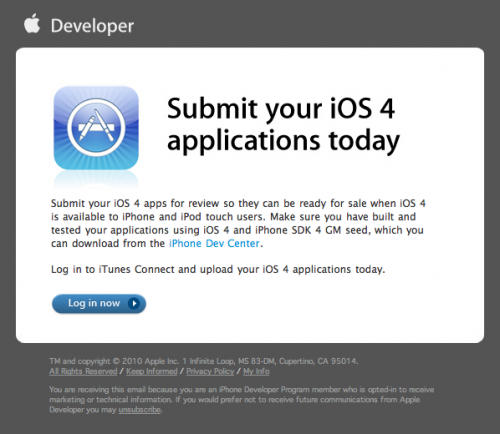
If you’re a developer itching to deploy any one of iOS 4’s 1500+ new APIs, good news: Apple has started accepting iOS 4 apps for submission.
There’s not much more to say, except for a personal plea to developers to get a move-on, since I want some multitasking apps to test come June 21st. And if you’re the developer of Skype or Reeder, that goes double for you.
Workers install suicide netting at a Foxconn plant. Image: NYT.
People are making a bigdeal about this report from Chinese news site ON.CC, in which they assert that the financial impact of Foxconn’s recent pay raises (a direct response to the dozen-odd suicides of workers this year) will cause the Taiwan-based contract manufacture to shutter its mainland China factories and lay-off up to 800,000 Chinese workers.
Uh, guys. Maybe we’re wrong, but didn’t we already talk about this? The ON.CC piece seems to be clearly referring to the recent shareholder meeting in which Foxconn announced plans to open a new automated facility in either Taiwan or Vietnam, and to offload some of the immediate work from its Chinese facilities to Vietnam as a counter-measure against the very worker stress that is prompting the Foxconn suicide problem.
Foxconn was explicit at that meeting that this was just workload lightening to give their Chinese workers a room to breathe. They’re not shuttering Shenzhen! They’re not laying off anyone… at least, in the immediate future. It’s just a badly translated Google page with a factually incorrect interpretation of what was discussed at the meeting. Or am I missing something here?
What exactly happened to cause the WWDC WiFi Meltdown during Steve Jobs’ keynote? Does Apple just not know how to set up a Time Capsule or what?
As it turns out, the problem was just what Apple said it was: too many 3G and MiFi devices. Over on the Future Tense blog, Glenn Fleishman has a very clear explanation of what happened and why.
A sensationally-titled piece over at Gadget Lab posted on Wednesday asserted that Jobs’ claims about the iPhone 4’s Retina Display being so dense that individual pixels were unobservable to the naked eye was “false marketing.”
Not so, says the Bad Astronomer himself, Phill Platt, who uses what he knows about optics and resolution from his years spent calibrating cameras aboard Hubble to prove that Jobs’ (mostly) told the truth when it comes to how the iPhone 4’s display looks from twelve inches away.
On Monday, Apple made a big deal about exactly how tough the new iPhone 4 glass was, bending it almost thirty degrees on stage without a sliver of a crack webbing across the glass.
Pretty impressive! Too bad you can’t even drop an iPhone 4 from waist height onto the ground without it shattering, finds repair shop iFixYourI (who don’t have an iPhone 4, but do already have replacement parts).
Where’s the blame, according to iFixYourI? The bezel. Previous iPhones had counter-sunk glass flush with the bezel, while the iPhone 4’s glass actually extrudes a little bit, so the bezel can’t protect it.
iFixYourI says design flaw. Possibly, but as a commenter points out below, it’s worth noting that a hollow iPhone 4 (as we have here) is going to have glass more vulnerable to drops than one supported by an interior hardware architecture. Furthermore, Apple seems aware of just this vulnerability: their new cases seem almost sole-mindedly designed around eliminating the exact sort of shock impact being discussed here.
Either way? Whether your fingers exude butter or not, you’ll probably want one of Apple’s new iPhone 4 bumpers. Probably the pink one, too.
We start off the day with another deal on MacBook Pros. ExperCom is offering a 2.8GHz Core 2 Duo with 17-inch screen for $2,147. Next is a number of iPods, including a 4GB iPod nano for $69.99. Our last top deal is the latest batch of freebies from the iPad App Store, including “Air Guitar HD,” which simulates an actual instrument.
Along the way, we check out some new case for the iPhone 4, iPhone 3 and iPhone 3GS. Also up is the latest App Store price reductions for iPhone and iPod touch users. As always, details on these and many more items are available on CoM’s “Daily Deals” page right after the jump.
The Cult of Mac team had a rollicking good time at BoxTone’s iNSpired party, checking out the machines and chatting to devs.
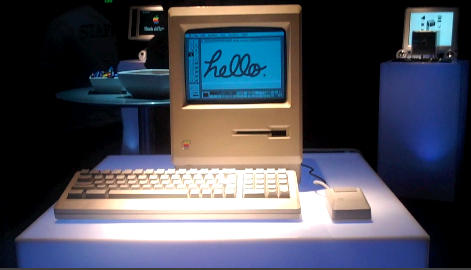
There were about 20 Apple machines on show, from the Apple I to the iMac. The best part, they were working machines — something the organizers probably regretted with a room full of people intent on playing with them while downing beer and inhaling scrumptious mini-sandwiches.
httpv://www.youtube.com/watch?v=DBQJ7eLx1Jo
We start with Wendell Sander, Apple employee no. 16, who fires up his Apple I for a memory dump using an iPod.
As a big fan of the sport, I’ve played a lot of soccer games on the iPad – from full 3D soccer sims like Real Soccer, to little 2D 1-on-1 games. However the most addictive pick-up-and-play soccer game I’ve played so far is easily Deadball Specialist HD by Full Fat Productions Ltd, which pushes your finger flicking skills to the limit!
T-Mobile — not Verizon — is more likely to get the nod when Apple is expected to expand it U.S. iPhone carriers as early as this fall, one analyst suggested Thursday.
Kaufman Bros. analyst Shaw Wu told investors the likelihood that Apple will add a second iPhone carrier in the U.S. to augment the currently exclusive arrangement with AT&T is “closer than reality than ever.” Additionally, “we continue to believe that T-Mobile USA is the most likely candidate given its use of similar cellular technology as AT&T,” he wrote.
Such a deal would have advantages both for the carrier and the Cupertino, Calif. iPhone maker. “We are picking up that T-Mobile views the iPhone as a key in winning back lost customers and as such could be more likely to agree to Apple’s terms,” according to Wu. Verizon and Apple reportedly have been at odds over the iPhone’s price. Apple wants Verizon to pay $700 per iPhone, while the carrier is paying $400 per Droid, an Android-based rival, according to analyst Maynard J. Um.
Also, Apple sees expanding the iPhone’s availability beyond AT&T as a way to counter the growth of such handsets as the Droid. Google has taken advantage of the single source for iPhone owners to offer its Android platform on a number of U.S. carriers. The tactic has propelled the iPhone rival from 0 percent of the market to 9 percent.
“Our sources also indicate that one of the key reasons why Apple is more open to adding U.S. carriers in the 2011 is to attack Android more directly,” Wu told investors. “Looking at industry data, Android’s wins have been where iPhone isn’t available and that could change dramatically if the iPhone were available on more carriers,” the analyst adds.
Another point in T-Mobile favor is technology. T-Mobile’s 3G service operating at 1700MHz and 2100MHz, which closely matches the iPhone 4 and iPhone 3GS’ 2100MHz 3G. AT&T supports 850MHz and 1900MHz frequencies.
Apple has settled claims with state regulators who allege the company mishandled electronic waste. Photo: Thomas Dohmke
Apple’s decision to restrict what companies can serve ads to iOS-based mobile devices has caught the eye of federal regulators who reportedly have opened an investigation into the practice. The Cupertino, Calif. company plans to launch its iAd service July 1.
Although its unclear whether the Department of Justice or the Federal Trade Commission would lead the investigation, regulators have “taken an interest in Apple’s actions,” according to the Financial Times, which cites two unnamed sources. The probe seems centered on an iOS developer agreement that limits user data to “an independent advertising service provider whose primary business is serving mobile ads.” Rivals argue the language blocks Google’s AdMob, as well as Microsoft’s advertising service.
From Barcelona-based Herraiz Soto (the same people who brought you zen text editor Ommwriter) comes another idea for your notebook Mac: Bros and Mos, aka Stick with me baby.
They’re decorative stickers that add a little personality to the Apple symbol on your computer’s lid.
The stickers are made with 3M Controltac (whatever that is) and the designers say they won’t leave any nasty sticky marks on your laptop. But they are easy to put on and peel off as the mood takes you.
Each sticker costs eight Euros – about $9.60 at today’s exchange rate. But that does include shipping.
We’ve known for some time that the iPhone and iPod Touch are not as secure as we would like them to be — and unfortunately the same can be said about the new iPad. The lack of built-in encryption leaves our personal data on any of these devices at risk. Luckily for iPhone and iPod Touch users third party vendors are supplying apps that help fill some of these gaps in security. One such app, which was popular on the Palm OS platform, is SplashID from SplashData, Inc., which stores all your passwords, logins, and banking details.
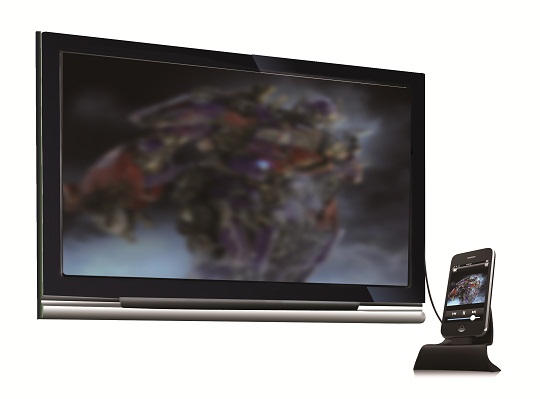
Looking for a stylish and affordable way to hook your iPhone or iPod to your 50-inch plasma? Konnet Technology has just unveiled its new, $49.95 ReflexDock Pro, which looks like a pretty fantastic tool for the job.
In addition to piping out your audio and video to a larger screen thanks to included AV Out cables, the ReflexDock Pro also will charge your iPhone. It even includes features like Advanced Sound Reflection, designed to enhance audio and speaker quality when the iPod or iPhone is docked. And yes, Virginia, it’s iPhone 4 compatible.
My only criticism is actually the image Konnet is choosing to use to showcase their product. Sure, it’s a pretty accurate appraisal of how an iPhone-compressed video will look when smeared across a 50-inch plasma without the proper encoding, but creative license and all.
According to Slashgear, the ReflexDock Pro should be available soon on Amazon.
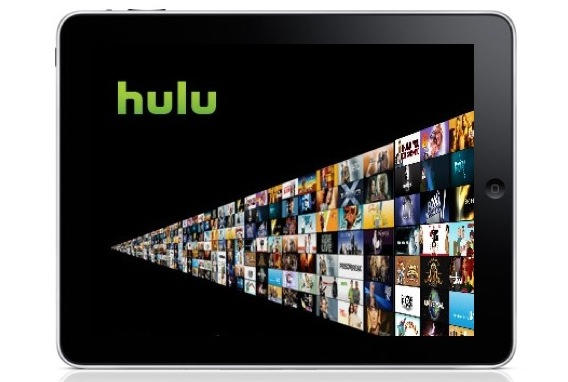
According to a new report by Reuters citing three inside sources, everyone’s favorite television streaming service Hulu is preparing a subscription-based service that will be available on numerous non-PC devices, with the iPad and Xbox 360 prominently named.
Other than that, there’s little information, but rumors in the past have indicated that a premium Hulu service would be subscription-based and get you access to a complete library of older content, as opposed to free Hulu’s library of newer episodes and randoms.
Since Hulu hasn’t announced anything at this week’s WWDC, if the rumor is true, it’s likely that they will announce their plans for the Xbox 360 console at next week’s E3 gaming expo.
The question is: Netflix is already available for the iPad, and it already offers a lot of old television shows available for streaming. Is there room for another subscription-based service on the iPad streaming much of the same content?
A few days after Tweetie for Mac was named a winner in Ars Technica’s design awards for best Mac OS X software, Tweetie and Twitter for iPhone developer Loren Brichter has said that an iPad version is in the works… and he soon plans to get back into the update cycle for Tweetie for Mac as well.
Yesterday, we posted an iBook that had been hollowed out and modded into a working iPad keyboard dock.
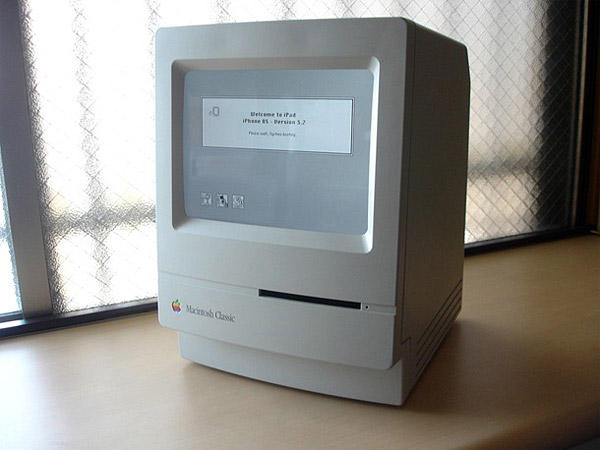
Today? The same concept, but accomplished far more elegantly with a vintage Mac Classic… complete with a custom MacOS desktop to keep things appropriately retro.