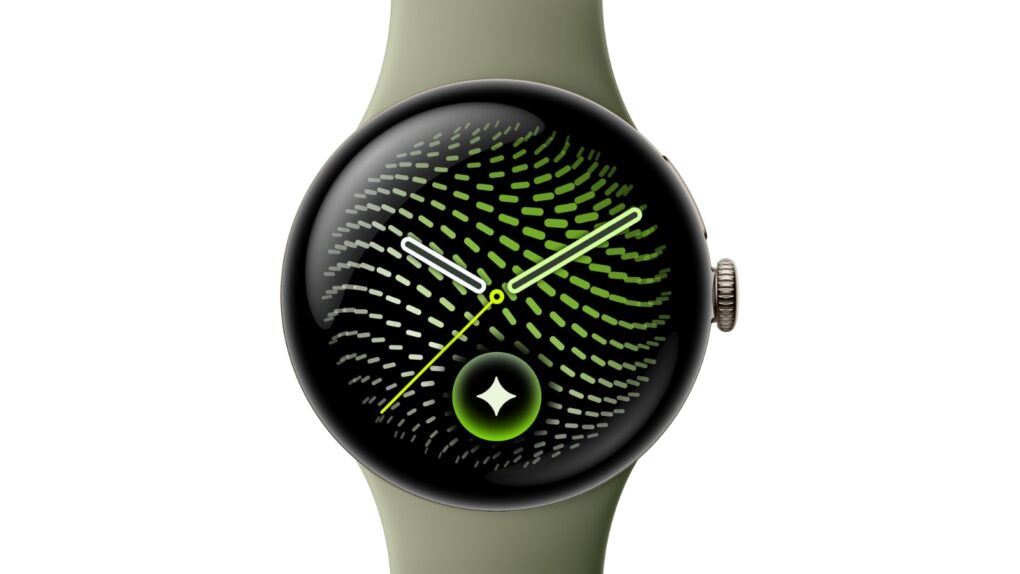
People often accuse Google of stealing from Apple, but here’s something Apple should pinch from its rival ASAP.
The new Pixel Watch 5, unveiled Wednesday at the annual Made by Google event, comes with a new feature that can predict insulin resistance, a precursor to Type 2 diabetes. If flagged early, insulin resistance can often be reversed with lifestyle changes.
“A first-of-its-kind feature on Pixel and Fitbit wearables, Insulin Resistance Trends analyzes multi-week physiological data to track shifts in your metabolic health without requiring a single drop of blood,” Google said in a press release Wednesday.
It’s not the sort of full-blown blood sugar monitor Apple has been trying to build into the Apple Watch for years. However, Pixel Watch’s Insulin Resistance Trends feature could spot changes in the health of someone wearing the device in time for them to take action. And that could keep them from a potentially deadly diabetes diagnosis.
Google’s Pixel Watch 5 tracks insulin resistance
The power of putting health features like this into a wearable like the Pixel Watch or Apple Watch lies in the noninvasive, round-the-clock monitoring the devices provide — and their ability to spot dangerous trends over time.
Rather than a continuous glucose monitor that samples your blood and alerts you about a sugar spike in real time, the goal is to watch how your body works and tell you when something seems amiss. Then, you can seek advice from a doctor and/or make necessary lifestyle changes.
Spotting burgeoning insulin resistance could prove unbelievably helpful in battling Type 2 diabetes, a condition that affects more than 460 million people worldwide. The disease can cause a wide variety of health problems, potentially damaging the eyes, kidneys and cardiovascular system.
It’s the ninth leading cause of death, according to WebMD, resulting in about 1 million lives lost per year. And yet, many people don’t realize they’ve got a blood sugar problem until an A1C test reveals they are prediabetic.
What is insulin resistance?
Insulin, a hormone released by the pancreas, regulates blood sugar levels in healthy individuals. After you eat, food breaks down into sugars that rush into your bloodstream, and the pancreas pumps out insulin.
“Insulin acts like a key to let blood sugar into your body cells, which use the sugar as energy,” according to the U.S. Centers for Disease Control and Prevention.
If your metabolic system functions properly, your body uses that fuel and your blood sugar level drops back to normal. If not, things go awry — and your blood sugar levels remain high.
That, in turn, starts a vicious cycle. Your pancreas releases more and more insulin in an attempt to get the sugar out of your blood and into your cells. But eventually, your cells don’t respond as well — that’s insulin resistance.
The resulting persistent high blood sugar prompts your pancreas to release more insulin, but at some point, the organ can’t keep up. Blood sugar continues to rise, leading to prediabetes or Type 2 diabetes.
The Pixel Watch’s Insulin Resistance Trends feature aims to spot this hazardous progression of events before things get out of hand.
How the Pixel Watch’s Insulin Resistance Trends feature works
Google’s system works by measuring the wearer’s resting heart rate and heart rate variability, two metrics that the Apple Watch already tracks.
A higher resting heart rate correlates with increased insulin resistance, as does lower heart rate variability during sleep, according to a recent study conducted by Google researchers and published in Nature, titled “Insulin resistance prediction from wearables and routine blood biomarkers.”
Google’s Pixel Watch and Fitbit devices also monitor the wearer’s physical activity and some sleep and respiration metrics, such as skin temperature variation and respiration rates while sleeping.
Google then feeds this data into an AI model that monitors these metrics over a rolling window (one week to six weeks). All that information helps the AI estimate metabolic trends. The software tries to determine if the wearer’s body is working harder to process energy, a sign of elevated insulin resistance.
The company describes it as “actionable fuel gauging,” a measure of how effectively your body manages its glucose levels.
“Think of it as a personal efficiency meter, giving you a sense of how efficiently your body absorbs energy from food and manages it throughout your activities,” according to Google.
An early alert that can motivate lifestyle changes or medical intervention
If insulin resistance is flagged early enough, it could motivate Pixel Watch or Fitbit wearers to make the kinds of lifestyle changes that could keep them from developing Type 2 diabetes.
“Identifying [insulin resistance] early can guide several focused lifestyle interventions, such as weight loss, regular exercise and a healthy dietary pattern, that can substantially improve or even reverse [the condition],” according to the paper’s authors.
Since the Apple Watch gathers similar data, it’s conceivable that Apple could cook up a watchOS update that provides the same sort of background monitoring to spot insulin resistance.
Google’s Health Guardian features
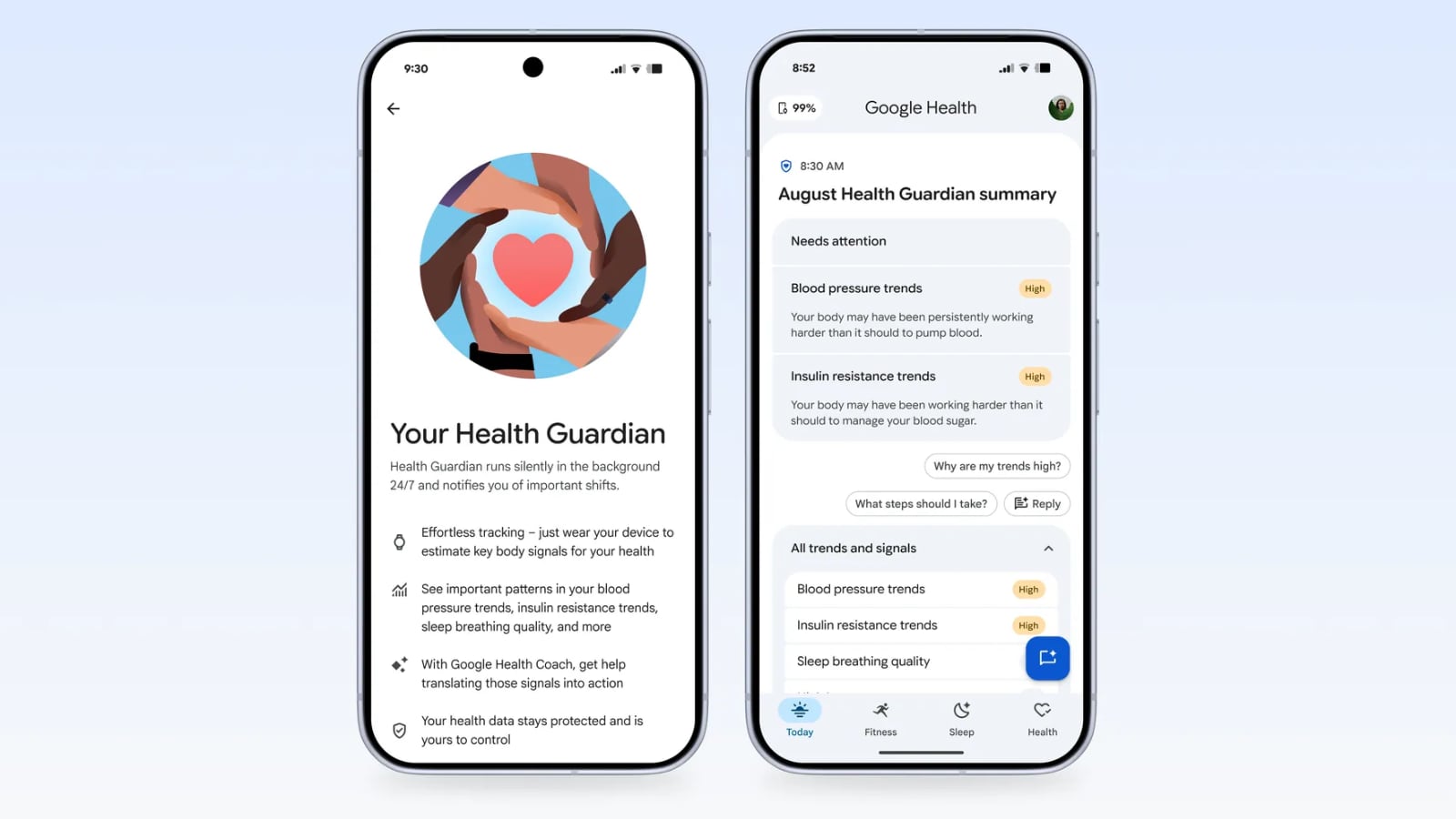
Image: Google
The Pixel Watch’s Insulin Resistance Trends feature is part of the Google Health app’s new suite of proactive health and safety tools called Health Guardian.
“By working quietly in the background 24/7, Health Guardian features can track usually invisible health and wellness indicators, such as insulin resistance trends,” Google said in a different press release Wednesday. “The information is shared in a monthly summary in the Google Health app that highlights noteworthy shifts. You can also get timely notifications if a feature detects something that requires your attention.”
While the insulin resistance feature jumps ahead of Apple Watch’s current capabilities, other aspects of Health Guardian — tracking blood pressure and sleep breathing quality– are playing catch-up to Cupertino’s offerings. (Apple Watch added hypertension notifications in 2025 and sleep apnea monitoring in 2024.)
“Every Health Guardian feature has undergone thoughtful clinical validation with gold-standard ground truth devices and measurement protocol, incorporating feedback from the scientific community,” Google said.
But there are caveats
Still, as with many such non-medical features on Apple Watch, the new Insulin Resistance Trends features come with a beefy disclaimer.
“This product is not intended to diagnose, mitigate, treat, or cure any disease,” Google said. “This product is not a prescreener for diabetes nor is it intended to monitor glucose levels in real time. Do not use this product for diabetes management or rely on this product to alter any medications or insulin levels. Consult a medical professional for any questions about your metabolic health.”
Why this kind of proactive advice matters
As a person recently diagnosed with Type 2 diabetes, I really hope the Apple Watch adds this type of insulin resistance detection feature (perhaps as a stepping stone to actual blood glucose monitoring).
After I got my surprise diagnosis last December, a combination of exercise, medication and dietary changes helped me drop my A1C from off the charts to the prediabetic range.
If my Apple Watch had alerted me to possible metabolic changes, perhaps that would have lit a fire under me to seek medical advice and make crucial lifestyle changes earlier.
“Over 40% of adults live with quiet, invisible changes in how their bodies process energy,” Google said. “Because you can’t necessarily ‘feel’ insulin resistance, you might not realize your body is struggling to manage glucose and is putting stress on your body. Our technology brings those unseen signals into the light, allowing you to fine-tune your energy management with simple daily choices.”
Google Pixel Watch 5 preorders
Google Pixel Watch 5 comes in two sizes, 41 mm and 45 mm. Its design retains the circular, bezel-free glass look of the Pixel Watch 4, with a rotating crown and side button. And there’s a new 45 mm Special Edition Stephen Curry model, with a satin pyrite aluminum case and a Rye Performance Loop Band.
The Google Pixel Watch 5 is available for preorder now, starting at $399, and it ships August 20.
Google says the Insulin Resistance Trends feature is “coming September 2026” to Pixel Watch 3, 4, 5 and Fitbit Air.
Preorder from: Google
Leander Kahney contributed to this report.

Lewis Wallace is the managing editor of Cult of Mac and author of our weekly newsletter, The Weekender. He appears weekly on the Cult of Mac podcast. You can find him on X @lewiswallace.


3 responses to “Pixel Watch 5 adds a feature Apple Watch desperately needs”
Without a real sensor it’s an educated guess.
I’d like to see the opposite. I’d like Apple (and Google, I suppose) sell me a watch WITHOUT and health and performance features at all. Strip out all of the sensors, reduce the size of the watch. Just apps and notifications. I want the total opposite of those Google Fitbit, Whoop, Garmin devices. I want all of those health features removed and just create a smart watch.
Bill, this is a really interesting idea. I read your comment and disagreed, thinking to myself, “but a lot of people love these features and these devices really have become health devices.” Then I thought about it, and I think you might be on to something…
Keep the Apple Watch as is. Keep the Apple Watch Ultra as is. These two devices are health-tracking centric.
Make the Apple Watch SE without health features and, because it has less hardware, drop the price a bit.
Or, if you want a high-end health-sensor-free model, maybe a thin Apple Watch Air.
What do you think?