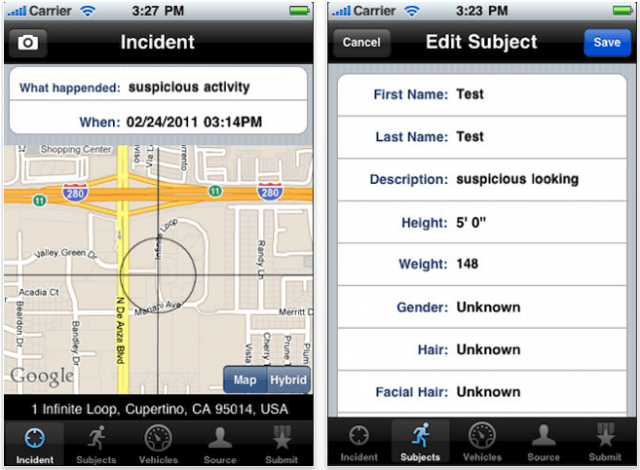
Concerned citizens in Kentucky can report “suspicious activity” to their state branch of Homeland Security through an iPhone app.
Called Eyes and Ears of Kentucky, the app is offered gratis on iTunes. The handiwork of developers NICUSA, it has been in the store since March 7. So far, it has not received enough reviews to reach an average rating. Through the app, you can report a suspicious incident or activity along with details about the alleged subjects and their vehicles.
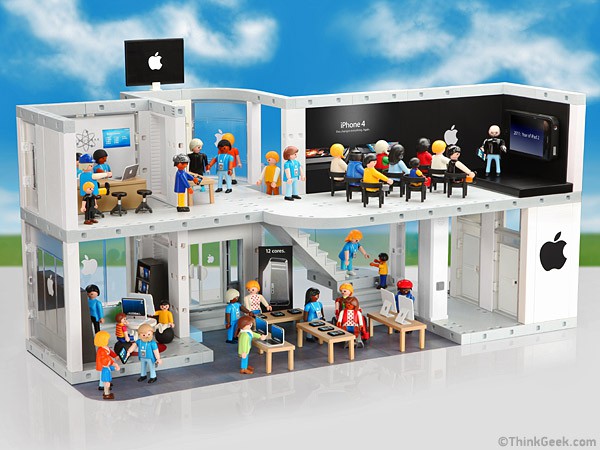
Unlike iFixIt’s gag, this Playmobil Apple Store Playset isn’t a real product, but if enough people are interested and Apple’s lawyers look the other way, maybe it could be.
From the description:
A quick peek at the miniature Genius Bar and we were feeling a bit woozy. Then we saw the tiny Steve Jobs presenting in the Keynote Theater on the top floor and that was it. Our wallets popped out faster than you can say Jonathan Ive and we plunked down whatever money was needed to own this amazing playset.
Of course, once we had the playset, we had to get the optional Line Pack to simulate our own exciting Apple product launches. Since it comes with a tiny Woz on a tiny Segway, it was a no-brainer. We decided that Apple & PLAYMOBIL™ together is the most unlikely and awesome collaboration ever. It changes everything.
Think Geek’s brought its April Fool’s Day products to market before, so it’s possible this could become real someday.
Soon, Little Rock, Ark. may be known for more than being the site of former U.S. President Bill Clinton’s library. Reportedly, Apple may open its first store in the city of 190,000 this October. Before you get your bags packed for the ribbon-cutting, be aware there’s been similar chatter since 2007.
However, a blog that tracks Apple’s retail moves reports the Cupertino, Calif. company has signed a lease in the Chenal Mall. If the report bears out, the addition could remove a gaping hole in what is described as a ‘black-out zone’ for Apple retail locations. The zone stretches from the Gulf to southern Missouri.
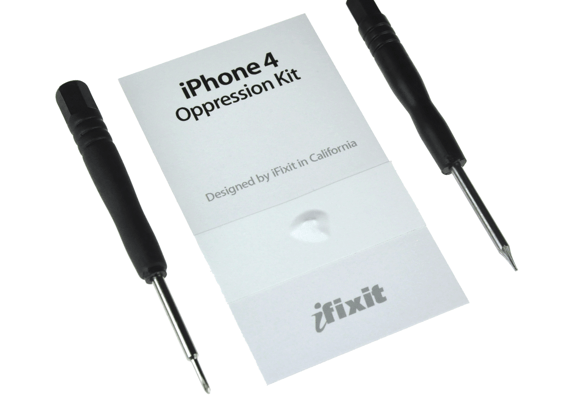
When you bring in your iPhone for repair, Apple has a nasty habit of replacing your iPhone’s standard Phillip’s Head screws with proprietary pentalobular torx screws, which require a very special driver to remove. The result? It becomes all the much harder to repair your iPhone yourself.
iFixIt‘s April Fool’s Day joke this year may be a gag, and a good one, but it’s also a real product: an iPhone Oppression Kit that allows you to replace normal phillips screws with pentalobular ones, or vice versa. $10.
Today’s April Fools Day, which means that most of the news today will be in the form of witless lies propagated by mouth-breathers to try to “gotcha” bloggers, all to appease some ancient Pagan God. We will be doing our best not to partake in the festivities, so in the mean time, please enjoy this video of a Claymation iPad, produced by Svetlana Shokhanova at the British Higher School of Art and Design in Moscow.
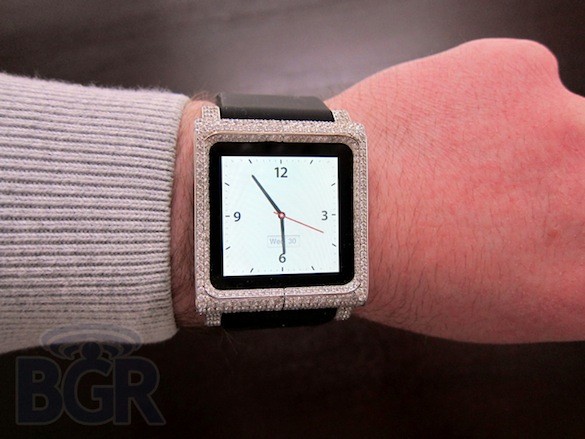
The formula for transforming a stock Apple product into something worthy to be sold for a boatload of money to the most garish of Beverly Hills Frankensteins and gaudiest of Middle Eastern Oil Barons is as old as time: buy something from the Apple Store, drizzle it in glue, then roll it in crushed glass and gold foil and voila: a luxury iProduct.
Here’s the latest: the ZShock Lunatik iPod nano watch case, a product with its audience clearly identified in the title. Diamond-encrustations, white gold, Apple’s second-cheapest iPod, all yours for just $18,000.
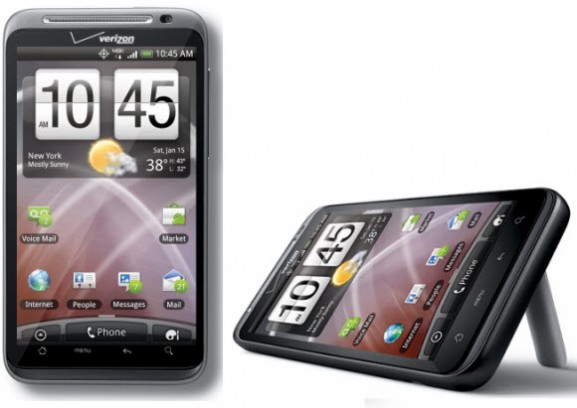
How successful might an iPhone 5 be on Verizon’s LTE, or 4G, network? Although the new handset with support for the faster technology isn’t expected until late this year, we can get a glimpse via Verizon’s recently-introduced Android-based Thunderbolt from HTC. Nearly a third of Verizon stores report the Thunderbolt is outselling the iPhone.
While 61 percent of the 150 Verizon stores polled by BTIG analyst Walter Piecyk said both the iPhone and the two-week-old Thunderbolt are selling equally well, 28 percent of the locations report more customers are asking for the Android-based smartphone. Just 11 percent said the iPhone is preferred.
Acer CEO Gianfranco Lanci becomes the latest head of a PC company to exit after fighting a losing battle to topple Apple’s domination of the tablet market. Apple’s successful iPad and other products is seen as the “key reason” why Lanci left.
Executives at Motorola, Toshiba, Sony, Lenova and Asustek Computer reportedly could also be dethroned, according to an industry publication, citing unnamed sources. “First-tier smartphone and PC brands are still unable to find an effective strategy to counter Apple’s advance,” the Taiwan-based DigiTimes writes.
Supplies of the first-generation iPad are now beginning to dwindle away as Apple sells off the last few units of its original tablet. Since the launch of the iPad 2, the original model has been sold at a discounted price through the clearance & refurbished sections of the Apple online store, and on Thursday the 16GB Wi-Fi model disappeared completely.
32GB and 64GB models of the Wi-Fi iPad are still available in the refurbished section, but there are only 3G models left in clearance.
Despite the launch of the iPad 2, it’s expected that the remaining iPad stock won’t stick around too long thanks to the generous reductions Apple has made to their price tags. The 16GB model was previously listed at $349 before it sold out – $150 below its original asking price – but the cheapest model now left is the refurbished 32GB Wi-Fi at $429.
So, if you’re not happy with a 4-week wait for the iPad 2, and you’re happy to settle for the first-generation device, you’d better get your order in quick before the device is no longer available from Apple.
We’re hearing rumors that Steve Jobs is on the verge of resigning from Apple.
Nothing more than that: Jobs is about to leave the company he co-founded 35 years ago. The anniversary of Apple’s founding is today. It was established on April 1, 1976.
This is totally unconfirmed, but there is chatter about it. A local TV news channel has also been asking about the rumor.
Maybe it’s an April Fools’ joke. Most likely, it’s just the Silicon Valley echo chamber. We’re throwing it out because there’s talk about it.
Jobs is still on medical leave that began in January.
Calling himself “Steve Jobs’ best customer,” a politician in charge of a government efficiency drive in the U.K. hopes to end the “monopoly” from companies like Microsoft, Fujitsu, BT and HP.
Ian Watmore, former head of the e-Government Unit, is now CEO of the coalition government’s Efficiency and Reform Group. He’s calling for smaller, less expensive IT projects (capping them at £100m), criticizing the previous administration’s “over-ambitious projects.”
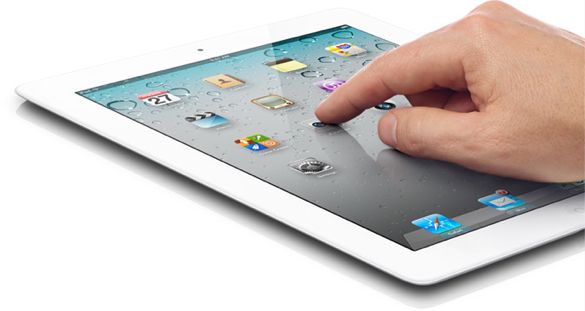
If you are wondering just how briskly the iPad 2 is selling, you don’t have to wait until Apple announces official sales figures – just ask the online auction site eBay. Thursday morning, the service announced just under 12,000 of the new generation tablets were sold in the two weeks between the start of U.S. sales and the recent launch in 25 additional countries.
Among the interesting figures, a majority (65 percent) of iPad 2s sold through eBay went to domestic customers, nearly double the 35 percent for the original iPad in 2010. Canada and Russia topped the list of international destinations for the iPad 2. Intriguingly, Russian demand for the iPad 2 is much higher than for the first tablet, according to eBay.
If you’ve been wondering when Adobe’s Photoshop offerings on iOS are going to stop being so lame, don’t worry: Adobe’s working on an awesome new iPad Photoshop App, and they just debuted it at PhotoShop World. Make sure to stick around to the end when they show off the 3D style layers animation at the end. Wow.
Bono Vox reportedly handed over another iPod in the name of diplomacy, this one loaded with music by U2 for Argentina’s President Cristina Fernández de Kirchner.
U.S. President Barack Obama famously gave the Queen of England with an iPod, loaded with majesty-friendly music like “Dreamgirls” and “The King and I.”
3D is the newest craze in gadgetdom — or, at the very least, a lot of gadget makers would like it to be — and it looks like even Cupertino is interested in getting in on it. a new patent says that Apple has been exploring a multi-camera system for 3D picture taking, hinting at a future iPhone 3D.
Apple appears to be doing its part to revive the U.S. economy. Taiwan-based chipmaker Samsung reportedly will hired 300 new technicians in its Austin, Tex. plant to fill a growing number of orders for the iPad 2. Meanwhile, the Cupertino, Calif. tech giant is paying a little-known company three to four times the going price for LCD screens destined for the new tablet.
Samsung Austin Semiconductor plans to hire 300 more engineers, with most of the plant’s chip production reportedly going to Apple. The new workers follow more than 600 hired in 2010, brining the plant’s total payroll to around 1,700. Although rumor suggested Apple may have used its own A5 chip in the iPad 2, closer x-ray examination found Samsung still powering the next-generation device. Apple is expected to spend $7.8 billion with Samsung this year, purchasing processors, flash memory and LCDs.
Apple has released the next beta version of Mac OS X Lion. The new release dubbed Developer Preview 2 build number 11A419 is available to registered Mac OS X developers through the Mac App Store. Developers wishing to acquire this release must visit developer.apple.com and request a redemption code.
In addition to the above Apple has also made Mac OS X Lion Server Developer Preview 2 with the same 11A419 build number available. Both releases are accompanied by Xcode 4.1 Preview 2 which is the pre-release version of Apple’s Mac OS X development suite.
Contrary to rumors none of these releases have been labeled as Gold Masters. Instead according to developers the builds still have a number of issues that are outstanding and unresolved.
The release of Mac OS X 10.6.7 isn’t even two weeks old and Apple has issued a supplemental update that patches the latest OS release. The patch fixes problems encountered by late 2010 13-inch MacBook Air users who upon launching iTunes experienced crashes that left their computers completely frozen and unresponsive.
I even experienced it myself before the problem mysteriously disappeared after forcing the machine to restart by powering it off and then on again. Since then I haven’t had a problem, but for some the problem persists. Luckily Apple has a fix.
According to Apple:
This update addresses an issue that makes the system unresponsive when using iTunes. It is recommended for all 13″ MacBook Air (Late 2010) users running Mac OS X v10.6.7.
You can grab this update via Software Update on your Mac or download it directly via this support page.
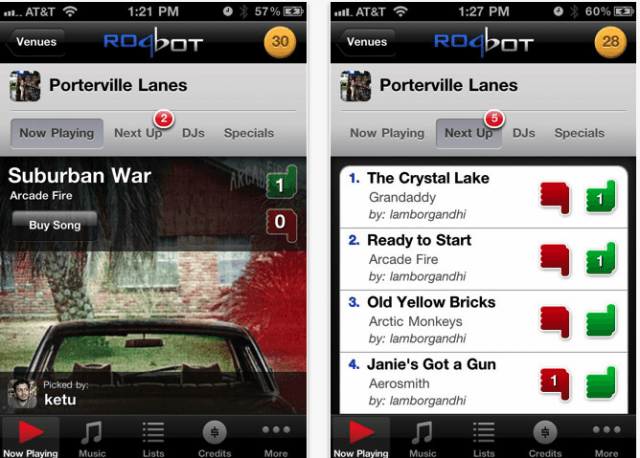
Roqbo, a jukebox app with the inevitable social media component that debuted at SXWX, is now animating one San Francisco bar.
CTO Ketu Patel got the brainwave for it because walking over to select the right tunes on the jukebox at the bowling alley in his small California town was ruining his game mojo.
Instead of waddling around with change for the jukebox, you can buy credits or earn them by interacting with the app – confirm your email address, rate songs on the bar’s playlist, or post your picks to Facebook or Twitter and you get more DJ credits.
Roqbot runs on any internet connected computer, iPod Touch, or Roku hooked up to the locale’s speaker system and owners can choose what music plays when from 20 catalogues or create their own playlist. The app is free to download for users and available for iPhone and Android.
The app currently is getting the most traction at San Francisco SOMA watering hole Bar Basic, where the six top spinners there have been playing stuff like Lil Wayne “A Milli” and Far East Movement “Girls on the Dance Floor.”
Anyone up for a Cult of Mac meetup and DJ-off there?
Word that Apple may not release the iPhone 5 as early as expected prompted some observers to talk of a “delay.” Naturally, Wall Street’s sensitive rumor tripwire went into action, the result the start of analysts downgrading estimates for the iPhone.
Piper Jeffries’ Peter Misek Wednesday morning shaved four percent from his fiscal year 2011 revenue projection, telling investors he expects the Cupertino, Calif. company to rake in $103 billion, rather than his previously estimated $106.9 billion. The fiscal year ends September. More dramatic is the analyst’s double-digit refiguring of iPhone shipments.
For months we’ve been reporting that iPad sales are eroding demand for traditional PCs, such as netbooks. Little wonder then top executives have begun sniping at Apple as inflexible and only for consumers with oodles of cash. The most vocal sour grapes come from the sales and marketing heads at HP and Dell.
“I can say that it really feels like they’re [Apple] holding you hostage sometimes,” said Stephen DeWitt, senior vice president of HP’s Americas Solution Partners, talking in an interview about the difference between how the PC maker and the Cupertino, Calif. tech giant work.
Now here’s a relationship that’s off to a good start. 9to5Mac reports on a couple of lovely geeks – or a couple of geeks in love – who just got engaged with the assistance of an iPad 2 and Apple’s custom engraving. Lucky groom-to-be Jordan wrote to tell them the story:
I stayed up all night to order my iPad with the inscription “Will You Marry Me?” Received mine this Monday, Took my then-girlfriend, Jessica, up to the National Redwood Forrest in Northern CA. After having to cross a river on a downed Redwood and dealing with the intermettant rain I found the largest tree in the world I kneeled down and gave it my best!
Whether it was something I said or “Apple’s Magic” in action she gushed and said YES, now give me my iPad!!
Congrats to the happy couple, and good work Jordan! Another reason to order your iPad online and avoid standing in line.
There’s been a lot of press lately about Time Warner Cable’s foray into portability by offering its subscribers access to their programming via their iPads.
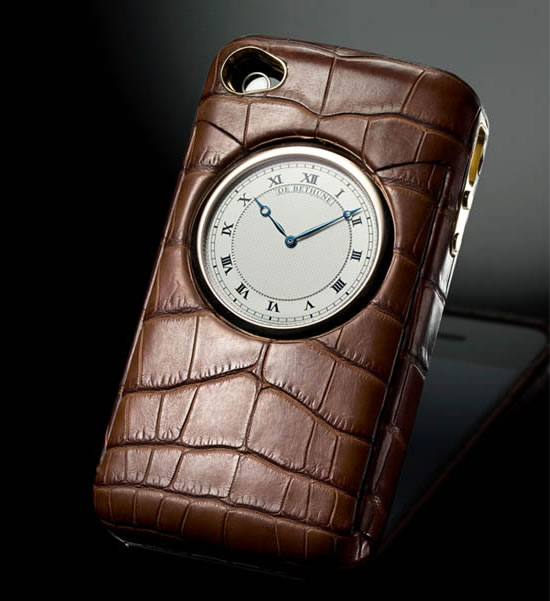
With iPhones and other devices replacing watches as personal timepieces for most people, analog craftsmen of yore are looking for other ways to ply their trades. Juxtaposing timekeeping technology across the centuries, luxury watchmaker De Bethune has introduced a new iPhone case that incorporates their DB 1024 pocket watch mechanism directly into the back panel of an alligator leather sleeve. It’s rather… unique. For those who can’t decide whether you prefer analog or digital, now you won’t have to make the choice.
I’m not sure the watch would provide good impact protection during a fall, however – for itself or the iPhone’s rear glass. Would that require another case to protect the first one?