It’s our own fault. We all asked Apple to dramatically change the look and feel of the iOS operating system, which, until yesterday, remained largely unchanged since the introduction of the original iPhone back in 2007. And we all complained when it didn’t do that with iOS 6 this time last year.
But I can’t help but feel the Cupertino company is now punishing us for all those requests, and all that complaining we did before about its skeuomorphic designs.
When it comes to design, iOS 7 is vastly different to its predecessors. It still functions in much the same way — though there are some new features you’ll need to get used to — but it looks completely different. As soon as you power it up for the first time the minimalistic feel is staring back at you, but it isn’t until you’ve completed the setup process and arrived at your home screen that you want to vomit in your own lap.
I’d be happy if it weren’t for the icon designs.
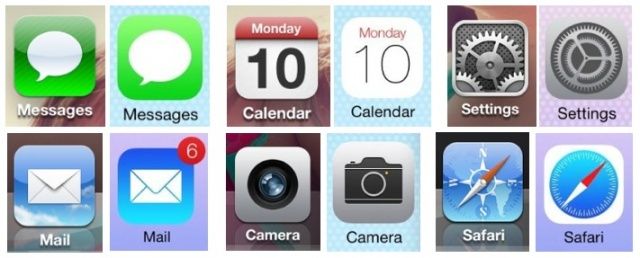
The majority of Apple’s own app icons in iOS 7 are completely different to those from iOS 6. Apple has now adopted the “flat” design we’ve all been hearing so much about, doing away with the funky reflections that previously made icons look like they were almost sat on top of the display.
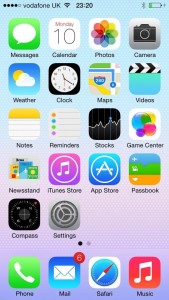
And I’d be happy with that if it weren’t for the icon designs. There are a couple that look good. The Clock icon is great — maybe because it’s one of the few that haven’t changed dramatically — and it now shows the actual time (finally!). And the Music, App Store, and iTunes icons are… okay, too.
But then there’s Game Center, Weather, Newsstand, Reminders, Safari, Camera, Mail, and Settings. Oh, Settings… what happened there?
These icons look amateur — like someone installed Photoshop on Jony Ive’s Mac for the first time, and he knocked them up in 30 minutes before he went out to dinner. They’re inconsistent, and many just look out of place.
The Game Center icons looks completely different to everything else, as does the Maps icon, and the Weather icon looks like it was designed for a toddler’s play phone. Some icons have gradients, some don’t, and others others just have too much white space.
When you mix them all together, they look like a mismatched mess — a jumble of colors and textures that don’t belong together. If Apple had followed some kind of theme, then it wouldn’t have been so bad. But as I noted on Twitter last night after installing the iOS 7 beta, it’s like every Apple executive (or intern?) was allowed to design one app icon each, but they weren’t allowed to see each others’ before they were all thrown together.
iOS devs, please don’t ruin your app icons just because Apple did.
— Killian Bell (@killianbell) June 10, 2013
Although I didn’t mind the skeuomorphic look in previous iOS releases, I can understand why some people didn’t like it. But trust me, this is worse. At least the previous icons looked like someone painstakingly agonized over the designs and spent hours perfecting every little detail.
But there are no details to perfect with these ones; they’re just blobs of color with what looks like bad clipart stuck on top.
Then there’s Control Center, which provides you with quick settings toggles, a brightness slider, music playback controls, buttons for AirDrop and AirPlay, and shortcuts to a flashlight, the Clock, the Calculator, and the Camera.
There’s no sense of organization in Control Center.
There’s hardly any color here; there’s a slightly transparent background with dark grey text and icons on top of it, and sliders and active settings are white. There’s also no sense of organization, and again, no consistency. For example, the Clock and Calculator icons looks nothing like their actual app icons.
The Control Center isn’t customizable, either, so you can’t replace shortcuts you don’t use with others that might be more helpful to you, which is a shame.
Fortunately, it’s not all bad news. In places, iOS 7 looks great.
Fortunately, it’s not all bad news. In places, iOS 7 looks great, and actually very impressive.
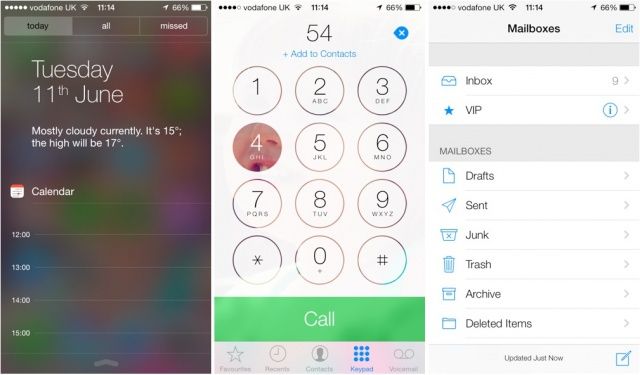
The Notification Center has lost the linen background in favor of a dark transparent panel, and it looks nice and modern. It also displays the date, a brief weather forecast for the day, and your upcoming appointments. Notifications are split into two sections now — “all” and “missed.”
I’m also a big fan of the new dialer inside the Phone app. Like Notification Center, it’s modern and simplistic, and it has a really nice touch — when you press a digit, your wallpaper shows through, and it looks really nice.
The Mail app also looks fantastic, and it kind of reminds me of Windows Phone.
iOS 7 isn’t a complete shambles, then, but I’m really disappointed in some of the changes Apple has made. Although iOS 6 and its predecessors weren’t perfect, they were at least beautiful.

Killian Bell is a freelance writer based in the U.K. He has an interest in all things tech and also covers Android over at CultofAndroid.com. You can follow him on Twitter via @killianbell.

50 responses to “iOS 7 Reminds Us To Be Careful What We Wish For”
Yes, iOS 7 was designed by tech blogger whining, and only implemented by Apple, who had absolutely no internal vision for what it should be. It sounds like I’m being sarcastic, but I am not. iOS 7 really is that bad.
For months and months before iOS 7 was debuted, I would read and hear tech bloggers pleading for iOS to be made ugly and techie and academically correct (that is, it arbitrarily has flat design, it arbitrarily doesn’t have skeuomorphism) and I was like, “WTF are you guys thinking? That is an awful idea!”
The thing is, if you are a computer scientist, then you see the primary function of an iPhone or iPad is “to run apps.” But if you are everybody else, you see the primary function of an iPhone or iPad is “to morph into other devices.” For example, my iPhone often morphs into a tiny music studio, so I can write songs wherever I am. It morphs into a calculator device. It morphs into a metronome. It morphs into a typewriter. It morphs into a movie camera. It is so good at morphing into these things that it has obsoleted many of the dedicated devices, and even put the makers out of business.
So the skeuomorphism that people were complaining about was *not* skeuomorphism. The definition of that ugly and abused word is when you make a new thing and you dress it up to look like the old thing. Computer scientists see the iOS 6 calculator app as a new thing — an app — that is dressed up as an old thing: a pocket calculator. But to the rest of us, we don’t care it is an app, or even know it is an app — to us, the iOS 6 calculator app *is* a calculator. The fact that it is an app is an implementation detail that is irrelevant to users — that is “backstage.” The fact that it is a calculator is the only interesting thing about it — that is “onstage.” So the calculator app should look like a calculator (very obvious raised and rounded buttons, very prominent display, styled like jewelry) not an app (gradients, blue underline links, lots of square space.)
So after replacing all the devices we use with one morphing device that can become any other device, now, with iOS 7, Apple has now imposed a computer/techie edict: “all your music studios and calculators and metronomes and typewriters and movie cameras will now look like computer apps instead of looking like music studios and calculators and metronomes and typewriters and movie cameras. Why? Grids and defer to content. That is all.”
That is to say: all of the tools and instruments you use will now represent computer/techie culture (underlined blue links, flat icons, techie symbols everywhere) instead of representing music culture, art culture, writing culture, business culture, and all other human endeavors. Forget about how calculators and metronomes have typically been a kind of beautiful jewelry — henceforth, they will be flat, bland computer apps. Forget about how buttons have typically been carefully designed to be inviting to the touch — henceforth they will be underlined words.
You know that Apple commercial where the athlete throws the hammer at the screen to free the people from the dull gray technology that is ruining their creativity and their lives? I feel like the guy on the screen is the one who iOS 7 is designed for. I think the bright colors are a kind of disguise. But if you look at iOS 7 in grayscale, it is obvious it is just gray, grim space. If you look at something that is truly beautiful in grayscale, it stays beautiful.
And the usability has suffered so much, because people don’t know how to use computers! That is why they bought Apple devices! To get a music player instead of a computer that can play music.
My friends consider me to be a technical person because I make art and music with computers for many years now, which before the original iPhone/iPad meant I had to learn a lot of computerese. I can’t tell you how many times they have shown me their iPhones and asked me to decode a glyph that they don’t know what to do with, and I have to say, “in computer culture, that glyph means DELETE.” I can’t tell you how many times they have gotten stuck in an interface and asked me to tell them how to get out, and I have to say, “you tap the word HIDE” and they say “to hide what?” and I have to explain you are hiding the dialer to get back to the primary view of the phone app (all computer culture, no phone culture) and then they ask, “how am I supposed to know that HIDE is a button?” and I say it is underlined, or it is in a particular color, which varies from app to app — that is how (more computer culture — buttons aren’t finger-shaped things you press, they are words with underlines, like the WorldWideWeb in 1990.)
I used to tell people to get an Apple product because it will be great and it will get incrementally better over time, and it will treat you well, and it will be beautiful at every level, and it will delight you in unexpected ways, and that will improve your life in many subconscious ways. And then I would tell them that even if that all doesn’t turn out to be true for them, the Apple products are the most reliable, secure, and have by far the best apps and accessories and support (this was true of the Mac also, before the iPhone.)
Now, I am sort of eating my words because the only reason I still use Apple products is they are the most reliable, secure, and have by far the best apps and accessories and support. The delight is gone, replaced by there is no other choice, because I need these apps. The liberal arts are gone, replaced by computer science and academic design philosophies. The idea of starting with the user and working back to the technology is gone, replaced by starting with the academic philosophies and working back to the design college professor and tech blogger.
Notice how when somebody defends iOS 7, they always do it with an academic computer science argument. There is a grid! There are flat icons! It looks and works more like a computer! I can “multitask” better! I haven’t seen a single pro- iOS 7 argument that told me something I can do with an iOS 7 iPhone that I couldn’t have done just as well with a theoretical iOS 6.5 iPhone that included minor functional updates to features like FaceTime Audio calls or app thumbnails in the app switcher. What is it that the massive visual redesign and all my time re-learning my iPhone because of it is going to get me? What can I now do that I couldn’t do before?
Notice that the app switcher got a functional redesign, but the Messages app did not! The first time I accidentally sent a text to the wrong person with an iPhone was June 2007, and the Messages interface in the 2014 iPhone is functionally the same! It still doesn’t show a photo of the person I’m sending the text to, even if I have put a photo of them in my Contacts. It still shows too little of the person’s name. It still can be confusing if you start a FaceTime call from the Messages app and then a message comes in, and you end the call and you are in a different user’s conversation and may or may not know that. But priority: computer science multitasking. Deprioritized: the needs of actual human users.
So I think iOS 7 is a dramatic failure. It may be a great-looking, great-feeling, great-functioning COMPUTER, but it is a terrible-looking, terrible-feeling, terrible-functioning iPhone/iPad. If I wanted a computer, I wouldn’t have bought an Apple device. I know that hurts the tech people who work at Apple. I know it hurts the tech bloggers who cover Apple. But you are not the center of this world. The users and the many fields of human endeavor that they are pursuing are the center of this world. Apple really let a lot of people down.
So I think iOS 7 is a dramatic failure.
Sorry, John, but you are wrong. If iOS 7 was such an unmitigated diaster, the rest of the industry would have held their ground and round buttons and chrome would have held sway on every other mobile OS but Apple’s.
The exact opposite effect has occurred.
Hhfhiib,