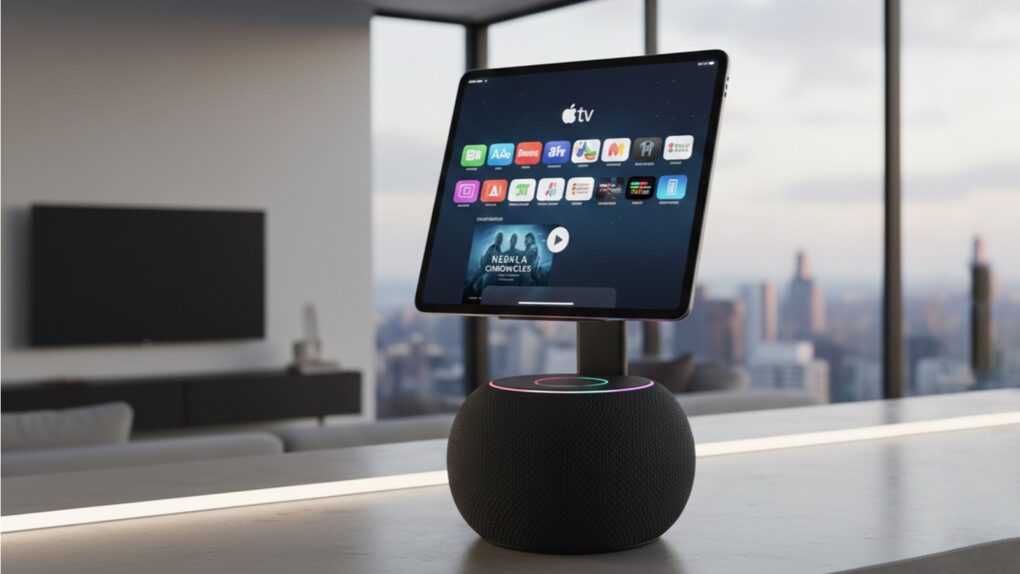
Apple once again delayed its long-awaited smart home hub with a display — casually known as the “HomePad” — until around September as the company continues struggling to get its revamped Siri voice assistant ready for prime time, according to a report Monday.
Apple postpones ‘HomePad’ amid Siri delays
The setback is the latest sign that Apple’s AI ambitions are proving harder to execute than anticipated, with ripple effects delaying hardware products that have otherwise been ready to ship for months, Bloomberg‘s Mark Gurman reported.
A device waiting on software

AI image: ChatGPT/Cult of Mac
The smart home hub with display, internally code-named J490, has actually been finished from a hardware standpoint for several months, according to Gurman. The problem isn’t the device itself — it’s the software meant to power it.
Siri, which serves as the central interface for the product, isn’t ready. Apple initially planned to ship the display in spring 2025, then retargeted a launch for this month. Now, with Siri still not where the company wants it, the launch has slipped again to the fall.
Apple now aims to tie the display’s release to tvOS 27, the next major version of its Apple TV operating system, which is expected in September alongside iPhone 18 Pro. An earlier plan called for the device to ship with tvOS 26.
What the device actually does
The J490, which may or may not be called “HomePad” when it launches, is a 7-inch touchscreen display with a single USB-C port and Apple’s signature silver aluminum finish, according to Gurman. Users can mount it on a wall or place it on a half-dome-shaped speaker base. The home screen uses circular app icons arranged similarly to the Apple Watch interface.
HomePad’s headline feature is a facial recognition system. It identifies household members as they approach, then surfaces personalized content like reminders, calendar events, notes, news and music preferences — without any input needed. That kind of ambient, context-aware experience is exactly why a more capable Siri is so essential to the product working as intended.
The broader Siri problem
AI image: Google Gemini/Cult of Mac
Apple has worked for a while to overhaul Siri and make it a more modern AI assistant. In other words, one that can tap into users’ personal data to answer questions more meaningfully and operate as a true conversational AI rather than a simple command executor. But the company has repeatedly pushed back features, including some announced to consumers nearly two years ago.
Apple originally hoped to deliver its full suite of new Siri capabilities in the 26.4 software update cycle, but testing has shifted those features into the 26.5 and 27 release windows. The company’s target is to have everything ready by the time iPhone 18 Pro ships this September.
Apple postpones ‘HomePad’ amid Siri delays: What comes next

Illustration: Midjourney/Cult of Mac
The J490 is only the beginning of Apple’s home ambitions. A larger 9-inch version with a robotic arm is reportedly planned for 2026, alongside a compact home security sensor. Apple is also developing a new HomePod without a screen and an updated Apple TV box, both tied to new AI features. The current Apple TV hardware hasn’t seen an update since 2022.
Further out, Apple has been working on AI-powered accessories, including a wearable pendant, camera-equipped AirPods and smart glasses. Scheduled to follow the new Siri’s rollout, they shouldn’t suffer unless development continues to slip.
Apple enters the smart home market years behind Amazon and Google. Those rivals put AI-powered home displays on the market some time ago. Still, Apple gains an advantage thanks to its massive installed base — the company reported more than 2.5 billion active devices globally in January — and its deeply integrated ecosystem. Whether that’s enough to make up for lost time may depend heavily on how the new Siri actually performs when it finally arrives.
Apple declined to comment, according to Bloomberg.

David Snow, an expert on Apple hardware and software, writes on a variety of technological and cultural topics for Cult of Mac. They include Apple news, technology buying guides, and features about computer setups and Apple TV shows and movies.
With 30 years of experience covering technology and other subjects, he has written and edited for numerous print and online publications, including CMP Media, TechTV.com, CNET, Wired News, Red Herring magazine, Law.com, The National Law Journal and Law Technology News magazine. Among other roles, he served as executive editor of the Law.com network of websites and editorial director, technology, for ALM Media.
Snow graduated with a B.A. from Syracuse University with majors in magazine journalism and psychology. While there, he worked as a reporter for The Daily Orange newspaper and associate editor of Equal Time magazine.
Founder of the blog At the Waterline, he can be reached on X (formerly Twitter) via @atthewaterline and on Mastodon via @dsnow.

