
Apple is putting the pedal to the metal as it rushes to produce new types of AI-powered wearable devices. Three products — smart glasses, upgraded AirPods and an AirTag-size pendant — will rely on built-in cameras, the iPhone’s processing power and the upgraded Siri voice assistant to power new AI capabilities.
A new report, based on anonymous sources within the company, sheds light on what the devices will look like, what they will do, and when we can expect them.
New details on Apple’s AI wearables
While Apple’s hardware prowess remains unrivaled, the company’s AI efforts currently fall far short of competitors’ capabilities. Embarrassing delays in rolling out the AI-upgraded Siri — envisioned as a key component of the AI wearables — continue to dog Cupertino.
But Apple promises to deliver a smarter Siri later this year. And we could see the first of the company’s new AI-focused hardware in 2026 as well, according to a Tuesday report from Bloomberg.
After lackluster sales of its expensive Vision Pro headset, Apple is looking for a hardware hit in a new product category. One of these wearables could be the one!
Apple smart glasses to compete with Meta
Apple plans to launch smart glasses with high-definition cameras built into them. The glasses will take on the likes of the growing Ray-Ban Meta lineup. While Apple initially considered partnering with eyewear makers, the company has now decided to design its own frames.
“The design uses high-end materials, including acrylic elements intended to give the glasses a premium feel,” according to Bloomberg. “Apple is already discussing launching the device in additional styles over time.”
They will come in several sizes and colors, with Apple’s high-end build quality and camera tech differentiating them from the competition.
“Apple has made significant progress in recent months on its glasses, code-named N50, and has recently distributed a broader set of prototypes within its hardware engineering division,” according to Bloomberg. “The company is targeting the start of production as early as December, ahead of a public release in 2027.”
Apple’s smart glasses will come with two camera systems. One will capture high-def video and still images, while the other will provide input for AI-powered features.
Apple reportedly sees the glasses as an “all-day AI companion” capable of capturing actionable information about the wearer’s surroundings. The eyewear might, for instance, identify objects the wearer sees, a la the iPhone’s Visual Intelligence feature. Or the smart specs might recognize landmarks to make navigating through city streets easier.
After seeing the success of Meta’s smart glasses, Cupertino prioritized development of its AI glasses. The company reportedly put a more affordable version of its Vision Pro headset on the back burner to bring the glasses to market faster.
AI pendant will take on OpenAI’s devices
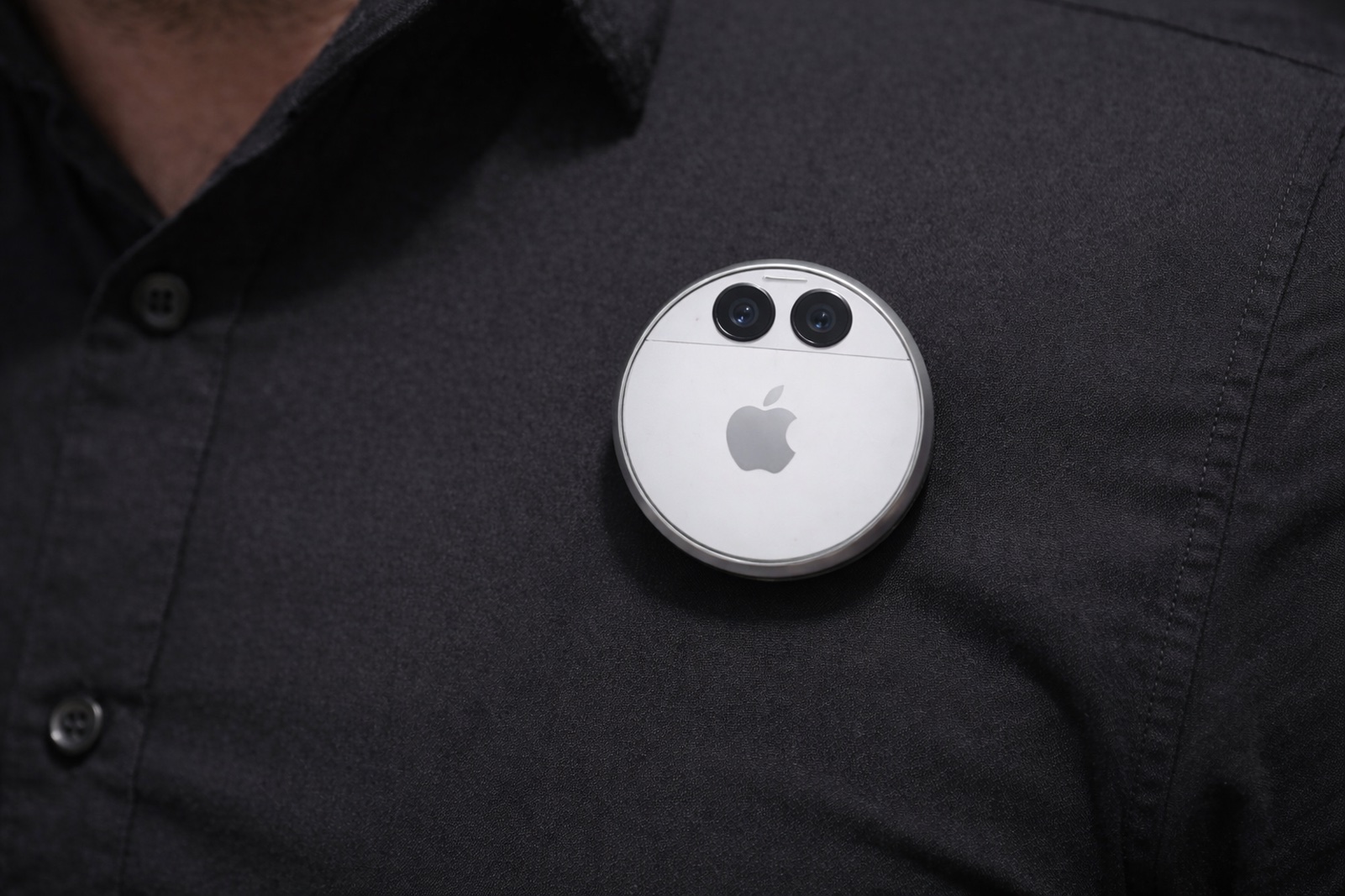
Concept image: ChatGPT/Cult of Mac
Apple’s rumored smart pendant, previously described by The Information as an AI pin incorporating cameras and microphones, would be clipped onto clothing or worn on a chain around the neck.
Like the smart glasses, Apple’s AI pendant would capture video constantly and feed that data to the iPhone.
“Some Apple employees call it the ‘eyes and ears’ of the phone,” according to Bloomberg.
Apple is rushing to beat OpenAI to market with this type of novel AI device. OpenAI, which teamed up with former Apple design chief Jony Ive to work on hardware, reportedly wants to produce “AI companion” devices.
Unlike Humane’s failed Ai Pin, Apple’s AirTag-size pendant would not come with lasers or any other sort of display. Apple has not yet decided whether to add a speaker to the AI pendant, according to Bloomberg.
The device is at an early stage of development and could be canceled. If it does see the light of day, Apple’s AI pendant “could launch as early as next year,” Bloomberg said.
AirPods with cameras for AI tasks
As previously reported, Apple plans to add cameras to AirPods that will enable advanced AI features. As with the AI pendant, the updated AirPods will come “equipped with lower-resolution cameras designed to help the AI work rather than for taking photos or videos,” according to Bloomberg.
The AirPods with earcams could arrive as early as this year. OpenAI is reportedly developing AI-powered earbuds that could launch this year. (For more info, see: OpenAI’s first device might take on AirPods.)
Apple’s intense focus on AI
Apple CEO Tim Cook recently addressed employees, trying to get them psyched up about the company’s AI ambitions. The talk followed Apple’s revelation that it will rely on Google Gemini to underpin the long-delayed smarter Siri.
“There will be new categories of products and services that are enabled through AI, and we’re extremely excited about that,” Cook said. “We’re excited about the opportunities that it opens for Apple.”

Lewis Wallace is the managing editor of Cult of Mac and author of our weekly newsletter, The Weekender. He appears weekly on the Cult of Mac podcast. You can find him on X @lewiswallace.

2 responses to “3 game-changing AI wearables Apple is rushing to launch”
Hyping up a turd, no one wants any of this fake AI garbage.
How can they “rush these to launch” when they can’t even get AI/New Siri to work? AI is a big black eye for Apple that I hope they correct soon.