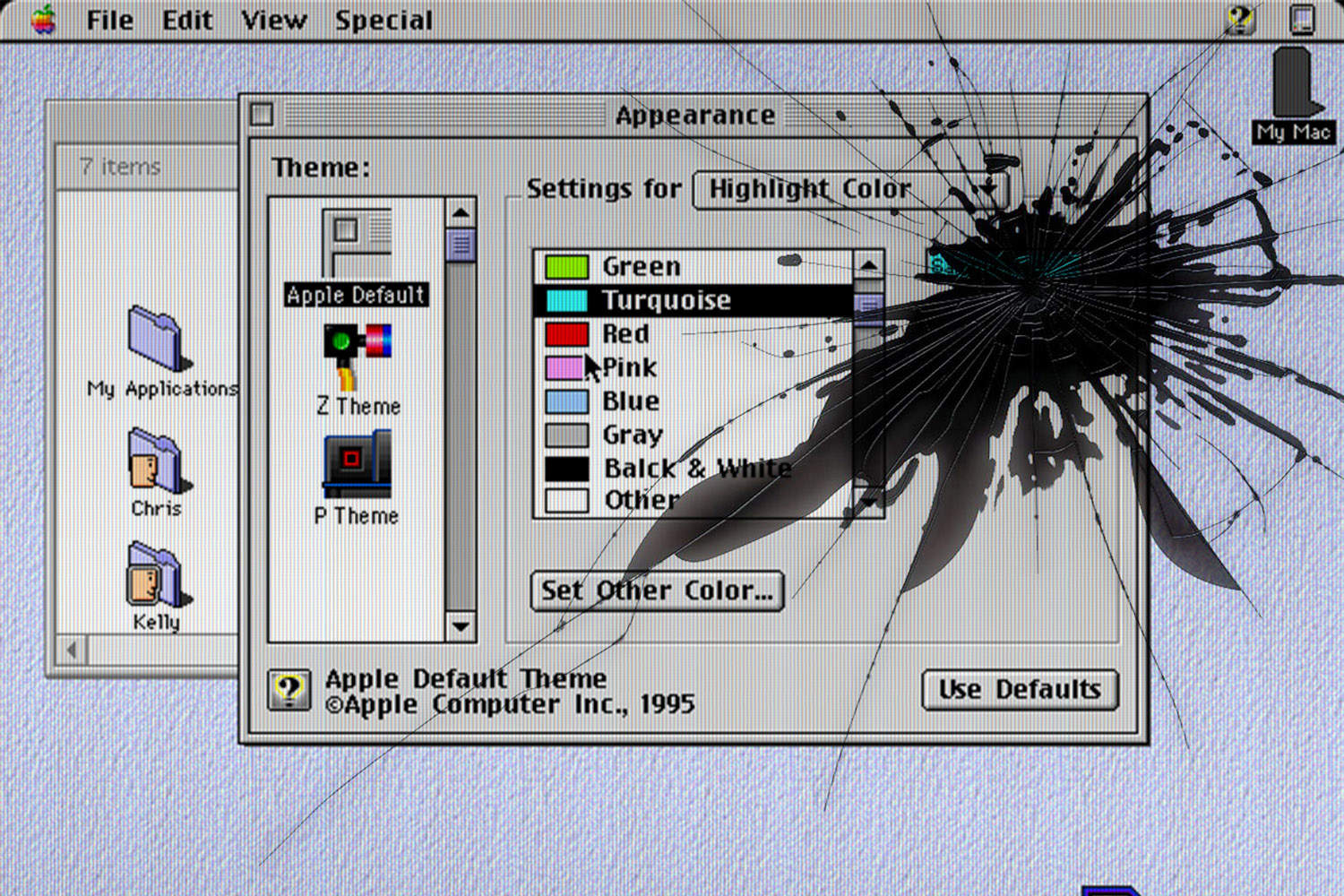
 April 26, 1996: Mac OS Copland, Apple’s eagerly anticipated but much-delayed operating system for the Macintosh, suffers a fatal blow when the senior VP in charge of the project leaves the company.
David C. Nagel, Apple’s chief technologist, previously promised Mac OS Copland would ship to users by mid-1996 at the latest. With meeting that deadline no longer possible, he leaves Apple for a job running AT&T Laboratories.
It’s yet another sign that Apple’s top-to-bottom Mac operating system upgrade is in major trouble.
Mac OS Copland: Apple reacts to Windows 95
For as long as Apple had been shipping Macintosh computers, Mac OS had been the clear benchmark for high-quality computer operating systems. However, by the mid-1990s, the Mac’s core software was starting to look a little long in the tooth. System 7 remained superior to Windows 95, but to many users, the gap looked less evident than before.
The Copland operating system, named after American composer Aaron Copland, was a project designed to restore Apple’s competitive edge. Announced in March 1994, the OS promised many features that seem familiar today. Among them: a Spotlight-esque “live search” feature in the toolbar, more comprehensive multitasking, and the ability to let different users log in (each with different desktops and permissions).
In keeping with this customization, Apple made Mac OS Copland “theme-able.” Users could choose the theme they liked best — such as a Dark Mode-style futuristic look or a brighter, more kid-friendly one. The operating system’s visual flourishes extended to an interface using 3-D shading and color in a way Macs previously could not.
Similar to today’s Mac Dock (or Windows’ taskbar), Copland made it possible to minimize windows by dragging them to the bottom of the screen, where they became tabs. Another big change came under the hood: Apple designed Mac OS Copland to be PowerPC-native, with older programs running through an emulator.
One Copland beta … and lots of feature creep
Things seemed on track for a while. In November 1995, Apple released the first Mac OS Copland beta to a select group of around 50 Mac developers. However, things never went further than that. After the beta shipped, Apple kept rolling back the timeline for the full release. Amid the delays, Apple routinely added extra features to justify the increased development time.
As a result, the project simply became too expensive and unwieldy. By 1996, 500 engineers toiled away on Mac OS Copland. The project’s annual budget ballooned to a massive $250 million.
When Nagel left Apple on this day in 1996, it was proof positive that things were going wrong. One of the Apple execs most synonymous with the project, he even led the Copland discussion at Macworld Boston in August 1995.
Despite the defection of such a key player, Apple insisted that the operating system would ship eventually. However, Nagel’s departure came soon after Apple posted a staggering $740 million quarterly loss.
CEO Gil Amelio took to the stage at Apple’s Worldwide Developers Conference and said Mac OS Copland would ship as a series of upgrades rather than a unified single release. A few months after that, Apple effectively canceled Copland.
Today, Copland’s biggest legacy is that it pushed Apple to rethink its operating system strategy. That led to Cupertino buying Steve Jobs’ company NeXT — and Jobs returning to the Apple fold.
Do you remember the Mac OS Copland saga? Were you an Apple user at this time? Leave your comments below.

Luke Dormehl is a U.K.-based journalist and author, with a background working in documentary film for Channel 4 and the BBC. He is the author of The Apple Revolution and The Formula: How Algorithms Solve All Our Problems … and Create More, both published by Penguin/Random House. His tech writing has also appeared in Wired, Fast Company, Techmeme and other publications.

9 responses to “Today in Apple history: It’s the beginning of the end for Mac OS Copland”
I remember the Copland saga…. As I recall, the problem was that they were required to add the new plumbing in for a modern operating system (protected memory, preemptive multitasking, etc.) while still remaining compatible with all existing software. They weren’t allowed to make the clean break and just design something new from the ground up. The concept was flawed from the beginning as the stated goals were effectively impossible.
In the end, Mac OS X became a macified version of NextOS. That worked out well in the end, but there was disruption for developers. Apple had to do a lot of extra work in the form of the Carbon APIs as a temporary stop gap until Apple was able to eventually force everyone onto Cocoa years later.
There is a lesson to be learned here. Backwards compatibility is important, but sometimes, when the change is big enough, it’s far more effective to start over with a clean slate.
Keep in mind that you’re viewing with 20/20 Hindsight.
In 1997, Apple’s plan was to basically end Mac OS. Everyone was going to rewrite their applications in Objective C and NextStep. That was the future.
And pretty much every developer said, “You want us to throw out decades worth of code and rewrite everything in this weird language for a company that has 2% market share? If we’re going to end up rewriting everything anyway, we’ll do it for Windows. Nice working with you.”
So in 1998, Apple basically came back and said, “Okay, we’ll meet you halfway. Bring your applications at least up to System 7 standards and you’ll be okay.” And Developers said, “Okay, yeah, we can do that.”
So, yeah, Apple tried the clean slate thing. Nobody was having it.
Actually, the clean slate thing is what did work. NextStep was effectively the clean slate OS with the carbon APIs added on top for the sake of code portability. That’s the approach that proved to be effective. Trying to gradually replace the plumbing in the aging classic Mac OS proved to be the wrong move. Copland was only going to bring some of the newer features… more were planned for Gershwin.
The point being, when you try to shoehorn advanced features onto an old OS, you are going to run into trouble and make bad compromises. Going with the clean slate approach and then working the compatibility after the fact was a much better approach.
There are a few things just a touch off. According to one of the project leaders, whenever they would fix one thing, “it would cause a dozen other things to break”. It should be noted that the tabbed browser was introduced in 1997, but in OS 8. It should be noted that the Find icon was only “Spotlightesque” in that it was in the menu bar. The “live search” was nothing special – just a search of the existing directories. Spotlight, which is based on an automatically updating index, was introduced in 2004. During the introduction Jobs stated that the Spotlight engine was based on that of iPhoto. Up until that point, there were no search glitches, as the OS was searching the actual files. With Spotlight, there can be hiccups with the indexing (such as being unable to find a file you just created.
Another OS 8 feature was themes. Apple had built in the hooks for a wildly (insanely) customizable UI, even demonstrating a theme that looked like it was made of barber poles and all sorts of weird stuff (as well as the black interface hinted at in the article. Although Apple had announced this, they quickly backtracked when they realized that, as Windows was omnipresent, the Mac was not, and that a more uniform UI would bolster the Mac’s identity. As a result they pulled back to a choice between blue and graphite.
The notion that features were added to justify the development time, is only a theory. In those days Apple was extremely good about keeping things quiet and they allowed the trades to know only what they wanted them to know – at least until they abandoned Copland.
(Off-topic but related: Frankly the intensity in which people these days ferret out info from patent applications and such, it totally takes away the fun of new product reveals – which, once upon a time, were extremely exciting. You simply can’t avoid spoilers on a daily basis – and a lot of people do not like spoilers. It is like having a sibling secretly opening presents under the tree, resealing them, and then telling you what you’re getting from Christmas. Many of us don’t want to know, plus it is annoying to hear people whine about the things didn’t make the cut instead of enjoying the things that did.)
No, prior to Spotlight, Apple had the V-Twin search engine which was a tent-pole feature that was part of Copland.
The closest most of us ever got to using Copland at the time was by installing the ‘Aaron’ system extension by Greg Landweber (whatever happened to him?), which imitated the proposed Copland look-and-feel (ahead of its eventual release in Mac OS 8/9). Apple, prior to buying NeXT (and the return of Steve Jobs), was also considering buying Be Inc, in order to use their BeOS as the basis for its own next-gen OS (BeOs still lives on as Haiku). I loved the BeOS UI, with its bright yellow, left-aligned window title bars, and remember installing a ‘BeOS’ system extension, again created by Greg Landweber, which mimicked the Be interface in Mac OS. These were, simultaneously, dire and exciting times to be a Mac user and I have fond memories of the period.
I gotta admit, that’s one of those alternate history concepts that I think is intriguing.
Let’s remember, the year was 1996 and Copland was the future. It would have pre-emptive multitasking and protected memory and all those great things. Yeah, the schedule had been pushed back, but it would happen eventually.
Well, eventually wasn’t good enough. Apple needed a new operating system now. So they went and bought NeXT. But remember that Mac OS X didn’t ship until 2001–five years later–and wouldn’t be installed by default on Macs for another year.
What might have happened if Apple had spent five more years working on Copland?
Apple had severe problems with regard to their engineering management at the time. You don’t come to the decision to scrap multiple years of effort lightly. If there was any confidence that the existing team could deliver, they would have stayed the course. There was simply no confidence and deservedly so. Going with BeOS or NeXT was effectively punting…. a last resort. While NeXT proved to be a great choice on a technology basis, but the gem in that deal was bringing Steve Jobs back. It wasn’t just bring Jobs back, but bringing his team from NeXT…. Forestall, Tevanian, Rubenstein, etc.. Apple had great engineers and they were developing great technology, but they lacked the leadership deliver. That all changed with the NeXT acquisition.
As much as I loved the classic Mac OS and the conventions that were used, etc. In the long run, especially in the internet age and the popularity of open source, etc….. going with a UNIX based OS proved to be the right move.
My very first computer was a Performa 6300CD, purchased in February 1996. I remember reading references to Copland, but was not really aware of what it meant.
I do recall connecting to eWorld, Apple’s own little foray into the primeval internet. What I found there made me wonder what the fuss was all about.
Very shortly thereafter (March 1996), Apple discontinued eWorld, and gave all former users an introductory AOL account. The first time I signed into that, I literally stayed up all night exploring.