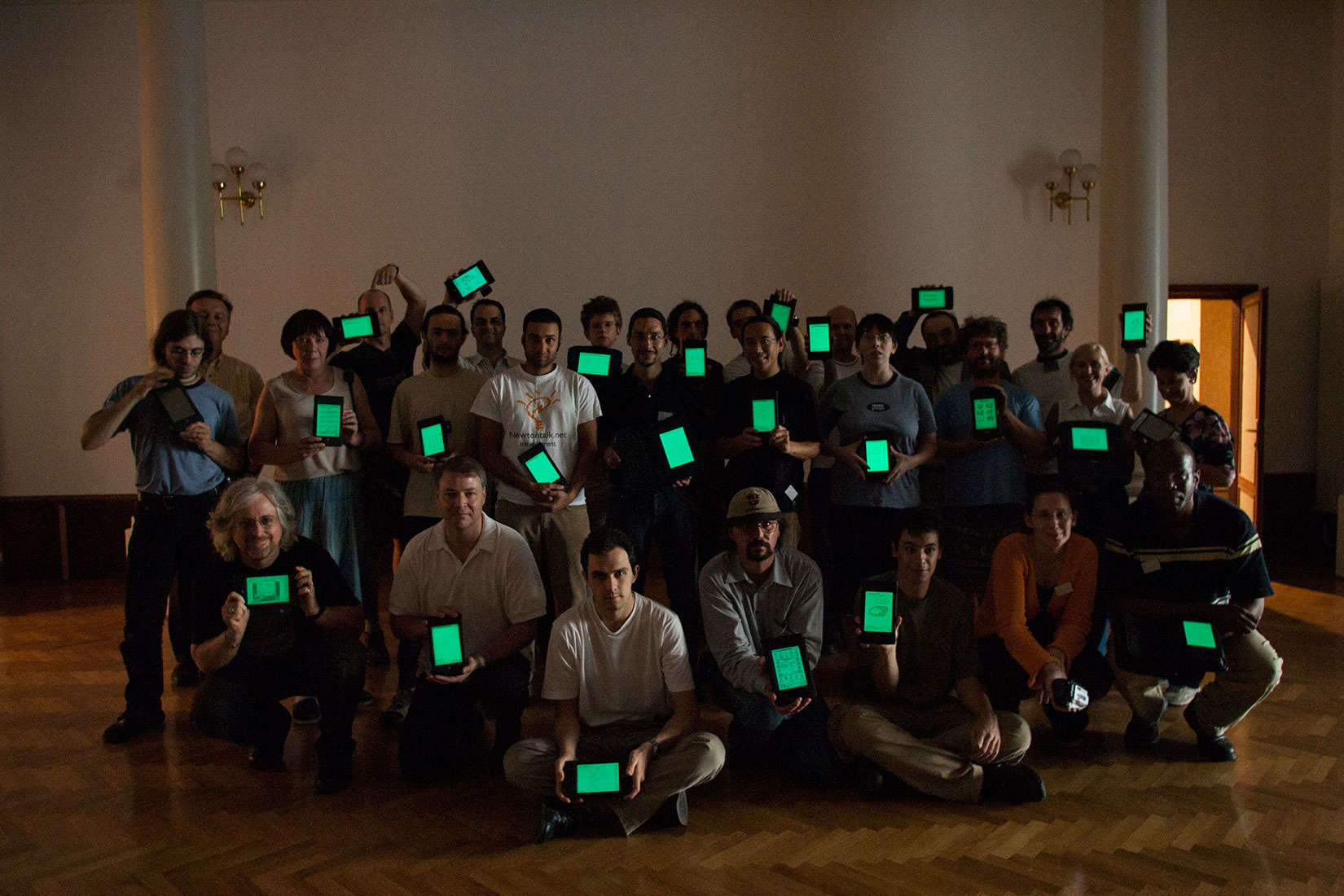
 Grant Hutchinson has never owned an iPad. He does, however, own some 15-dozen Newton devices, a few of which he uses every day to help manage tasks, a schedule and software clients.
Why would Hutchinson cling to and even rely on a clunky obsolete digital message pad, an Apple failure so big it inspired f-bomb rage in Steve Jobs and a week’s worth of damning Doonesbury comic strips?
Hutchinson is just one of a few thousand people worldwide who collect and even use Apple’s first mobile computing device, discontinued in 1998 after a number of incarnations over a rocky five-year run.
Ahead of its time
Some look at the incredible computing power of the iPhone or the iPad and will grant at least a little bit of gratitude for the Newton.
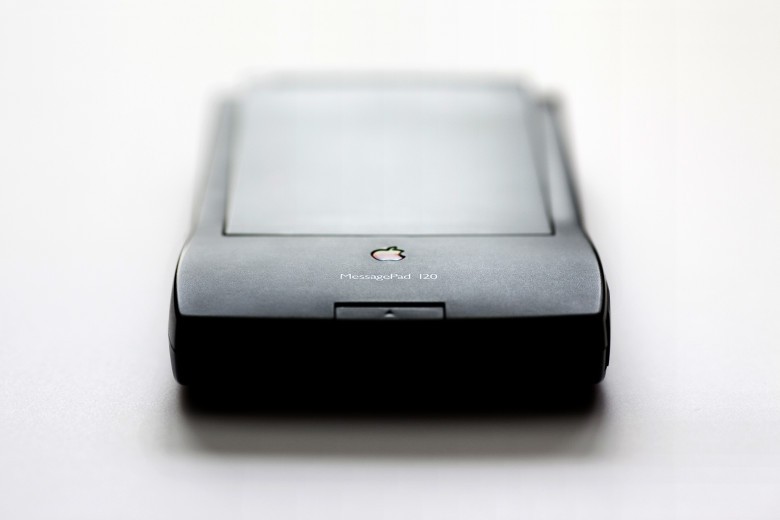
Photo: Grant Hutchinson
Technologically sophisticated for its time, problems with Newton’s handwriting recognition, and a hefty price tag kept it out of most hands. And don’t forget, Jobs may have taken great personal pride in killing it when he returned to Apple because it was a project headed by the people who initially ousted him from his own company.
But the keepers of the flame — or should we say green-lit screens — say Newton was turning a corner when it got shelved. The reputation, its place on a number of failed devices lists, is not fair, they say. Newton enthusiasts can chuckle about the jokes, but quickly come to its defense.
When Hutchinson speaks of the device’s epic failure, he gestures with air quotes around the word failure.
“The Newton did not fail,” said Hutchinson, a web-design and software consultant from Calgary, Alberta. “It was early to market and it was killed just as it was getting going. The thing that gets under my skin is when people call Google Glass or the Apple Car the next Newton. Don’t compare Beta Max tapes to Newton.
“Pop culture references are too engrained. We still laugh and have a good sense of humor about it. It’s because we know.”
The handwriting on the wall
The Newton Talk mailing list, which Hutchinson oversees, has a membership of just under 1,000. With several active Newton user groups overseas (Japan is a “hotbed” for Newton aficionados), he believes the number of Newtonists is around 4,000.
To appreciate the various generations of Newtons and the designs, check out the Newton Flickr group, just shy of 300 members.
The Newton MessagePad arrived in 1993 for a cost of $699. It was roughly 7 by 4 inches and weighed about one pound.
Users were attracted to the device for how it could link contacts and calendars, and the stylus-based touchscreen in replace of a keyboard was exciting for the time. Icons clearly marked the various tasks it could perform and features were easily launched with a single tap of the stylus’ tip. Networking through modem accessories and IR ports were attractive to workers in the field and one feature, Newton Assistant, was a stylus-driven precursor to the voice-activated iPhone assistant, Siri.

Photo: Grant Hutchinson
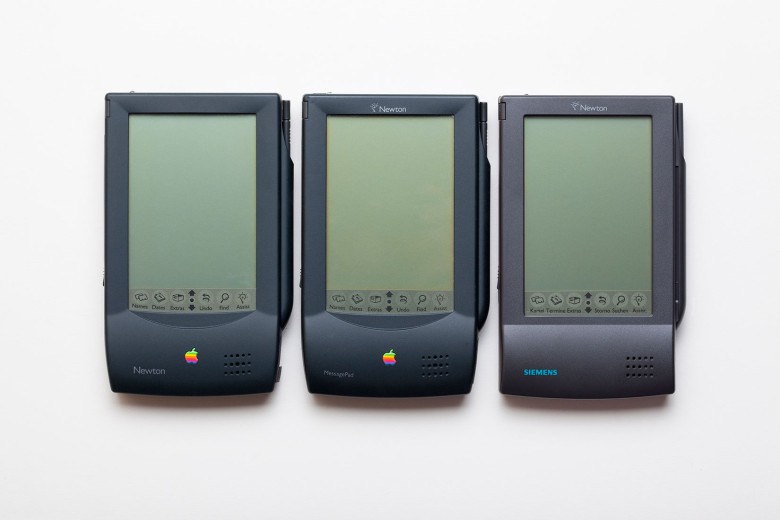
Photo: Grant Hutchinson
Near the end, the Newton was embraced by certain professionals, including doctors, scientists, educators and executives. The software for recognizing handwriting was improved and nearly perfect by the end, enthusiasts say.
But the problems in the early days overshadowed those improvements. Even as Apple refined the software over the five years (one version, the eMate, had a keyboard), sales were unimpressive. Jobs expressed disdain for the stylus, saying future computing power should be guided with our fingertips.
Newton continues to live
New Newton’s were no more but the ones that survived with its defenders continued to run.
The Newton faithful continued to develop software, and even devised hardware and software hacks to give it more modern functions.
Morgan Aldridge, runs two Newton-based websites, including the United Network of Newton Archives, that share software, software mirrors and app developing resources. He said some members are working on ways to bring SSL encryption to the Newton so that users could use email more securely.
Aldridge has an iPhone and an iPad, but still likes using a Newton — he owns four — for management of personal information. He became interested in Newton devices after they had been discontinued but of an interest in preserving technology.
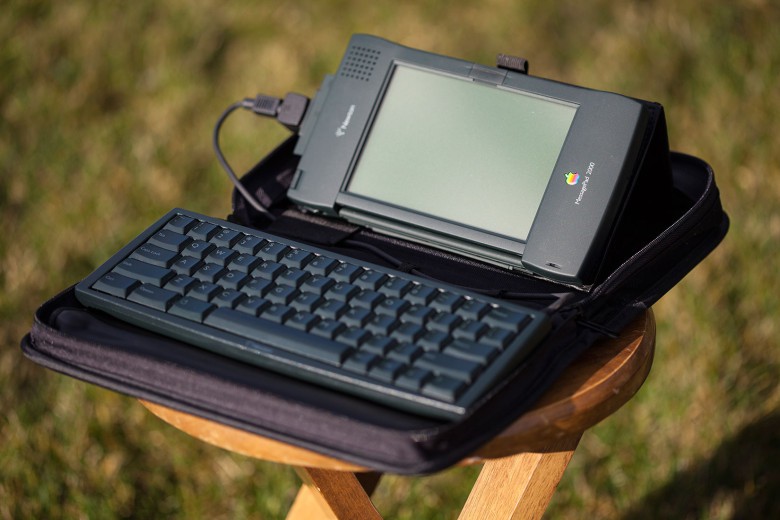
Photo: Adam Tow
He says the numbers in the Newton groups are slowly declining.
“We’re definitely getting smaller,” said Aldridge, a developer and systems administrator in Vermont. “Now there are really viable tablet solutions out there. For a long time, despite the age of the Newton, it still had a power and software that was unrivaled. Once the iPhone came out, the iPad and the app store, software and tablets began to diverse from the original Newton abilities.”
Adam Tow, a tech engineer for Vox Media, loved the Newton and even organized a picket outside Apple’s office in 1998 in hopes the company would reconsider.
Tow later poured his energy into a user group that held yearly conferences until recently. He has written software and designed apps to keep Newtons a glow. But now his collection of Newtons rest in a box.
Tow has moved on.
“I remember when the first iPhone came out,” Tow remembered. “The Newton User Group meeting was a little less than two weeks later. I remember thinking ‘This is it. It’s here. We have our Newton back.’”

David Pierini is a former newspaper writer and long-time photographer. Considered a luddite by most of his friends, they did not believe him when he broke the news that he would be writing for a technology website. He is fascinated by human nature and would love to cultivate stories about the people driving the tech bus. Reach out to him at [email protected].

7 responses to “Meet the loyal Newton fans who keep the device alive and kicking”
Great group!
I still have my Newtons (two upgraded 2000s, a 100, and an eMate) and I was a loyal, daily user until the iPad Mini. I loved the iPhone and iPad, but it was that form factor and size that finally convinced me to put the Newton on the shelf. I’ve had countless PDAs and devices, but the Newton is the only one that still gets to me. I still power it on occasionally and go back and read David McNiel’s Newton Notes columns.
The Newton was a truly amazing device, and there are things I still miss about it – Apple still hasn’t even come CLOSE to matching the capability of the old, default Notes on the Newton. Today, I use OneNote. The Newton interface put Notes first – and it was the best device to match my way of thinking and working.
The Newton User Group is a great bunch of people! I was a member for a while and always wished there were local meet ups (but there were none around my area). Up until about two or three years ago, I was still interested in getting the Newton OS on a modern Tablet as a daily carry device (I did this on a Nook Tablet – it was really cool, but slow and not useable).
Of course, I really won’t be absolutely satisfied until the Apple Pencil is available for the iPad Mini.
I have a MP 130, but the screen busted on it 10 years ago, which makes me really sad. And I miss it. I have a developer friend who keeps asking me what iOS app he can make to replace something I miss from the newton era. NOTHING holds a candle to how Newton did notes, with its collapsable To-Do bulleted outlines that you could drag and drop 5 levels in and out of. I have a bunch of notes apps on my iPad 3 and my iPhone5s as well as my latest gen iPod touch, but, nothing I have come across yet can replicate how responsive and useful Newton notes was. I’m almost tempted to get another newton off of Ebay or something to play with one again, because I miss it dearly. I would probably go to UNNA and download a bunch of crap to install on it though.
Had 3 of them over the years. Still love the concept. They were chasing the Knowledge Navigator.
What made the Newton stand out, like the early Mac, was that it was ‘friendly’. It had quirks, that gave it a personality. I love the functionality of my current Apple devices, but that’s what they are, functional, they’re not intrinsically fun to use the way Newton was. The AppleWatch has something of that quality, from what I can see.
I have been a Newton user since 2001. Today my daily driver is a Tablet PC. Like a Newton it offers HWR as an OS service so all apps have HWR support. Unfortunately handwriting can only be applied claustrophobically within an input panel. On the Newton, users can write anywhere on the screen.
The Newton HWR gesture system is the other much missed feature. It is so well thought through compared to the Windows system.
I concur with the others, Notepad on the Newton is an outstanding app that stands out from every other note taking app, I know.
I had a Newton. This makes me wish I had kept it…but I also wish I had kept my first Mac and my PowerBook 100, too!
The caption in this story that reads “A MessagePad made to work with a keyboard” implies that this was an unusual and non-standard way of working. BUT. The keyboard shown is the Newton Keyboard (X0044), and the Newton Interconnect dongle (590-0756)—they are both Apple products. Yes, Apple “made them” to work with the Newton 2000 and 2100.