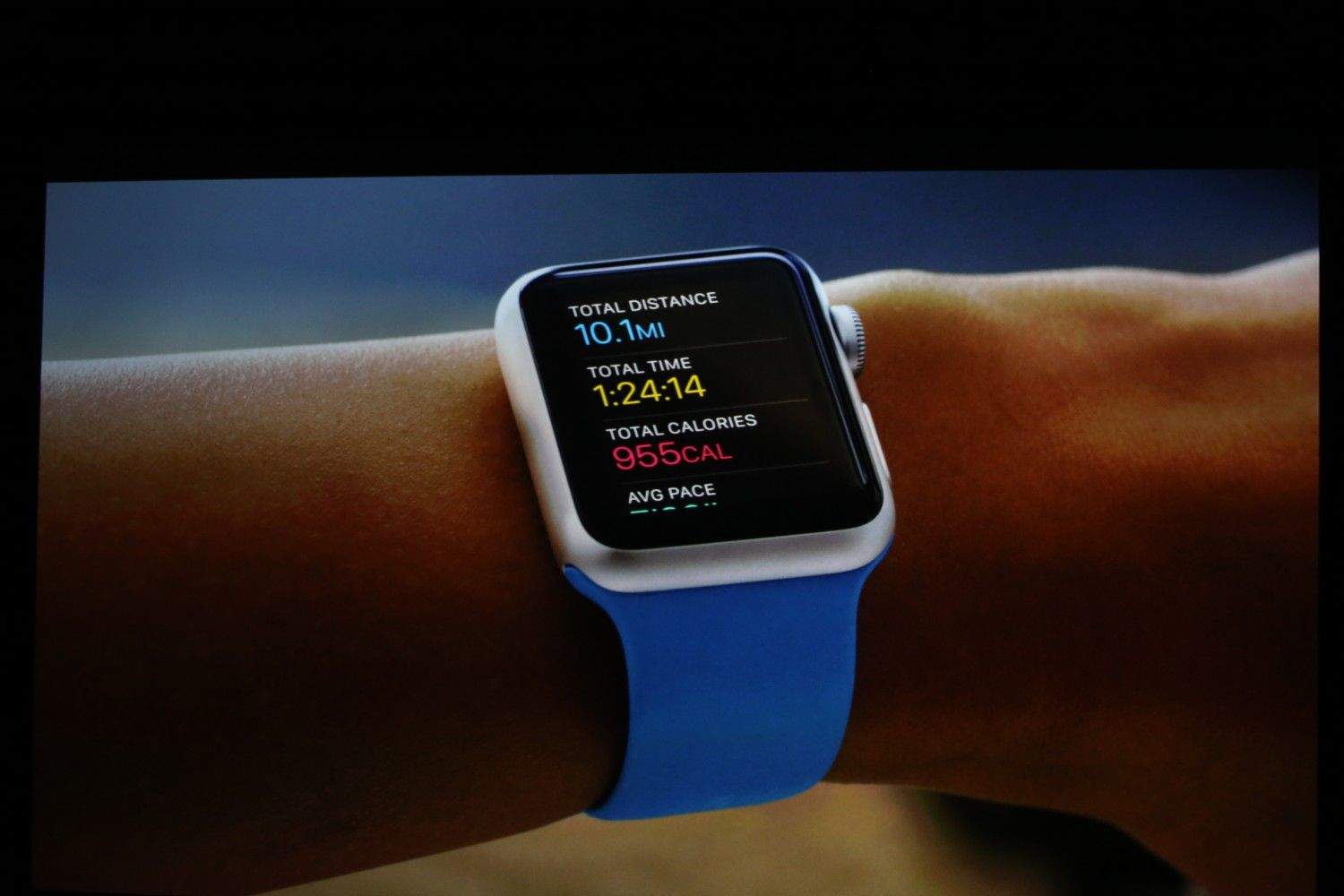
One of the big selling points of wearable devices is that they will be able to help us keep track of various fitness metrics.
However, a new report claims smartphones are just as good (if not slightly better) at tracking physical activity as the most popular wearables on the market.
“Our findings suggest that smartphone apps could prove to be a more widely accessible and affordable way of tracking health behaviors,” noted the author of the study, which was conducted by researchers at the Perelman School of Medicine and the Center for Health Incentives and Behavioral Economics at the University of Pennsylvania.
Trying to establish consistency between different fitness trackers, researchers gave users three different wearable devices (a Fitbit Flex, Jawbone UP24 and Nike FuelBand) and two smartphones — including an iPhone 5s, running the FitBit, Health Mate and Moves apps.
While the wearables varied wildly in their findings, with a range of -22.7 percent to -1.5 percent difference (Nike’s now-defunct FuelBand was the worst), smartphones only differed slightly in terms of mean step counts. Conclusion: If accuracy is your goal (and why wouldn’t it be?) you might be better off sticking to your iPhone.
In a sense, the study is a bit of a double-edged sword for Apple. On the one hand, it’s great that iPhones are now so good at tracking our steps on a daily basis. My wife looks at her iPhone to see how far she’s walked most days, but at least currently it would never cross her mind to wear a fitness tracker like a Jawbone UP or Fitbit.
At the same time, it means Apple has an extra challenge when it comes to selling the Apple Watch. Fitness tracking isn’t the only thing Apple Watch is designed to do, but it’s certainly a pretty major use case, which has formed the basis for wearable companies like Fitbit. Apple’s never been afraid to cannibalize its own products (e.g. the iPhone replacing the iPod as de facto music player) but in this situation, has it cannibalized its new product in advance?
For the sake of Apple and its customers, I hope other Apple Watch apps are up to snuff. From the anecdotal evidence I’ve heard about Apple Watch, I think fitness tracking is barely going to register among the top 10 uses for Apple’s upcoming smartwatch.
Via: EurekAlert!

Luke Dormehl is a U.K.-based journalist and author, with a background working in documentary film for Channel 4 and the BBC. He is the author of The Apple Revolution and The Formula: How Algorithms Solve All Our Problems … and Create More, both published by Penguin/Random House. His tech writing has also appeared in Wired, Fast Company, Techmeme and other publications.

13 responses to “iPhone tracks fitness levels better than wearables”
Thing is nobody wears a phone in a sports armband or has a belt clip or pockets in their gym shorts and certainly can’t when it comes to high intensity interval training. It’s barely going to stay on when you are doing burpees or jumping jacks or any other vigorous activity that involves throwing your arms up or down, or shaking your hips.
A wearable is better because you can do all those moves and not worry about it falling off and breaking on the floor.
funny, I was just thinking how my armband that holds my iphone works perfectly fine and that I don’t need a watch. My only criticism with the band is that the wire from my headphones sometimes get caught on barbells and such; but that’s neither her nor there in regard to what you are saying.
www.cashtime10.com
I cycle and I use the Digifit app with my iPhone 5S, now 6+ to track my vitals. My phone is mounted to my bike. One additional benefit of using an iPhone is I can stream (Spotify) music while cycling. It helps make the miles go by faster.
But who carries/wears a phone 24×7? If lazy people (like me) really want to keep a track of day-to-day activity then a wearable is quite essential!
These are both valid points. I don’t play sport, which is a scenario where I can see you definitely not carrying an iPhone (but would you wear an Apple Watch?), but I do keep my iPhone with me when I’m in the gym or running, since I use it to listen to music.
I suppose it boils down to what the individual wants or prefers. I use a Polar M400 which combines running watch with activity tracker. While I track steps, that’s not my primary motivation. I track my training. Currently I’m training for a 5K. When I run, sometimes I carry my phone, sometimes I don’t. Plus my watch connects to a chest strap heart rate monitor via bluetooth as I do heart rate training giving me far more accurate caloric output results than a phone or most wrist worn trackers. My phone simply can’t do all that and be as portable as I need it to be. When I play basketball, a tracker would obviously work better than a phone for that.
If you want to track step count a phone in your pocket will be more accurate but combined with activity data from your wrist wearable you will get a better picture of your overall physical activity. Swinging a golf club might not trigger a step on the phone but the will register activity with the accelerometer in your watch.
What no one has cracked yet is the reconciliation of movement tracking data across multiple devices. I.e. If, during the course of a day, I wear both a fitbit and carry a phone, and use an iPad in the office, but not all necessarily all the time at the same time, having the intelligence to reconcile all those steps into a seamless single profile based on time/location/etc. With the Apple Watch, Apple has a chance to do that since they are a single vendor. And with Health as a data hub, that might be possible across other vendor products. But to me, that’s what’s needed to bridge the issues noted above and in the comments.
1TopSpy – The spy software works well and is backed up with good assist from a sound company you can belief. If you are happy to live without the more higher functions then this is the most inexpensive way to track on a cell phone. I have used it and can propose it.
The other issue with the phone (Health app) it is really poor effort by Apple. On my FitBit app I can go back month and review/compare data, on the Health App, it chokes just exporting 3 month of data. It does not even allow me to go back to last week (without going to month view).
Secondary Conclusion: The same hardware accessed through the same API will produce consistent results.
And what were these percent differences comparing to?
Good to know I do not need to purchase a smart band/watch as most of I what I do is running.