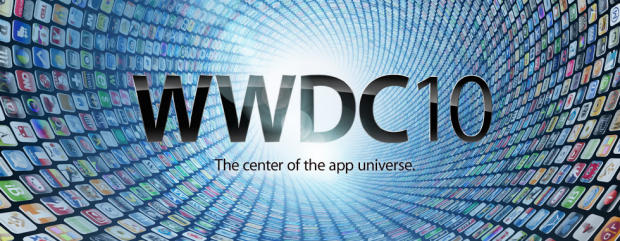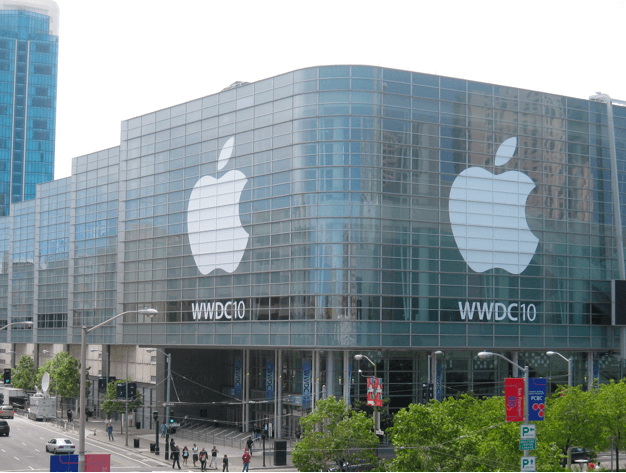
An application built for The Financial Times newspaper was named the best iPad or iPhone application designed, according to organizers of Apple’s 2010 Worldwide Developers Conference. The WWDC Wednesday released the 10 winning designs for 2010, the first year without a Mac OS X category.
The 10 winning entrants were evenly split between iPad and iPhone designs. The winners were picked from among more than 225,000 App Store possibilities. Designers earned more than $1 billion so far from Apple’s software application store.
Apple has posted the full video of Steve Jobs’ keynote at WWDC yesterday. It’s worth watching for a few highlights.
Look out for the iPhone 4 announcement at around 30 min (“Stop me if you’ve already seen this…”), about the retina display (“Once you’ve used a retina, you’ll never go back”) at around 38 minutes and enjoy Jobs coping with a wi-fi glitch at around 40 minutes. We also enjoyed the Guitar Hero demo and the video chat with Jonathan Ive.
What was your favorite moment of the hour-long state of the Apple nation?
It’s hard to remember when one of Steve Jobs keynote speeches WWDC had a glitch, but the Demo Gods weren’t smiling on Jobs today. Thanks to network problems, Jobs had to ditch on a demo because of Wi-Fi trouble. But maybe it’s not some luckless Apple engineer’s fault: The same thing happened to Google during its developers conference last month at the same venue.
A couple months ago, Apple stopped selling cases on their online store, which implied they were getting into cases themselves.
They call their new case a “bumper” and it comes in numerous colors, including white, pink, orange and other spectrums of colors. It looks like it wraps around the sides of the device without protecting the back, hence the automobile terminology: it’s all about protecting the iPhone at its most vulnerable spot.
Additionally, Apple has just announced an official iPhone dock, which will cost just $29 and support charging and syncing.
Jobs has just completed outlining all of the iPhone 4’s revolutionary new features. Now to reveal what it’ll cost your wallet.
Coming in black and white, the iPhone 4 will cost $199 for the 16GB models, the same price as the 3GS. $299 gets you the 32GB iPhone 4.
Already in a contract? AT&T is allowing anyone with a contract expiring this year to be immediately eligible for a new iPhone at the same $199 – $299 price, as long as they top up their contract for two years.
Predictably, the 3Gs is becoming the new sub-$100 model, and will cost $99.
The iPhone 4 will be available on June 24th, with pre-orders starting on June 15th. It will immediately ship in five countries: the US, France, Germany, the UK and Japan, with 24 more countries following in August, and 40 more countries following in September.
It’s almost over, but like usual, there just “one more thing” and while we all knew it was coming, it’s the first time it’s been directly confirmed: a front-mounted camera on iPhone 4 that allows for user-to-user video chat.
Calling Jonathan Ive on his iPhone 4 to demo the new iPhone’s video chat capability (after first having issues with a connection and yelling at the audience to turn off their WiFi), Jobs reminisced about growing up with the Jetsons and Star Trek, “dreaming about communicators and video calling. Now it’s real!”
Apple’s calling their user-to-user video calling solution FaceTime.
In addition to utilizing the front-mounted cam, FaceTime allows you to switch to the rear camera so the other person can see what you’re seeing. You can use FaceTime in either portrait or lansdcape.
FaceTime is iPhone 4 to iPhone 4 only (no other iDevice has a front-mounted video camera yet), and it works anywhere with WiFi. What a shock: AT&T’s 3G network just can’t handle it. Apple claims they’ll work with their carrier partners to get it ready later in the year, but look at AT&T’s abysmal record implementing tethering, and my guess we’ve got a long wait ahead of us.
Apple’s getting into the advertising game with their iAds network, and Jobs says the goal is Emotion + Interactivity. The idea is to make it painless for developers to put ads in their apps: just tell Apple where you want them and they’ll inject it themselves. Likewise, it should be painless for viewers to see them: tap them and it’ll expand. You’ll never be hijacked into the browser.
They’ve only been selling iAds for eight weeks, and already attracted a huge number of advertisers, including Nissan, Citi, Unilever, AT&T, Chanel, GE, Liberty Mutual, State Farm, Geico, Sears, JCPenny, Target, Best Buy, DirecTV, TBS network, and Disney.” Overall, iAds has brought in $60M in advertising, and makes up 48% of US Mobile Display Advertising Spending in the second half of 2010.
The demonstrated advertisements look pretty good, admittedly. Certainly more like interactive applications than musty old banner ads. They’re almost like mini-apps that dynamically download when needed into an existing program. The new interactive Nissan Leaf iAd is particularly impressive, which allows you to interactively compare a $1 of gas when driving the fully electric Leaf compared to other hybrids.
iAds probably isn’t going to be very good for consumers — I despair that there will be literally no reason for a developer not to put ads even in paid apps anymore, and that too much of the iPhone’s screen real estate will be taken up with advertisements — but it should be a windfall for both Apple and the developers taking part in the iAds ecosystem.
It’s made a huge splash on the iPad, so naturally, iBooks is coming to the iPhone and iPod Touch, with the same controls, same note taking features, same highlights, same PDF reading and same bookmarks.
Like the iPad version, you can purchase and download a book to all your devices for no charge, and automatically sync your place, bookmarks and notes.
Not so surprisingly, on the iPhone 4 retina display, iBooks looks gorgeous. And to think: this coming from the man who said that people didn’t read anymore.
Apple may be warring with Google in the smartphone arena, but they’re not going to take it out on their customers: Jobs has just confirmed rumors that Apple was getting into bed with Microsoft and adding Bing as a search option to iOS.
Google’s still the default, but now you have another choice, and Bing’s doing some really snazzy things with the HTML5 presentation of results. If you like your search results to be pretty, it looks like Google’s going to have some catching up to do with Bing.
Oh, and the three of you who still default to Yahoo… you can still search with them too. Go nuts!
It has made less and less sense by the day that the iPhone OS would continue to be called that as non-iPhone devices begin to run it. Jobs has just confirmed the earlier rumor of an iPhone OS rebrand: starting with iPhone OS 4.0, it’ll just be called iOS4.
From a humble blogger’s heart directly to Cupertino: thank you, my benefactors. You don’t know how confusing it was to talk about iPhone OS for the iPad on a daily basis. Having “Phone” plugged into the name of an increasingly non-Phone operating system was just ridiculous.
Anyone else wonder if this is the first blush of a reveal of a new iOS-capable Apple TV?